










































































Trump added that ‘if Israel has the wrong leader, which would be anyone other than Bibi, America will have to do this work ourselves, and I am not inclined to do so’
Prime Minister's Office
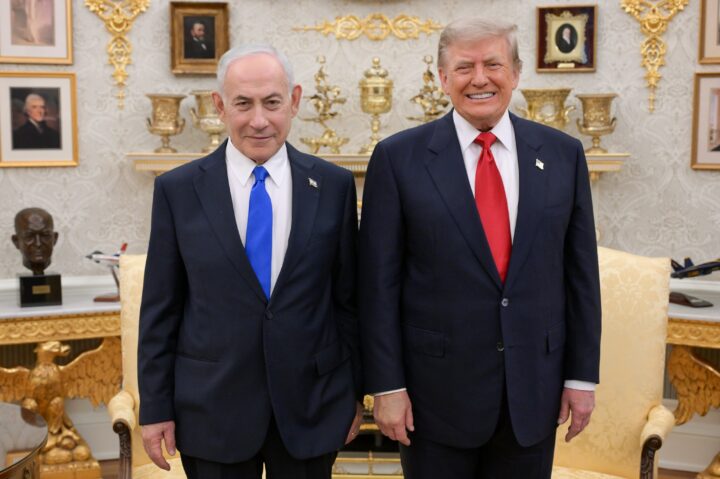
Israeli Prime Minister Benjamin Netanyahu meets with President Donald Trump in the Oval Office on July 28, 2026.


 Add JewishInsider on Google
President Donald Trump endorsed Israeli Prime Minister Benjamin Netanyahu on Sunday, ahead of the Knesset election set for Oct. 27.
Addressing a Truth Social post to “the great people of Israel,” Trump called Netanyahu “a great warrior prime minister and an even greater partner for peace in combatting the Islamic Republic of Iran with its 51-year-old chant ‘death to Israel, death to America!’”
Trump said that “if Israel has the wrong leader, which would be anyone other than Bibi, America will have to do this work [of finishing the war against Iran] ourselves, and I am not inclined to do so.”
“Bibi Netanyahu has been strong, brave and brilliant in the face of tremendous opposition, including that coming from even Israel itself,” the president added. “Normal men or women in such situations would have wilted under the pressure, but Bibi did not wilt, he actually got stronger.”
Trump concluded that his statement was his “complete and total endorsement of Bibi Netanyahu in his upcoming race for reelection as prime minister of Israel.”
Immediately after Trump published the endorsement, Netanyahu posted on X: “Thank you President Trump for the tremendous support and joint work. Together we will complete our mission.”
The post was accompanied by a video featuring Trump’s past remarks praising the prime minister.
Trump previously hesitated to endorse Netanyahu, not wanting to repeat what happened in Hungary earlier this year, where he and Vice President J.D. Vance supported Viktor Orban, who lost, but the Likud campaign shared polls with Trump that convinced him that the right was likely to win the upcoming election, Ma’ariv reported.
Last week, following a report that the Trump administration supported a unity government of Netanyahu and his rival Gadi Eisenkot, U.S. Ambassador to Israel Mike Huckabee posted on X that “the US government is NOT trying to manipulate Israel’s election or telling [Netanyahu] what to do. Period. Full stop.”
Trump first endorsed Netanyahu in the 2013 Knesset election, when the former was still a reality TV fixture.
Trump is more popular in Israel than in any country in the world other than the Philippines, according to a Pew Research Center poll taken earlier this year, in which over 66% of Israelis viewed him favorably.
Both Netanyahu’s bloc and the opposition fall short of the votes necessary to form a coalition in most polls
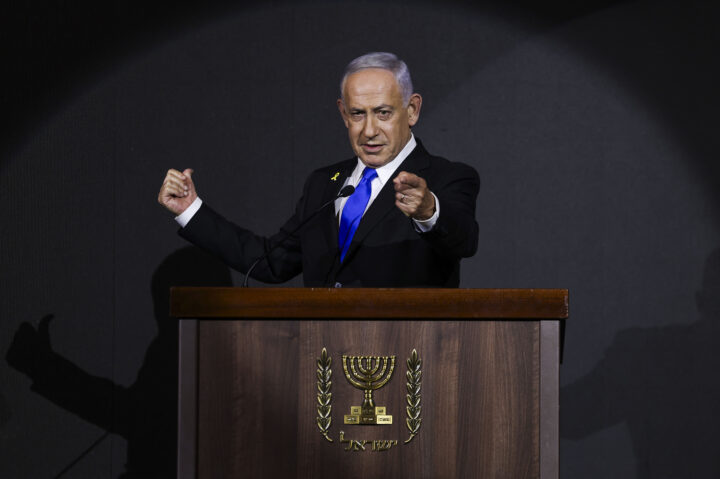
Israeli Prime Minister Benjamin Netanyahu (Photo by Ronen Zvulun / POOL / AFP) (Photo by RONEN ZVULUN/POOL/AFP via Getty Images)
The bloc of political parties backing Israeli Prime Minister Benjamin Netanyahu had its best showing of the campaign ahead of the Oct. 27 Knesset election.
In eight polls published by Israeli media outlets in the last week, the pro-Netanyahu bloc led in four and tied in two, while the opposition bloc led by Gadi Eisenkot’s Yashar party, won in two. In all polls, the bloc sizes are very close, except for two polls in which Netanyahu’s bloc leads by 12 and 18 seats, respectively.
The average of the eight polls puts Netanyahu’s bloc at 55 seats and the Eisenkot bloc at 51. Without the outlier polls, the average for Netanyahu’s bloc drops to 52 and the opposition bloc leads with 53 seats.
In a poll in the Hebrew daily Ma’ariv, taken by veteran pollster Menachem Lazar, the Netanyahu bloc tied with the center-left opposition bloc for the first time in three years, with each receiving a projected 52 seats. The Netanyahu and Eisenkot-led blocs tied in an Israel Hayom poll, as well.
The Netanyahu bloc also reached a two-year high in Channel 13’s poll, conducted by Shmuel Rosner, with 55 seats, and the opposition bloc was projected to receive fewer votes than in any of his polls in recent years, with only 50 seats.
Notably, the pro-Netanyahu bloc still did not receive enough votes to form a coalition in either poll in which Likud performed better than before. In addition, in each poll, a party that often fails to clear the 3.25% mark necessary to win seats in the Knesset cleared the threshold.
The pro-Netanyahu bloc is large enough for a governing coalition in two polls: One, conducted by former Netanyahu adviser Shlomo Filber for the pro-Netanyahu Channel 14, gives the bloc 63 seats, compared to the opposition bloc’s 45. The other, from i24 News and conducted by Direct Polls, in which Filber used to be a partner, gives the Netanyahu bloc 60 seats — a very narrow, but legitimate coalition — and the opposition bloc 48.
The Eisenkot bloc outperformed the right and religious parties in two polls: Times of Israel, in which the opposition received 55 and Netanyahu 51, and Channel 12, in which the opposition received 54 and Netanyahu 49.
Public Security Minister Itamar Ben-Gvir’s Otzma Yehudit has an average of about eight seats, while Finance Minister Bezalel Smotrich’s Religious Zionist Party averages six seats, putting them roughly at the same number of seats as they currently have and only slightly smaller than the Haredi parties. While they are much smaller than Likud, which is averaging at 23 seats, they still have significant leverage to demand senior cabinet positions, as Netanyahu will need every party in his current bloc, and more, to form a coalition. Ben-Gvir has said he will request the defense portfolio.
The Israel Hayom poll also found that the top issue for Israeli voters is the economy, with 29% saying it will determine their vote, followed by security at 23%, democracy and rule of law at 13%, Israel’s Jewish identity 9%, Haredi conscription 9%, a commitment to establish a commission of inquiry on the Oct. 7 attacks 7%, and judicial reform 4%.
Netanyahu bloc voters put security first (30%), followed by Israel’s Jewish identity (22%) and then the economy (20%), while Eisenkot bloc voters put the economy first (35%) followed by democracy and rule of law (20%), and then security (19%).
Judging by polls published by six Hebrew-language media outlets after the merger on Sunday, not much has changed since the announcement that Bennett and Lapid were joining forces
Chaim Goldberg/Flash90
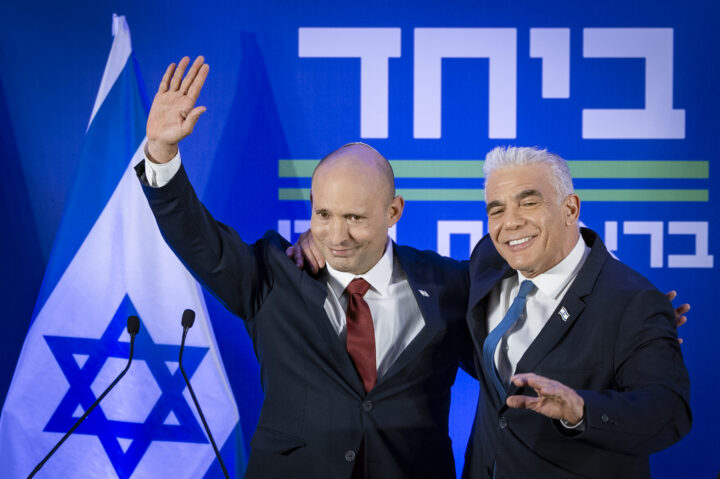
Opposition Leader and Head of the Yesh Atid party Yair Lapid and former Prime Minister Naftali Bennett speak during a press conference announcing a joint list named “Together” ahead of upcoming elections, to be led by Bennett, in Herzliya, central Israel, April 26, 2026.
The near-consensus among Israeli political pundits is that the merger of the parties led by former Prime Ministers Naftali Bennett and Yair Lapid is a huge moment in the campaign ahead of the next Knesset election, scheduled for Oct. 27.
However, judging by polls published by six major Hebrew-language media outlets after the merger on Sunday, not much has changed since the announcement that Bennett and Lapid were joining forces.
The newly formed “Together” opposition party polled around 24 seats — nearly the same number of seats as the two parties combined before the merger. Israeli Prime Minister Benjamin Netanyahu’s Likud party is, according to the average of the latest polls, still the largest party at 29.
According to the latest polling, it would be difficult for either side to build a governing coalition. The opposition Zionist parties did not get a 61-seat majority in any of the six polls. The most favorable poll for the opposition showed the anti-Netanyahu Zionist parties at 60 seats in the 120-seat Knesset, while the current coalition received over 61 seats in two polls (from those commissioned by Channel 14 and I24NEWS, which are more sympathetic to Netanyahu than the other media outlets).
To be sure, polls taken within 24 hours of an event are not the most reliable, and much can change in the six months until the election.
The key question after the Bennett and Lapid merger is whether they are fighting other opposition candidates for dominance within their bloc – in which case, Bennett has likely solidified his status as Netanyahu’s main competition for the premiership – or to broaden the bloc’s appeal to win a majority in the Knesset.
Netanyahu famously said in 2018 and many times since, in reference to shifts in the opposition: “I don’t intervene in how the left divides up its votes.” That quip, made when Bennett was still in the pro-Netanyahu camp, is now reflective of Bennett’s weakness.
So far, the polling has shown that Bennett, who was solidly on the right for the first eight years of his political career, will struggle to peel off voters from the right-wing pro-Netanyahu bloc into his camp.
In his last election campaign in 2021, Bennett ran primarily on right-wing messages but ended up leading a coalition of mostly center and left parties, together with an Arab party in the government, something many right-wing voters, as well as two Knesset members who jumped ship, viewed as a betrayal.
Add to that the fact that Lapid is to Bennett’s left — something both acknowledged several times in their Sunday night press conference, referring to their “differences” – likely referring to Bennett’s support for settlements and opposition to a two-state solution, which Lapid supports. Both candidates emphasized their shared views on domestic policy in response.
Netanyahu has kept mostly quiet about the Bennett-Lapid merger, but his one response shows that he will try to widen the wedge between Bennett and the right.
Netanyahu’s social media accounts posted an image from 2021 showing Lapid and Bennett sitting with Mansour Abbas, head of Ra’am, the Islamist party in their governing coalition. Ominous music plays in the background, and the words “they already did it once; they will do it again” are splashed across the picture.
The Ra’am factor will also likely be key after the election. The Zionist opposition parties have said mixed things about whether they would be willing to have an Arab non-Zionist party in their coalition in a post-Oct. 7 Israel. Revelations about the Ra’am party’s financial and historic ties to Hamas will also likely come up in the campaign.
As of now, the Knesset’s three Arab parties have said they will run in a single Joint List this year, as they did in 2015-2021, increasing Arab voter turnout and their representation in the Knesset. Ra’am is the only one of the parties that has to date been willing to sit in a coalition, and unlike Abbas, the other party leaders, Ayman Odeh and Ahmed Tibi, do not accept Israel as a Jewish state.
Because of those realities, Bennett and Lapid’s Together party will likely have to make a concerted – and perhaps quixotic – effort to win over right-leaning voters if it wants to increase its bloc and unseat Netanyahu. That task will be easier said than done.
Bennett will lead the party after having a consistently stronger showing in polls in recent months
Chaim Goldberg/Flash90
Opposition Leader and Head of the Yesh Atid party Yair Lapid and former Prime Minister Naftali Bennett speak during a press conference announcing a joint list named “Together” ahead of upcoming elections, to be led by Bennett, in Herzliya, central Israel, April 26, 2026.
Former Israeli Prime Ministers Naftali Bennett and Yair Lapid will run in this year’s Knesset election as a joint party called “Together,” led by Bennett, they announced on Sunday.
The move comes as the bloc of Zionist parties running against Prime Minister Benjamin Netanyahu’s bloc has recently polled higher than the parties in Netanyahu’s coalition, but with fewer than the 61-seat majority needed to form a government.
Sources close to both party leaders told Jewish Insider that they began discussing a joint run a week ago, and reached the final decision on Saturday night. Bennett will lead the party after having a consistently stronger showing in polls in recent months.
Bennett, a former IDF combat officer, described the merger as “the most Zionist and most patriotic thing we have ever done for our country.”
“I am proud that two leaders with different opinions can fight together for the good of the people of Israel, just like our sons, our soldiers, fight shoulder to shoulder,” he said in a press conference, and commended Lapid for putting “the good of the country above all.”
Lapid said that the country “needs unity like air to breathe.”
“We are standing here together for whoever believes in democracy, believes in the deep Jewish element of the state, believes in the value of Zionism and our right to this land … Israel has the best people in the world who deserve an efficient, functioning and fair government,” he said.
Lapid noted that he and Bennett are longtime friends who trust one another.
Bennett and Lapid both entered Israeli politics in 2013, with Bennett elected leader of Bayit Yehudi, as the historic National Religious Party was called, and Lapid establishing his own Yesh Atid party. After a strong electoral showing for both that year, they negotiated in a bloc, essentially forcing Netanyahu to form a coalition with them that excluded Haredi parties. Bennett joined subsequent Netanyahu-led governments until 2021, and established new parties over the years, while Lapid stayed with Yesh Atid and refused to work with Netanyahu after the 2013-2015 coalition collapsed. In 2021, they formed a coalition with Bennett at its helm.
Lapid said in response to a question at the press conference on Sunday that by running together, he and Bennett would ensure that the next government would not be led by Netanyahu.
Bennett described the party’s positions as “right-wing liberal Zionism: strength in diplomacy and security, with a home for the whole Israeli public.”
Among the policies the leaders said they would advance are a commission of inquiry about the failures of Oct. 7, 2023, mandatory IDF draft for all and “not even one shekel” for those who dodge the draft, eight-year term limits for prime ministers, starting with Bennett, as well as a focus on education, the cost of living and fighting corruption.
Bennett and Lapid have similar positions on the aforementioned domestic issues, but the former is an opponent of a Palestinian state and has been a major advocate of West Bank settlements, heading their umbrella organization the Yesha Council in 2010-2012. Lapid has generally supported a Palestinian state, though at times had said it is unrealistic in the short term.
Party sources speaking to JI on Sunday had a similar message, that, while Bennett and Lapid do differ on the Palestinian issue, it is not on the agenda right now. One noted that they both believe there needs to be a crackdown against extremist violence against Palestinians.
Asked during the press conference about legalizing same-sex marriage in Israel, Bennett avoided using the term “marriage,” but said that any couple should be able to “start a family and enjoy all of the rights of a married couple without having to go to Cyprus or Utah,” places where Israelis unable to marry in Israel, whether because they are the same sex, different religions or other reasons, are able to obtain civil marriages. As the leader of a religious party, and when he continued to court right-wing votes in more recent elections, Bennett did not express support for gay marriage.
Netanyahu responded to the merger with an image from 2021 showing Lapid and Bennett with Mansour Abbas, head of Ra’am, an Islamist party, who was in their governing coalition. Netanyahu added the message “they will do it again,” accompanied by menacing music.
The Knesset election is currently set for Oct. 27, but could be called for an earlier date, with at least 90 days notice.
Please log in if you already have a subscription, or subscribe to access the latest updates.
 Continue with Google

 Continue with Apple