


























































A traveling program called ‘Soul and Roll’ by singer Hananel Edri and Foodish CEO Merav Oren tells the Jewish story through an immersive culinary and musical experience
Haley Cohen
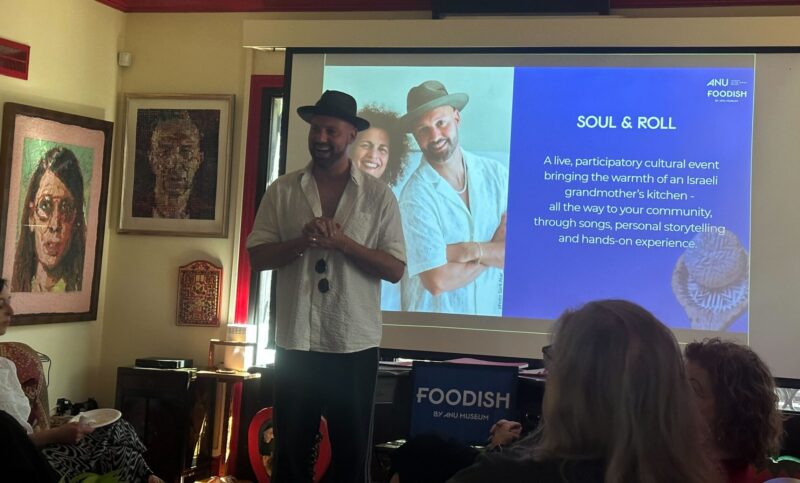
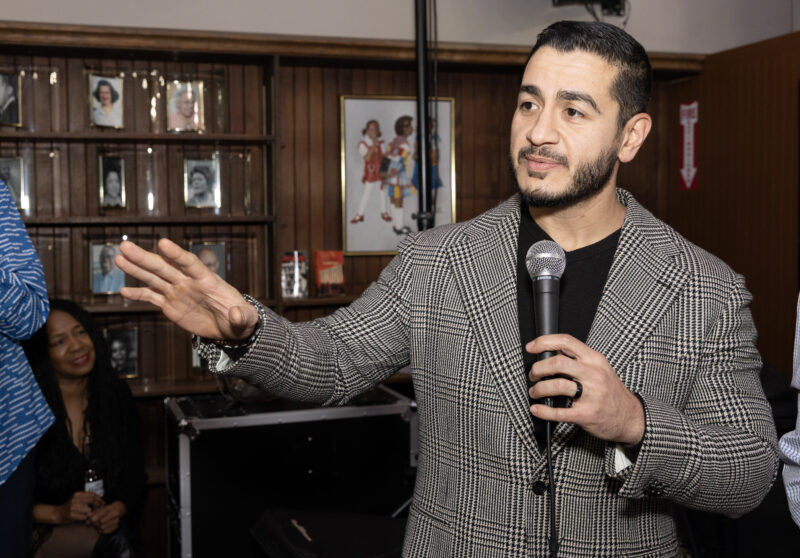
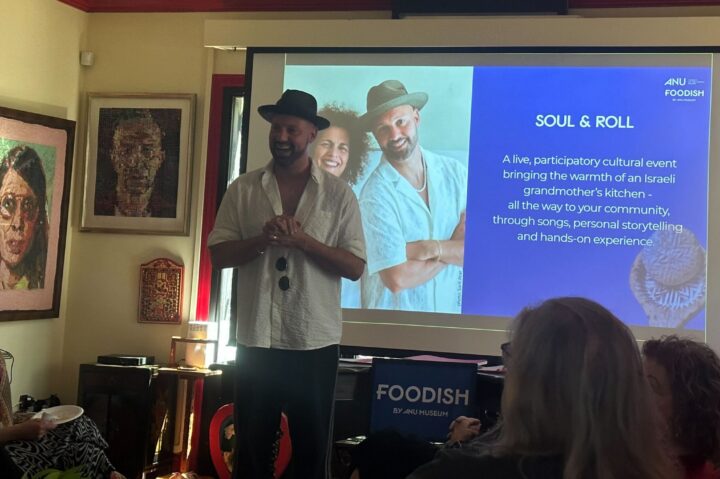
Israeli singer Hananel Edri presents “Soul and Roll” at an event held at the Washington home of documentary filmmaker Aviva Kempner.


 Add JewishInsider on Google
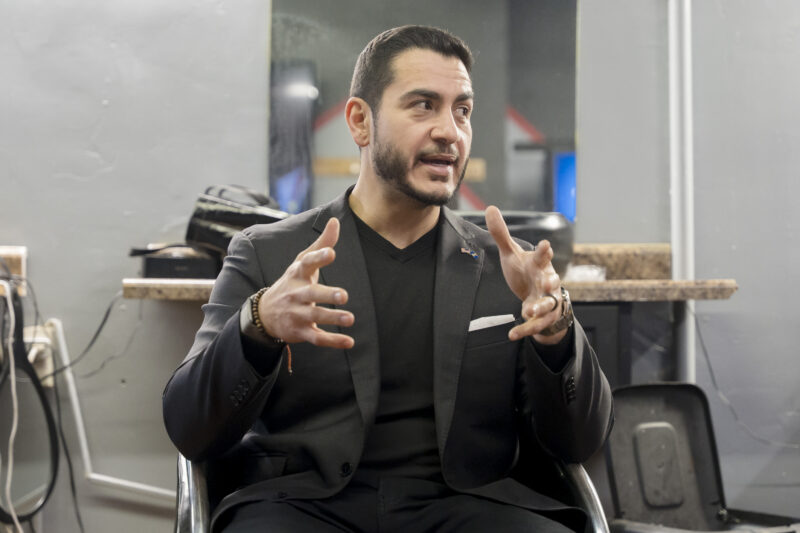
Israeli singer Hananel Edri discovered his love for food and his family’s Moroccan traditions in his grandmother’s kitchen, where he found solace after the trauma of a rocket strike on his family home in Kiryat Shmona, near Israel’s northern border with Lebanon, at age 10.
Meanwhile, Merav Oren — founder and CEO of Foodish, the culinary department of Tel Aviv’s Anu Museum of the Jewish People — grew up between Atlanta and Israel, rooted in a different culinary tradition: Ashkenazi Jewish cuisine.
This year, the two brought their worlds together to form “Soul and Roll,” a new immersive culinary and musical experience designed by Oren and Edri — a self-proclaimed “foodie” and singer who has performed on some of Israel’s most prestigious stages including Habima National Theatre. “We talk, Hananel sings and at the end people do a hands-on experience making ma’amoul,” a traditional Middle Eastern pastry often served at Mimouna, the Moroccan-Jewish celebration to mark the end of Passover, Oren told Jewish Insider on Sunday at an event to launch Foodish’s international expansion.
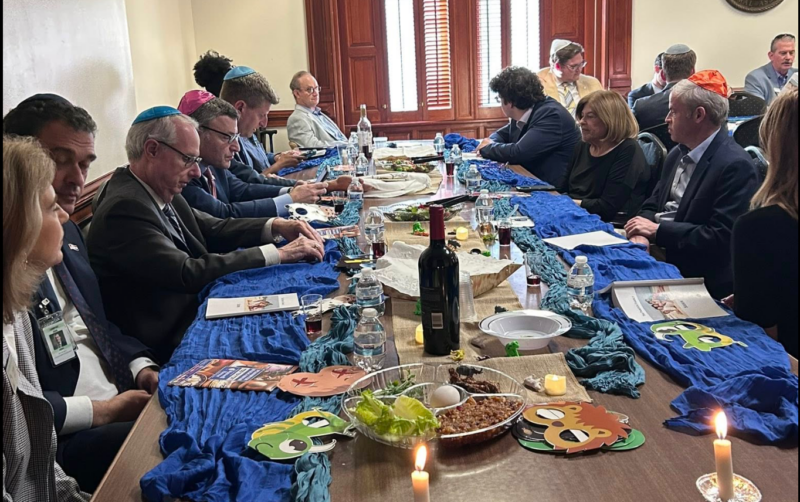
Held at the Washington home of documentary filmmaker Aviva Kempner, some two dozen attendees got a taste of a Soul and Roll show, including Edri’s rendition of “Jerusalem of Gold” and a Moroccan song dedicated to his grandmother, followed by a lesson in making date-filled ma’amoul pastries to bring home. The invitation-only event also featured remarks from Israeli chef and food writer Vered Guttman and Jewish cookbook author Joan Nathan.
“Anu strengthens the Jewish belonging through history and art. We at Foodish do that through food — we tell the story of the Jewish people through food, through events and festivals,” said Oren.
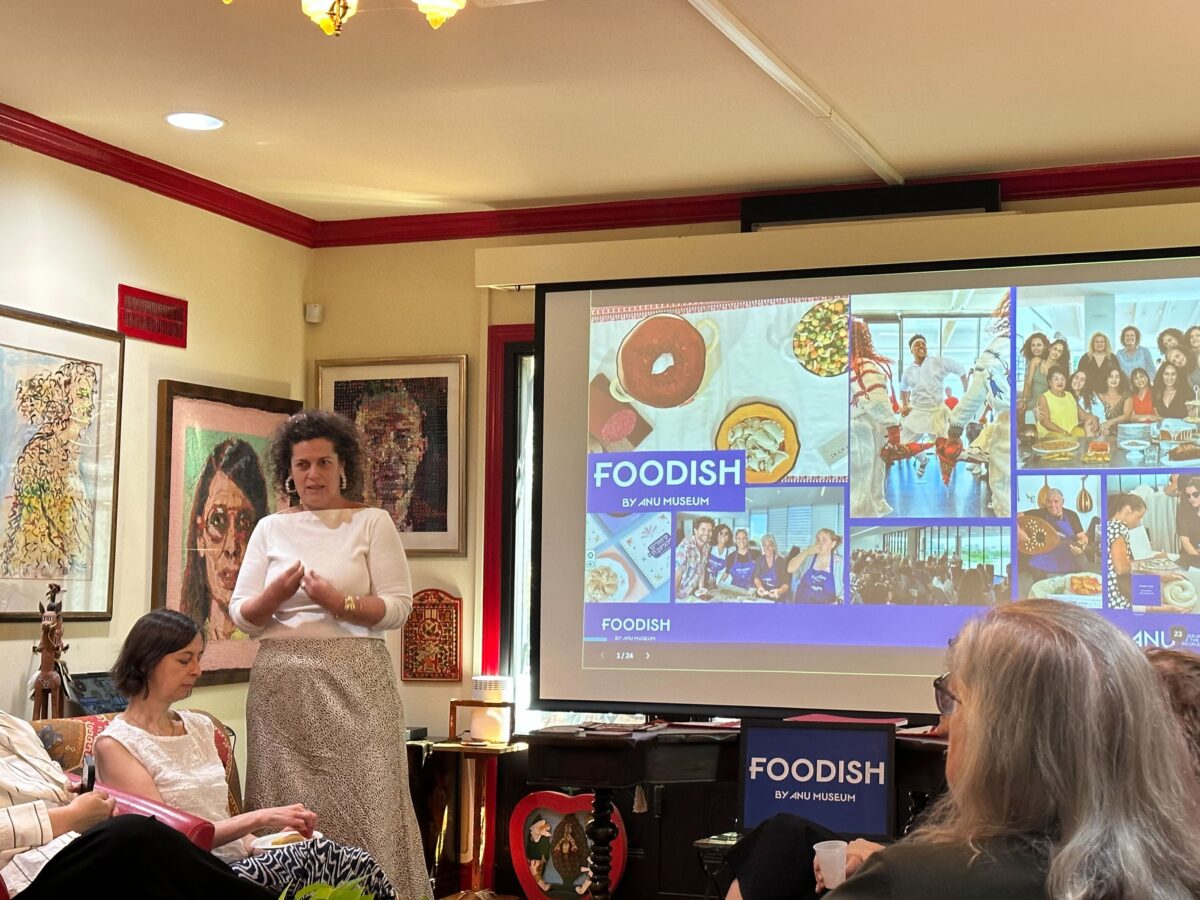
Merav Oren, founder and CEO of Foodish, the culinary department of Tel Aviv’s ANU Museum of the Jewish People, presents “Soul and Roll” at an event held at the Washington home of documentary filmmaker Aviva Kempner. (Haley Cohen)
Edri and Oren, both of whom reside in Tel Aviv, met during a visit to Warsaw, Poland, working with Jewish communities through food and music, just days before the Oct. 7, 2023, terrorist attacks. After Hamas’ massacre, the pair reunited to lead food therapy workshops.
“Just after Oct. 7 we went down to the south where evacuees were staying and started doing culinary workshops with them,” Oren recalled on Sunday. One moment that still stands out to her, she said, was when she began doing dishes after the workshop and an evacuee insisted on helping because what she missed most about home was “the basic stuff like washing dishes, baking or cooking.”
Also in the immediate aftermath of Oct. 7, Foodish ran a pop-up exhibition with 14 of the leading chefs in Israel, including Eyal Shani, pairing each with a famous Israeli artist. Each illustrator designed artwork for a chef coat based on the chef’s personal story, which was then sold in an exhibition. Funds raised went towards expanding the food therapy workshops.
Foodish has since launched several other programs, including one that invites high school students to taste cultural, and sometimes unpopular foods like chopped liver, “that are kind of disgusting, but through that we tell the story of specific communities,” said Oren.
Another program designed to alleviate loneliness among the elderly sends volunteers to their homes and to document their history as they cook together. “Then we have an event where they invite their families, go onstage and tell their stories. The food helps them tell their stories, which otherwise probably no one would have asked them about,” said Oren.
The newest projects, which Oren said are “going global,” include Soul and Roll, as well as one designed for schools that focuses on teenagers and young adults to assist them in documenting their family’s food stories, both online and in print.
“All of these are examples that explain to us food is not just food, it’s so much more engaging. We deal with Jewish identity through food,” said Oren. “We want to take what we do to Jewish communities all over the world.”
Noting Israel’s war with Iran and the countless hours they have spent in Tel Aviv bomb shelters over the past month, both Oren and Edri said that the launch of Foodish’s latest programs comes amid a challenging period.
“This is a difficult time for us. Growing up, the rocket situation was my reality,” said Edri. “Today, I live in Tel Aviv and we are facing the same reality. Doing what we do, and to be able to come here and share our stories with you, is even more important [than ever] for me because we are strong only if we stay together. Our existence really depends on each other,” he told the American Jewish audience.
Although the war forced the cancellation of two of their three scheduled shows in Israel, Edri told JI that Soul and Roll is persevering, adding, “It’s difficult, but we’re getting it out there.” The pair’s trip to the U.S. also included a Mimouna show in New York.
“My background is mainly onstage and I’m a big foodie,” continued Edri, adding that what draws him to the program is the combination of “kitchen, memories, Jewish identity brought all together with music and what Anu does, and people leaving with cookies, music they can sing to and memories.”
Edri, who runs his own culinary-musical web series called “Cooking with Hananel,” shared the reason each Soul and Roll show begins with the same song, “Jerusalem of Gold,” the iconic Israeli tune written by Naomi Shemer in 1967: “Merav’s family came from Poland, my family came from Morocco,” he said. “Our grandmothers were in very different situations and settings, but they all prayed and longed for the same place, which is Jerusalem.”
Amy Schumer, Debra Messing and David Schwimmer were among the celebrities performing on stage at ‘Letters, Light and Love’

Instagram/Amy Schumer
From left: Julianna Marguiles, Amy Schumer, Debra Messing and Judy Gold at the “Letters, Light and Love” U.S. premiere at Carnegie Hall, NYC, February 24, 2026
Call it a mash note to Jewish identity, and to the Jewish homeland.
Hollywood heavyweights took to New York City’s world-renowned Carnegie Hall stage on Tuesday night to highlight the link between the Jewish people and the land of Israel, spanning thousands of years, in the form of recounting historic love letters to the Jewish state.
“Letters, Light and Love” made its U.S. premiere in a one-night only performance hosted by UJA-Federation of New York as Jewish celebrities including Amy Schumer, David Schwimmer, Debra Messing, Tovah Feldshuh, Jonah Platt and Michael Aloni read excerpts of letters written about Israel across centuries. The notes came from writers such as Julius Caesar, Maimonides, Golda Meir, Sir Moses Montefiore, Albert Einstein, Harry Truman, John Adams, Winston Churchill and Leonard Bernstein.
The performance was the second-ever showing of the three-act play, which first ran in 2024 in London’s West End. Co-produced by Sarah Sultman and Michal Noé, proceeds from the $1.5 million raised on Tuesday will go towards rebuilding Kibbutz Be’eri in southern Israel, where around one in 10 residents were killed by Hamas on Oct. 7, 2023.
“I’ve always loved letters,” Sultman, who is the co-founder of the Gesher School in London, told Jewish Insider. The idea for the play came to her in early November 2023, while on a solidarity visit to Israel through a U.K. delegation weeks after the attacks.
“Whilst I was out there, visiting a number of kibbutzim, they asked us what we would do when we went home,” recalled Sultman. “I had this idea about using letters to tell our story. I suppose it was driven by the pervasive narrative that Jews are white colonizers from Poland. That our connection to Israel [began] in 1948. For me, Judaism and its connection to Israel are inextricably linked and always have been.”
“I came back from that trip and began researching letters, working with the National Library of Israel, digging through archives and accumulating hundreds of letters,” continued Sultman. “We have a 3,000-year-old history. We have letters from across time. [We created] a performance, interwoven with music, that tells our story in a way that is educational, soulful and moving. It’s also purposeful. It should be used as a project of regrowth in Israel.”
“We researched who are the actors proud of their Judaism and Zionism,” Sultman told JI, noting that most of the cast that came on board decided to “because of a personal connection” and it was easier to appeal to the actors directly rather than working through their agents. Several actors that Sultman thought would be interested turned down the opportunity, but she was surprised by others who were eager to participate.
Schumer, whose hits include “Trainwreck” and “Life and Beth,” said in a statement that “being on stage at Carnegie Hall, being a part of last night’s ‘Letters, Light and Love,’ was an honor … I am proud to be Jewish and to represent my ancestors, most of [whom] didn’t make it.”
The London show “was a wartime effort” and was supposed to be a one-off, according to Sultman. But she described the audience’s response as “overwhelming.”
It was then that she realized there was a further need for “a space where the artistic community can feel supported and safe and where an audience could feel pride in their story.”
“Post-Oct. 7, we’ve had lots of debate and fireside chat but there was nothing bringing joy in the room and celebrating who we are as a people. New York felt like it was aiming for the stars and a bit crazy,” Sultman said. “But we worked for a year on making it happen… and [finally] got the green light from Carnegie Hall in December.”
The show opened with the reading of a letter written by Israeli astronaut Ilan Ramon to his professor, seeking guidance on “man’s purpose in life.” It closed with excerpts from a letter written by Rabbi Lord Jonathan Sacks in 2001, telling Jews that each one is a “letter in the scroll.”
Other readings included notes written by Maimonides to Rabbi Yaphet bar Eliyahu the Judge, in the 12th century; Stephen Norman, the only grandchild of Theodor Herzl, on his first visit to then-Mandatory Palestine in the years before Israel’s statehood was declared; Esther Cailingold, who was mortally wounded defending the Jewish Quarter in Jerusalem during Israel’s war of independence; and a final letter written by Elkana Wiesel to his family, just before he fell in battle in the Gaza Strip in January 2024.
There was also a personal nod to Sultman’s love for letters. Schumer, in her comedic style, read an October 1994 note that Sultman mailed to her sister while on a gap year in Israel, sharing that, unlike back home, Israelis party all day during Simchat Torah and celebrating her experience meeting Jews from all around the world.
“I have all my letters from gap year and camps in my attic at home,” Sultman told JI. The letter was “something personal, but I also felt it represents so many 18-year-olds’ experiences. It was written by me but it could have been written by thousands of young people visiting Israel for their first time and they’re like, ‘Wow, this is so cool.’”
“When we curated the letters it was important to take the audience on an emotional journey that wasn’t just about being sad or reflective but also celebratory and happy,” continued Sultman.
“It was important to me that this wasn’t a history lesson. We broke it into three acts so you had moments you learned something, moments you felt sad and moments you felt happy. We also adapted it for New York [to reflect] American Jewry’s relationship with Israel, so we added the letter from Israeli President Chaim Weizmann to President Harry Truman.” About 70% of the letters were the same from the London show, while the others were switched out, Sultman said.
For many audience members, the two-hour performance offered a welcomed respite from the antisemitism that has plagued Jewish communities since Oct. 7. Attendees were asked not to promote the event in advance as a security precaution and there was heavy NYPD and Community Security Initiative presence. A few cast members asked for their names to not be disclosed in the media, presumably also as a safety measure.
Sultman said that had the event not been postponed by a day due to this week’s blizzard, she would have expected to see protests outside Carnegie Hall, even though organizers tried to keep the event under wraps. “It was remarkable that there were no protests,” she said. “We pivoted so fast [after the snow storm] that I don’t know that anyone would have caught on to the fact that we rescheduled for the next day. Protesters may have thought it was canceled.”
The sold-out audience was comprised of three groups, according to the organizers. The parquet seats were given to UJA’s invite-only guests, which included donors as well as cast members’ family and friends. The Charles and Lynn Schusterman Family Foundation and Jim Joseph Foundation funded 800 seats for young people involved with groups including Hillel and Taglit to attend at no cost. The third group, about 1,000 tickets, were available for the general public to purchase through UJA.
Among the star-studded cast — which also included musical performances by Matisyahu, The Maccabeats, Noa Tishby, David Draiman and others — only one presenter received a standing ovation: Eli Sharabi.
Sharabi, a former resident of Kibbutz Be’eri who was kidnapped by Hamas on Oct. 7 and held in Gaza for 491 days — and whose wife and daughters were murdered during the terrorist attack — took to the stage to thank American Jewry for its support.
Sultman isn’t sure what comes next for the show, but she’s received requests to bring it to Los Angeles, Miami, Australia and even to translate it into Spanish for a run in Argentina.
She said now that they’ve pulled off a performance in New York City — “then we could do it anywhere.”
The survey found 64% of young conservatives ages 18-34 agreed with at least one antisemitic statement

Genaro Molina/Los Angeles Times via Getty Images
Pomona College students march to Alexander Hall where 20 students were arrested during a sit-in at on Pomona Campus in Claremont on April 11, 2024.
Younger voters hold overwhelmingly more critical views of Israel and of the Jewish people than older generations, a new survey finds in keeping with other recent research on the issue, with antisemitic beliefs strongest among the most conservative cohort.
The Yale Youth Poll, an undergraduate-led research group based at Yale University, surveyed over 3,400 American voters for their views on Israel, Zionism and antisemitism between Oct. 29-Nov. 11, with over half of respondents under the age of 35.
On a basic assessment of whether the American Jewish community has had a positive or negative impact on the United States, over half (54%) of all respondents answered positive, while the same was true of only around a third (35%) of 18-22-year-olds.
In a list of antisemitic statements — including “Jews in the United States are more loyal to Israel than to America,” “It’s appropriate to boycott Jewish American-owned businesses to protest the war in Gaza” and “Jews in the United States have too much power” — 70% of respondents overall disagreed with all three; however, only 57% of 18-22-year-olds and 60% of 23-29-year-olds said the same.
Among those ages 18-34 who self-identified in their responses as “extremely conservative,” a sizeable majority of 64% said they agreed with at least one of the listed statements, far more than any other subgroup of younger voters — 38% of 18-34-year-olds overall said the same, already a notable minority.
Younger people also had overwhelmingly negative views of Zionism: Given a list of possible definitions of the ideology, respondents overall most commonly identified the “positive” definitions, including “self-determination and statehood for the Jewish people,” “the continued existence of Israel in the face of calls for its destruction” and the Jewish people having an equal “right to statehood,” as accurate.
Among voters ages 18-22, however, the most commonly selected definitions described Zionism as “maintaining a Jewish demographic majority in Palestine by driving out the native Palestinian population,” (36% vs. 17% of all respondents), creating “a nation-state where Jews get more rights than others,” (33% vs. 15% overall) and “a form of racism and apartheid against Palestinians” (31% vs. 13% overall). Fifteen percent of respondents under 30 said they believe that Israel should not exist, compared to 5% overall.
The younger cohort’s view of what qualifies as antisemitism was also distinct — asked if comparing the Israeli government’s policies to the Nazis constitutes a form of anti-Jewish prejudice, 46% of 18-34-year-olds said no, compared to 28% of respondents overall. Seventeen percent of younger voters said they did not believe use of the phrase “globalize the intifada” was antisemitic, compared to 12% overall, and 67% said calling the war in Gaza a genocide did not constitute antisemitism, compared to 47% overall.
Nearly half (46%) of 18-22-year-olds think the U.S. should cut off all military aid to Israel compared to 23% of all respondents. This hostility to Israel, as with most of the survey’s findings, decreased with age to only 13% of respondents aged 65 and older.
The documentary highlights anti-Israel conspiracy theories and is filled with antisemitic tropes

Anna Moneymaker/Getty Images
Rep. Ro Khanna (D-CA) speaks at a rally near the U.S. Capitol on June 29, 2021, in Washington, D.C.
Rep. Ro Khanna (D-CA) distanced himself from antisemitic influencer Ian Carroll after the congressman posted to social media an excerpt from a YouTube documentary that featured separate clips of himself and Carroll.
Carroll, described in the documentary as a researcher, is an antisemitic conspiracy theorist who has engaged in Holocaust distortion. He has claimed that Israel and Jewish people are involved in a malign global conspiracy, control the U.S. government and were responsible for the 9/11 attacks. He has also asserted that pedophile and financier Jeffrey Epstein was a “clearly a Jewish organization working on behalf of Israel and other groups.”
In the excerpt shared by Khanna alongside his own comments, Carroll stated that recipients of pro-Israel support are “operat[ing] our government on behalf of someone else,” referring to AIPAC and Israel. Khanna himself discussed his concerns about interest group spending in U.S. elections.
“This was a documentary made by Tommy G who interviewed me. I did not speak to or meet Ian Carroll. I stand by my words and should be judged by them,” Khanna said in a statement to Jewish Insider. “I vehemently disagree and reject any views blaming Israel for 9/11, denying the Holocaust, or conspiracies about a Jewish syndicate exerting control.”
In the documentary, Khanna described the U.S. as “complicit” in the destruction in Gaza and stated that Israel has committed war crimes in the enclave and that the International Court of Justice should examine and adjudicate the issue.
“The Hamas terrorist attack was awful, and I said that people who committed those crimes had to be brought to justice and the hostages had to be released,” Khanna said. “But that happened months in. Netanyahu has been bombing for 2 years.”
“Who says, ‘We’re going to starve the people so much that they suffer that we’re going to force the surrender?’ It’s sick, and your tax dollars, my tax dollars, are funding them,” Khanna added.
The documentary itself, posted by a YouTube videomaker with the handle Tommy G, is filled with antisemitic tropes. The thumbnail for the video frames Israeli Prime Minister Benjamin Netanyahu as a puppetmaster with strings controlling several men in suits, posed in front of the White House, flanked by Israeli and AIPAC flags. There are also several dollar bills superimposed over the image.
The documentary highlights anti-Israel arguments — including some conspiracy theories — and repeatedly brushes off or attempts to rebut arguments from pro-Israel voices featured in it. Anti-Israel voices receive the majority of the screen time in the video.
The narrator, Tommy G, opens the documentary by highlighting claims of a coverup or Israeli foreknowledge of the Oct. 7 attack, and plays up alleged Israeli abuses in Gaza.
While condemning Hamas’ actions, he suggests that the terrorist group’s actions could be seen as reasonable or provoked by Israel’s own actions, framing the group — as well as the Taliban in Afghanistan — as “freedom fighters” and “resistance movements.”
Tommy G also makes passing mention of — and does not interrogate — baseless claims that Israel may have been involved in the assassination of Charlie Kirk.
The documentarian describes Carroll as “one of the internet’s top conspiracy analysts,” who critics “label an antisemite … but to others he is a fearless journalist that speaks on what some perceive as an extremely strong Zionist pressure on our government.”
He also suggests that it is inherently suspicious that many lawmakers have traveled to Israel.
And he concludes the documentary by stating, “A lot of us feel deep in our gut something is off here, something is wrong here and I will not be intimidated into not asking questions.”
Carroll himself suggests in the documentary a connection between the pro-Israel cause and the John F. Kennedy assassination, that Israel had foreknowledge of the 9/11 attack and that Israel dispatched Jeffrey Epstein to cultivate relationships with U.S. leaders and blackmail them.
Another anti-Israel voice in the documentary is Anthony Aguilar, a former Gaza Humanitarian Foundation contractor whose key claim of Israeli and GHF abuses has been disproven.
Aguilar states in the documentary that American politicians aren’t allowed to talk about Israel and that shows “who controls you.”
Other featured guests include Sens. Rand Paul (R-KY) and Ron Johnson (R-WI) and Reps. Nancy Mace (R-SC) and Hank Johnson (R-GA), as well as Code Pink leader Medea Benjamin, an IDF reservist and a U.S. doctor who volunteered in Gaza.
Mace, Johnson and the IDF reservist all spoke in defense of Israel.
The video includes a clip of Norman Finkelstein, an antisemitic scholar who has voiced support for Hezbollah and accused Jews of exploiting the Holocaust.
In the documentary, Paul suggests, falsely, that the U.S. has created “easier” rules around lobbying disclosures for countries the U.S. considers to be allies and that many pro-Israel activists are dual-citizens, part of a segment of the documentary that attempts to interrogate why AIPAC is not registered as a foreign lobbying group.
The group’s members and leaders are American citizens who act on their own recognizance, rather than at the instruction of the Israeli government.
Khanna, pushing back on the narrative framing AIPAC supporters as foreign agents, states in the documentary, “They’re American citizens. If you’re an American citizen and you’re articulating a point of view, that’s your right. … They’re American citizens. They’re lobbying for their interests. They’re lobbying for the Netanyahu government’s interests because they think that’s what benefits America. And they’re paying millions of dollars, which under Citizens United is legal.”
Khanna argues in the documentary that spending from outside super PACs on behalf of favored candidates should be outlawed.
The California congressman, rumored as a potential 2028 presidential candidate, has also recently faced scrutiny for his appearance at ArabCon, where other speakers defended Hamas and laughed off the idea of condemning its Oct. 7 attacks.
The Google cofounder criticized the U.N. as ‘transparently antisemitic’ in comments on an internal employee forum

Taylor Hill/FilmMagic
Sergey Brin attends the 2025 Breakthrough Prize Ceremony at Barker Hangar on April 05, 2025 in Santa Monica, California.
Google cofounder Sergey Brin recently panned the use of the term “genocide” to describe Israel’s war against Hamas, describing it as “deeply offensive” to Jewish people “who have suffered actual genocides.”
Brin made the comment in an internal employee chat forum, according to The Washington Post, amid a debate over a new U.N. report that accused corporate entities, including Google, of profiting from “Israel’s economy of illegal occupation, apartheid and now, genocide.”
In the Google DeepMind staff forum, screenshots of which were viewed by the Post, Brin wrote, “With all due respect, throwing around the term genocide in relation to Gaza is deeply offensive to many Jewish people who have suffered actual genocides. I would also be careful citing transparently antisemitic organizations like the UN in relation to these issues.”
The U.N. report was authored by U.N. special rapporteur Francesca Albanese, who has faced ongoing accusations of antisemitism from U.S. officials and lawmakers who have called for her to be removed from her position.
Rabbi Arie Zeev Raskin, chief rabbi of Cyprus, said the Israelis stranded on the island amid Israel’s war with Iran are making ‘lemonade out of lemons’

Courtesy Chabad of Cyprus
Israelis stranded in Cyprus amid Israel's war with Iran gather at Chabad.
An American couple who were en route to Israel to celebrate their wedding but had their flight diverted. Two Israeli single mothers on holiday looking for a quick refresh, now stranded. A group of injured Israel Defense Forces soldiers on a healing retreat.
These are some of the nearly 2,500 Jewish people that Rabbi Arie Zeev Raskin, the chief rabbi of Cyprus, and his wife, Shaindel, unexpectedly found themselves hosting for Shabbat last Friday after at least 32 flights from the United States and Europe were diverted to the island in the Mediterranean amid Israel’s preemptive military campaign against Iran, which was launched early Friday morning.
“Everybody in the community gave a hand with cooking and preparing,” Raskin, who has run the local Chabad center in the port city of Larnaca since 2003, told Jewish Insider.
Shabbat at Chabad “was amazing, a crazy experience,” said Tzvi Berg, a Jerusalem resident who was flying home from a wedding in New York on Thursday night when — just moments away from landing in Tel Aviv — his flight was rerouted to Larnaca.
“When the pilot made the announcement, everyone went online and saw Israel was attacking Iran and instead of being upset, everybody was clapping,” Berg said.
But as Shabbat ended — with Israeli airspace still shuttered as Iranian missiles continued to strike in Tel Aviv and elsewhere — “the challenge began again,” Raskin said. Hotels on the island are overwhelmed. Tourists have exhausted their vacation funds. People with chronic illness can’t access medications.
And they are knocking on Chabad’s door looking for food and accommodations, as many Jews do in moments of crisis around the world.
“We have a few challenges at the moment,” Raskin said.
“People have started to lose patience. Parents want to get back to their kids,” said Berg, who on Tuesday traveled some 30 miles to the island’s other Chabad, located in the resort town of Ayia Napa, where he barbecued for the injured IDF soldiers.
The couple whose wedding is scheduled for Thursday remains hopeful they can still get to Israel via boat.
One of the single mothers who came to Cyprus on vacation has two children with special needs in southern Israel facing constant missile fire. “There’s a lot of tears and crying that she can’t get back to her kids,” Raskin said.
Still, Raskin said that most of those stranded are making “lemonade out of lemons” during their time on the picturesque island — which is a popular tourist destination for Israelis due to its proximity.
“The majority of the people here trust in God, so you see happy faces,” Raskin said. “They’re saying, ‘OK, we’re here on holiday, we have a place to stay and food, we’re happy.’”
Cypriot police said on Sunday that security measures would be increased for Israeli tourists following concerns that Iran or its proxies could attempt to target them abroad.
Israel’s Transportation Ministry announced on Monday it would launch Operation Safe Return to bring close to 150,000 Israelis stuck abroad back home. According to the Israeli airline El Al, 60,000 Israelis registered for rescue flights to return them to Israel within the first 90 minutes of the registration site going live on Monday.
Israeli carriers El Al, Arkia and Israir announced on Tuesday that they received permission from the Israeli government to organize repatriation flights to bring back Israelis stranded abroad. The first two flights from Larnaca, Cyprus, landed at Ben Gurion Airport on Wednesday morning.
“People are doing crazy stuff to get back,” Berg said, adding that while he looks forward to reuniting with his wife and children, who have been hunkered down in Jerusalem, the people in Cyprus “have been very hospitable and accommodating. They love Israelis.”
“I was here [on holiday] in the summer once, but this is a different experience,” said Berg.
Some Israelis, including Aliyah and Integration Minister Ofir Sofer, who was stuck in Azerbaijan, which borders Iran, were able to return home over the weekend by flying to Greece and then to Cyprus, from which they took a boat to Israel. Others, including civilians, have charted private flights from Larnaca to Israel through Sharm el-Sheikh, Egypt.
But Raskin advises displaced Israelis who are safe in Europe to “stay where you are if you have good accommodations.”
“Don’t rush to Cyprus because it won’t get you to Israel any faster.”
Blumenthal: ‘Our bipartisan effort seeks to strengthen measures to bring long overdue justice to families whose cherished art was brazenly stolen by the Nazis’

J. Scott Applewhite/AP Photo
Sen. John Cornyn, R-Texas, center, is flanked by Senate Judiciary Committee Chairman Dick Durbin, D-Ill., left, and Sen. Richard Blumenthal, D-Conn., at the Capitol in Washington, Thursday, Nov. 14, 2024.
Sens. John Cornyn (R-TX) and Richard Blumenthal (D-CT) introduced bipartisan legislation last week aimed at eliminating loopholes used by museums and other stakeholders to continue possessing Nazi-looted artwork that Jewish families have been trying to recover.
Introduced on Thursday, the Holocaust Expropriated Art Recovery (HEAR) Act would expand on Cornyn’s 2016 legislation of the same name, which was passed at the time by unanimous consent, by ending the Dec. 31, 2026, sunset date on the original bill and strengthen the existing procedural protections to ensure that victims’ claims are not dismissed due to non-merit-based factors such as time constraints.
“The artwork wrongfully ripped from Jewish hands during the Holocaust bears witness to a chapter in history when evil persisted and the worst of humanity was on full display. I’m proud to introduce this legislation to support the Jewish people and Holocaust survivors by helping them recover art confiscated by the Nazis that they are rightfully owed and give them the justice and restitution they deserve,” Cornyn said in a statement.
“The theft of art by the Nazi regime was more than a pilfering of property — it was an act of inhumanity. Our bipartisan effort seeks to strengthen measures to bring long overdue justice to families whose cherished art was brazenly stolen by the Nazis,” Blumenthal said.
Many families of Holocaust victims in the U.S. who have located artwork from deceased relatives and sued to recover those items face the deadline at the end of next year before the statute of limitations sets in. Thousands of stolen works of art remain unreturned to their rightful owners from the Nazi plunder, and there are scores of ongoing cases to resolve disputes over ownership of those items.
“Unfortunately, many museums, governments, and institutions have contradicted Congress’ intent and obstructed justice by stonewalling legitimate claims, obscuring provenance, and employing aggressive legal tactics designed to exhaust and outlast Survivors and their families. Rather than embracing transparency and reconciliation, too many have chosen to entrench and litigate, effectively preserving possession of stolen works rather than returning them to their rightful owners,” a press release for the bill states.
Sens. Thom Tillis (R-NC), Cory Booker (D-NJ), Marsha Blackburn (R-TN), John Fetterman (D-PA), Eric Schmitt (R-MO) and Katie Britt (R-AL) co-sponsored the bill, which was endorsed by a number of Jewish organizations including Agudath Israel of America, the American Jewish Committee, Anti-Defamation League, Jewish Federations of North America, StandWithUs and World Jewish Congress, among others.
“This legislation helps to right a historic wrong committed during one of the darkest chapters in history. By eliminating unnecessary legal obstacles, the HEAR Act establishes a clear path to restitution for Holocaust survivors and their families, ensuring that art and cultural property stolen by the Nazis can finally be returned to their rightful owners,” Tillis said.
Fetterman said in a statement, “Eighty years after the Holocaust, we have a moral responsibility to do right by the victims of these atrocities and their families. I’m grateful to join my colleagues from both sides of the aisle in introducing the HEAR Act to help return artwork stolen by the Nazis to its rightful owners.”
Please log in if you already have a subscription, or subscribe to access the latest updates.
 Continue with Google
 Continue with Apple