
































The nominee faced opposition from Democrats and Sen. John Curtis over his past views on Israel and Jewish people
DOMINIC GWINN/Middle East Images/AFP via Getty Images
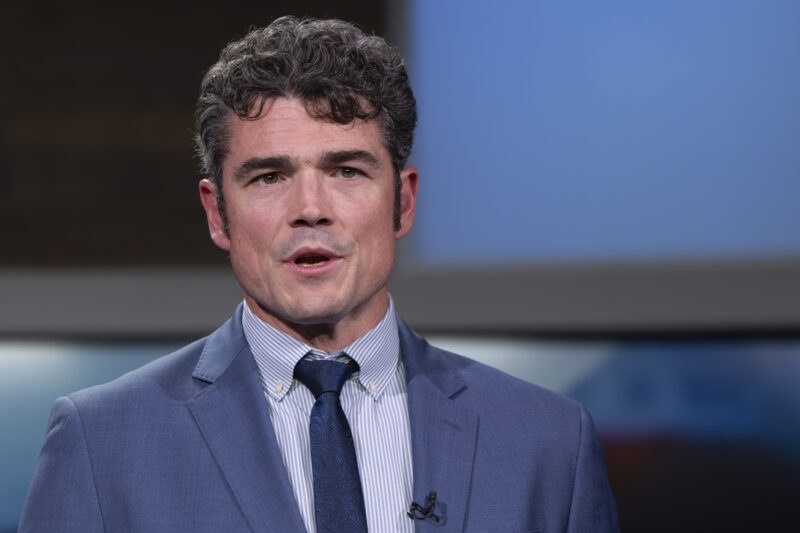
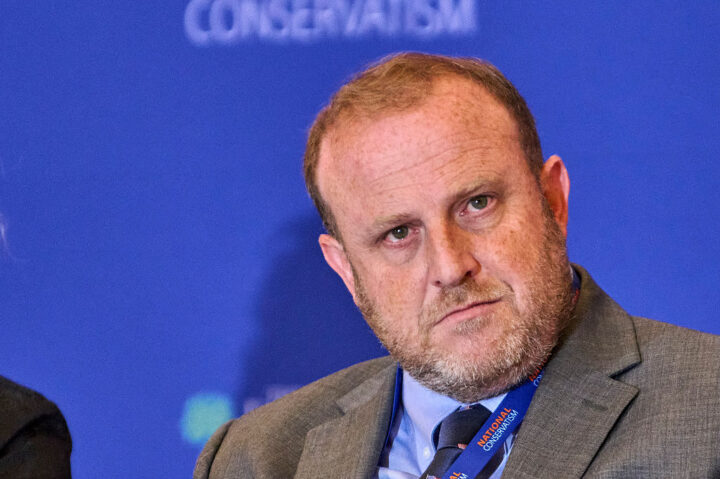
Jeremy Carl speaks at the National Conservatism Conference in Washington D.C., Sept. 3, 2025.


 Add JewishInsider on Google
With no clear path to confirmation in the Senate a month after he was grilled and struggled to explain his past views and writings at a confirmation hearing, Jeremy Carl withdrew his nomination to be assistant secretary of state for international organizations on Tuesday.
Carl faced unified opposition from Democrats on the Senate Foreign Relations Committee, as well as Sen. John Curtis (R-UT), who said after the hearing he found Carl’s past comments downplaying the U.S.-Israel relationship and his “insensitive remarks about the Jewish people unbecoming of the position for which he has been nominated.”
The nominee had previously expressed a range of derogatory views about Jews, describing them as having a victim mentality, downplaying the significance of the Holocaust to the Jewish story and experience and musing about the need to address the what he called the “Jewish Question.” He also espoused a view of the United States as a white, Christian nation, claiming that white people are undergoing a “cultural genocide” and deliberate replacement.
Curtis’ opposition was sufficient to prevent Carl’s nomination from advancing out of the committee, leaving Carl with no clear path to confirmation.
“I am tremendously grateful to President Trump for nominating me and then (upon expiration of my original nomination) renominating me for this role, and I am also grateful to Secretary Rubio and his team for their continued support throughout this long and time-consuming process,” Carl said on X.
He added that, with no path to unanimous support from Republicans on the committee, he did “not wish to have the President, Secretary Rubio, or the rest of his team waste valuable time and energy attempting to change that decision.”
GOP Sen. John Curtis said of Carl, ‘I find his anti-Israel views and insensitive remarks about the Jewish people unbecoming of the position for which he has been nominated’
DOMINIC GWINN/Middle East Images/AFP via Getty Images
Jeremy Carl speaks at the National Conservatism Conference in Washington D.C., Sept. 3, 2025.
The nomination of Jeremy Carl, tapped to be the assistant secretary of state for international organizations, appears bound to fail after Sen. John Curtis (R-UT) announced his opposition to Carl’s confirmation following a contentious confirmation hearing in the Senate Foreign Relations Committee this morning.
Curtis and a series of Democrats questioned Carl over past antisemitic, anti-Israel and otherwise inflammatory comments that the nominee had made online and in a series of podcast appearances. All Democrats are expected to oppose the nomination.
Curtis, in his questioning, honed in on past remarks by Carl that the U.S. spends too much time and energy on Israel “often to the detriment of our own national interest.” He emphasized that a key part of Carl’s role would be to resist antisemitism and anti-Israel bias at the United Nations, and sought to elucidate Carl’s views on whether the U.S. should provide diplomatic support to Israel at the U.N. and whether he understands the value of the U.S.-Israel relationship.
Carl, in spite of his past comments, said he would push back on anti-Israel and antisemitic bias, and highlighted his past ties to former Secretary of State George Shultz and Turning Point USA founder Charlie Kirk in order to demonstrate his pro-Israel bona fides.
Curtis said that, in light of Carl’s own past comments and his failure to push back against antisemitic sentiments expressed by a podcast host with whom he conducted an interview, he was skeptical of Carl’s ability to serve as a credible voice on these issues with foreign diplomats who hold anti-Israel and antisemitic views.
“When asked by other diplomats, who do come with these agendas that you referred to in your remarks, how do you push back on that when you didn’t push back on that moderator?” Curtis questioned.
Pressed further on whether there are any other allies that he thinks the U.S. dedicates too much time and attention to, Carl evaded the question.
“You’re [nominated to be] the principal manager of the U.S. multilateral policy, and anti-Israel bias in international organizations is part of a broader strategy to undermine the United States [and] our legitimacy,” Curtis told Carl at the end of his questioning. “I don’t know that I’ve been convinced that you understand the threat posed to the West and [in that] narrative.”
A Curtis spokesperson told Jewish Insider after the hearing that he plans to oppose Carl’s nomination, which will be enough to block the nominee from advancing out of committee, assuming no Democrats on the committee support him.
“After reviewing his record and participating in today’s hearing, I do not believe that Jeremy Carl is the right person to represent our nation’s best interests in international forums, and I find his anti-Israel views and insensitive remarks about the Jewish people unbecoming of the position for which he has been nominated,” Curtis said in a statement after the hearing.
A series of Democrats lined up during the hearing to criticize Carl and highlight his inflammatory past comments.
Sen. Jacky Rosen (D-NV), sitting beside a poster with a quote from Carl, “the Jews love to see themselves as oppressed,” said that the “nomination should alarm every senator who believes in basic decency, truth and responsibility that does come with public service.”
She emphasized that Carl’s Jewish heritage — he grew up Jewish before converting to Christianity — does not excuse his “antisemitism” and “hateful rhetoric” and that a vote for Carl “tells Jewish Americans they simply don’t matter,” and disrespects the memories of those who fought in World War II.
“If you have empathy for the Jewish community, communities experiencing hate [or are] simply tired of advancing nominees who I doubt will be respected on the world stage, you must vote against Mr. Carl’s nomination,” Rosen concluded.
Under questioning from Sen. Cory Booker (D-NJ), Carl expressed generalized regret about past comments downplaying the impacts of the Holocaust on the Jewish people and arguing that the Jewish people are too focused on that historical trauma.
“Sometimes I take an idea too far, and I made some comments in interviews about minimizing the effect of the Holocaust that were absolutely wrong. And I’m not going to sit here and defend them here,” Carl said.
Pressed by Booker on whether he believes that the ethnic and racial makeup of the country is important — for example, whether the country would be worse off if it were 40% Jewish — Carl said, “echoing President Trump, I believe unity rather than diversity is a strength” but insisted that he does not believe any race is inherently superior.
Carl also affirmed his belief in the Great Replacement Theory, which claims that there is an intentional effort by elites to replace white Americans with immigrants, saying “the Democratic Party, through its immigration policies, has certainly shown signs of that.”
“You have no decency. You have no honor. You say inflammatory things because you think it will ingratiate you to those who are paying your salary, and you sit here before me and try to wrap yourself in the American flag?” Booker said. “I believe in this nation. I believe in the principles. I believe in those who fought and died for our country. You disgrace that legacy and the ideals that we all swear an oath to uphold.”
Booker went on to blast Carl for his defense of those involved in the Jan. 6, 2021 attack on the U.S. Capitol.
Sen. Chris Murphy (D-CT), pointing to Carl’s past comments asserting that anti-white discrimination is the most widespread and problematic form of discrimination in the modern day and that white Americans are undergoing a “cultural genocide,” pressed Carl to specify what he believes constitutes white culture and the elements of it that are being erased.
Carl appeared to struggle to provide specific answers, ultimately arguing that white Christian churches are distinct from Black churches “in terms of its tone and style on average,” “foodways could be different” and “music could be different,” pointing to the Super Bowl halftime Show, which was performed in Spanish by Puerto Rican artist Bad Bunny.
“I’m not a racial nationalist … I’m a civic nationalist,” Carl said. “I am concerned with the majority common American culture that we had for some time, that through particularly mass immigration, I think has become much more balkanized, and I think that weakens us.”
Carl said that he stands by his view that “white Americans are often very disfavored in overt ways” in the U.S. legal system but insisted that he does not believe that white culture is superior.
Sen. Tim Kaine (D-VA) highlighted statistics showing the prominence of white people in positions of power nationwide.
“Sen. Rosen … was reading comments to you where you had been saying, ‘Man, Jews play the victim. Jews like to be the victim,’ and yet you’re making a claim that whites are victimized by a cultural genocide, when all the statistics would say, not just in history, but today, that whites are very well represented at every level of every institution,” Kaine said.
When Sen. Jeanne Shaheen (D-NH), the committee’s ranking member, pressed Carl on how lawmakers can “trust that you can represent the United States of America to the rest of the world in an unbiased manner when you have taken no steps to restrain your conduct” during his confirmation process, Carl said he “understand[s] the importance of restraint and conduct” but said he needs to “balance that with my current job [as a senior fellow at the Claremont Institute], which involves advocacy” until such point as he is actually confirmed.
Sen. Jeff Merkley (D-OR) accused Carl of “judging people by the color of their skin,” going on to argue that Carl is underqualified and inexperienced for the position, having no past staff experience in the U.S. Mission to the United Nations or in any official diplomatic roles.
He pressed Carl for specifics about the U.S. policy toward a series of United Nations organizations — seemingly testing Carl’s knowledge of the U.N. system and the Trump administration’s policy toward it. Carl generally did not provide specific answers, pointing to his status as a private citizen.
Carl mused about the need to address the ‘Jewish Question’ and characterized Jews as religiously incorrect and in need of conversion
DOMINIC GWINN/Middle East Images/AFP via Getty Images
Jeremy Carl speaks at the National Conservatism Conference in Washington D.C., Sept. 3, 2025.
Jeremy Carl, a Trump administration nominee for a senior position at the State Department, has expressed a range of derogatory views of the Jewish community, characterizing in writings and public interviews the community as holding a victim mentality, downplaying the significance of the Holocaust to the Jewish story and experience, musing about the need to address the what he called the “Jewish Question” and characterizing Jews as religiously incorrect and in need of conversion.
Carl also rejected the argument that Israel is the United States’ strongest ally and was deeply critical of Christian Zionism. He has additionally espoused a view of the United States as a white, Christian nation, claiming that white people are undergoing a “cultural genocide” and deliberate replacement.
Carl was nominated to be the assistant secretary of state for international organizations in June, but did not move forward to a hearing in the Senate Foreign Relations Committee before the end of this year’s Senate session. Should the Trump administration still want Carl in the role, it will have to re-file his nomination in the new year. Carl said in a response on X that neither he nor the administration have decided whether to resubmit the nomination. Carl served as deputy assistant secretary of the Interior in the first Trump administration.
“Jews have often loved to play the victim rather than accept that they are participants in history. That means that at times of course they’ve been victims but they also can be perpetrators,” Carl, who was raised in a secular Jewish household but converted to Christianity, said in a 2024 interview with “The Christian Ghetto” podcast, saying that some Christians have been “understandably” resentful of Jews throughout history.
“I think it’s inevitable of course that people will always take their own side in [a] historical quarrel. The Jewish community has kind of done [that] to an unusual extent,” Carl continued.
While he offered disclaimers that he was not speaking about all Jews, he generally painted with a broad brush, characterizing the majority of the Jewish community in largely pejorative ways.
He said that the Holocaust “kind of dominates so much of modern Jewish thinking,” adding that he believed it to be “very unhealthy.”
“Now, when you’re getting to this next generation — everybody has traumas in their past. How much are we going to relitigate them?” Carl asked rhetorically. “There’s a level of [self]-involvement there that I kind of find a little distasteful.”
He also said that he feels that “mainline Christian[s]” do not expect as much from Jews as they could and are “very reluctant to criticize Jews or Jewish communal behavior even when, in my view, that might be very warranted.”
Carl said that Jews, meanwhile, “tend to see evangelical Christians in a very negative light … and I frankly think reflects poorly on the Jewish community.”
He claimed that the Jewish community is afraid of Christian communal unity as a legacy of past conversion efforts.
Carl also declared that Jews have never been oppressed in the U.S. and added that “the notion that Jews are the downtrodden here just doesn’t really match with actual reality. I understand why this type of attitude can cause resentment among some Christians who observe it. … Even when I was Jewish, I found it distasteful.”
In a lengthy response on X, Carl dismissed Jewish Insider’s reporting as a misleading and agenda-driven smear.
“I have never ‘downplayed’ the Holocaust, one of the great horrors of modern history, except in the overactive imagination and perhaps bad faith portrayal of the author,” Carl said.
At the same time, in “The Christian Ghetto” interview he claimed to reject conspiracy theories about the Jewish community as a whole and the neo-Nazi Groyper movement, saying that adherents go too far in their hatred of Jews in unproductive ways.
“Nobody can just take a small sip of the drink in front of them, which is the ‘Jewish Question,’ and imbibe carefully and have a mature discussion on it,” Carl said. “[They] need to overdose massively on it, to the point that they just begin saying completely ridiculous and absurd things.”
Carl said that such activity makes him shy away from “critique” of the Jewish community “because you don’t want to be lumped in with these clowns.” He declared that Jewish activists “love the Groypers because they’re just so discrediting of anyone who would ask questions about any of this,” referring to Jewish political activism.
He also claimed that Jews are “more susceptible to political radicalisms of all types and political ultra-enthusiasms” due to a “misplaced religious impulse” of Judaism “searching for the Messiah that had actually been found.”
“I have, of course, been very critical of the political activities of much of the establishment Jewish community since most of the community is liberal and I am a conservative. This should surprise nobody, nor is it a scandal. I have also been critical of the extreme neoconservatives such as those who seem to be pushing this hit piece,” Carl said in his response.
Carl also said on “The Christian Ghetto” podcast the U.S. should have less of a relationship with Israel, and was highly critical of Christian Zionist ideology that attaches a theological dimension to support for Israel.
He said that while from a secular perspective, he feels “vaguely positively disposed to Israel,” he rejects Christian Zionism and the “theological trappings that some Christians put around Israel.”
“At a basis, I have a very pro-Israel view of the Israeli-Palestinian conflict in abstract, I just don’t want us involved in it that much,” Carl said. “The amount of time and energy that America spends on this question — often to the detriment of our own national interest. Nor do I accept that Israel is our greatest ally.”
He characterized himself as a “Buchananite” and a “Paul-ite” in his ideology.
Carl said in his response that he is fully supportive of the Trump administration’s foreign policy and support for Israel, including the administration’s sanctions on the International Criminal Court and the UN’s “Israel monomania.”
He said in an interview with “The Will Spencer Podcast” that conversion from Judaism is a “very fraught thing” and that, in many Jewish families, “it would be easier to convert to Satanism honestly, in some ways.”
He said on “The Christian Ghetto” podcast that Jews have been a “particularly thorny problem” in their resistance to conversion to Christianity. He said he does not believe, from a theological perspective, in religious pluralism, and characterized Judaism as an incorrect and invalid religious practice, arguing that Christians should be trying to convert Jews “where we can.”
In his response, Carl said, “As a Christian I want everyone to embrace the Christian faith, especially my family and friends, because I believe Christianity to be true, and other religions false. Again, this is not a scandal except perhaps in the minds of the author and his editors who evidently believe that standard beliefs held by the vast majority of Christians throughout history are scandalous.”
Carl has also espoused a vision of America as a white, Christian nation, and asserted that white people in America are subject to “persecution” and a “cultural genocide.”
“American whites are victims of a cultural genocide,” Carl said at the 2024 National Conservatism conference. “I’m suggesting this partially again to troll any leftist media who might be in the room and furiously scribbling my unforgivable hate speech in their notebooks. But I’m not saying it entirely for that purpose.”
He’s the author of The Unprotected Class: How Anti-White Racism is Tearing America Apart, which dismisses the idea of rising white supremacy and focuses on the thesis that anti-white policies are endemic in modern America.
The original title of the book, Carl revealed in a 2024 essay, was It’s Okay to Be White, which has become a slogan used by white supremacists.
He states in that essay that demographic shifts in the country are the result of “a great replacement of whites,” referencing the conspiracy theory that a shadowy force is attempting to replace the country’s white population with immigrants. He declared that the great replacement is “a fact” and “a basic statement of the Democratic Party’s platform.”
“I can understand why [Indian President Narendra] Modi wants India to be a Hindu nation, because I want America to be a Christian nation, defined not in total but in part by its European historic identity,” he continued.
He added in “The Christian Ghetto” podcast interview that he does not “really believe in Judeo-Christian — I think America is a Christian nation.”
He said in “The Will Spencer Podcast” interview that his book was designed to help white people “figure out a way as a white person to navigate around the issue and also understand that you’re not crazy. The sorts of things you’re experiencing in terms of discrimination or racism, etc. are very real and that you don’t need to put up with that.”
At the same time, Carl did acknowledge in that interview that America would never be an “ethnically uniform” or “racially uniform” way and “that’s okay, that’s manageable,” but that the country should have a “sense of a majority tradition … majority religious practice” and a “tolerance for other minority groups to all be within that culture.”
The State Department did not respond to a request for comment.
CNN previously reported that Carl scrubbed thousands of inflammatory posts after his nomination.
This article was updated on 12/21/2025 to include Carl’s response.
Please log in if you already have a subscription, or subscribe to access the latest updates.
 Continue with Google
 Continue with Apple