
































Jeremy Carl nomination derailed after grilling over antisemitic, anti-Israel comments
GOP Sen. John Curtis said of Carl, ‘I find his anti-Israel views and insensitive remarks about the Jewish people unbecoming of the position for which he has been nominated’
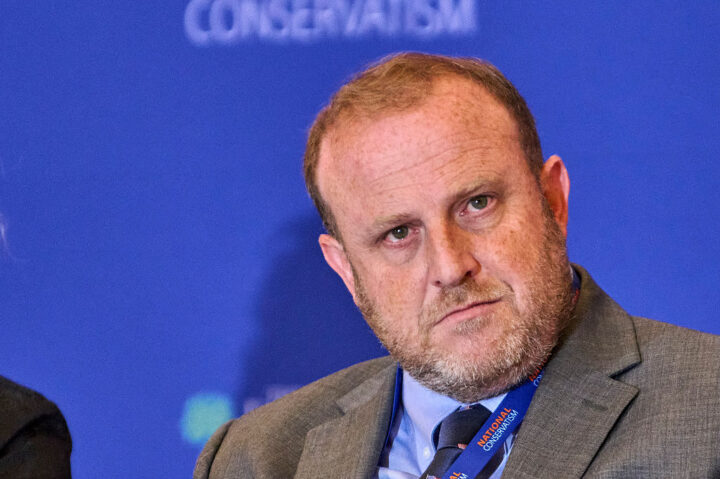
DOMINIC GWINN/Middle East Images/AFP via Getty Images
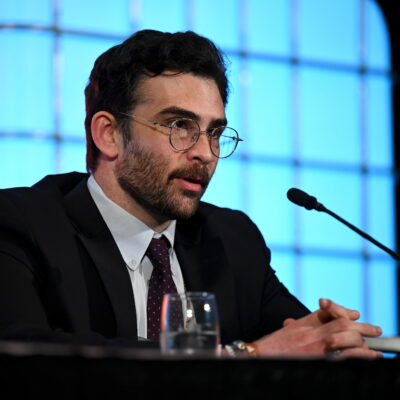
Jeremy Carl speaks at the National Conservatism Conference in Washington D.C., Sept. 3, 2025.


 Add JewishInsider on Google
The nomination of Jeremy Carl, tapped to be the assistant secretary of state for international organizations, appears bound to fail after Sen. John Curtis (R-UT) announced his opposition to Carl’s confirmation following a contentious confirmation hearing in the Senate Foreign Relations Committee this morning.
Curtis and a series of Democrats questioned Carl over past antisemitic, anti-Israel and otherwise inflammatory comments that the nominee had made online and in a series of podcast appearances. All Democrats are expected to oppose the nomination.
Curtis, in his questioning, honed in on past remarks by Carl that the U.S. spends too much time and energy on Israel “often to the detriment of our own national interest.” He emphasized that a key part of Carl’s role would be to resist antisemitism and anti-Israel bias at the United Nations, and sought to elucidate Carl’s views on whether the U.S. should provide diplomatic support to Israel at the U.N. and whether he understands the value of the U.S.-Israel relationship.
Carl, in spite of his past comments, said he would push back on anti-Israel and antisemitic bias, and highlighted his past ties to former Secretary of State George Shultz and Turning Point USA founder Charlie Kirk in order to demonstrate his pro-Israel bona fides.
Curtis said that, in light of Carl’s own past comments and his failure to push back against antisemitic sentiments expressed by a podcast host with whom he conducted an interview, he was skeptical of Carl’s ability to serve as a credible voice on these issues with foreign diplomats who hold anti-Israel and antisemitic views.
“When asked by other diplomats, who do come with these agendas that you referred to in your remarks, how do you push back on that when you didn’t push back on that moderator?” Curtis questioned.
Pressed further on whether there are any other allies that he thinks the U.S. dedicates too much time and attention to, Carl evaded the question.
“You’re [nominated to be] the principal manager of the U.S. multilateral policy, and anti-Israel bias in international organizations is part of a broader strategy to undermine the United States [and] our legitimacy,” Curtis told Carl at the end of his questioning. “I don’t know that I’ve been convinced that you understand the threat posed to the West and [in that] narrative.”
A Curtis spokesperson told Jewish Insider after the hearing that he plans to oppose Carl’s nomination, which will be enough to block the nominee from advancing out of committee, assuming no Democrats on the committee support him.
“After reviewing his record and participating in today’s hearing, I do not believe that Jeremy Carl is the right person to represent our nation’s best interests in international forums, and I find his anti-Israel views and insensitive remarks about the Jewish people unbecoming of the position for which he has been nominated,” Curtis said in a statement after the hearing.
A series of Democrats lined up during the hearing to criticize Carl and highlight his inflammatory past comments.
Sen. Jacky Rosen (D-NV), sitting beside a poster with a quote from Carl, “the Jews love to see themselves as oppressed,” said that the “nomination should alarm every senator who believes in basic decency, truth and responsibility that does come with public service.”
She emphasized that Carl’s Jewish heritage — he grew up Jewish before converting to Christianity — does not excuse his “antisemitism” and “hateful rhetoric” and that a vote for Carl “tells Jewish Americans they simply don’t matter,” and disrespects the memories of those who fought in World War II.
“If you have empathy for the Jewish community, communities experiencing hate [or are] simply tired of advancing nominees who I doubt will be respected on the world stage, you must vote against Mr. Carl’s nomination,” Rosen concluded.
Under questioning from Sen. Cory Booker (D-NJ), Carl expressed generalized regret about past comments downplaying the impacts of the Holocaust on the Jewish people and arguing that the Jewish people are too focused on that historical trauma.
“Sometimes I take an idea too far, and I made some comments in interviews about minimizing the effect of the Holocaust that were absolutely wrong. And I’m not going to sit here and defend them here,” Carl said.
Pressed by Booker on whether he believes that the ethnic and racial makeup of the country is important — for example, whether the country would be worse off if it were 40% Jewish — Carl said, “echoing President Trump, I believe unity rather than diversity is a strength” but insisted that he does not believe any race is inherently superior.
Carl also affirmed his belief in the Great Replacement Theory, which claims that there is an intentional effort by elites to replace white Americans with immigrants, saying “the Democratic Party, through its immigration policies, has certainly shown signs of that.”
“You have no decency. You have no honor. You say inflammatory things because you think it will ingratiate you to those who are paying your salary, and you sit here before me and try to wrap yourself in the American flag?” Booker said. “I believe in this nation. I believe in the principles. I believe in those who fought and died for our country. You disgrace that legacy and the ideals that we all swear an oath to uphold.”
Booker went on to blast Carl for his defense of those involved in the Jan. 6, 2021 attack on the U.S. Capitol.
Sen. Chris Murphy (D-CT), pointing to Carl’s past comments asserting that anti-white discrimination is the most widespread and problematic form of discrimination in the modern day and that white Americans are undergoing a “cultural genocide,” pressed Carl to specify what he believes constitutes white culture and the elements of it that are being erased.
Carl appeared to struggle to provide specific answers, ultimately arguing that white Christian churches are distinct from Black churches “in terms of its tone and style on average,” “foodways could be different” and “music could be different,” pointing to the Super Bowl halftime Show, which was performed in Spanish by Puerto Rican artist Bad Bunny.
“I’m not a racial nationalist … I’m a civic nationalist,” Carl said. “I am concerned with the majority common American culture that we had for some time, that through particularly mass immigration, I think has become much more balkanized, and I think that weakens us.”
Carl said that he stands by his view that “white Americans are often very disfavored in overt ways” in the U.S. legal system but insisted that he does not believe that white culture is superior.
Sen. Tim Kaine (D-VA) highlighted statistics showing the prominence of white people in positions of power nationwide.
“Sen. Rosen … was reading comments to you where you had been saying, ‘Man, Jews play the victim. Jews like to be the victim,’ and yet you’re making a claim that whites are victimized by a cultural genocide, when all the statistics would say, not just in history, but today, that whites are very well represented at every level of every institution,” Kaine said.
When Sen. Jeanne Shaheen (D-NH), the committee’s ranking member, pressed Carl on how lawmakers can “trust that you can represent the United States of America to the rest of the world in an unbiased manner when you have taken no steps to restrain your conduct” during his confirmation process, Carl said he “understand[s] the importance of restraint and conduct” but said he needs to “balance that with my current job [as a senior fellow at the Claremont Institute], which involves advocacy” until such point as he is actually confirmed.
Sen. Jeff Merkley (D-OR) accused Carl of “judging people by the color of their skin,” going on to argue that Carl is underqualified and inexperienced for the position, having no past staff experience in the U.S. Mission to the United Nations or in any official diplomatic roles.
He pressed Carl for specifics about the U.S. policy toward a series of United Nations organizations — seemingly testing Carl’s knowledge of the U.N. system and the Trump administration’s policy toward it. Carl generally did not provide specific answers, pointing to his status as a private citizen.
More Stories
WAR WORRIES
Could another war with Iran be the October surprise of the Israeli election?

UNKNOWN HORIZON
Final Israeli polls point to stalemate ahead of Tuesday’s election
MINNESOTA MIC DROP
Jacob Frey, Betty McCollum join Minnesota Dem chorus condemning Piker event
HISTORY LESSON
Brett McGurk’s fact check of former Harris advisor Phil Gordon on hostage negotiations
CANCEL CALLS
Democratic push grows for Ilhan Omar, Fateh to cancel Hasan Piker event
DFL DISCORD
Amy Klobuchar, Angie Craig condemn Hasan Piker ahead of Minneapolis event with Ilhan Omar
Please log in if you already have a subscription, or subscribe to access the latest updates.
 Continue with Google
 Continue with Apple