












































































The messaging theme has been an effective attack against anti-Israel candidates in the past, and has been especially resonant with Black voters

Then-Rep. Cori Bush (D-MO) speaks at the "Just Majority" Supreme Court press conference on June 22, 2023 in Washington, DC. / Then-Louis County Prosecutor, Wesley Bell gives remarks at the Urban League Empowerment Center on June 17, 2020.


 Add JewishInsider on Google
In the concluding weeks of the primary season, AIPAC is drawing in part on a messaging strategy used successfully by pro-Israel groups in previous cycles to thwart the far left, which is facing a new set of political tests after a series of recent victories in heavily progressive congressional districts.
From Michigan to Missouri, where tensions between the Democratic Party’s moderate and far-left factions are playing out in high-profile contests for the House and Senate, AIPAC is hitting its anti-Israel opponents for their past criticism of former President Joe Biden and former Vice President Kamala Harris in an effort to portray the candidates as hostile to mainstream policy goals.
The tactic, which UDP also deployed last election cycle in key races, dates back to at least 2021, when DMFI PAC, Democratic Majority for Israel’s political arm, had relentlessly attacked Nina Turner — a former Ohio state senator running for an open House seat in Cleveland on a platform that was critical of Israel — for remarks in which she had compared voting for Biden to eating a “bowl of s**t.”
Mark Mellman, the veteran Democratic pollster who founded DMFI and died in November 2025, was the brainchild of the anti-Turner strategy. His attack ads were effective in emphasizing what became a liability for Turner, particularly among Black voters, helping to elevate a lesser-known moderate rival with ties to the establishment, Rep. Shontel Brown (D-OH), to a come-from-behind upset.
The race served as an early venue for the Democratic proxy fights over Israel shaping a growing number of primaries in the wake of the war in Gaza and Hamas’ Oct. 7, 2023, attacks.
Now, UDP is reviving Mellman’s playbook as it takes on former Rep. Cori Bush (D-MO), who is seeking a rematch against Rep. Wesley Bell (D-MO) after she lost her St. Louis House seat in 2024.
In recent attack ads, UDP, which has spent over $2.5 million to boost Bell, is hitting Bush over past comments criticizing Biden and Harris, as well as her vote against the bipartisan infrastructure package while in Congress in 2021. Its strategy is reminiscent of messaging it deployed two years ago to help oust the former Squad member who was among the harshest critics of Israel in the House.
“Cori Bush’s attacks helped Trump,” one of the UDP ads claims, citing interview clips in which she voiced misgivings about voting for Harris shortly before the 2024 election.
It remains to be seen if such ads will resonate amid a national political environment favorable to left-wing populists who are now casting themselves as strident opponents of the establishment and claiming wins in recent competitive congressional primaries.
The playbook has had mixed results in other races, including a 2022 primary in Pittsburgh where UDP failed to block Rep. Summer Lee (D-PA) even as the group spent heavily on ads depicting her as disloyal to Biden’s agenda.
More recently, Rep. Adriano Espaillat (D-NY), a close AIPAC ally, lost his House seat early last month to an anti-Israel challenger, Darializa Avila Chevalier, who drew scrutiny over controversial deleted social media posts in which she had called Biden a “rapist” as well as a “war criminal,” while also dismissing Harris with an expletive.
Both Espaillat and his allies sought to draw attention to the comments in the final stretch of the race, to no avail. UDP was not directly involved in the New York City primary but did contribute over $1.5 million to a pro-Espaillat super PAC that hit his opponent for her past remarks, according to campaign disclosures filed after the race had concluded. Avila Chevalier has said she regrets her rhetoric attacking Biden and Harris.
For her part, Bush, rather than leaning into her reservations with Harris tied to the war in Gaza as the former vice president keeps the door open for a White House bid in 2028, has indicated she sees the attacks as a possible vulnerability.
During a recent joint media appearance, Bush, who endorsed Harris soon after she had announced her campaign to replace Biden in July 2024, accused Bell of equivocating on whether he had immediately done the same.
In a statement to Jewish Insider, Patrick Dorton, a spokesperson for UDP, criticized Bush as “a terrible member of Congress who didn’t do her job and didn’t deliver for St. Louis.”
“We are going to educate every Democratic primary voter in St. Louis about how bad and ineffective Cori Bush was in Congress,” Dorton said on Monday when asked to explain how UDP believes its repeat strategy will again persuade voters in the Aug. 4 primary race.
Meanwhile, in Michigan’s closely watched Senate primary set for next Tuesday, Abdul El-Sayed, an anti-Israel insurgent who is facing AIPAC-backed Rep. Haley Stevens (D-MI), has sought to downplay his role in promoting the “uncommitted” movement that urged Democratic primary voters to leave their ballots blank as a protest against Biden’s support for Israel during the war in Gaza.
In a recent campaign ad, for example, El-Sayed boasted that he was “the first Muslim American leader to endorse Kamala Harris for president,” a claim that fact-checkers have deemed inaccurate.
While Stevens has highlighted El-Sayed’s support for “uncommitted,” UDP, which is spending aggressively in the primary, has been focused more broadly on his perceived hostility to popular Democratic leaders.
In its first negative ad, released earlier this month, UDP attacked El-Sayed for what the group called his “long history of disrespecting women,” citing harshly worded past criticisms of former First Lady Michelle Obama as well as Michigan Gov. Gretchen Whitmer, the latter of whom announced a late endorsement of Stevens last week.
Elsewhere in Michigan, a far-left Democrat who is seeking the nomination to claim a Republican-held Lansing swing seat, Will Lawrence, has faced recent attacks for his comments denigrating Black political leadership and calling Harris a “warmonger,” as well as his support for the “uncommitted” movement. He has said his remarks have been taken out of context.
The race is expected to be close as Lawrence, a vocal critic of Israel, has gained endorsements from several prominent progressives, including Sen. Bernie Sanders (I-VT). Crush MAGA PAC has spent nearly $1 million on attack ads against Lawrence that have cited his affiliation with “uncommitted,” among other things.
While Lawrence’s allies have accused AIPAC of funding the ads, UDP has denied involvement in the race, calling such claims “pure fiction and dishonest.”
State Rep. Donavan McKinney lost decisively to Thanedar in 2020, but is building progressive support by running to his left

Tom Williams/CQ-Roll Call, Inc via Getty Images
Rep. Shri Thanedar (D-MI) arrives to the U.S. Capitol for the last votes of the week on Thursday, July 20, 2023.
Rep. Shri Thanedar (D-MI) is facing a serious primary threat from state Rep. Donavan McKinney, a left-wing challenger backed by several anti-Israel groups including Justice Democrats and TrackAIPAC.
Those groups are riding high, coming off of a recent wave of congressional primary victories in New York City and, most recently, Colorado, which they say point to a desire for a leftward shift in the Democratic Party and, in particular, rejection of support for Israel and pro-Israel groups among the Democratic base. Thanedar is one of their next top targets.
Thanedar is one of the few Democrats who has gotten more supportive of Israel during his tenure in Congress, even as the party has become more hostile to the Jewish state. As a state legislator in 2021, he co-sponsored a resolution calling for a halt in U.S. aid to Israel, which described Israel as an “apartheid state” and accused it of “countless human rights violations.”
Thanedar sought to walk back his support for the resolution during his 2022 primary, but the AIPAC-linked United Democracy Project backed his opponent, then-state Sen. Adam Hollier, in that race. The independently wealthy Thanedar was able to counter with millions in his own spending.
After comfortably winning the contested 2022 primary, Thanedar met with supporters of Israel and traveled to the Jewish state, ultimately reinventing himself as a strong pro-Israel voice and picking up support from the Jewish community. That stance has since cost him support among progressives.
McKinney was the first challenger to an incumbent endorsed by Justice Democrats this cycle, and is also supported by Sen. Bernie Sanders (I-VT), Rep. Rashida Tlaib (D-MI) and former Rep. Andy Levin (D-MI) — all anti-Israel voices. (Former Rep. Brenda Lawrence, who was strongly pro-Israel during her time in office, is also endorsing McKinney’s campaign.)
Thanedar may be particularly vulnerable, given that he represents a district with a large Black population in and around Detroit with a history of Black representation. He’s also built something of an odd public persona in Washington, including an effort to force a vote on impeaching President Donald Trump earlier this year, which he ultimately walked back after pressure from House Democratic leadership.
“We haven’t seen any publicly available polling in this race yet in this primary, but Shri has to be feeling at least somewhat vulnerable here in that today he’s been able to avoid a heads-up primary against a Black Detroiter and now he’s got a heads up primary against a Black Detroiter,” Adrian Hemond, a Michigan political strategist, told Jewish Insider.
Given his district is in an “overwhelmingly majority Black city,” which had at least one Black member of Congress since the 1960s and now has none, “Congressman Thanedar is going to have some work ahead of him to get those folks to pull the lever for him and not to have Black representation in Congress.”
Hemond — who has been publicly critical of Thanedar as ideologically flexible — said that Thanedar isn’t necessarily disliked at home, but has a “reputation as being odd,” and has faced criticism over poor constituent services — often an Achilles heel for Democratic lawmakers who’ve lost primaries in recent years — in part because he has struggled to maintain staff in his office.
But, Hemond argued, McKinney — who has gone on the road visiting other states and districts to stump for fellow progressive candidates — shouldn’t be “confident at all” in victory because “Shri’s got a lot of money, and it’s not like this hasn’t been attempted before.”
McKinney, Hemond said, may be somewhat to the left of the district as a whole, but his views are largely aligned with the Democratic primary voter base, more so than Thanedar’s own. In order to win the district, he continued, McKinney will need to out-organize Thanedar on the ground, particularly in ensuring his supporters return their absentee ballots, which are set to go out at the end of the week.
“If you have a better absentee program than Shri Thanedar does, you should win this election,” Hemond continued, adding that “it looks like they’ve got the pieces in place to be able to run a really strong absentee chase effort, and if they do, it’s going to bode real well for him come 9 o’clock on election night.”
Adam Hamawy has been endorsed by CAIR, Justice Democrats and a new group affiliated with the Institute of Middle East Understanding
DREW ANGERER/AFP via Getty Images
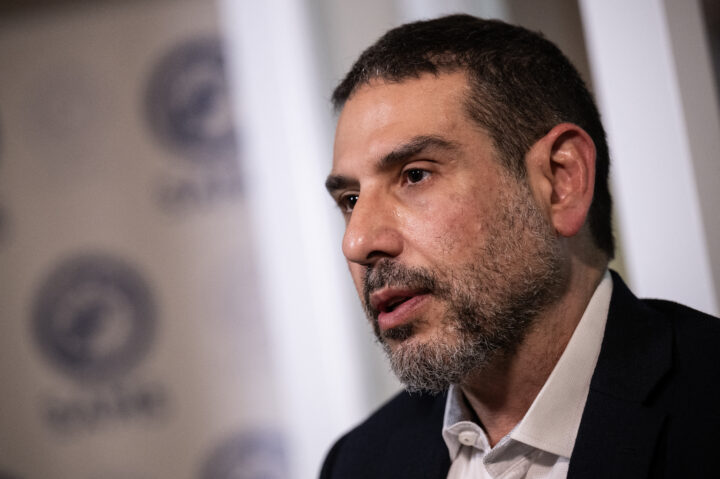
Dr. Adam Hamawy speaks during an AFP interview after meetings on Capitol Hill, in Washington DC, on June 14, 2024.
A constellation of anti-Israel groups is coalescing behind Adam Hamawy, a doctor who served as a trauma surgeon in Gaza during Israel’s war against Hamas and has been an outspoken critic of Israel, in the competitive Democratic primary for New Jersey’s 12th Congressional District. He also recently reported raising $550,000 in the first quarter of 2026, a sizable sum.
Justice Democrats and PAL PAC, a new group affiliated with the Institute for Middle East Understanding that aims to counter AIPAC, both offered their endorsements of Hamawy last month, moves that could bring more national attention and backing to the candidate.
“From war zones to the operating room, Dr. Hamawy has seen firsthand how our government’s misplaced priorities mean life and death for millions of people in America and across the world,” Justice Democrats executive director Alexandra Rojas said in a statement.
“As a physician, he has witnessed the destruction wrought by our tax dollars abroad, while seeing his own patients struggle to afford the healthcare they need at home,” PAL PAC executive director Margaret DeReus said in a statement. “He is a witness with a mandate to ensure our resources fund healthcare at home, not Israel’s war crimes abroad.”
Hamawy had previously been endorsed by the Council on American-Islamic Relations and TrackAIPAC, as well as by former Rep. Jamaal Bowman (D-NY), who was also an outspoken critic of Israel. Hamawy was also endorsed by the more moderate Sen. Tammy Duckworth (D-IL), who credits Hamawy for saving her life after her helicopter was shot down in Iraq.
Sue Altman, a progressive organizer and former senior staffer for Sen. Andy Kim (D-NJ), is viewed as a highly competitive challenger, alongside a handful of local officials who are likely to have support in their own communities, including East Brunswick Mayor Brad Cohen, Plainfield Mayor Adrian Mapp and state Rep. Verlina Reynolds-Jackson.
Altman advanced to the June ballot despite a slew of challenges to petition signatures she collected.
Micah Rasmussen, the director of the Rebovich Institute for New Jersey Politics at Rider University, said that Hamawy’s $550,000 first quarter fundraising haul and the recent endorsements show momentum for his campaign, but “what remains to be seen is whether this translates into forcing Altman to split the outside lane with him. In order for that to happen, he will need to invest his money effectively — presumably in sharing his personal story, which is how he differentiates himself.”
Dan Cassino, the executive director of the Fairleigh Dickinson University poll, said he sees Altman as the frontrunner, “but Hamawy’s fundraising numbers certainly put him in the top tier along with [former Department of Energy official Jay] Vaingankar and a host of local candidates who could win on the strength of name recognition and strong ties to the district. “
Cassino said that, if voters focus on national issues in the election, as they did in the special election in New Jersey’s 11th Congressional District, that would be a poor sign for Reynolds-Jackson, Cohen and Mapp.
“The endorsements matter, because they serve as a signal to voters in a race where partisanship can’t be used as a heuristic, but anyone who’s closely following the endorsements probably already has a favorite candidate,” Cassino added. “The more important signal is about who is, and is not, a serious candidate: voters are very concerned about tossing their ballots away on a candidate who doesn’t have much of a chance, and endorsements can be used as a signal that a candidate should be taken seriously.”
Rasmussen said that Cohen, who is Jewish, remains one of the stronger candidates in the “establishment lane,” having picked up the endorsement of the Middlesex County Democrats, which have a strong vote-by-mail turnout operation. Middlesex has also made up the largest turnout bloc in the district.
“But … he’s still sharing that crowded establishment lane with candidates from every other county,” Rasmussen said.
Hamawy’s campaign did not respond to a request for comment.
Comedian Guy Hochman performed an alternative show outside in freezing cold weather
Noam Galai/Getty Images
Guy Hochman speaks at the IAC National Summit 2026 at The Diplomat Beach Resort on January 17, 2026 in Hollywood, Florida.
A Manhattan comedy club canceled Israeli comedian Guy Hochman’s show on Tuesday night after pro-Hamas groups protested outside of the venue.
“The owner of the place was afraid and canceled the show,” Hochman told Jewish Insider, referring to Broadway Comedy Club, located near Times Square. “So, I did an alternative show for my audience outside freezing to death.”
“We are not giving up,” Hochman continued, adding that “another, big show” was planned for Wednesday evening. He did not disclose the location of the rescheduled show. “We are the Jewish people and we want to live and laugh,” said Hochman.
The owner of the venue, Carolyn Martin, did not respond to a request for comment from JI.
City College of New York’s Students for Justice in Palestine chapter was among the groups promoting the Tuesday demonstration on social media. It shared a post from the New York City chapter of the Palestinian Youth Movement that said “victory” was achieved by the cancellation. CCNY SJP, which remains a registered student group, also participated in this month’s pro-Hamas protest in Queens that caused nearby schools and a synagogue to close early.
Outside the comedy venue, masked demonstrators banged on drums, chanted and held signs that read “clean up the trash,” “death to the IDF” and “no war criminals in our city.” A heavy NYPD presence was called to monitor the protest.
Hochman was reportedly detained at the airport for six hours of questioning on Monday when he arrived in Toronto after the anti-Israel group Hind Rijab Foundation filed a complaint about his service in the IDF. He was released after intervention from the Israeli consulate.
Please log in if you already have a subscription, or subscribe to access the latest updates.
 Continue with Google

 Continue with Apple