































































Trust in Trump dropped 15 points among Jewish Israelis in the last month, though a majority still see tensions between Washington and Jerusalem as temporary
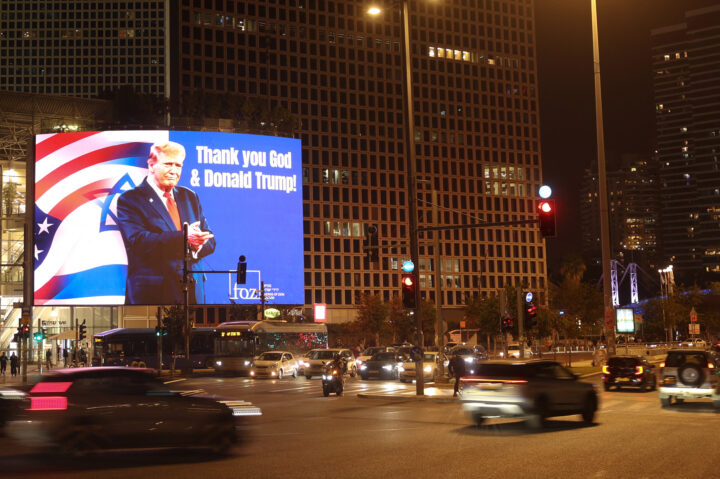
Jack GUEZ / AFP via Getty Images
A billboard depicting an image of President Donald Trump with a message thanking him, is displayed on the side of a building in the Israeli coastal city of Tel Aviv on March 12, 2026.


 Add JewishInsider on Google
The number of Israelis who believe President Donald Trump views Israel’s security as a central consideration has continued to fall to record lows after Washington signed a memorandum of understanding with Iran, according to a new survey from the Israel Democracy Institute.
The June 2026 Israeli Voice Index, conducted between June 28 and July 1, found that 28% of respondents — including 26% of Jewish Israelis and 36% of Arab Israelis — believe Israel’s security is a key consideration for Trump.
Among Jewish Israelis, the figure dropped 15 percentage points from a month ago, when 41% of respondents said they felt Israeli security was a key consideration for Trump as his administration engaged in negotiations with Tehran. At the time, those findings marked the lowest levels of Israeli trust in Trump since the research center began tracking the metric when he was elected to a second term in November 2024.
Despite declining confidence in Trump, a majority of Israelis continue to view current tensions between Washington and Jerusalem as temporary rather than indicative of a meaningful deterioration in bilateral ties. Among Jewish Israelis, 54% said current disagreements represent a temporary crisis that will not harm the relationship, while 34% said they mark a longer-term shift for the worse.
Respondents were more divided when asked whether Israel’s strategic security situation was better or worse than it was before the Iran war. Thirty-six percent said Israel’s security situation is now worse, an increase of eight percentage points from April. Meanwhile, 38% said it is better, down six percentage points over the same period.
The survey also found strong support for maintaining an Israeli security zone in southern Lebanon, even if doing so conflicts with U.S. interests. Overall, 72% of respondents backed a permanent security zone in the area. Support was especially high among Jewish Israelis, at 80%, while a majority of Arab Israelis (58%) opposed maintaining a permanent Israeli presence in southern Lebanon.
Beyond military and diplomatic issues, the poll found that rising antisemitism and attacks targeting Israelis abroad were influencing travel decisions. Fifty-six percent of respondents said the threat environment has affected their travel plans, with 41% saying it has impacted where they choose to travel and 15% saying they plan to avoid traveling abroad altogether because of security concerns.
Three out of four Jewish Israelis back the war, down 15 points since the first week of the war
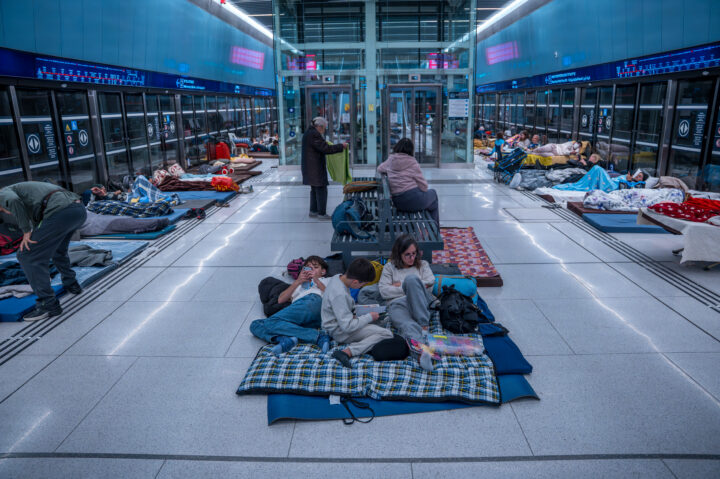
Ori Aviram / Middle East Images / AFP via Getty Images
Israelis take shelter in an underground metro station in Ramat Gan, in Israel's Tel Aviv District, on February 28, 2026.
Jewish Israelis’ support for the war against Iran dropped by 15 points from the first week of the war, according to a poll released by the Israel Democracy Institute on Monday.
In the first week of the war, 93% of Jewish Israelis supported continuing the war, while in the latest IDI poll — conducted nearly a month into the war — 78% support it. More than twice as many Israeli Jews (11.5%) oppose the war as did at the beginning of March (4%).
As at the start of the war, only a minority of Arab Israelis are in favor of it, with their support dropping from 26% to 19%.
Most Israelis said Iran was more resilient than anticipated, with 56% of Jewish Israelis and 51% of Arab Israelis answering in the affirmative.
Most Jewish Israelis (62%) said that Prime Minister Benjamin Netanyahu launched Operation Roaring Lion against Iran for strategic and security-related reasons, while most Arab Israelis (55%) said he was motivated by personal and political considerations.
Over a third (35%) of Jewish Israelis said that the war against Iran would be sustainable in Israeli society for a month, while 28% said Israelis can bear it as long as needed to meet the operation’s goals. Among Arab Israelis, 33% said Israelis could endure the war for a month, while only 5% said the Israeli public can sustain it as long as needed.
At the same time, there was a rise in hope among Israelis: When respondents were asked for their outlooks in four areas, optimism about social cohesion was up eight percentage points from last month, reaching 30%; optimism about the economy rose to 34% from 31%; and optimism and the future of democracy reached 44%, up from 39%. Optimism about national security stayed about the same at 47%.
The vast majority of Arab Israelis reported that their mental health (85%) and financial situation (89%) had deteriorated, a slight increase from the last time IDI asked the poll question in November. Among Jewish Israelis, 43% reported a deterioration in their mental state and 36% in their financial situation, almost identical to the November 2025 findings.
The poll was conducted among a sample of 756 Israeli adults from March 22-26, with a 3.56% margin of error.
Polls find a sharp divide between Republicans and Democrats and a further split between MAGA-aligned Republicans and other Republicans
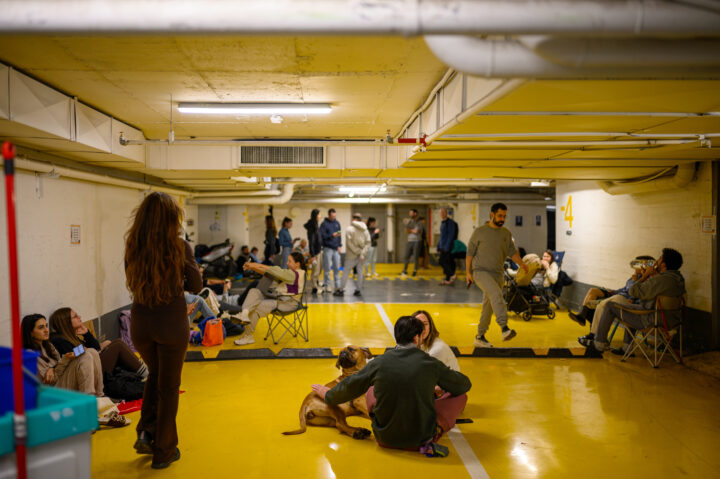
Alexi J. Rosenfeld/Getty Images
People take shelter in an underground bomb shelter amid reports of incoming missiles on February 28, 2026 in Tel Aviv, Israel.
More than 80% of Israelis support the war against Iran, polls by two major Israeli research institutions found this week, while several U.S. polls found that a majority of Americans oppose it.
The Israel Democracy Institute found that 82% of Israelis — 93% of Jewish Israelis and 26% of Israeli Arabs — support the war with Iran.
Among Jewish Israelis, the war has strong support across the political spectrum, with 76% of respondents on the left backing it, 93% of voters from the center and 97% from the right.
Similarly, the Institute for National Security Studies at Tel Aviv University found that 81% of Israelis back the war against Iran, and 63% support continuing military efforts until the Iranian regime falls.
Among Jewish Israelis, support for the war was at 92%, while only 38% of Israeli Arabs support it. About half (49%) of Israeli Arabs oppose the war, while the rest said they did not know.
According to the IDI poll, three-fourths (74%) of Jewish Israelis said they supported continuing the war until the Iranian regime is overthrown, while only 18% of Israeli Arabs agreed; 61% of Israeli Arabs called for a ceasefire as soon as possible, while only 3% of Jewish Israelis chose that as their preferred option.
Over a third of respondents (37%) to the INSS poll said that Israelis would be able to live under the current war situation for up to a month, while 29% said they could continue for over a month.
At the start of last year’s Iran war, half of the respondents said it could continue for over a month.
IDI found that most Jewish Israelis (74%) feel protected from Iranian attacks, whereas only 15% Israeli Arabs feel the same. Among Israelis who have a safe room in their homes, 76% feel safe, whereas among those who have to go to a shelter elsewhere, 63% feel safe.
Nearly two-thirds (64%) of Jewish Israelis feel that Israel’s security is a central consideration for President Donald Trump, while only 43% of Israeli Arabs do.
Meanwhile, in the U.S., a CNN poll, conducted by SSRS shortly after the war began on Saturday, found that nearly 41% of Americans approve of the U.S. military action in Iran, with a sharp divide between Republicans, Democrats and independents — 77% of Republicans approve of the launch of the operation, compared to 32% of independents and 18% of Democrats. The poll found that 59% of Americans disapprove of the U.S. decision to strike.
Similarly, an NBC poll found that 41% of American registered voters approve of Trump’s approach to Iran, while 54% disapprove and 5% aren’t sure. Just 8% of Democrats approve of the president’s handling of the situation, while 79% of Republicans and 28% of independents approve of it. In addition, the poll found that 52% oppose the current U.S. military operation. A sizable majority of Republicans (77%) agree with the U.S. decision to strike Iran, while 89% of Democrats and 58% of independents disagree.
There is a further divide between self-identified MAGA-aligned Republicans and other Republicans, the poll found: 90% of the former back the strikes, while 54% of the latter support them. The CNN poll found that MAGA Republicans are 30 points more likely than non-MAGA Republicans to strongly approve of the decision to take military action.
A Reuters/Ipsos poll found that just 27% of Americans approve of U.S. strikes — 55% of Republicans, 7% of Democrats and 19% of others. According to the poll, some 56% see President Donald Trump as too willing to use military force to advance U.S. interests — with 87% of Democrats holding this view, 23% of Republicans and 60% of people who don’t identify with either major party.
A Fox News poll found that Americans were evenly split between support and disapproval of the current U.S. action against Iran with Republicans overwhelmingly supportive and Democrats overwhelmingly against. Most American respondents (61%) saw Iran as a “real national security threat,” and only 38% did not.
Right-wing Israelis support a strike even if Iran does not attack, while other political camps prefer to wait and see if Iran strikes Israel first, IDI poll finds
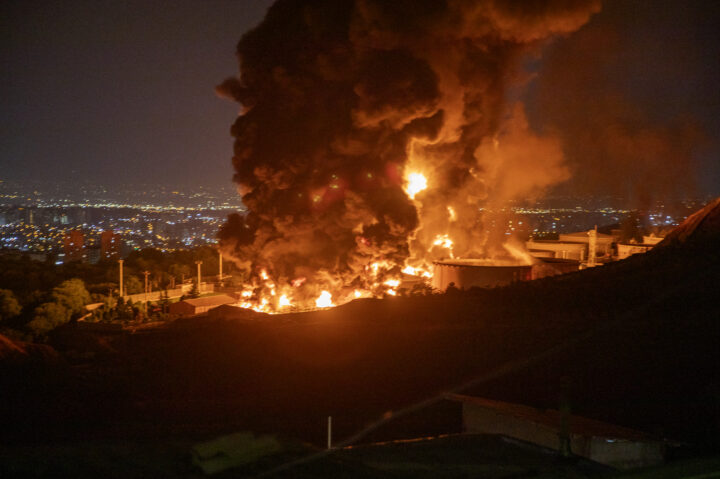
Stringer/Getty Images
Fire and smoke rise into the sky after an Israeli attack on the Shahran oil depot on June 15, 2025 in Tehran, Iran.
Less than half of Israelis support joining an American strike on Iran if Israel is not directly attacked, a poll from the Israel Democracy Institute found this week.
Half of the Israelis polled supported a military response only if Israel is directly attacked by Iran, while 44% backed joining an American strike on Iran even before a potential attack on Israel.
Among Israeli Jews, 46% support intervening only if Iran attacks first, while 48% support involvement regardless.
If those results are further divided between political affiliations, only among Israel’s right does a majority (62%) support joining a preemptive American strike on Iran. On the center-right, 41% support such a scenario, while that number decreases to 35% among centrists, 36% of those polled on the center-left and 31% of respondents who identified as left.
Among Israeli Arabs, 67% would only support an Israeli strike if Iran attacks first.
Israelis are also split over Israeli Prime Minister Benjamin Netanyahu’s announcement that U.S. military aid would be phased out in the coming years. About half (49%) think the change would make Israel less secure, while 39.5% think otherwise.
The Israeli right is less likely to think that bringing U.S. military aid down to zero will be harmful to Israel’s security, with only 30% holding that view, while most on the center-right (56%), center (64%), center-left (72%) and left (72%) hold that view.
Most Israeli Jews (54%) believe that President Donald Trump’s Board of Peace will not “help solve the problems in Gaza while maintaining Israel’s security,” while 37% believe it will. When the results are analyzed by political affiliation, a slight majority of those on the left, center and right all agree the Board of Peace will not help.
Among Israeli Arabs, 42% believe the Board of Peace will help and 34% say it will not; 24% did not know.
IDI conducted the poll on January 25-29 among a sample size of 604 with a margin of error of 3.57%.
Please log in if you already have a subscription, or subscribe to access the latest updates.
 Continue with Google

 Continue with Apple