














































































‘Why do we just get promises while they get billions?’ former Trump Iran envoy Elliott Abrams said
Jonathan Raa/NurPhoto via Getty Images
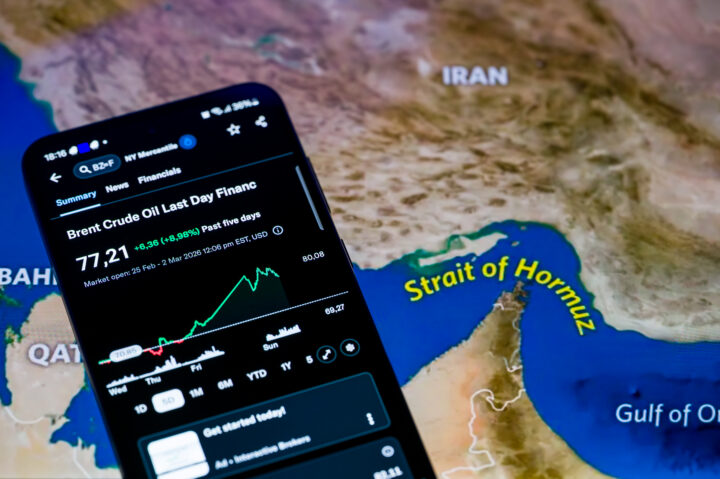
The Brent crude oil price chart is displayed on a mobile screen on March 2, 2026.


 Add JewishInsider on Google
Former White House officials and Middle East experts are expressing concern over the Trump administration’s move to lift sanctions on Iranian oil sales through August, warning that Tehran will gain significant revenue it could use for malign activities before it demonstrates concrete progress on its diplomatic commitments.
On Monday, the U.S. Treasury Department issued a temporary 60-day license authorizing the production, delivery and sale of Iranian oil, lifting decades-old sanctions. The move was made in response to Tehran’s agreement to open the Strait of Hormuz and allow international nuclear inspectors into the country following weekend talks in Switzerland, according to Treasury Secretary Scott Bessent, a claim which Iranian officials have denied.
Under the memorandum of understanding signed last week between Washington and Tehran, the U.S. agreed to authorize waivers allowing the export of Iranian crude oil, petroleum products and related derivatives, as well as associated services such as banking transactions, insurance and transportation.
The temporary license is set to expire on Aug. 21 and represents a historic pivot in U.S. policy. It marks the first time since Washington imposed strict energy sanctions on Iran in the wake of the 1979 Islamic Revolution that Iranian oil can be legally imported into the U.S. and purchased using U.S. dollars. The 2015 Joint Comprehensive Plan of Action suspended certain secondary sanctions, allowing foreign companies to purchase Iranian oil, but it did not authorize imports of Iranian oil into the U.S.
Tehran has previously relied on a “shadow fleet” of aging oil tankers to move its crude abroad, funneling most of it to Chinese refineries. Under the new license, the Treasury Department said Iran may now lawfully sell oil from these previously sanctioned vessels, temporarily legitimizing that clandestine network. The waiver also shields Iranian entities, including the Central Bank of Iran, from nonnuclear sanctions tied to terrorist activity.
When asked whether the Iranians could use the profits from oil sales for malign activity, President Donald Trump said “they’re not supposed to be doing that,” and that Tehran is meant to use the income to purchase agricultural goods from the U.S.
“We’ll see, but they’re supposed to use the money to buy food for their people,” Trump told reporters in the Oval Office on Monday. “They’re buying it exclusively from us … all that money is coming back [to the U.S.] in the form of purchase of food … largely to our farmers.”
Meanwhile, foreign policy experts told Jewish Insider that Iran could use the money for malign activity, also expressing concern that Tehran is receiving revenue before proving it will fulfill its long-term obligations under the deal.
“It doesn’t take a lot of imagination to guess what this oil revenue will be used for,” Dan Shapiro, a former U.S. ambassador to Israel under President Barack Obama, told JI. “It won’t be used to benefit the Iranian people. This early concession is just further evidence of how badly the United States conceded leverage to Iran in Trump’s misguided war. We are paying dearly now just to get the Strait of Hormuz reopened.”
Elliott Abrams, who served as special envoy for Iran during the first Trump administration, similarly indicated that the regime would likely use the funds in ways contrary to U.S. interests.
“Why give them the money to stabilize the regime and start rebuilding their military before they have done anything at all on their nuclear program?” Abrams asked. “Why do we just get promises while they get billions?”
Miad Maleki, a former senior Treasury official, said that the sanctions relief “could be an economic lifeline for the Islamic Republic,” in a post on X on Monday. Maleki said the move “theoretically unlocks” around 67 million barrels of oil that are stranded in the Gulf, which he estimated would be worth roughly $8-9 billion, as well as another $10-15 billion in potential relief through the sale of petrochemical tons.
“The license explicitly allows buyers to pay Iran — including the Iranian government and blacklisted Iranian entities — directly for the oil. This isn’t just permission to sell. It’s permission to get paid,” Maleki wrote. “And the payments can be made in U.S. dollars. The dollar is the backbone of global finance, and Iran has been largely locked out of it for years. Handing the regime dollar revenue restores access that sanctions were specifically designed to deny.”
He also noted that the Treasury Department’s authorization will allow Tehran’s “shadow market” to operate “cheaper, faster, and [be] dollar-denominated.”
“While major Western and new-market buyers won’t be rushing to do business with Iran, the license authorizes far more than Iran can currently produce, and there are more than enough willing buyers in China and across Asia to absorb every barrel and petrochemical ton Iran can move,” he wrote.
Abrams also took issue with Iran appearing to gain notable benefits without yet complying with all the U.S. demands.
“The benefits for Iran in the MOU seem to be frontloaded,” Abrams said. “That’s a mistake because to the extent that they benefit now, they have less and less incentive to comply with what we want.”
Abrams maintained that U.S. sanctions should continue even after the lifting of the U.S. naval blockade and the reopening of the Strait of Hormuz.
Shapiro told JI he held similar concerns, particularly regarding how Iran is securing immediate relief without any concessions on its nuclear program and noted that the agreement “doesn’t even mention Iran’s ballistic missile program or support for terrorist proxies.”
Jonathan Ruhe, a fellow at the Jewish Institute for National Security of America, argued that the move provides Iran “upfront sanctions relief,” while simultaneously requiring “fewer concessions” than the JCPOA signed in 2015 under Obama.
AIPAC similarly compared the agreement to the JCPOA, which the group spearheaded efforts to oppose when it was signed.“This license is broader than the terms detailed in the MOU or what was included in the JCPOA,” AIPAC wrote on X on Monday. “Waiving sanctions on production will allow Iran to increase its output and gain increased revenues under the terms of the MOU.”
Ruhe noted that such a move sidesteps mandatory congressional oversight by granting immediate waivers before lawmakers have had a chance to formally review or vote on the arrangement.
“It also runs afoul of the Iran Nuclear Agreement Review Act (INARA), which prohibits any sanctions relief until Congress can review the deal,” Ruhe said. “Iran’s regime should get sanctions relief only in exchange for meaningful concessions on its nuclear program, which it has not made, and congressional review of the deal, which has not happened.”
The lawmakers called it another example of Trump’s ‘troubling lack of strategic foresight’ in executing the war against Iran
Tasos Katopodis/Getty Images for VoteVets
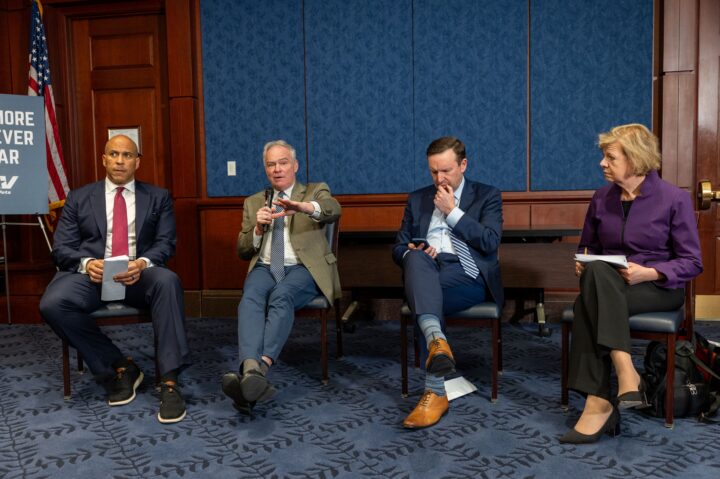
Sens. Cory Booker (D-NJ), Tim Kaine (D-VA), Chris Murphy (D-CT) and Tammy Baldwin (D-WI) speak with veterans about the Iran war at Capitol Hill on March 18, 2026 in Washington, DC.
A group of 25 Senate Democrats criticized President Donald Trump on Friday for lifting sanctions on Russian and Iranian oil exports, sanctions which have seen broad bipartisan support.
“We write with deep concern and confusion over your administration’s recent decision to ease sanctions on Russian and Iranian oil exports,” the Democrats wrote in a letter to the president. “These actions speak once again to the troubling lack of strategic foresight that has marked your administration’s decision-making prior to and during its war of choice with Iran, jeopardizing the lives of our servicemembers across the region and raising costs for Americans here at home.”
The lawmakers accused Trump of “scrambling — and failing” to address the impacts of the effective closure of the Strait of Hormuz amid the conflict, despite reported warnings that an attack on Iran would likely cause oil prices to spike.
And, they alleged, the sanctions waiver will provide a new revenue source of as much as $14 billion for “the very regime that U.S. servicemembers are risking their lives to strike” while having little impact on bringing down global oil prices.
They highlighted that Russia is already reportedly set to make $4.9 billion from rising oil prices, an amount further supplemented by the sanctions waivers, in spite of Russia’s support for Iran’s strikes on U.S. military forces.
“Relieving sanctions on U.S. adversaries during an active conflict is just the most recent indicator of an incoherent and disordered policy approach,” the letter continues. “Economic relief for Americans starts with the cessation of wars of choice, not the continuation of them.”
The lawmakers demanded public hearings by administration officials on the decision to provide sanctions relief.
The letter was signed by Sens. Tim Kaine (D-VA), Ruben Gallego (D-AZ), Jack Reed (D-RI), Cory Booker (D-NJ), Chris Murphy (D-CT), Tammy Baldwin (D-WI), Tammy Duckworth (D-IL), Adam Schiff (D-CA), Chris Coons (D-DE), Jeff Merkley (D-OR), Chris Van Hollen (D-MD), Angus King (I-ME), Richard Blumenthal (D-CT), Angela Alsobrooks (D-MD), Michael Bennet (D-CO), Ron Wyden (D-OR), John Hickenlooper (D-CO), Andy Kim (D-NJ), Sheldon Whitehouse (D-RI), Elissa Slotkin (D-MI), Alex Padilla (D-CA), Gary Peters (D-MI), Mark Kelly (D-AZ), Dick Durbin (D-IL) and Mazie Hirono (D-HI).
Republicans, despite widespread support for the U.S. sanctions on Iran, have generally been downplaying the impacts of the sanctions relief, describing it as a careful measure to relieve oil price shocks that is designed to be temporary. Some have also echoed claims by the administration that they plan to intercept and freeze the revenues for Iran before they reach the regime’s coffers.
‘The irony is, we worked so hard to get those sanctions imposed and Republicans pushed so diligently,’ Blumenthal told JI
Heather Diehl/Getty Images
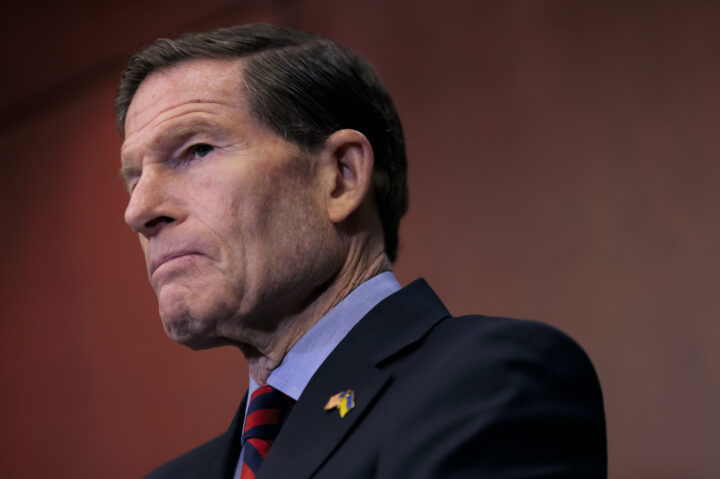
Sen. Richard Blumenthal (D-CT) holds a press conference at the U.S. Capitol on March 03, 2026 in Washington, DC.
Sen. Richard Blumenthal (D-CT) lambasted the Trump administration for lifting sanctions on some Iranian oil last week, allowing the sale of 140 million barrels of oil currently at sea in a bid to bring down oil prices globally and potentially netting Iran $14 billion.
Lawmakers in both chambers, on a bipartisan basis, have spent years working to increase financial pressure on Iran, with broad support. Those efforts have been ongoing, including as recently as last week when the House passed the Enhanced Iran Sanctions Act by a bipartisan voice vote — in spite of concerns from the White House about sanctioning China, which predated the war, that delayed and watered down the bill.
“The irony is, we worked so hard to get those sanctions imposed and Republicans pushed so diligently, and now literally in the flick of a pen, [President Donald] Trump lifts them with very little benefit to consumers in America and tremendous boost to Iran and Russia, both of them trying to kill our troops and saying ‘death to America’ and ‘death to Israel,’” Blumenthal told Jewish Insider.
The administration had previously waived sanctions on Russian oil, which were designed to to pressure the Russian government to end its invasion of Ukraine.
“I’m having trouble wrapping my head around this really, seemingly, stupid action,” Blumenthal continues.
Sen. Pete Ricketts (R-NE) defended the move as an effort to bring down oil prices.
“What the president is trying to do is make sure that Americans aren’t seeing too high of gas prices at the pump,” Ricketts said.
Sen. Rick Scott (R-FL) said that he does not have an issue with the sanctions relief “as long as the money doesn’t go to Iran, then it makes sense.”
“I don’t think that the money was going to go to Iran,” Scott said.
Treasury Secretary Scott Bessent claimed on Sunday that the U.S. was “jiujitsuing the Iranians” and “using their own oil against them,” suggesting that by lowering global oil prices, Iran would ultimately make less money from its oil exports.
He also claimed the U.S. would track the transactions and block the funds involved from actually reaching Iran, though the license issued to allow the oil sales did not provide any such specific provisions or restrictions. The license also allowed the U.S. to import Iranian oil, for the first time in decades.
Off Capitol Hill, the decision has been met with puzzlement and skepticism from Iran hawks, some of whom have raised questions about the actual impact the sanctions relief will have on lowering global oil prices.
Please log in if you already have a subscription, or subscribe to access the latest updates.
 Continue with Google

 Continue with Apple