














































































A similar provision in the House version of the bill has drawn controversy, with critics falsely claiming it would merge the U.S. and Israeli militaries or undermine U.S. sovereignty
Win McNamee/Getty Images
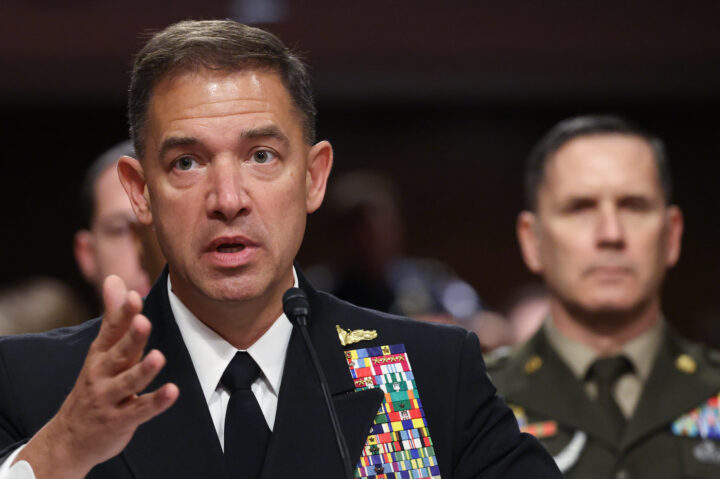
CENTCOM Commander Adm. Brad Cooper testifies during a Senate Armed Services Committee hearing in the Dirksen Senate Office Building on Capitol Hill on May 14, 2026 in Washington, DC.


 Add JewishInsider on Google
The Senate Armed Services Committee’s draft of the 2027 National Defense Authorization Act includes a provision based on the FUTURES Act, establishing a U.S.-Israel Defense Cooperation Initiative, according to an executive summary released on Thursday by the committee and congressional officials.
A similar provision in the House version of the bill attracted significant controversy in anti-Israel circles — with critics falsely claiming that the measure would irrevocably merge the U.S. and Israeli militaries or undermine U.S. sovereignty — with multiple House members vowing to try to strip the provision from the bill. Top lawmakers on both sides of the aisle have defended the provision.
A congressional official said that the Senate provision has some adjustments from the House bill and the original FUTURES Act, with a focus on medium- and long-term threats; the original bill encompasses numerous areas of cooperation that already exist between the U.S. and Israel.
The official also emphasized that the idea that the legislation would integrate the U.S. and Israeli militaries is a “misconception” and a “fallacy.”
The precise text of the Senate bill, which was amended in a closed session, will not be available for a few days.
Critics have also begun attacking a provision of the Senate’s draft of the 2027 Intelligence Authorization Act, titled, “United States-Israel Intelligence Sharing Enhancement,” which aims to increase intelligence collaboration and sharing with Israel to counter shared threats from Iran and other adversaries.
The legislation directs the administration, “subject to applicable law and the protection of intelligence sources and methods” to expand intelligence sharing with Israel, and limits the ability of this or a future administration to suspend or reduce intelligence sharing unless the administration documents and notifies Congress of a “specific and identifiable national security concern” raised by such collaboration.
It also calls for expanded intelligence sharing with other Abraham Accords countries, except in cases in which the administration finds that a recipient of such intelligence cooperation maintains any intelligence, defense or technology cooperation with a U.S. adversary.
According to the executive summary released on Thursday, the Senate NDAA also authorizes increased funding for existing U.S.-Israel cooperative programs in countering drones and subterranean warfare and maintains support for cooperative missile-defense programs.
The NDAA also includes an “initiative to bolster defense cooperation among the United States and signatories of the Abraham Accords,” according to the executive summary. A source familiar with the legislation said the provision parallels the OASIS in the Middle East Act, which directs the Pentagon to develop a coordinated air and missile defense acquisition strategy with Israel, Abraham Accords members and other Middle East allies, further building on current air-defense integration efforts.
The bill would additionally condition funding to the Lebanese Armed Forces on its actions to counter Hezbollah — similar to a provision in the House bill — and to the Syrian government on its actions to disarm foreign fighters and jihadists in the country.
The Senate draft of the NDAA would also provide congressional authorization for the Civil Military Coordination Center — established by U.S. Central Command, alongside Israel, other U.S. partners and international organizations, to oversee ceasefire and stabilization efforts in Gaza — “as a subsidiary of the Board of Peace to oversee the implementation of the Gaza ceasefire in pursuit of Hamas’ complete and permanent disarmament,” according to the executive summary.
Rep. Dan Goldman said that ‘words of condemnation are no longer enough’ and that there has been a ‘systematic failure’ by Congress to address rising antisemitism since Oct. 7
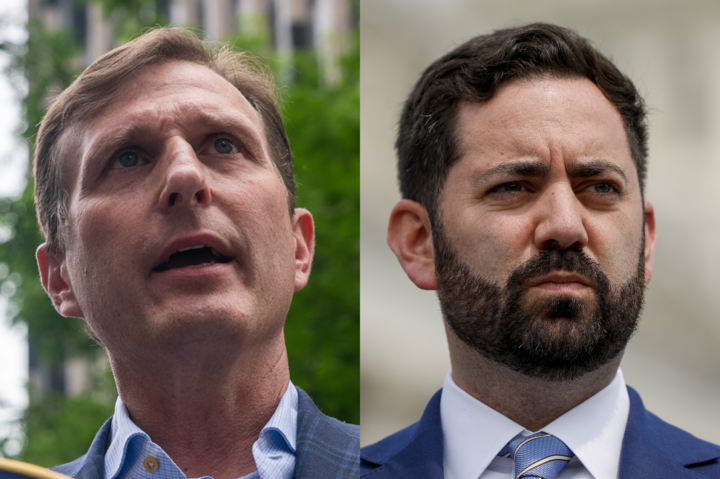
Reps. Dan Goldman (D-NY) and Mike Lawler (R-NY) are leading 28 colleagues in introducing a House version of the Jewish American Security Act, the package of antisemitism-related legislation introduced by Sens. Jacky Rosen (D-NV) and James Lankford (R-OK) last month in the Senate.
The bill includes a proposal for significant increases in security funding, new oversight and administrative measures to address antisemitism on college campuses and new transparency requirements for social media companies relating to antisemitism online.
The legislation is being co-sponsored by Reps. Grace Meng (D-NY), Brian Fitzpatrick (R-PA), Debbie Wasserman Schultz (D-FL), Maria Salazar (R-FL), Jared Moskowitz (D-FL), Rudy Yakym (R-IN), Josh Gottheimer (D-NJ), Marc Veasey (D-TX), Don Bacon (R-NE), Haley Stevens (D-MI), Michael McCaul (R-TX), Nicole Malliotakis (R-NY), Laura Gillen (D-NY), Jeff Van Drew (R-NJ), Jake Auchincloss (D-MA), Ted Lieu (D-CA), Dan Meuser (R-PA), Brad Schneider (D-IL), Tom Barrett (R-MI), Jen Kiggans (R-VA), Greg Landsman (D-OH), David Kustoff (R-TN), Juan Ciscomani (R-AZ), Lois Frankel (D-FL), Tom Suozzi (D-NY), Randy Weber (R-TX), Kristen McDonald Rivet (D-MI) and John Moolenaar (R-MI).
“Words of condemnation are no longer enough,” Goldman said in a statement. “Since the October 7th attacks, there has been a systematic failure in Congress and in our communities to counter the threat posed by surging antisemitism across this country.”
Goldman, a co-chair of the House antisemitism task force, said the bill would change that pattern: “Whether on campus, at synagogues, or online — the Jewish American Security Act will provide the tools necessary to help secure our at-risk communities to practice their faith without fear. American Jews cannot be asked to bear this burden alone. As Americans, we must stand shoulder to shoulder with those under siege by hate.”
Lawler, who is also the lead sponsor of the long-stalled Antisemitism Awareness Act, said in a statement that by providing additional resources for the Nonprofit Security Grant Program, the bill would help safeguard constitutionally protected religious freedom and bolster Jewish institutions against attacks.
“This bill also delivers critical protections for Jewish students on college campuses through stronger Title VI enforcement, requires greater transparency from online platforms on antisemitic content, and establishes key threat assessments,” Lawler said. “We must act decisively so Jewish Americans can feel safe in their schools, synagogues, and online.”
The legislation is supported by a wide range of Jewish groups across the religious and political spectrum.
“[A]ntisemitism remains a serious threat to the safety and security of the American Jewish community. A piecemeal approach to combat this scourge of [antisemitism] is no longer sufficient. The Jewish American Security Act is a serious and comprehensive federal response to this epidemic of hate,” Jonathan Greenblatt, CEO of the Anti-Defamation League, said in a statement. “We are grateful to Congressmen Goldman and Lawler for championing this bill in the House and showing that keeping Jewish Americans safe is a genuine bipartisan priority.”
Eric Fingerhut, the CEO of the Jewish Federations of North America, told Jewish Insider in a brief interview that, given the support in both the House and Senate and the Jewish community, “there’s never really been something like this at this level of comprehensiveness on Jewish security, with all the Jewish organizations working together.”
“People care, but they just don’t realize how bad it’s been. They don’t realize what’s happened in the last year. They don’t understand how Temple Israel was almost a disaster that would have changed the country,” Fingerhut continued. “This is really an important moment and we are all over this. There’s nothing that’s a higher priority.”
He said that if the bill passes, “we really have something that will make a difference for the Jewish community, which has been the target of a serious domestic terror crisis over this last year. So we’re grateful and we’re ready to work.”
American Jewish Committee CEO Ted Deutch said in a statement that Americans should not need security to pray or be afraid to leave their homes and interact in their communities, “yet, that is exactly what Jews in this country are experiencing every day.”
“We are at an inflection point. Surging antisemitism is not just a threat to the Jewish community; it is a crisis for our democracy and the values we cherish as Americans — pluralism, religious freedom, and the promise of equal protection,” Deutch said. “We thank Representatives Goldman and Lawler for their leadership and demonstrating that confronting this hatred is not a political issue, but a moral obligation.”
Amy Spitalnick, the CEO of the Jewish Council for Public Affairs, said that antisemitic violence “demands investments in a sustained, whole-of-government and whole-of-society response.”
“The Jewish American Security Act helps us to meet that need by focusing on tools that we know work,” Spitalnick said. “A truly inclusive American democracy requires Jewish safety — and so too does our safety as Jews depend on protecting our democratic institutions and values and ensuring the safety and rights of each and every community.”
Nathan Diament, the executive director of the Orthodox Union Advocacy Center, said that the organization “strongly supports” the bill and that the “unprecedented wave of antisemitism demands an unprecedented response by our government,” including increasing NSGP funding to $1 billion.
Rabbi Jonah Pesner, the director of the Religious Action Center of Reform Judaism, said that “the need for meaningful steps to bolster security and the fight against hate is vital.”
“The Jewish American Security Act strengthens the government tools and funding that will be available to help us meet this moment and uphold the American commitment to religious freedom,” Pesner said.
William Daroff, the CEO of the Conference of Presidents of Major American Jewish Organizations, praised the bipartisan support for the legislation as well as the broad consensus around it in the Jewish community, urging the bill’s quick passage.
“It is deeply encouraging to see this bill come together with bipartisan, bicameral support at a time when that kind of consensus is all too rare. There is real meaning in Republicans and Democrats joining around the shared responsibility to protect Jewish Americans,” Daroff said.
“It is encouraging to see real consensus across Jewish organizations. Since October 7, engagement is up and coordination is stronger. That unity is both needed and significant.”
Please log in if you already have a subscription, or subscribe to access the latest updates.
 Continue with Google

 Continue with Apple