















































The amendment sought to cut $500 million in cooperative missile defense funding
Kayla Bartkowski/Getty Images
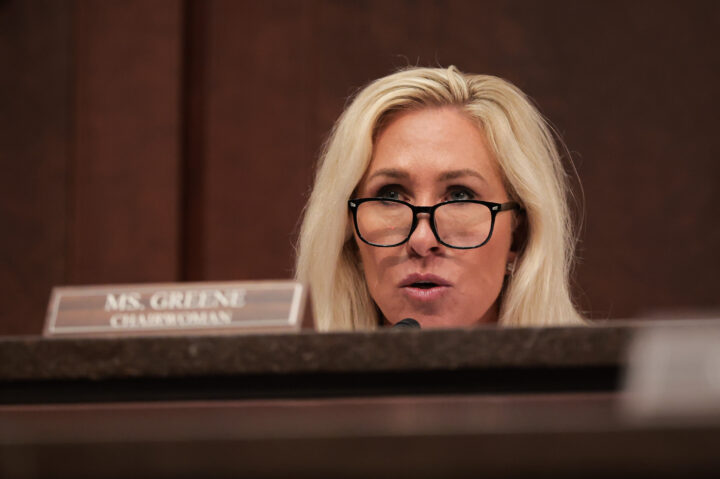
Rep. Marjorie Taylor Greene (R-GA) speaks at the U.S. Capitol on May 07, 2025 in Washington, DC.


 Add JewishInsider on Google
The House of Representatives on Thursday rejected, in a 422-6 vote, a bid by Rep. Marjorie Taylor Greene (R-GA) to block the $500 million in cooperative missile-defense funding the U.S. provides annually to Israel.
Greene’s amendment sought to strip the funding, provided annually under the terms of the U.S.-Israel memorandum of understanding, from the House’s 2026 Defense funding bill. Rep. Ilhan Omar (D-MN), had introduced a similar amendment.
Greene, Omar and Reps. Al Green (D-TX), Summer Lee (D-PA), Thomas Massie (R-KY) and Rashida Tlaib (D-MI) voted for the aid cutoff.
The House also defeated Greene-led amendments that would have cut military funding for Jordan by a 400-30 vote, for Ukraine by a 353-76 vote and for Taiwan by a 421-6 vote. Only Republicans voted for each of those amendments.
Legislators also rejected, by a 355-76 vote, an amendment by Rep. Greg Steube (R-FL) to cut funding for the Lebanese Armed Forces. All of the votes in favor came from Republicans.
Steube has long opposed funding for the LAF, arguing that it is complicit in Hezbollah’s actions against Israel and infiltrated by Hezbollah members and sympathizers.
Greene argued on the House floor that the Israel funding is “money we don’t have” and that Israel is “very capable of defending themselves.”
Referring repeatedly to the Jewish state as “nuclear-armed Israel,” Greene suggested that Israel’s undeclared nuclear capabilities should deter any threats — even though that has not been the case in the past. Israel has long maintained a policy of nuclear ambiguity, neither confirming nor denying its possession of a nuclear arsenal.
She also highlighted the U.S.’ extensive use of its own ballistic missile interceptors to defend Israel during the recent Iran-Israel war.
Greene noted Israel’s bombing this week of a church in Gaza, for which the Israeli government apologized, calling it a mistake, and said that “an entire population is being wiped out as they continue their aggressive war in Gaza.”
The funding in question supports programs including Iron Dome, Arrow and David’s Sling that are jointly developed by Israel and the United States. The systems, designed to intercept threats like missiles and drones, do not have offensive applications.
Reps. Ken Calvert (R-CA) and Betty McCollum (D-MN), the chair and ranking member of the House Appropriations Committee’s Defense Subcommittee, both spoke on the House floor against Greene’s amendment, as did Rep. Randy Fine (R-FL).
Calvert said that Israel’s success in intercepting ongoing attacks has come partly as a result of the U.S. missile-defense funding provided in past years. He highlighted that the funding supports the U.S.’ defense industrial base, funding production of the systems in both the U.S. and Israel and joint technological development.
McCollum is a vocal longtime critic of Israeli policy toward the Palestinians and the Israeli military operations in Gaza.
“To be clear, I have disagreements with Prime Minister Netanyahu’s government,” McCollum said, describing the war in Gaza as a “tragedy.” “But the funding in this bill does not support offensive weapons for Israel. … This bill provides for defensive measures only.”
McCollum said that everyone in the region deserves safety and that “Israeli children deserve to go to bed at night knowing that missiles from Yemen, Iran or from the Houthis or anywhere else in the region will not rain down on them.”
Fine highlighted that there is a significant American population in Israel under threat from air attacks. He said the co-development of missile-defense programs with Israel helps support America’s own air defense, including President Donald Trump’s Golden Dome proposal for a national air-defense infrastructure.
Addressing Greene’s comments, he noted that America has nuclear weapons, but that hasn’t deterred some adversaries from trying to attack it.
“When we oppose this amendment, when we vote it down, we are not only standing with Israel, we are standing with the best interests of the United States,” Fine said.
One resolution from Republicans highlights immigration issues; a bipartisan resolution links the attack to a growing series of violent antisemitic incidents

Kevin Carter/Getty Images
U.S. Capitol Building on January 18, 2025 in Washington, DC.
The House of Representatives is set to vote next week on two resolutions condemning antisemitism and the terrorist attack on a hostage march in Boulder, Colo.
One resolution from Republicans, focused on Boulder, highlights immigration issues and denounces the slogan “Free Palestine,” while the other, which is bipartisan, links Sunday’s Colorado attack to a series of other recent violent antisemitic attacks.
The first of the two resolutions is already attracting criticism from some Democrats. Led by Reps. Gabe Evans (R-CO), Jeff Crank (R-CO) and Lauren Boebert (R-CO), it includes a line that describes “Free Palestine” — a slogan shouted by both Mohamed Sabry Soliman, the Boulder attacker, and Elias Rodriguez, who killed two Israeli Embassy employees at the Capital Jewish Museum, during or shortly after their crimes — as “an antisemitic slogan that calls for the destruction of the state of Israel and the Jewish people.”
Evans’ resolution also notes that Soliman, an Egyptian national, violated U.S. immigration restrictions and states that the case “highlights the need to aggressively vet aliens who apply for visas to determine whether they endorse, espouse, promote, or support antisemitic terrorism or engage in other antisemitic or anti-American activity” and “demonstrates the dangers of not removing from the country aliens who fail to comply with the terms of their visas.”
It criticizes Colorado’s sanctuary state policies, stating that Colorado “hinders immigration enforcement” activities and prohibits law enforcement officials from providing information to federal immigration officials.
It also “affirms that free and open communication between State and local law enforcement and their federal counterparts remains the bedrock of public safety and is necessary in preventing terrorist attacks” and “expresses gratitude” to Immigration and Customs Enforcement personnel and other law enforcement.
Given Democratic opposition to many of the Trump administration’s immigration policies, those provisions could prove controversial, and some on the left are also likely to oppose labeling “Free Palestine” as antisemitic.
In statements about the legislation, the sponsors lambast Colorado’s sanctuary state policies, the Biden administration, Democratic Colorado Gov. Jared Polis and state lawmakers for their approach to immigration issues.
The resolution goes on to condemn Soliman and his “antisemitic terrorist attack on peaceful demonstrators supporting the release of the hostages” and prays for the victims of the attack.
The second resolution, led by Rep. Jeff Van Drew (R-NJ), has 53 bipartisan cosponsors, and condemns “the rise in ideologically motivated attacks on Jewish individuals in the United States,” including the Boulder attack, and expresses the House’s “commitment to combating antisemitism and politically motivated violence.”
The resolution describes the Colorado attack, as well as the D.C. shooting and the arson targeting Pennsylvania Gov. Josh Shapiro’s residence on the first night of Passover, as part of a “disturbing pattern of targeted aggression” and “politically and religiously motivated violence directed at Jewish individuals and institutions.”
It states that the three attacks “share a common pattern of targeting Jewish individuals or symbols of Jewish life and civic engagement” and calls antisemitism “fundamentally incompatible with the values of the United States,” saying it must be “condemned unequivocally.”
The Van Drew resolution calls on law enforcement to thoroughly investigate and prosecute the incident and on leaders to “speak out against antisemitism and politically motivated violence in all forms.”
Rep. Jerry Nadler (D-NY), a co-chair of the House Jewish caucus and a prominent progressive Jewish voice in the chamber, condemned Republicans for calling up the Evans-led resolution and urged colleagues not to support it.
“I am deeply disappointed in the Republican majority’s decision to put a blatantly partisan antisemitism resolution on the floor next week — especially since there is a bipartisan resolution that appropriately speaks to the horrible tragedy in Boulder that is already scheduled to come to the floor,” Nadler said in a statement to Jewish Insider.
“Once again, Republicans are using Jewish safety and the rise of antisemitism in America for their own partisan gain and to perpetuate their bigoted immigration propaganda,” Nadler continued. “As a community full of families who fled to America in search of a better life, American Jews will not fall for this cynical tactic, and I urge my colleagues not to take the bait.”
The two resolutions are the latest in a series of resolutions on antisemitism introduced by House members in the weeks since the Washington attack, some of which point to the increasingly fractured and politicized discourse about the issue.
Following the D.C. attack, 73 House Republicans led by Rep. Addison McDowell (R-NC) introduced a resolution condemning the attack and antisemitism, which noted that “the murderer is a far-left activist and has been affiliated with the Party for Socialism and Liberation.” It also called for “the enforcement of existing laws that punish hate crimes, protect religious freedom, and ensure justice for victims of antisemitic violence and discrimination.”
Following the Boulder attack, another Republican-only resolution led by Reps. Randy Fine (R-FL) and August Pfluger (R-TX), co-sponsored by 23 other House Republicans, also noted that Soliman overstayed his visa, said he “should never have been permitted to remain in the country as long as he was” and called for Congress to “take immediate action to secure the border and deport migrants who overstay their visas.”
Separately, six members of Colorado’s House delegation — all but Evans and Boebert — introduced a bipartisan resolution condemning the attack and expressing support for the survivors, as well as calling for additional federal resources to counter antisemitism and hate crimes and protect targeted communities.
Former state Rep. Rick Becker opposes most U.S. foreign aid; he expressed skepticism of aid to Israel in a recent interview but told JI he wants to continue it for now

AP Photo/Jack Dura/Tom Stromme/The Bismarck Tribune via AP File
North Dakota Republican Public Service Commissioner Julie Fedorchak steps up to a lectern to announce her U.S. House candidacy at Republican Party headquarters in Bismarck, N.D., Thursday, Feb. 15, 2024/In this Nov. 9, 2015 photo, North Dakota state Rep. Rick Becker, R-Bismarck, speaks in Bismarck, N.D.
In North Dakota, the race for the state’s sole House seat is set to play out as another battle between the Republican Party’s traditional wing and the Freedom Caucus-aligned insurgent right wing.
North Dakota Public Service Commissioner Julie Fedorchak faces former state Rep. Rick Becker, a plastic surgeon, in the primary. Fedorchak is defending U.S. engagement around the world, while Becker is pushing for scaled back U.S. involvement globally and opposes most foreign aid.
Fedorchak has backing from GOP leaders including Gov. Doug Burgum, former Gov. Ed Schafer, Sen. John Hoeven (R-ND), Attorney General Drew Wrigley and a slew of state officials, as well as House Republican Conference Chair Elise Stefanik (R-NY).
Becker, meanwhile, is endorsed by various right-wing leaders at the federal level including Sen. Rand Paul (R-KY), Vivek Ramaswamy and Reps. Bob Good (R-VA), Chip Roy (R-TX), Lauren Boebert (R-CO), Matt Gaetz (R-FL), Paul Gosar (R-AZ), Scott Perry (R-PA), Thomas Massie (R-KY) and Warren Davidson (R-OH), as well as former Rep. Ron Paul (R-TX). Becker challenged Hoeven in the 2022 North Dakota Senate race, first as a Republican and subsequently as an independent.
He significantly led Fedorchak in fundraising as of the end of March, with $828,000 raised throughout the campaign to her $449,000 raised. The primary election will be held on June 11.
One of the sharpest divides between the two Republicans is over foreign policy. Fedorchak is leaning into traditional conservative views on foreign policy in her campaign — expressing staunch support for continued U.S. assistance to Israel and Ukraine — while Becker favors dramatically cutting foreign aid.
“I think Israel needs to have the resources necessary to properly secure its safety and stability and help reinforce the stability in the broader region as a whole and the Middle East,” Fedorchak told Jewish Insider, adding that she’s “committed to ensuring the continuation of foreign aid to Israel.”
Speaking more broadly about the recent foreign aid bill, Fedorchak said, “We have to support our allies around the world and help them defend their democracies and stave off the aggressors that are anti-democracy and anti-American.”
She declined to weigh in specifically on the humanitarian Palestinian aid in the bill, but said that there need to be mechanisms to “ensure that it’s going to the right places to help the women and children” impacted by the war and will not ultimately be used against Israel.
She called Iran “the trouble source in the Middle East,” emphasizing the need to work with U.S. allies to crack down on Iran, its nuclear program and its regional influence, using “the strongest diplomatic and economic sanctions.”
Fedorchak said U.S. energy independence and production is a critical method to ensure that U.S. allies globally aren’t dependent on countries like Iran and Russia for their energy supplies.
She said stronger U.S. energy production could also stave off price fluctuation driven by Saudi Arabia and other oil-producing gulf states. She described herself as “very excited to join forces with President Trump and support his America First energy policy.”
When he spoke to JI, Becker said that he is “very much in favor of pulling foreign aid,” particularly from U.S. adversaries, but that “Israel should be the last place that we pull foreign aid” and he is “completely in favor” of continuing that aid in the near term.
Ultimately, he continued, he wants to see Israel in “a position where Israel no longer even desires or needs aid from the United States.” He said Israel’s continued reliance on the U.S. may not be in Israel’s “best interest” because it “makes them susceptible to these changes that we have whenever we get a new administration.”
Becker’s support for continued near-term aid for Israel appears different from a view he has expressed in at least one other interview.
In a Feb. 17 interview with The Dakotan, Becker said that foreign aid “is a bunch of bullcrap for the most part.”
“I respect Israel and I respect Israel’s right to defend itself completely but sending billions and billions of dollars to Israel — they are less in debt than we are. I understand they may even have a surplus, I don’t know,” he said. “But the point is we’re in the hurt bay. There’s no place for us to be lending money, even to our friends, Israel.”
He said the U.S. should stop sending money ”to both Israel and Israel’s enemies” and “just maybe let the taxpayers keep it.”
Pressed on the apparent contradiction between those past comments and his position expressed to JI, Becker said he didn’t recall having made them and suggested they were taken out of context, insisting that he’s been consistent in his views.
“It’s crazy to me that we will go further into debt and then send money overseas… that is the starting point of the principle from where I’m coming,” Becker said. “But we have the conundrum that we have an ally which we have put into a precarious position because of funding her neighbors.”
When he spoke to JI, he said he supported the $14.3 billion in U.S. military aid for Israel passed by Congress, but said he would have preferred to see it voted on by itself and is not sure how he would have voted on the full Israel portion of the aid package.
Many of Becker’s congressional allies voted against the Israel aid bill.
He called humanitarian aid for the Palestinians, also included in the bill, potentially problematic, adding that he’s “very skeptical that the humanitarian aid money is going to where it’s supposed to go and isn’t just funding Hamas.” But he said he might be supportive of purely humanitarian support like food and medical supplies.
He also said cuts to the U.S.’ own defense budget must be in consideration, arguing that there’s “very likely inefficiency and waste,” and overall advocated for scaled-back U.S. military involvement globally.
Becker said he wants to avoid direct armed conflict with Iran, and that sanctions, whenever possible and effective, should be used. He said he’s more open to direct military action against the Houthis.
He said unequivocally that he opposes additional U.S. aid for Ukraine and that he’s “very reluctant” to support aid to Taiwan without receiving intelligence briefings on the nature of the threat and the planned “endgame.” He said he wants to see action to “calm the waters” and avoid a military conflict between China and Taiwan.
In the Dakotan interview, Becker further claimed the U.S. had “manipulated the Ukraine government since 2014,” when a pro-Western protest movement overthrew the Russian-backed government, and said that the U.S. may have “set up a situation that puts Russia in a position where they maybe feel like they have to do this.”
Addressing antisemitism at home, Fedorchak told JI that the current wave of antisemitism “just can’t be tolerated in our country.”
She said that colleges need to “get tougher” on protests that are “getting out of hand,” and said that federal aid for colleges that support anti-Israel and anti-American agendas should be reexamined.
Becker said he sees fighting antisemitism as “much more of a state issue and maybe even much more of a local issue.” He said he’s concerned that powers granted to the federal government to fight antisemitism “can be used elsewhere… perhaps one day against us.”
But he said that if he were running for a state office, like governor, he’d be pushing to “get some bulldozers and clear the encampment.” He said that leveraging education funding would be the limit of federal government action.
Told about the Nonprofit Security Grant Program, which provides funding to religious institutions and nonprofits, Becker said it sounded like it is “outside of the scope” of proper federal authority and spending, and that the federal government should instead reduce taxes to allow people to choose to spend their money on increasing their institutions’ security themselves.
The two GOP rivals also view their priorities in Washington very differently. In the interview with JI, Fedorchak highlighted her background in business and public service, and said she believes she has “a lot of good experience” and “the passion for conservative solutions” to solve issues like energy policy and border security. Her in-state work has focused heavily on energy policy.
She said she’d be a “very serious-minded problem-solving member of Congress who’s ready to get to work on day one.”
Becker told JI he’s running for Congress because “the entire country is in a very precarious position,” warning that federal spending is “effectively sending America over a cliff.”
He said he wants to work with lawmakers like those who’ve endorsed him to help rein in spending, describing himself as having been “very principled and very consistent” in his time in state government. In North Dakota, he founded an ultra-conservative legislative caucus, the Bastiat Caucus, named for 19th-century French economist Frederic Bastiat, famous for his free trade theories.
“I am happy to label myself America First,” Becker said. “For me it means refocusing on American sovereignty and moving away from some of these international treaties” and organizations, warning that the executive branch is implementing a “very globalist agenda.”
The former NYC mayor predicted that Washington lawyers will 'make a fortune' in legal battles

Jacob Kornbluh
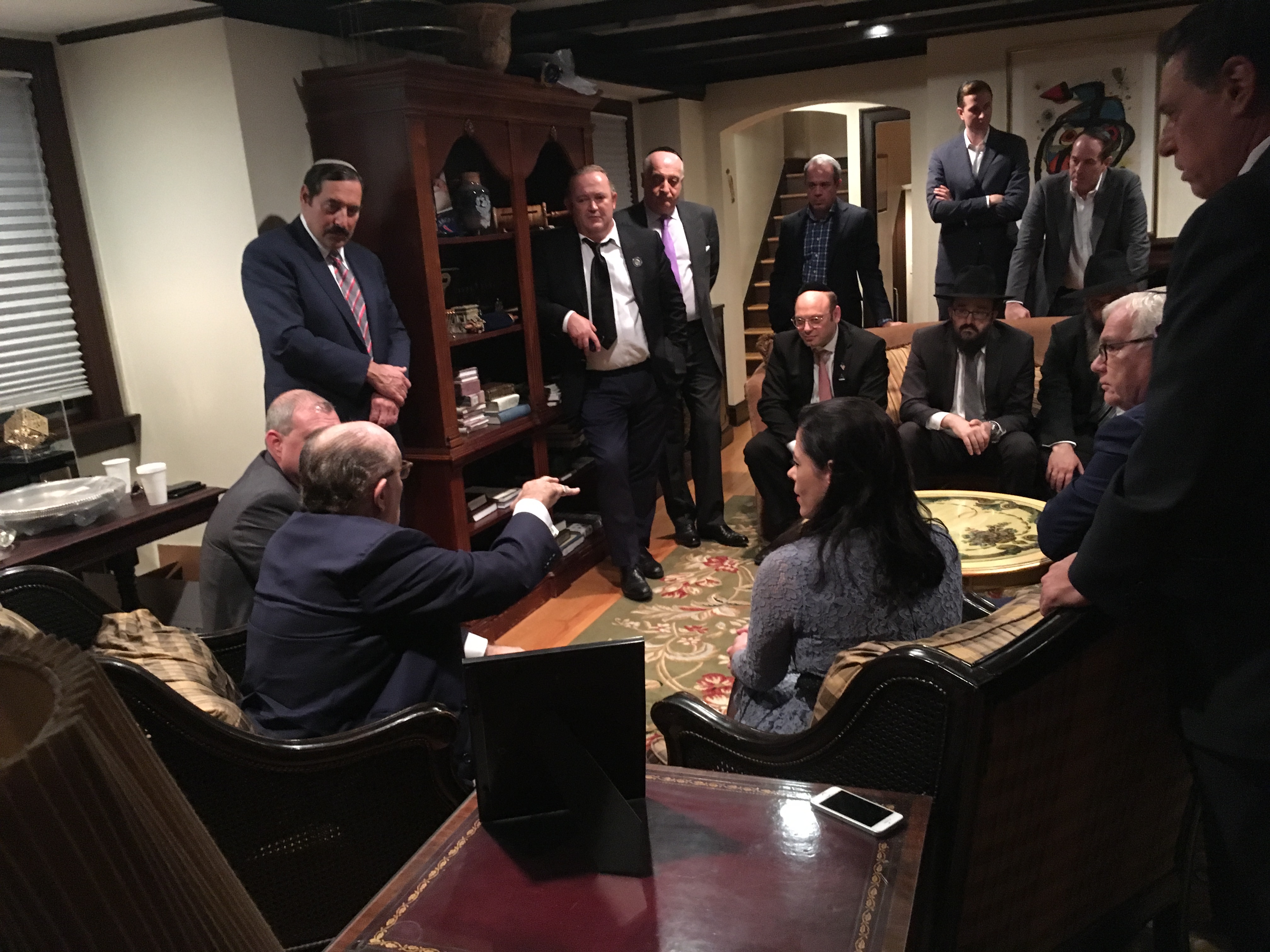
Lev Parnas and Rudy Giuliani visit the burial site of the Lubavitcher rebbe in Queens in November 2018.
President Donald Trump’s personal lawyer Rudy Giuliani seemed to predict his fate and a possible impeachment by the House of Representatives during an event with his indicted associates ― Lev Parnas and Igor Fruman — on the eve of the 2018 midterm elections.
In previously unreported remarks at an event hosted by Dr. Joe Frager, vice president of the National Council of Young Israel in Queens, N.Y., on November 1, 2018, Giuliani foresaw the Democrats starting “a hundred investigations” against the president and predicted that “Washington lawyers will make a fortune.”
“The part of their winning is that the House will go crazy. They will start a hundred investigations” — to which Parnas could be heard agreeing, “Oh, you’re right.” Giuliani continued: “They’ll go overboard. They’ll turn the American people off,” he said, stressing the importance of the Republicans holding onto the Senate majority.
“If we have the Senate, they can’t do permanent damage. They can only make trouble, but they can’t pass a law, they can’t impeach anybody,” Giuliani explained. “They have nothing. They can subpoena people like crazy. Then you go to court and fight them… The Washington lawyers will make a fortune. Yeah. I mean, this would be great. I should open an office in Washington (laughter).”
According to Giuliani, Trump “doesn’t mind the battle. They don’t know what they’re taking on. He’ll destroy them. He’ll absolutely destroy them, and they’ll destroy themselves because the president’s just one person and he’s got one White House that works for him. But they have like probably about a hundred lunatics in the House of Representatives and they’re all going to want the microphone and they’re all going to want to be crazier than the other, and there’s only a certain tolerance the American people have for this.”
The former mayor of New York City called Rep. Maxine Waters (D-CA) — who in a 2017 press conference had suggested possible impeachment — “crazy” and “stupid.”
Also in attendance was Ukrainian Chief Rabbi Moshe Azman, who has been associated with Parnas and Fruman. At the beginning of the event, Parnas introduced Azman as “one of your biggest supporters.”
During Giuliani’s remarks, Parnas chimed in and implored the crowd: “We need to win the midterms. That’s the bottom line. The president can’t do everything on his own, unfortunately.”
Parnas and Fruman were indicted Thursday on campaign finance charges related to their efforts to remove Marie Yovanovitch, the former U.S. ambassador to Ukraine, from her post. They were arrested Wednesday evening at Dulles International Airport as they tried to leave on one-way plane tickets to Vienna. Social media activity over the last two years indicate the duo had socialized with the president and his son, Donald Trump, Jr., and had visited both the White House and Trump’s Mar-a-Lago Club in Florida.
Please log in if you already have a subscription, or subscribe to access the latest updates.
 Continue with Google
 Continue with Apple