





































































At Temple Israel, the lawmakers and the New York Times columnist discussed the rise of antisemitism and anti-Israel sentiment with the Call Me Back host
Courtesy
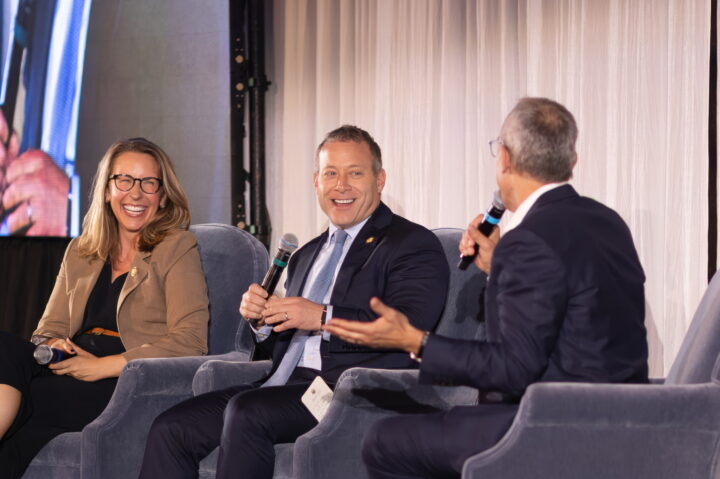
Reps. Hilary (D-MI) and Josh Gottheimer (D-NJ) speak onstage with Dan Senor at an event at Temple Israel in West Bloomfield, Mich., on Monday, Oct. 12, 2026.


 Add JewishInsider on Google
More than 1,100 people gathered Monday night at Temple Israel in West Bloomfield, Mich., for an event organized by local Jewish groups featuring Reps. Hillary Scholten (D-MI) and Josh Gottheimer (D-NJ) alongside commentators Dan Senor and Bret Stephens, discussing the rise of antisemitism and anti-Israel sentiment in political life.
Though the Michigan Senate race wasn’t directly addressed, the event came ahead of the election in less than a month, in which Israel and the Jewish community have been central topics of discussion. During the event, Scholten and Gottheimer discussed the rising antisemitic and anti-Israel trends in their party and why they’ve remained outspoken against them.
The event was jointly organized by the the Jewish Federation of Detroit, the Anti-Defamation League’s Michigan office and the local American Jewish Committee chapter, billed as exploring “some of the most urgent questions facing the Jewish people today from the rise of antisemitism and the meaning of Zionism to the increasingly challenging climate for political discourse in the United States.”
Temple Israel was the site, seven months to the day before Monday’s event, of a Hezbollah-inspired terrorist attack. Scholten told the audience, during a Q&A session alongside Gottheimer moderated by Senor, that she felt “emotional” arriving at the synagogue, according to clips of the event reviewed by Jewish Insider.
“I want to say to this Jewish community here tonight that we’re with you,” she said. “It’s so important for us to communicate to you that we are with you in this moment. … People are scared right now. I hear from our Jewish community, especially our young people who have experienced the horrors of a post-Oct. 7 moment on their college campuses.”
She said that the Jewish community feels outnumbered, “and that is one of the main reasons why I have felt so compelled to not be shy in speaking out in this moment. … I want American Jews, Michigan Jews, to feel like they have an ally and a champion.”
Scholten is the only sitting Democratic member of Michigan’s congressional delegation who hasn’t yet endorsed Democratic nominee Abdul El-Sayed.
Asked why she’s staked out such a strong position, in such a difficult political environment, Scholten said, “I’m not a radical. In fact, I am radically not radical, and it almost seems like in today’s politics, to be not radical is almost a radical position. Everyone is trying to pull you farther and farther to the extremes, but it is actually a very bold and noble position to stake out this position in the center.”
She said that she wishes there was “more respect across the board from our colleagues to say, ‘I was elected to serve my constituents with the values that I bring to this position,’ and more intellectual curiosity, instead of just an immediate rejection or retribution of the position that we have taken out.”
Scholten said she believes the Democratic Socialists of America and DSA-aligned candidates are gaining steam because they are emphasizing issues like healthcare, jobs and fighting corruption, “and people don’t even recognize the underlying current of the U.S.-Israel relationship or the antisemitism that is a part of that. I know we see that across Michigan.”
Scholten said that she sees First Lady Eleanor Roosevelt as a model for how Democrats can respond in a moment when a growing DSA bloc is set to enter Congress. Roosevelt, she said, “really took on communism” without resorting to McCarthyist tactics, staking out a position in defense of strong New Deal-era social programs while rejecting radicalism.
Scholten applauded Rep. Haley Stevens (D-MI), in whose district the event took place, and Stevens’ likely successor, state Sen. Jeremy Moss, who Scholten said was in the audience Monday evening.
Gottheimer praised Scholten for having the “courage” not to cower in the face of “major blowback” as support for Israel has become highly unpopular among the Democratic base, particularly as a lawmaker who’s not Jewish.
He attributed the shifting tides on Israel policy among Democratic elected officials in part to pressure and harassment from vocal anti-Israel activists, which can be particularly effective with lawmakers for whom the issue is not top of mind and don’t have Jewish or other constituents invested in it. Other pro-Israel colleagues have offered a similar diagnosis.
“All you had to do is say this magic word [genocide] and it would all go away,” he said. “That’s how this thing started. And then the disinformation gets out there and, of course, it’s everywhere.”
Gottheimer described socialists as a separate entity trying to hijack the Democratic Party by playing on real anxieties about the economy, and then, “in a crafty way, [they] threw the Jewish thing into there, and they kind of melded it together” — blaming economic problems on U.S. aid to Israel.
“But this is not about money to Israel when you protest outside a temple, or boycott a Democratic member of Congress from buying coffee at his coffee shop in his own district,” Gottheimer continued. “It has nothing to do with your position on Israel. That’s just finding a great scapegoat.”
Ultimately, he said, it became easier for Democrats to stay silent. “You’re kind of nuts right now in Democratic politics for running around and talking about this stuff in the way that we do. It’s not popular, right? You get harassed for it. People cancel fundraisers.”
He said that some once-dependable allies have said they’ll stick with him on key votes, but have been unwilling to speak up boldly and publicly.
He warned that the same trends are growing in the GOP.
Gottheimer emphasized the need for the Jewish community to remain strong and optimistic even in the face of hardship.
He said that the current environment has shown the community who its friends and allies are, as well as bringing the Jewish community closer together. He said that figures like himself and Scholten are “not going quietly” and intend to fight back in the face of attacks from socialists.
“We [the Jewish community] know we’ve got to look out for each other, and that only we can overcome this by working together. We got to stay focused. [Enemies of Israel and the Jewish community] spent a long time — decades — focused on how they’re going to tear it apart,” Gottheimer said. “We were a little asleep at the switch, I think, but now we’re up and we’re focused and we know what we need to do to actually overcome it — overcoming socialism and overcoming antisemitism.”
In a statement to JI, Gottheimer thanked Scholten for inviting him to the event and emphasized that “silence is not an option” in the face of antisemitism.
“This is a moment of consequence, and we all have to stand up, speak out, and say plainly that hate has no place in our country. I’ll always stand with the Jewish community against antisemitism, and I’m proud to be in the room with so many others who feel the same way,” Gottheimer said.
Prior to the Q&A with the two members of Congress, Senor delivered prepared remarks and then conducted a separate Q&A session with Stephens. In his opening remarks, Senor pushed back against the accusations of genocide against Israel, describing them as a modern iteration of the ancient blood libel.
The genocide accusation has been deployed, Senor said, to attack every Jew and Jewish institution, including the preschoolers at Temple Israel, and to declare Israel’s existence fundamentally illegitimate. And, he said, political leaders have joined in by parroting the genocide accusation.
Brian Hermelin, the president of the Detroit Federation, told JI that the idea for the event came from a conversation between himself and Senor.
“He wanted to come have a conversation with the community, not to advocate for any particular candidate, but to talk about the seriousness of the issues that we’re facing around antisemitism, around the blood libel of the genocide lie and put it in historical context for the community to understand,” Hermelin said. “This has a lot of historical precedent that hasn’t bode well for the Jewish community, and we should be paying attention.”
Hermelin said the event was “really well received” and that it was particularly poignant to host it at Temple Israel on the seven-month anniversary of the terrorist attack, marking the first time that some attendees had returned to the synagogue since the attack happened. “For the community, it was important, it was meaningful to be there,” Hermelin said.
Bringing together the Federation, AJC and ADL to host the event provided a “united front” among the major Jewish advocacy organizations and demonstrated that “everybody realizes the seriousness of the decisions that we have in front of us,” he continued.
He said that Senor and Stephens had discussed the “obsessive focus on Zionist participation in political life” in the current moment, and how that is a unique facet of the current electoral cycle.
Meanwhile, elsewhere in the state, the pro-El-Sayed coalition Michigan Jews for Democracy held an event night with Brad Lander, the progressive Jewish Israel critic expected to join the House next year, and former Rep. Andy Levin (D-MI).
Decky Alexander, the chair of the Michigan Democratic Jewish caucus and one of the hosts of that event, said that the goal of the event was to create an intimate space for traditional Democratic Jewish voters who are unsure how to vote to talk through their feelings and concerns.
The coalition, which is not formally affiliated with El-Sayed’s campaign but issued a recent petition in support of him, also recently held a similar event with Rep. Becca Balint (D-VT), another progressive Jewish House member.
David Kramer, a Jewish Democratic leader in Michigan, said Rep. Hillary Scholten is ‘someone who has a very strong sense of self and what she thinks is right and wrong’
Heather Diehl/Getty Images
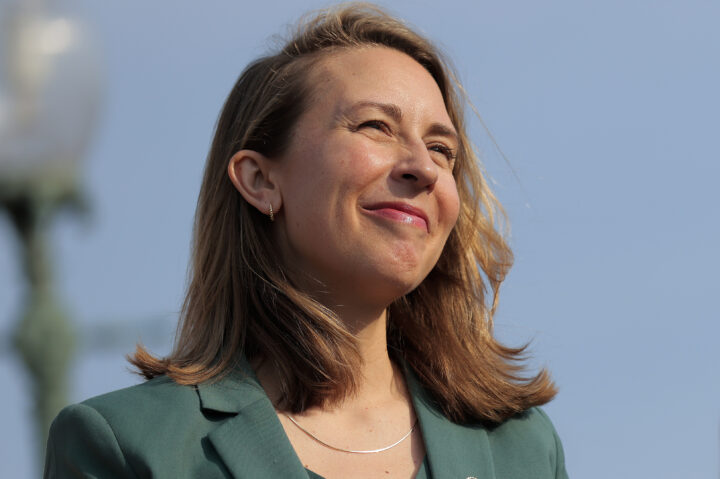
Rep. Hillary Scholten (D-MI) speaks outside the U.S. Capitol on March 26, 2026 in Washington.
Rep. Hillary Scholten (D-MI) has emerged in recent weeks as one of the Democratic Party’s most outspoken voices against antisemitic influencer Hasan Piker — including standing as one of the few Michigan Democratic holdouts in endorsing Senate nominee Abdul El-Sayed in light of his relationship with Piker.
Her stalwart outspokenness against antisemitism and resistance to her party’s home-state Senate nominee is increasingly rare in today’s politics. But Jewish Michiganders who have worked with her say she’s long been close with and supportive of the community, and that she’s been deeply and personally disturbed by rising antisemitism and other rhetoric from Piker and El-Sayed.
At an event for a fellow Michigan House candidate this week, Scholten faced down a questioner who said that she was making “bad faith accusations” against El-Sayed and Piker and stoking Islamophobic hate speech in the interest of protecting U.S. aid to Israel. Scholten stood her ground.
“I do not support the comments of Hasan Piker. He has said some terrible things about America, about American troops, and I would stand by comments condemning those. I think they don’t have any place in the Democratic Party or in the United States of America,” she said. “But even though we may not necessarily be in agreement about all of those things, we are in alignment about the things that unite us as Democrats: lowering costs, delivering on universal health care, and fighting corruption.”
Speaking to reporters after the event, she said that she has not endorsed El-Sayed and hasn’t heard from him in any capacity.
“If he would [reach out to me], I would have questions,” Scholten said. “A lot of it has to do with his past associations with Hasan Piker.”
She said she’s hearing “a lot of support” from people who agree with her raising the question of “whether this is the right direction for our party.”
Scholten was among Rep. Haley Stevens’ (D-MI) most outspoken supporters during the Senate primary, and unlike Stevens, refused to commit to endorse El-Sayed during the general election. Her decision to stick to her guns carries political risk: El-Sayed carried Scholten’s district in the Democratic primary, winning the Kent County (Grand Rapids) base by 26 points over Stevens.
El-Sayed’s campaign did not respond to a request for comment, but largely shrugged off questions about Piker and criticisms from Scholten and other Democrats during a press conference on Wednesday.
He accused Republicans of pushing a false narrative of Democratic division and suggested that his critics are simply “still nursing wounds or grievances from the primary.”
Despite having repeatedly campaigned with Piker, El-Sayed also dismissed him as “a streamer in California” who is not central to the campaign, which he described as focused on issues in Michigan. He asserted that questions about Piker are driven by a media focus on a “tabloid version of our politics.”
Scholten declined to comment to Jewish Insider for this story.
She was first elected in 2022, after losing a 2020 race in a GOP-leaning district against former GOP Rep. Peter Meijer. The Grand Rapids-area district was redrawn to be more favorable to Democrats two years later, and she prevailed over a hard-right Republican challenger who defeated Meijer in the GOP primary. The Cook Political Report now rates her as a shoo-in to win reelection.
In a 2020 interview with Jewish Insider during her run for the House, Scholten did not rule out conditioning or reducing U.S. aid to Israel in the interest of serving as a neutral arbiter to pursue a two-state solution, though she also argued that the U.S. should continue to be supportive of Israel. Scholten voted earlier this year against an amendment cutting U.S. aid to Israel that was supported by nearly half of House Democrats.
She also strongly condemned the Boycott, Divestment and Sanctions movement, saying that it has “deep roots in antisemitic sentiment and rhetoric.”
Jewish Democrats in Michigan said that Scholten is a longtime ally of their community, and said that her strong stand against Piker and antisemitism is nothing new.
David Kramer, a prominent Jewish Democratic leader in the Detroit area who served as campaign chair for Stevens’ Senate race, said Scholten is “someone who has a very strong sense of self and what she thinks is right and wrong, and she has a history of speaking up, even if it’s unpopular” — pointing also to her early call for then-President Joe Biden to end his reelection campaign and her strong and early support for Stevens.
“This is another one in the pattern of her doing what she thinks is right, even when she knows she’s going to get some flak for it,” Kramer continued. “I’m absolutely, positively convinced that she’s doing this just because of what her convictions are and her gut reaction.”
He said he’s heard from Scholten directly that even her staff have warned her about the potential consequences of the stand she has taken on Piker and El-Sayed, but that she feels strongly that this is an issue of right and wrong.
Kramer said that Scholten has come to him on various occasions about her concerns that El-Sayed and Piker’s comments and activity will cause insecurity in the Jewish community — “she just gets it.”
He added that, while Scholten is close with the small Jewish community in Grand Rapids as well as with Jewish leaders in the Detroit area, her positions come from her own deeply held values.
“She is a very, very smart, very, very principled person who is willing to speak the truth and is willing to take stands even if it is not something that others would say will help her politically, and that is really unusual today in politics,” Mark LoPatin, another Detroit-area Jewish Democrat who has interacted with Scholten, said. “She is one of the few who is really willing to get out there to say, ‘This is wrong,’ and why she believes it’s wrong.”
LoPatin said that Scholten may very well face a more difficult primary race in 2028 as a result of her outspokenness and has told supporters that she has faced backlash for her stances, but that she does not plan to back down.
“We should have more congressional leaders that are willing to do that,” he said. “We probably wouldn’t be in the position that we’re in right now.”
Michael Horowitz, another Detroit-area Jewish Democrat, said he got to know Scholten through Stevens and her campaign at joint events they held together. “She just fits a category of intelligent, caring people who are trying to do good … they approach their job with the goal of trying to get things done.”
He said that Scholten is someone who “sees right and wrong” and was “particularly offended” by the attacks leveled against Stevens in the primary, as well as against state Sen. Jeremy Moss, a House candidate whom Piker attacked by name in recent comments that have drawn particular criticism.
“This isn’t a political calculation, she sees it as wrong,” Horowitz said. “It’s just a person who’s a decent person, cares about right and wrong. I think it just upset her. … I don’t see any agenda here, other than people that she’s close to have been attacked, and … she doesn’t buy into it. This isn’t who she is, and she’s willing to say something.”
Kramer said that, having known Scholten for several years, he believes her convictions on antisemitism are authentic and deeply rooted. He also noted that she’s an active member of her church and “someone of a lot of faith,” and said he believes that some of her dedication to the issue of antisemitism comes through her faith, though he said he hasn’t asked her the question directly.
LoPatin agreed that Scholten’s stance seems to be a product of her moral character, and said that quality means he’ll continue to support her even if he disagrees with particular stances she may take. “I do know that she will have a thoughtful response to whatever those issues are.”
Kramer also emphasized that, despite not having endorsed El-Sayed, Scholten remains committed to helping Democrats up and down the ballot in Michigan win in November — a commitment Scholten expressed herself at the event earlier this week.
Other centrist Senate Democrats also sounded reticent about embracing their Michigan Senate nominee
Tom Williams/CQ-Roll Call, Inc via Getty Images
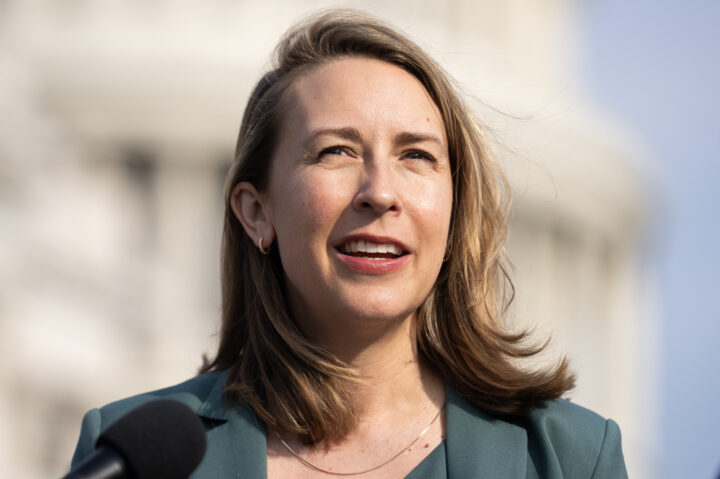
Rep. Hillary Scholten (D-MI) speaks during a news conference outside the U.S. Capitol on March 26, 2026.
Rep. Hillary Scholten (D-MI), a moderate Michigan lawmaker representing a swing district, broke with most other Democratic members of the Michigan congressional delegation in declining to offer an explicit endorsement of Democratic Senate nominee Abdul El-Sayed as of Wednesday afternoon, after offering strident criticism of him during the primary campaign.
“Congratulations to everyone who participated in Michigan’s hard-fought primary elections last night, and thank you to every voter who made your voice heard. In these close elections, we want you to know — you are HEARD,” Scholten said in a statement that did not mention El-Sayed. “Now our focus turns forward. I’ve always said I’ll work with anyone committed to lowering costs, expanding affordable health care, creating more opportunity, and fighting corruption. I mean that.”
A Scholten spokesperson did not respond to a request for clarification on whether this constituted an endorsement of El-Sayed.
Scholten said that she is a “proud, commonsense Democrat” and said that she’s focused on helping to elect “similar candidates around the country.”
During the campaign, as a vocal supporter of Rep. Haley Stevens (D-MI), Scholten suggested she might struggle to support El-Sayed in the general election.
“I will not stand beside someone who has allowed distinctly anti-American sentiment to enter our public dialogue,” she said in one interview.
In another, she criticized El-Sayed for campaigning with antisemitic and anti-Israel influencer Hasan Piker.
“To campaign with Hasan Piker, who said America deserved Sept. 11 — sure, he went on to disavow those comments, but I’m telling you, nobody on my team would ever, you know, come even close to making a comment like that,” she said. “I think that condoning behavior like this from candidates like Abdul El-Sayed is taking us in a direction that we don’t want to go as a party.”
Other Democratic moderates, with the exception of maverick Sen. John Fetterman (D-PA), are largely keeping their heads down following the election, with several contacted by JI declining to comment or not responding to requests.
Other Democrats are backing El-Sayed.
“He worked hard. People in Michigan had their word last night, and I imagine he’s going to work really hard over the next 90 days to win this race, and it’s obviously a critical one,” Sen. Mark Kelly (D-AZ) said. “If we’re going to fix some of the problems created by this president, we’ve got to win back the Senate.”
Asked whether he believes the narrow margin of victory for El-Sayed might imperil his chances in November, Sen. Gary Peters (D-MI), who had supported Stevens in the primary, offered a short response: “Yeah, he could win. Definitely.”
Sen. Chris Coons (D-DE) said he hasn’t met El-Sayed but noted that Stevens had endorsed him and “my sense is that whatever divisiveness there might have been because of the primary, they’re … past it.”
Sen. Richard Blumenthal (D-CT) declined to comment on El-Sayed’s history or his decision to campaign with Piker, and said that he doesn’t think “generalizations are possible from one race” about the direction of the party, “whether it’s in Brooklyn or Michigan.”
Please log in if you already have a subscription, or subscribe to access the latest updates.
 Continue with Google

 Continue with Apple