














































































Sen. Chris Murphy said that the U.S. could no longer guarantee regional security, but that might have a ‘silver lining’ by obligating the Gulf states to negotiate directly with Iran

Jemal Countess/Getty Images for Fair Share America
Sen. Chris Murphy (D-CT) speaks at the U.S. Capitol on April 10, 2025 in Washington, DC.


 Add JewishInsider on Google
ASPEN, Colo. — Sen. Chris Murphy (D-CT) argued on a panel at the Aspen Security Forum on Thursday that the war with Iran had irreparably damaged the U.S.’ reputation and capacity in the Middle East, and that Gulf states would now need to take the lead and negotiate with Iran over the region’s future.
The U.S. has been “effectively eliminated as a security guarantor for our allies” because of what he described as a failed military campaign against Iran, Murphy argued.
“You can make an argument that that could be a long-term silver lining, that the Gulf states will have to sit down and negotiate, at the beginning, the question over the Strait of Hormuz and maybe another set of factors, and in those negotiations, that might be the new reality in the Middle East,” he said.
“Maybe in that conversation with the U.S. not in the lead, but as a partner, there is a solution to the ultimate Iranian control of the strait, but it’s admittedly very hard to answer that question right now,” Murphy continued.
He said that the current state of play suggests that an emboldened, enriched Iran with control of the Strait of Hormuz “seems to be the best-case endgame” and “that is why our allies and friends in the region are questioning whether there is any way the United States can ever secure them.”
Some allies, he acknowledged, want to see the U.S. “finish the job” in Iran, but argued that that’s an unclear and undefined goal that in some cases might involve committing U.S. ground forces.
Asked by moderator Jim Scuitto, a CNN correspondent, how a future Democratic president would approach the situation assuming the current status quo persists through 2028, Murphy said that is “kind of an impossible question,” adding that the U.S. would have to engage with its partners and Iran to try to secure freedom of transit in the Strait of Hormuz. Murphy himself is viewed as a potential presidential candidate.
He said that resolving the current standoff would likely require lifting sanctions and pressuring Israel to permanently end its war against Hezbollah in Lebanon.
Asked about the possibility of expanded U.S. strikes on Iranian oil infrastructure, as suggested earlier in the forum by former National Security Advisor Robert O’Brien, Murphy said that would only lead Iran to escalate further by ordering the Houthis to close the Bab el-Mandeb strait.
Iran, in Murphy’s framing, had “taken our best shot and survived” and realized it can use the Strait of Hormuz to increase its leverage at the negotiating table. He said that the current situation essentially removes any leverage the U.S. had in nuclear talks — having surrendered sanctions relief for the reopening of the Strait of Hormuz and showing that the U.S. military threat is not sufficient to bring down the regime.
As a result, he said that the U.S. would likely not be able to get a better deal than the Obama administration’s 2015 nuclear deal even if talks resumed.
Murphy characterized the war as a catastrophic, generational mistake — “the greatest foreign policy disaster of the last 20 years [and] one of the greatest mistakes any president has made in the world in our country’s history,” which left the U.S. looking “weak and feckless.”
He said that, as a result of the munitions expenditures in the war, the U.S. could not defend Taiwan from China today if it wanted to.
Robert Greenway, who led Middle East policy on the National Security Council during President Donald Trump’s first term, was the primary voice of optimism on the panel, arguing that despite some changing rhetoric, Trump’s objectives have been clear — dating back even to his first administration — and that there is “no question in my mind” that Iran’s capabilities have been significantly degraded.
“Their means and the opportunity to constitute a threat to U.S. vital interests and to global interests, as a matter of fact, are probably the lowest they have ever been since 1979. From the enrichment standpoint, they haven’t been at zero enrichment capacity since 2006,” Greenway said. “So, from an empirical perspective, I would say yes, progress has been made, and I think at this juncture, I would be pleased with that progress. And I don’t think there’s a lot left to be done to eliminate the remaining threat.
He argued that those who are concerned by Iran’s disruptions of the global economy should be supportive of the administration’s military campaign, arguing that Iran would only be more emboldened under a nuclear and missile umbrella.
“This is the most practical way to solve it. Diplomacy up to this point hasn’t prevailed, and it won’t as long as you have a disingenuous partner,” Greenway said. “Now, Iran cannot defend itself from any attack by the United States, or frankly, anyone else.”
Diplomacy, he reiterated, was a “failed approach” and he said military action is the “fastest” and “probably the only realistic way” to achieve the U.S.’ objectives.
He also said that definitively eliminating the threat from Iran would allow the U.S. to reduce its troop presence in the Middle East in the longer term. He said he doesn’t see any need for U.S. ground forces in Iran, arguing that the only potential uses for them would be for search and rescue operations or recovery of Iranian nuclear materials.
But with the nuclear materials currently buried and closely monitored, Greenway said, a ground infiltration to remove them isn’t necessary in the short term, though he said they should be removed from the country in the long term.
Countering Murphy, Greenway also said that many Middle East allies are privately supportive of continued U.S. military operations to finish the job, and are happy to see the threat of Iran reduced, though he acknowledged opinions vary.
Karim Sadjadpour, a senior fellow at the Carnegie Endowment for International Peace, disputed Murphy’s notion that the result of the war would remove the U.S. as a guarantor of regional security. He said that the Gulf countries understand that only the U.S. can protect them in the near term — China and Russia not being viable alternatives — and they still understand and fear Iran as a threat.
But he also acknowledged that, as a consequence of geography, Middle Eastern states will need to seek side deals with Iran to some extent.
Sadjadpour also emphasized that there will never be lasting stability in the Middle East until Iran is led by a government that actually represents the interests of the Iranian people — an aim he said the war did not advance.
“It is militarily weaker than it was four and a half months ago, but … psychologically it feels much stronger. It’s much more confident than it was four and a half months ago before the war,” Sadjadpour said. “I don’t think it’s going to give up its control of the strait anytime soon. I don’t think it’s going to make meaningful compromise anytime soon.”
He compared the current situation in Turkey to post-Soviet Russia — continuing to pursue its own security and destabilize its neighbors, and use energy and trade as a weapon.
He added that leaders in the U.S. often misunderstand Iran, comparing it either to Nazi Germany, an ideologically rigid regime that cannot be bargained with, or to China, ripe for grand bargain and rapprochement. Iran is most similar, he said, to the Soviet Union — not suicidal but not willing to place its economic and national interests above its revolutionary ideology except when faced with “almost existential” economic pressure.
With the Iranians appearing prepared to wait out the Trump administration, Sadjadpour continued, he doesn’t see a clear end to the current war.
Roxana Saberi, a journalist and author with contacts inside Iran, said that most people in the country remain hopeful but were disappointed by the results of the war and the memorandum of understanding, which she said had demonstrably emboldened Iran to step up human rights abuses at home.
Among the anti-regime population in Iran, which she said constitutes 80% of the Iranian public, there are now three groups: those that opposed the war, those that supported it and want to see further strikes and those that have become numb to the situation and are simply trying to survive.
Trump said the change came after ‘highly productive conversations with Middle East leadership’
SAUL LOEB / AFP via Getty Images
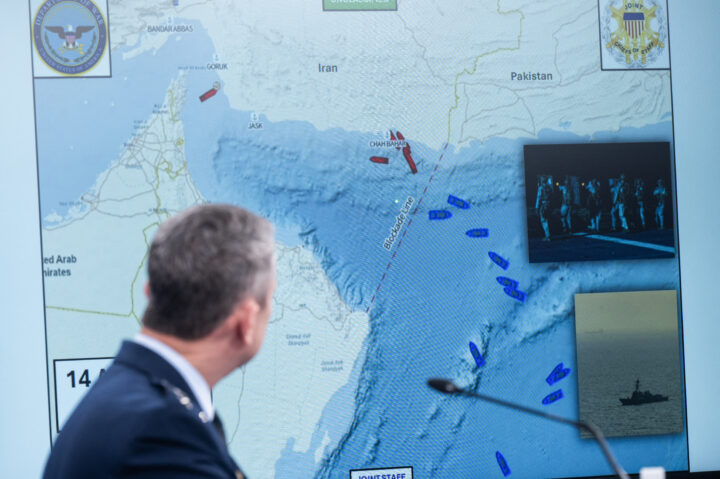
Chairman of the Joint Chiefs of Staff Gen. Dan Caine speaks as a map of the Strait of Hormuz is displayed during a press briefing at the Pentagon in Washington, DC, on April 16, 2026.
President Donald Trump on Tuesday walked back his announcement, made the previous day, that the U.S. would institute a 20% fee on cargo transiting the Strait of Hormuz, saying the toll would be replaced by trade deals with Gulf states.
Trump, having hosted Iraqi Prime Minister Ali al-Zaidi at the White House Tuesday morning, wrote on Truth Social that his change of heart was “based on highly productive conversations with Middle East leadership,” and that the deals “will be MASSIVE but, at the same time, extraordinarily good for them, and their future.”
Trump did not name specific countries, provide figures or outline a timeline for the new arrangement.
Trump reiterated in his post that the U.S. blockade, reinstituted on Tuesday, will remain in place on Iranian ships and cargo.
The reversal follows a rapidly escalating military exchange in the Gulf: The U.S. carried out a third consecutive night of strikes against Iranian targets early Tuesday. Iran, in turn, claimed to have struck and disabled two tankers in the strait and fired on Bahrain, Jordan and Kuwait.
‘Don’t trust, but verify,’ Sen. Blumenthal said of Washington’s discussions with Islamabad
Jacquelyn Martin - Pool/Getty Images
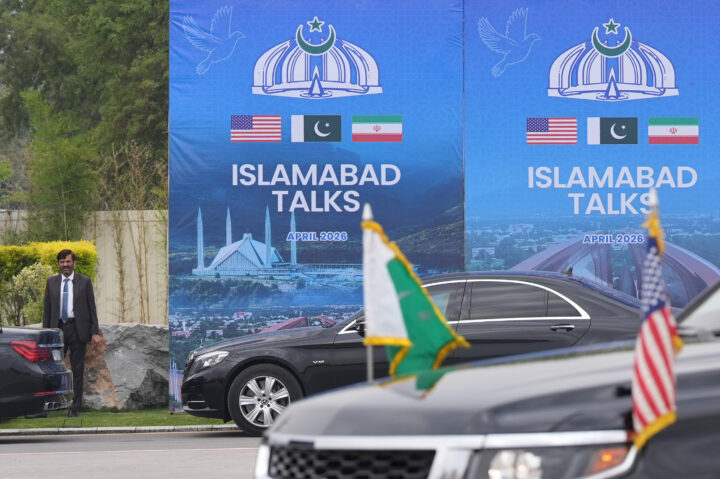
Vice President JD Vance arrives for talks with Iranian officials on April 11, 2026 in Islamabad, Pakistan.
Lawmakers are expressing skepticism over Pakistan’s expanding role in the Middle East, cautiously welcoming its involvement in U.S.-Iran negotiations while questioning its defense aspirations in the region and whether it can truly serve as an impartial intermediary — even as the Trump administration increasingly engages with the country.
Pakistan has taken on a more prominent role in Middle East geopolitics in recent months, deepening defense ties with Gulf states — including signing a mutual defense agreement with Saudi Arabia in September 2025 and nearing a potential security pact with Qatar — while also positioning itself as a key intermediary between Washington and Tehran.
Islamabad’s involvement in the negotiations has helped facilitate a ceasefire between the U.S. and Iran, even as Pakistan has taken steps to support Iran’s economy, including opening transit routes that allow it to import goods amid the conflict.
President Donald Trump has spokenly highly of Pakistani Prime Minister Shehbaz Sharif and maintains close ties with army chief Asim Munir, who nominated Trump for a Nobel Peace Prize for brokering a ceasefire between India and Pakistan in May 2025. Munir has since been invited to a private White House lunch and later to the Oval Office alongside Sharif — part of a longstanding pattern of close ties between U.S. presidents and Pakistani military leadership.
However, Islamabad’s posture toward Israel has not been as warm: Israel and Pakistan do not share diplomatic relations and Pakistan continues to strongly back the Palestinian cause. Islamabad has also refused to recognize or allow its citizens to travel to Israel. In a since-deleted tweet earlier this month, Pakistani Defense Minister Khawaja Asif called Israel “a curse for humanity” and a “cancerous state.”
Sen. Richard Blumenthal (D-CT) said that despite Pakistan’s complicated track record, the U.S. should “welcome” any “constructive role” it is willing to play — while remaining vigilant.
“I think the approach has to be: don’t trust, but verify,” Blumenthal told Jewish Insider. “[Pakistan] has certainly been a somewhat ambiguous force in many ways. They’ve been disruptive to some relationships. They’re a nuclear-armed power, but they are definitely a force, and if they can play a constructive role here we should welcome it. It doesn’t mean that we have to accept their word on everything they do or say.”
Rep. Tim Burchett (R-TN) struck a similarly cautious tone, questioning whether any actor in the region can be considered a truly neutral mediator.
“I’m not sure if anybody over there is an honest broker, to tell you the truth,” Burchett said. “They’ll all side with the winner, and that’ll be us when it’s all over, because they need those American dollars.”
Burchett warned that Pakistan’s growing engagement with Washington “could” strain U.S. ties with India.
“India has been a strong ally of ours, so I think we need to be very careful about that,” he said. “But I think Trump understands that, and he’s going to keep that in mind. Him and [Indian Prime Minister Narendra] Modi are fairly close.”
Rep. Brad Sherman (D-CA) was more critical, arguing that Pakistan’s role stems from its close ties to Iran — a dynamic he said raises concerns.
“[Pakistan has] good relations with Iran, which doesn’t speak well of them,” Sherman said. “I mean, I don’t have any friends of mine who engage in terrorism. So, you make peace with your enemies, not with your friends, so certainly we would like to have more support from Pakistan than we have.”
Sherman also warned that deepening U.S.-Pakistan ties could have consequences for Washington’s relationship with New Delhi.
“If we grow our ties with Pakistan to the point that we’re not calling upon them to clamp down on [hostility toward Israel] and other terrorist groups, then it would [hurt the U.S.-India relationship],” he said. “If it goes to the point that we [the U.S.] forget that there are terrorist groups that are finding haven in Pakistan and that Pakistan should be doing more to clamp down on them, then I will be upset and Modi will be upset.”
He further expressed concern over Pakistan’s expanding defense relationships in the region, cautioning that “you certainly don’t want Pakistan sharing nuclear weapons technology with Saudi Arabia or anyone else.”
Sen. John Cornyn (R-TX), meanwhile, suggested the U.S. may not have a choice as it faces limited options in choosing a mediator. “I don’t think we have a lot of alternatives,” he said. “I don’t think we’re in a position to be too picky in terms of interlocutors. I hope it works.”
Foreign policy experts have also expressed caution over Pakistan’s expanded role and the Trump administration’s apparent friendliness with Islamabad.
“The Trump administration’s Pakistan policy suffers from deep historical amnesia,” said Sadanand Dhume, a senior fellow at the American Enterprise Institute and columnist for The Wall Street Journal. “It appears as though the U.S. has decided to completely ignore decades of painfully learned lessons about Pakistan’s propensity to host anti-American and anti-Israeli terrorists. The Trump administration also risks upturning a robust U.S.-India relationship built over decades by Republican and Democrat administrations alike.”
“Pakistan is one of the world’s most strident critics of Israel,” Dhume added. “Pakistan’s obsessive hatred of the Jewish state masks the Islamic nation’s profound failures, including an inability, so far, to allow democracy to take root and a moribund economy that makes Pakistan one of the poorest countries in south Asia.”
He added that Islamabad’s broadening defense ties are in part due to a growing “insecurity following Israeli strikes on Qatar, and a widespread perception that the Pakistani Air Force performed credibly in a four-day-conflict with India in May 2025.”
Edmund Fitton-Brown, a former British diplomat and senior fellow at the Foundation for Defense of Democracies, noted that Pakistan’s emerging defense alignment in the region is based on its “historically close relationship with all the Arabian Peninsula countries because of geographical proximity, religious compatibility and the complementarity of small, wealthy countries with labor shortages and a populous poorer country that exports labor.”
Fitton-Brown said that “Qatar is especially attractive to religiously conservative Pakistani expats.” He added that the current conflict between the U.S. and Iran has “driven [Gulf Cooperation Council] countries closer to each other” and that Qatar has sought to bring “Saudi Arabia into a Sunni Islamist axis with Turkey and Pakistan.”
Blaise Misztal, vice president of the Jewish Institute for National Security of America, said that the Iran war has underscored certain Gulf states’ vulnerability to conflict despite U.S. security guarantees, presenting a need to seek multiple defense agreements.
He noted that prior to the Iran war, “reports suggested an even bigger agreement lashing Pakistan, Qatar, Saudi Arabia and Turkey all together into a defense pact.”
“The fact that the idea appears to have been revived should be a warning to Washington that all the gains that it had made in demonstrating American strength and resolve and convincing Gulf countries that only the United States can provide for their security are already beginning to evaporate as the region contends with the possibility of Trump cutting a deal that leaves the Iranian regime in place and in control of the Strait of Hormuz,” Misztal said.
Frustrated UAE leaders are questioning the ‘impotence’ of countries like Egypt — and warn that silence on Iranian aggression will push the Gulf closer to U.S., Israel
Gallo Images/"USGS/NASA Landsat data processed by Orbital Horizon"
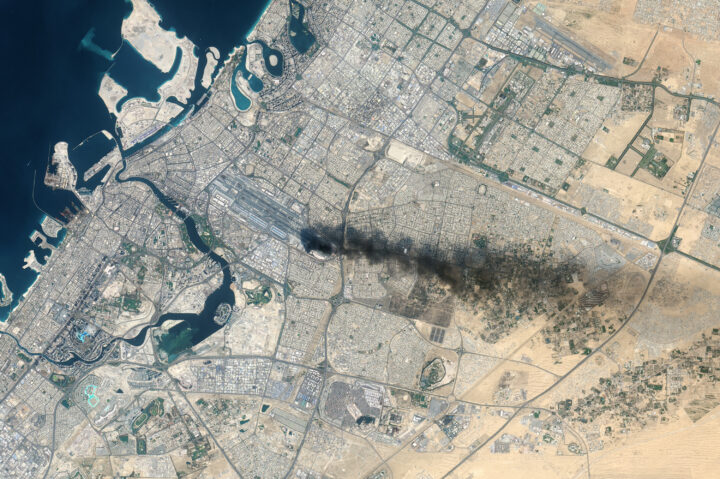
Satellite view of Dubai International Airport after a drone strike ignited a fuel tank fire. on March 16, 2026.
The United Arab Emirates has been publicly expressing its disappointment in Arab League countries like Egypt for not showing or expressing very little support for Gulf states under attack from Iran, a dynamic playing out more quietly in other Gulf states, as well.
In a post on X on Sunday that received significant attention, Anwar Gargash, an advisor to the UAE President Mohamed bin Zayed, said that “Iran’s brutal aggression against the Arab Gulf carries profound geopolitical repercussions … and the result is to bolster our national capabilities and the joint security, as well as to solidify our security partnerships with Washington.”
When French former diplomat Gérard Araud criticized Gargash’s approach, writing on X that “it means deepening your dependence on a country that has led yours into a disastrous conflict without caring about your interests,” Emirati Foreign Minister Abdullah bin Zayed backed up Gargash, responding: “We will never be blackmailed by terrorists.”
In subsequent posts, Gargash not only said that Iran’s attacks are bringing his country closer to the U.S., but criticized other Arab countries for not aligning themselves with the Gulf.
“Where are the joint Arab and Islamic institutions, chief among them the Arab League and the Organization of Islamic Cooperation, while our countries and peoples are subjected to this treacherous Iranian aggression? And where are the ‘major’ Arab and regional countries? … The Arab Gulf states were a support and partner to all in times of prosperity… So where are you today in times of hardship?” Gargash wrote.
As such, he argued, “in absence and impotence, it is unacceptable later to speak of the decline of the Arab and Islamic role or to criticize the American and Western presence.”
On Wednesday, Gargash followed up by distinguishing “those who offered genuine support” from “those who settled for statements without action.”
“The Emirates has proven its ability to confront and endure, and it does not need equipment and troops as much as it needs clarity of positions and knowledge of who can be relied upon in times of hardship,” he added.
Hussain Abdul-Hussain, a research fellow at the Foundation for Defense of Democracies and author of The Arab Case for Israel, told Jewish Insider that the UAE is not the only Gulf state that is expressing resentment towards Arab League states at this time, saying that similar messages have been published in Qatari newspaper editorials and have come out of Kuwait.
Some of the targets of that anger, he said, are Egypt and the Arab League, whose secretary-general, Ahmed Aboul Gheit, is an Egyptian diplomat.
“Gulf governments expected more denunciations of Iran as an aggressor. It took [Egypt] five days to say a word. The Arab League hasn’t met; they usually hold emergency summits and haven’t called for one. The foreign ministers met over Zoom and issued a statement that was a nothingburger,” Abdul-Hussain said.
While Egyptian President Abdel Fattah El-Sisi denounced the Iranian attacks and visited the Gulf, his remarks came across as weak, while Aboul Gheit called the attacks “audacious,” stopping short of a full denunciation, Abdul-Hussain argued.
“Even the adjectives they’re using are soft” in the eyes of Gulf leaders, Abdul-Hussain said.
The media in Egypt and Algeria, Abdul Hussain said, are showing “happiness … that Israel is being pounded. They’re happy with what Iran is doing and no one really seems to care about the Gulf states. The Gulf took 84% of the [Iranian] missiles, as opposed to Israel, which took 16%, and they still can’t straightforwardly say Iran is a problem?”
While Gargash did not specifically mention Israel, Abdul-Hussain interpreted Gargash’s remarks as meaning, “If we in the Gulf can’t rely on you Arabs and Muslims, we will have to find other allies to defend ourselves. That clearly means the U.S. and Israel.”
“The Emiratis feel vindicated, that they were right to move forward and seek their interests with Israel, because look at [other Arab states] now,” he added.
Prominent Emirati media personality Jamal Al Mulla said in a recent episode of his podcast “Arab Cast” that “the Gulf is hurt and will not forget how fellow Arab countries let it down.”
Al Mulla compared the current conflict to the 1991 Gulf War, when only 12 out of 22 Arab League members voted to condemn Iraq for invading Kuwait — “six Gulf countries and the six others were bought off by wealthy Gulf governments.”
“This round, the line is even clearer since aggression is not by an Arab League member against another, but by a non-Arab foreign country against Arab countries, and yet, the Arab League is shameful and so are countries like Iraq, Algeria, Sudan’s Burhan government and western Libya’s government,” he said.
Al-Mulla said that “when any Arab government wants not to take a position on anything, it inserts the Palestinian cause into its statement.”
Arab countries are “always citing Palestine as a distraction,” he added, and recounted that, in 1991, Palestinian leader Yasser Arafat told the Arab League that “the Kuwaiti problem will be solved only after the Palestinian cause.”
“When the shooting stops, I expect a few Gulf countries to rush to normalization with Israel. My money is on Kuwait, perhaps Saudi Arabia too,” Al Mulla said.
Abdul-Hussain agreed with Al-Mulla that Kuwait would return to its past pro-American stance and normalize relations with Israel.
“People in the Gulf were expected to support the Palestinians at all times during the Gaza war, with money, humanitarian aid, politically and diplomatically, and they get nothing in return,” Abdul-Hussain said. “I think they’re really hurt.”
Abdul-Hussain said that Hamas and the Palestinian Authority have not robustly denounced Iran. After initially only condemning the U.S. and Israel, Hamas released a statement two weeks into the war against attacks on the Gulf by Iran — one of its patrons — under pressure from Qatar, another of its patrons. The Palestinian Authority released a statement on the first day of the war expressing solidarity with the Gulf states and calling for de-escalation.
“The thinking in the Gulf is that this time, it’s our turn. We’re the victims. The Palestinians can wait,” Abdul-Hussain said.
If the reports are true, the South Carolina senator said, ‘there will be a dramatic rethinking on my part’

Anna Moneymaker/Getty Images
Sen. Lindsey Graham (R-SC) in the Senate Judiciary Committee on January 30, 2025 in Washington, D.C.
Sen. Lindsey Graham (R-SC) warned on Thursday that he would be “dramatically rethinking” the “nature of” the U.S. alliance with Saudi Arabia and other Gulf states if they “intervened on behalf of Iran to avoid decisive military action” by President Donald Trump against the Iranian regime.
Graham made the comments in a post Thursday morning on X in response to reports that Gulf states including Saudi Arabia, Qatar and Oman urged Trump against striking Tehran to avoid disrupting oil markets and sparking broader regional conflict, and without a clear succession plan for regime change.
The Saudis have also told the Iranians that they would not get involved in a potential conflict between the U.S. and Iran, nor would they allow the U.S. to use their airspace for strikes targeting the regime, The Wall Street Journal reported Tuesday.
“All the headlines suggesting that our so-called Arab allies have intervened on behalf of Iran to avoid decisive military action by President Trump are beyond disturbing. The ayatollah’s regime has American blood on its hands. They are slaughtering people in the streets,” Graham wrote on X. “If it is accurate that the Arab response is ‘action is not necessary against Iran’ given this current outrageous slaughter of innocent people, then there will be a dramatic rethinking on my part regarding the nature of the alliances now and in the future.”
Speaking to reporters at the Capitol on Thursday morning, Graham rejected the notion that Trump was reversing course on striking Iran. “There are a lot of headlines out there that are, in my view, not accurate. … President Trump’s resolve is not the question. The question is when we do an operation like this, should it be bigger or smaller? I’m in the camp of bigger.”
“Time will tell. I’m hopeful and optimistic that the [Iranian] regime’s days are numbered,” the South Carolina senator said of what’s to come.
Graham revealed in a post on X later Thursday that he is on his way to Israel to meet with Israeli Prime Minister Benjamin Netanyahu “at this crucial time in the history of the Middle East.”
“The goal is to build on the historic opportunities created by President Trump’s unprecedented leadership, to stand up to evil, and to support the people who are sacrificing for freedom,” Graham wrote of the visit. “The Trump-Netanyahu alliance has thus far been one of the strongest partnerships in the history of the U.S.-Israel relationship, and I am hopeful it will pay dividends in the near future.”
“We live in a time of great consequence with the Middle East on the verge of previously unimaginable change,” he added. “Standing together and following through on our commitments only makes us stronger.”
Please log in if you already have a subscription, or subscribe to access the latest updates.
 Continue with Google

 Continue with Apple