



































































The study shows how unions are turning away from advocating for higher wages and using their institutions to foment attacks against Israel
ANDREW THOMAS/Middle East Images/AFP via Getty Images
A group of faculty, staff, and students of the George Washington University who had met in the yard where there was a pro-Palestinian encampment last year, in May 8, 2025 in Washington D.C., march to the White House to show that they stand together.


 Add JewishInsider on Google
Dysfunctional union governance is leaving some Jewish faculty and graduate students marginalized and unrepresented by the labor organizations meant to advocate for them, a report released Wednesday by the Academic Engagement Network and the Anti-Defamation League documents.
The report, “A Crisis of Representation: Antisemitism and Inclusion in Higher Education Unions,” highlights how activist factions have used low-turnout union elections to push anti-Israel positions without broad member buy-in — often at the expense of Jewish members who say they have faced targeted attacks.
One union member interviewed for the report said, “I no longer feel that the national organization can represent me equally … Union leadership has not addressed antisemitism with any seriousness or clarity.”
Another said they resigned after “the climate in my union local was quickly becoming toxic for Jewish members. … I, myself, was labelled a ‘Zionist’ and ousted from a leadership position.”
The report comes following efforts by several major academic groups to change their bylaws to back academic boycotts of Israel in the aftermath of the Oct. 7, 2023, terrorist attacks and ensuing Gaza war. The American Association of University Professors led this shift in 2024; Since then, the organization hosted a webinar on “scholasticide in Palestine,” while requests from Jewish organizations to include differing perspectives in its programming allegedly went unanswered.
Several graduate student unions have similarly adopted positions hostile to Israel. The report highlights Cornell Graduate Students United, which adopted a statement in 2025 endorsing a boycott of Israeli academic and cultural institutions and affirming Palestinians’ “unequivocal human right to resist oppression by any means necessary,” a statement that many Jewish people see as a call to violence.
The report warns that this trend pulls unions away from their historical orienting goals such as wages and member trust. It recommends steps for union members, leadership and university administrators to improve governance, transparency and member diversity.
“Unions are strongest when all of their members believe they are represented fairly and can participate meaningfully,” said Miriam Elman, executive director of AEN, a network of faculty and staff countering antisemitism on campus. “When Jewish faculty and graduate students feel they must remain silent, disengage, or conceal aspects of their identity in order to participate, unions risk undermining the solidarity and equal representation at the heart of their mission.”
Officials and analysts warned that Hamas is seeking to cede administrative control of Gaza while retaining its weapons and remaining the dominant force in the enclave
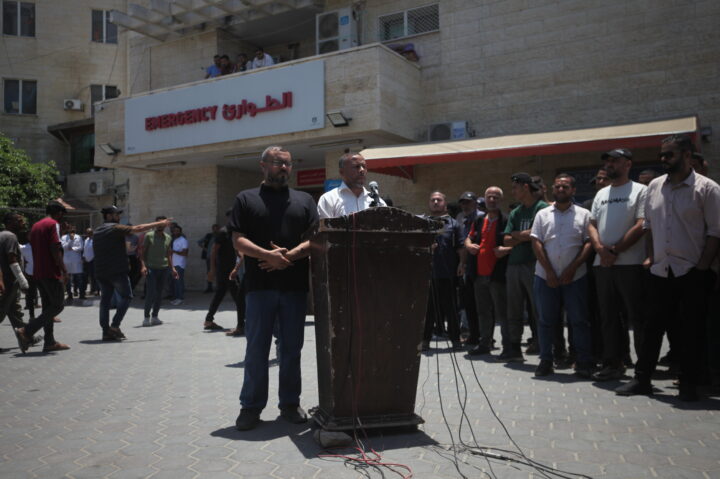
Photo by Moiz Salhi/Anadolu via Getty Images
Hamas spokesperson Hazem Qassem and Director of the Government Media Office in Gaza Ismail Al-Thawabta deliver a press statement following the announcement that the head of the Government Emergency Committee had resigned and the committee had been dissolved as part of the transfer of governance in the Gaza Strip to the National Gaza Administration Committee, on July 6, 2026.
American and Israeli officials expressed skepticism on Monday that Hamas would follow through with its pledge to dissolve its governing body that has ruled Gaza for over two decades.
Hamas announced the dissolution of the “Emergency Committee,” the terrorist organization’s governing body, and the resignation of Mohammed al-Farra as the committee’s chief on Monday. The terrorist group said that it was prepared to transfer authority to the National Committee for the Administration of Gaza (NCAG), the technocratic committee established under President Donald Trump’s Gaza peace plan and overseen by the Trump administration’s Board of Peace.
The announcement did not address whether the terrorist group would disarm, a key facet of the Gaza peace plan. Hamas’ announcement came after the Board of Peace convened a series of meetings last week to advance plans for the NCAG to take over the governance of Gaza.
The Board of Peace said that it was withholding judgment on the announcement, instead vowing to assess Hamas’ “actions, not promises, to meet the critical needs of the people of Gaza.”
“Decisions must be comprehensive with respect to the requirements as set out in the Roadmap for advancing governance, security, and transition in Gaza,” the board said in a statement. “We look forward to the successful conclusion of discussions on this Roadmap, including on the implementation mechanisms necessary to enable the National Committee for the Administration of Gaza to assume full governing authority.”
The board’s statement also noted that the “core principle” of the ongoing peace efforts in Gaza “remains one authority, one law and one weapon,” and reiterated its position that Hamas must disarm. “A genuine transfer of authority must enable the NCAG to exercise its mandate independently, including taking the administrative and governance decisions entrusted to it.”
Israeli Foreign Minister Gideon Sa’ar dismissed the move outright, saying that Hamas had agreed to give up governing control of the Gaza Strip in a largely symbolic overture while sidestepping disarmament calls.
“Hamas’s trick is simple. Hamas’s apparent willingness to ‘make room’ for a technocratic government is designed to prevent its own disarmament,” Sa’ar wrote on X. “Hamas seeks to replicate the ‘Hezbollah model’ in Gaza: a technocratic administration would be responsible for garbage collection and other municipal services, while Hamas would remain the dominant military force.”
“As long as Hamas retains its weapons, any civilian government will of course operate as Hamas dictates,” he continued. “This would allow Hamas to continue oppressing the Palestinian people in Gaza, while pursuing its jihadist war against Israel.”
Sa’ar went on to note that Israel “insists on the full implementation of the Trump plan, with its core principles being the disarmament of Hamas and all other terrorist organizations, and the complete demilitarization of the Gaza Strip.”
Elliott Abrams, who served as Iran envoy under the first Trump administration, similarly expressed doubt about the prospect of Hamas giving up its weapons and influence in Gaza.
“In my view, this is Hamas trying to become Hezbollah,” Abrams told Jewish Insider. “Hamas used to run everything, up to and including garbage collection. They were the government of Gaza. Hezbollah uses a different mode: there is a Lebanese government providing public services, so Hezbollah can just concentrate on being an army and a terrorist group.”
“This offer by Hamas does not suggest that they will disarm, and as Board of Peace chairman [Nickolay] Mladenov has said, without Hamas disarmament there will be zero progress,” he continued.
Steven Cook, a senior fellow at the Council on Foreign Relations, said that he believes Hamas is seeking to retain power and authority in Gaza without having to govern or be held accountable for the new government’s potential shortcomings.
“[Hamas] will cede governing to technocrats who represent no one but will retain its arms to ensure that Hamas remains the center of power and authority in Gaza,” Cook said.
Analysts argued that unless Hamas disarms, the group will remain in power and progress on the president’s Gaza plan will remain stalled. Jonathan Ruhe, a fellow at the Jewish Institute for National Security of America, called the announcement from Hamas “fairly meaningless” without disarmament.
“Hamas can proclaim it’s ceding administrative authority to technocrats, but it will retain de facto power in its slice of Gaza as long as it still has a monopoly on violence there,” Ruhe said. “Until and unless Hamas actually disarms, voluntarily or otherwise, anything else the group says or does is fairly meaningless in terms of the peace plan’s vision for stabilization, reconstruction, and new governance in Gaza.”
Ruhe also suggested that Hamas made the announcement in an effort to shift the pressure toward Israel without fulfilling its own commitments.
“The group’s official line is telling. Hamas cynically frames this step as removing the pretext for Israel’s ‘occupation’ of Gaza, even though it knows full well that demilitarization is a two-sided commitment, not a unilateral obligation on Israel,” Ruhe said. “This shows how Hamas wants to cherry pick parts of the Gaza peace plan, in order to put pressure on Israel, but without fulfilling its own commitments to disarm under that same plan.”
Neomi Neumann, an adjunct fellow at The Washington Institute for Near East Policy, similarly argued that Hamas is seeking to put the “blame game into an Israel area.”
“I think their [Hamas] message is: ‘We have given up the government in Gaza, and now Israel is on the side of preventing the progress,’” Neumann said. “For Hamas, they understand that if they will stay with the same position. [At] the end of the day, Mladenov will declare [Hamas] as a rejectionist organization, so as a result I think that Hamas is trying to frame the move … in order to survive.”
Neumann expressed skepticism that Hamas would give up its weapons in addition to governance in Gaza, adding that there is a “very low” chance that Hamas changes its mind. However, she said, “you can never say never.”
“We also thought that [Hamas] will never bring back the hostages,” Neumann said. “I think that if the United States and Turkey and Qatar will push Hamas very hard and put pressure on Hamas, they will say they are willing to give up the heavy weapons, but they won’t find it easy to say they are willing to give up their guns because everybody can kill them and in the end of the day they know they need to continue to control the Gaza Strip with weapons.”
Still, she noted that the situation remains a “disaster” from the Israeli perspective.
“From Israel’s point of view, I think it will be a disaster, because they [Hamas] just will get stronger.” Neumann said. “Iran will continue now to give much more money to Hamas. They [Hamas] won’t let any other power to emerge and to get strong, and it will be very complicated.”
Experts said the White House needs to clarify how governance and security structures will operate in Gaza moving forward
Majdi Fathi/NurPhoto via Getty Images
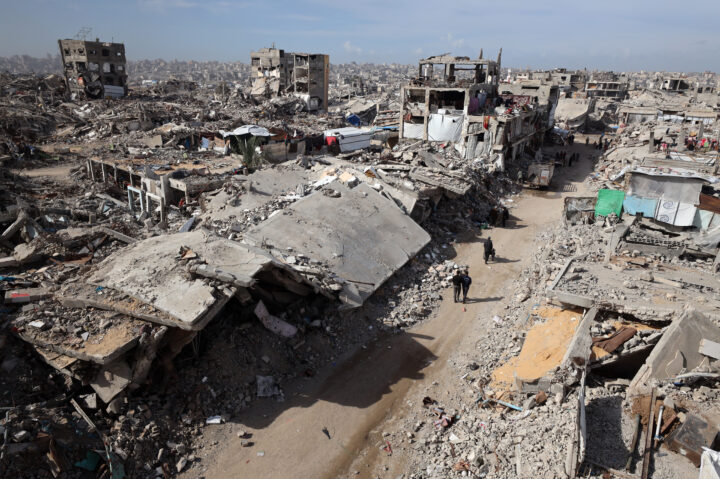
A photograph shows destroyed buildings in Jabalia, in the northern Gaza Strip, on December 9, 2025.
It has been nearly three months since President Donald Trump unveiled his 20-point peace proposal for Gaza, but officials have yet to explain how key aspects would function in practice or how Hamas’ entrenched presence in the enclave will be addressed.
Under the plan, Gaza’s governance would be overseen by a Trump-led “Board of Peace,” followed by an international executive board expected to include Jared Kushner and White House Special Envoy Steve Witkoff. Beneath the board would sit a technocratic Palestinian government of approximately a dozen Palestinians who are not affiliated with Hamas.
Trump initially planned to announce board members by Christmas, but that timeline has slipped to early next year. On Thursday, the White House proposed that Nickolay Mladenov, a Bulgarian diplomat and former UN Middle East envoy, join the Trump-led board as an on-the-ground representative in Gaza. In such a role, Mladenov would be expected to work with a future Palestinian technocratic government.
But as Trump focuses on hand-picking members for his ideal Palestinian governing body, experts told Jewish Insider that the administration has offered little clarity on how this layered structure would actually govern Gaza — or, more consequentially, how it can operate while armed Hamas terrorists remain in control of much of the enclave.
“It just hasn’t been made clear on the issue of governance or security how this stuff is actually going to work, or how Hamas is going to be persuaded to step aside,” said Aaron David Miller, a senior fellow at the Carnegie Endowment for International Peace. “Is [the Board of Peace] the overriding executive authority that has the final say in Palestinian governance and security? If that’s the case, it’s going to fail because none of these members of the Board of Peace have the time or inclination to make those decisions.”
Israel currently controls 53% of Gaza, as demarcated by the “Yellow Line,” while Hamas maintains control in the remaining western part of the enclave. Despite heavy losses, Hamas fighters continue to operate and have given no indication of relinquishing power. Miller called the task of ensuring Hamas is “stripped of its weapons” an “extremely difficult” objective.
“There is no indication that Hamas is ready to meet its commitments to disarm,” said Dana Stroul, research director at The Washington Institute for Near East Policy. “If anything, [Hamas’] surviving leaders are deliberately muddying the messaging to make their terrorist organization appear reasonable and a legitimate representative of the Palestinian people.”
To prevent a Hamas resurgence, Trump has made the deployment of an International Stabilization Force (ISF) a central pillar of the plan. But the administration has yet to define the composition of the force. Israel has objected to Turkish participation, and while countries such as Azerbaijan and Indonesia have been floated as part of the force, it lacks definitive commitments.
Elliott Abrams, who served as Iran envoy during Trump’s first term, told JI that the White House has yet to “seriously address the question of who would maintain security in Gaza and prevent a Hamas recovery.”
“To answer that question you have to answer, ‘Who is willing to shoot at Hamas terrorists?’” said Abrams. “The ISF proposal was unrealistic in that it never even asked this, much less answered it. The idea that Muslim or European or U.N. forces would shoot [at Hamas] was never realistic.”
Miller echoed that concern and questioned how an international force would respond in the event Hamas fighters “emerge from tunnels crossing the line of control.”
“Would forces from Arab and Muslim countries fire on Palestinians? Will they be able to maintain their legitimacy if the Israelis are unhappy or dissatisfied with the response of this force and choose to undertake a response of their own?” said Miller. “That’s an extraordinarily challenging set of problems that need to be unpacked.”
The Trump administration indicated on Thursday that it is planning to appoint a two-star American general to command the stabilization force. But experts said the administration should first lay out a concrete plan of what it expects from ISF participants.
“Who heads [the stabilization force] is much less important, frankly, then what it’s going to do,” said Miller. “It doesn’t matter who sits on top of the organization or the construct if it’s feckless, weak and riddled with contradictions and dysfunction.”
Stroul agreed, adding that without “clarity on the missions and activities” of the ISF, the force will “encounter challenges.”
“Without a clear plan of responsibility for security on the ground, it is difficult to imagine international organizations and funding coming into Gaza to start the work of rubble clearing and reconstruction,” said Stroul.
Please log in if you already have a subscription, or subscribe to access the latest updates.
 Continue with Google

 Continue with Apple