































































Netanyahu: Attacks were Israeli Air Force’s largest flyover in history
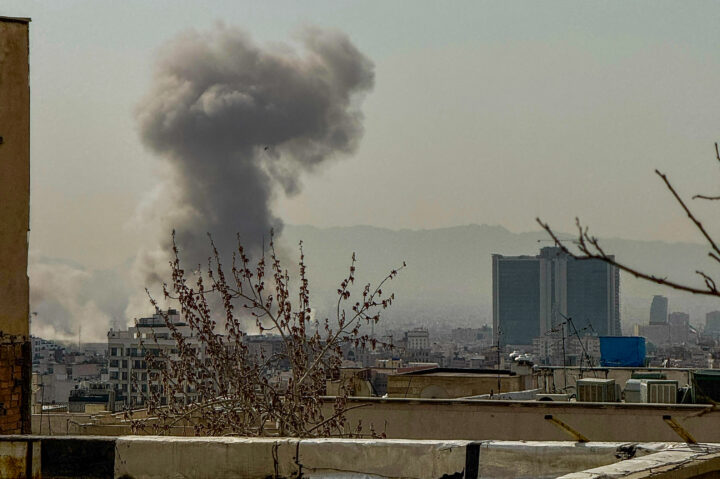
Mahsa / Middle East Images / AFP via Getty Images
A plume of smoke rises over Tehran after a reported explosion on February 28, 2026.


 Add JewishInsider on Google
The U.S. and Israeli militaries planned attacks on Iran for months, marking “unprecedented cooperation,” Lt.-Gen. Eyal Zamir, the IDF’s chief of staff, said on Saturday, hours after the launch of what Israel has called Operation Roaring Lion and the U.S. has called Operation Epic Fury.
“In recent months, under the direction of the political leadership, I have led — in coordination with my counterparts, the chairman of the Joint Chiefs of Staff and the commander of CENTCOM — a deep and comprehensive joint operational planning process. This reflects unprecedented cooperation between the IDF and the United States military,” Zamir said.
An IDF official speaking on condition of anonymity said that the two militaries “worked for thousands of hours” to increase its target bank “by hundreds of percent.”
The plan centered on “an intelligence effort … to identify an operational opportunity at the moment when senior regime officials would convene,” the official said. The IDF struck three such gatherings simultaneously and killed “several senior figures.”
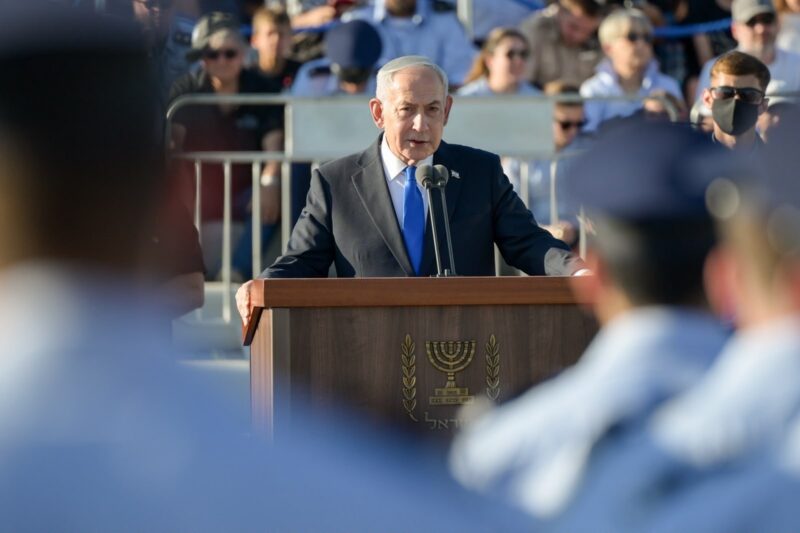
Israeli Prime Minister Benjamin Netanyahu confirmed in a video statement that one of those targets was Ayatollah Ali Khamenei, Iran’s supreme leader, saying that the IDF likely killed him.
“Today, in a surprise attack, we destroyed Iranian Supreme Leader Ali Khamenei’s compound in the heart of Tehran,” he said. “For three and a half decades, this tyrant sent terror throughout the world, immiserated his nation and worked all the time on his plan to destroy Israel.”
“That plan is gone and there are many signs that the tyrant is gone,” Netanyahu said. President Donald Trump later confirmed the news.
Netanyahu said that Israel plans to hit “1,000 terror sites” in the coming days.
Directing his remarks at the people of Iran, Netanyahu said, “Soon your moment will come in which you must go out on the streets … Help has arrived and now the time has come for you to unite for a historic mission … to bring down the regime and ensure your future.”
The strikes on Iran’s missile array and air-defense systems by 200 fighter jets were the Israeli Air Force’s largest-ever flyover, the IDF Spokesperson’s office said.
The IAF fighter jets struck 500 targets throughout western and central Iran, such as one in Tabriz, which was used for Iran’s surface-to-surface missiles. Another strike targeted an advanced SA-65 aerial-defense system near Kermanshah in western Iran, the IDF said.
The IDF sent warnings via social media to Iranian civilians living near weapons production and military infrastructure facilities: “Dear citizens, for your safety and well-being, we urge you to immediately evacuate these areas and remain outside of them until further notice. Your presence in these locations puts your lives at risk.”
Iran launched missiles and attack drones at Israeli population centers throughout the day, including ones that include cluster munitions, the IDF said.
“Cluster weapons are designed to disperse over a large area and maximize the chances of a harmful strike. Iran goes to great lengths in trying to maximize harm to Israeli civilians,” Nadav Shoshani, the IDF international media spokesperson, stated.
Zamir said that Operation Roaring Lion is “a significant, decisive, and unprecedented operation, to dismantle the capabilities of the Iranian terrorist regime — capabilities that constitute an ongoing existential threat to the security of the State of Israel. This is an operation to secure our existence and our future here, in the land of our forefathers, for generations to come.”
Since last year’s Operation Rising Lion, as the IDF called the 12-day war with Iran, “the radical Iranian terrorist regime has not abandoned its vision or its hostile intentions to advance its plan to destroy Israel. It has continued to promote its nuclear project, restore and accelerate ballistic missile production, and destabilize the region through the funding and arming of terrorist proxies,” Zamir said.
The IDF chief of staff also tied the operation to the holiday of Purim, which begins on Monday night, and celebrates the Jews of the Persian empire overcoming an attempted genocide.
“The Book of Esther teaches us that responsibility for our destiny rests first and foremost in our own hands — in courage, initiative, unity and the willingness to fight for our right to live here in freedom and in peace,” Zamir said. “Soldiers and commanders of the IDF… carry with you the vision of our forefathers.”
Shoshani wrote in a blog post that the timing of the operation was due to “a dangerous acceleration in [Iran’s] capabilities,” including long-range missile production and continued proxy funding.
“Israel reached a point where the threat was no longer ‘developing,’” Shoshani wrote. “The threat was direct and imminent.”
The objective of the strike, Shoshani said, was to “fundamentally reduce and degrade Iranian terrorist regime capabilities, eliminating long-term existential threats to the state of Israel.”
The IDF also called up 70,000 reservists to serve on Israel’s borders, the West Bank and Gaza to stop any infiltration attempts, as well as search and rescue forces prepared to go to the site of any Iranian missile strikes.
Israelis throughout the country spent the day going in and out of safe rooms and bomb shelters at the sound of air raid sirens, which blared more frequently in Israel’s densely populated center, reflecting the area Iran targeted.
IDF Home Front Commander Maj.-Gen. Shay Kleper said that “past experiences prove that the public’s strict following of protocol has saved many lives. The grit and responsibility of everyone is a key element in countering the threat.”
Israeli Foreign Minister Gideon Sa’ar spoke about Israel’s decision to strike Iran and the operation’s objectives with 17 of his counterparts, in phone calls to Argentina, Austria, Germany, India, Italy, Hungary, the Czech Republic, Latvia, the European Union, France, Canada, Australia, Ecuador, Greece, Ethiopia, Singapore and North Macedonia.
Lt. Gen. Eyal Zamir reportedly said reaching a deal is ‘in Netanyahu’s hands’ and advocated for the Israeli PM to accept the latest proposal

THOMAS COEX/AFP via Getty Images
Israeli army major general Eyal Zamir looks on as he stands near the Israel-Gaza border in the southern kibbutz of Nahal Oz on April 20, 2018.
IDF Chief of Staff Eyal Zamir said in remarks during a visit to a Haifa naval base on Sunday that the Israeli army has met its objectives in its war with Hamas in Gaza, “including deeply damaging Hamas,” and “as a result of the military pressure, we created the conditions for the release of the hostages.”
According to Israel’s Channel 13, Zamir also said in private conversations, “There is a deal on the table, it’s the improved [U.S. Middle East envoy Steve] Witkoff framework,” apparently referring to the deal Hamas said it agreed to last week.
Senior Israeli officials told Israel’s Channel 12 that that deal is “no longer relevant” because it includes the release of a limited number of hostages, whereas Israel wants to see a comprehensive deal with all 50 hostages released.
Zamir said Sunday that the deal is “in [Israeli Prime Minister Benjamin] Netanyahu’s hands” and advocated for him to accept it. Zamir claimed that “there is great danger to the lives of the hostages in taking over Gaza City,” a position he held about the operation before its approval, which reportedly led to clashes with Netanyahu.
The IDF has called up tens of thousands of reservists in preparation for its takeover of Gaza City, expected to ramp up in the next several weeks, and is moving to evacuate the residents of the central Gazan city.
Top IDF and government officials have clashed on a series of issues, including the appointments of more than two dozen military officials and Zamir’s opposition to the plan to take over Gaza City and expand IDF operations in the Gaza Strip

IDF
The Chief of the General Staff, LTG Eyal Zamir, the Director of the ISA, Ronen Bar, and the Commanding Officer of the IAF, Maj. Gen. Tomer Bar, in the IAF’s Underground Operations Center, commanding the strikes in Gaza overnight between March 17th and March 18, 2025
Tensions between Israeli Prime Minister Benjamin Netanyahu and Eyal Zamir, the chief of staff of the IDF, are as high as the record-setting temperatures that have swept the region.
The IDF’s top officials and the Israeli government have clashed on a series of issues in recent days, including the appointments of more than two dozen military officials and Zamir’s opposition to Netanyahu’s plan to take over Gaza City and expand IDF operations in the Gaza Strip, which was approved by Israel’s Security Cabinet last week.
The IDF chief of staff has warned that the new approach to Gaza risks the lives of the 20 remaining living hostages in the enclave, and would further deplete the military’s resources in Gaza. The army, under strain after nearly two years of war, has — even prior to Zamir’s appointment in March — been at odds with the government over the continued exemption of the majority of the country’s Haredi population from the mandatory conscription required of most Israelis.
Israel Democracy Institute President Yohanan Plesner told Jewish Insider this morning that “historically, the relationship between the political level — prime minister, defense minister — and the top brass of the defense establishment, and mainly the IDF chief of staff, has been based on the premise that when Israel engages or embarks on significant security endeavors, operations and so on, it’s based on mutual consent,” with both parties having “de facto … veto power.”
But now, Plesner said, Netanyahu “is violating this decision-making norm that characterized the way decisions on core security [and] national security issues were made in the past.”
Plesner pointed to IDI polling conducted earlier this summer that showed Zamir being the senior official in whom Israelis had the most trust, at 68.5%. The same poll found Netanyahu with a trust rating of 40%.
The potential removal of a senior official months into his tenure “was not in the cards in the past. A chief of staff would voice their professional opinion and they wouldn’t risk being fired.”
The clash between Netanyahu and Zamir has also drawn in former Israeli Prime Minister Naftali Bennett, who is widely seen as one of the only people who could topple Netanyahu in the next election. Bennett attributed the infighting to Zamir’s opposition to the continuation of Haredi draft exemptions — an issue that has sowed division even within Netanyahu’s coalition and still threatens to topple the government.
“Instead of standing behind the army,” Bennett said, “the government has launched an attack *on* the army.”
Netanyahu has previously clashed with — and dismissed — senior military officials, most notably former Israeli Defense Minister Yoav Gallant, whom Netanyahu first tried to fire in early 2024 but was met with mass protests, before ousting him in November 2024. Last summer, Israeli media reported tensions between the prime minister and Zamir’s predecessor, Lt. Gen. Herzi Halevi, over Netanyahu’s suggestion that hostage talks had not moved forward because Hamas did not feel enough pressure from the country’s military. Netanyahu also pursued the dismissal of former Shin Bet chief Ronen Bar whom he clashed with on a number of issues — including the hostage negotiations and war strategy — citing “continuing lack of trust.”
Plesner pointed out that relations between Netanyahu and both Gallant and Halevi “very much soured around the fact that they were committed to implementing the Supreme Court ruling” that removed the Haredi draft exemption, and that Zamir, as chief of staff, similarly backs the conscription of the Haredi community as war fatigue plagues the reservists who have served hundreds of days in uniform since the start of the war.
Nearly all of the IDF’s top leaders from Oct. 7, 2023, have departed their roles, whether by choice or force, in the almost two years since the attacks. Netanyahu — who has long tried to absolve himself of responsibility for the attacks, instead blaming the military and the Shin Bet — remains the only senior government official from that time still in power. Analyst Nadav Pollak suggested that the prime minister has, since Oct. 7, been “trying to divert the blame from him to the military leadership (he didn’t know Hamas plans etc.) and as long as the focus is on the IDF leadership it’s not on Bibi.”
Now, with the Knesset out for the rest of the summer, ceasefire talks stalled and an immediate collapse of his government off the table, Netanyahu is able to buy some time — perhaps up to several weeks — as Israel’s top political and military brass game out and implement the government’s Gaza strategy. Meanwhile, observers will watch to see how Zamir will carry out Netanyahu’s orders.
Maj. Gen. Eyal Zamir lived in D.C. from 2021 until 2022
THOMAS COEX/AFP via Getty Images
Israeli army major general Eyal Zamir looks on as he stands near the Israel-Gaza border in the southern kibbutz of Nahal Oz on April 20, 2018.
The Israeli government announced this weekend that Maj. Gen. (res.) Eyal Zamir, currently the director-general of the Israeli Ministry of Defense, will succeed Lt. Gen. Herzi Halevi as chief of staff of the Israel Defense Forces in March.
Zamir authored a report for the Washington Institute for Near East Policy in 2022 proposing a coordinated response between the U.S., Israel and Arab allies to counter Iranian aggression in the Middle East.
Rob Satloff, the executive director of the Washington Institute, offered strong praise for Zamir, who was a Washington Institute visiting military fellow between 2021-2022.
“The best description of General Zamir [is] he is a soldier’s soldier. Smart, instinctively insightful, doesn’t put on airs, no false modesty, no pretense,” Satloff said. “Having known and admired many of his predecessors, I am confident he will meet the unprecedented challenge faced by the IDF today.”
David Makovsky, the director of the Koret Project on Arab-Israel Relations at the Washington Institute, called Zamir “highly accomplished,” and said he’ll “have his hands full” in the new role.
He said that he believes Zamir’s current work as director-general will be an asset in his relationships with Washington, D.C, having put him in a position to work closely with the Pentagon since the Oct. 7 attack.
“He has had a very intense American immersion, I would say, since Oct. 7,” Makovsky said. “The interface with the Pentagon over weapons, the ammunition, that could only help him in the new job.”
Satloff said that, while Zamir was working with the Washington Institute, he “had the opportunity to develop good personal relations with a wide array of national security specialists that were of benefit during his wartime service as director-general of the MOD and will, I am sure, be useful in his new post.”
The director-general role would have also given Zamir “360 degree awareness in a way that soldiers are not exposed to,” Makovsky said. “Having that experience can only be helpful.”
Makovsky added that it’s significant that Israeli Prime Minister Benjamin Netanuyahu reportedly personally conducted interviews for the chief of staff role — rather than the defense minister, as has been traditional — indicating he may want to have a closer relationship with the critical military leader.
Please log in if you already have a subscription, or subscribe to access the latest updates.
 Continue with Google
 Continue with Apple