











































































Plus, Jewish leaders wary of Michigan's early primary role

Avi Ohayon (GPO) / Handout/Anadolu via Getty Images
Israeli Prime Minister Benjamin Netanyahu makes statements at Ben Gurion Airport ahead of his visit to Washington DC, where he will meet with US President Donald Trump in Tel Aviv, Israel on February 02, 2025.


 Add JewishInsider on Google
Good Monday morning.
In today’s Daily Kickoff, we report on concerns among Jewish leaders regarding Michigan’s positioning as an early Democratic primary state in the 2028 presidential nominating contest, and have the scoop on Democratic Majority for Israel’s decision to pause its endorsements of nine House Democrats who voted against aid to Israel. We talk to pollster Dahlia Scheindlin about Israelis’ understanding of anti-Israel sentiment in the U.S., and spotlight Judaica artist Debra Band, whose biblical manuscripts were acquired by the Library of Congress earlier this year. Also in today’s Daily Kickoff: Ashley Jackson, Rabbi Yitz Greenberg and Harold Grinspoon.
We also have a new on-demand Live Briefing that you can access throughout the day via our new app (on Apple and Android) and on our website.
Today’s Daily Kickoff was curated by JI Executive Editor Melissa Weiss and Israel Editor Tamara Zieve, with assists from Danielle Cohen-Kanik and Marc Rod. Have a tip? Email us here.
What We’re Watching
- With the late Sen. Lindsey Graham’s (R-SC) funeral scheduled for tomorrow in Washington, attendees will begin making their way to the capital today. Israeli Prime Minister Benjamin Netanyahu took off earlier today for Washington, where he’ll also meet with President Donald Trump tomorrow. More below.
- As tensions continue to simmer in the Middle East, Trump appeared to deescalate, halting strikes on Iranian targets over the weekend after nearly two weeks of nightly strikes. Speaking at the rescheduled White House Correspondents’ Dinner on Friday, Trump said that he didn’t think that Iranian leaders were ready to make a deal. “They are talking to us right now. They’d love to make a deal. I don’t think they’re ready to. I don’t think it’s time yet, but I’m willing to listen,” Trump said at the dinner. Read more here.
- The recalibration comes amid reports of dwindling interceptor stockpiles, as well as pushback to continued engagement among military leaders. Axios reports that CENTCOM head Adm. Brad Cooper had advocated for ending the U.S. bombing campaign around the Strait of Hormuz, arguing that the effort had reached its maximum effectiveness.
- Meanwhile, the IDF confirmed that two drones were shot down over the Jordanian border this morning, but did not say where the drones originated.
- The Atlantic Council is hosting a virtual fireside chat with Israeli Opposition Leader Yair Lapid in conversation with former U.S. Ambassador to Israel Dan Shapiro.
What You Should Know
A QUICK WORD WITH JI’S Josh kraushaar
For Democrats worried about the party’s left turn, the outcome of the presidential nominating calendar, which was approved by a Democratic National Committee panel on Friday, is something of a mixed bag. (For pro-Israel Democrats, the presence of Michigan taking center stage on the early schedule is already causing heartburn, per reporting from JI’s Matthew Kassel.)
In a boost for centrists, the nomination process is slated to lead with South Carolina, a Southern state that has long been a moderating force in the party’s presidential calendar, largely because of its sizable Black population.
But as Jonathan Martin noted in Politico, South Carolina’s first-in-the-nation status carries some unintended consequences. The state, which has typically voted after Iowa’s caucuses and New Hampshire’s primary, often played the role of choosing the nominee after the field was winnowed down by the earlier states. South Carolina has picked the primary winners in the last two decades: Barack Obama (in 2008), Hillary Clinton (in 2016) and most notably Joe Biden (in 2020) when pundits counted the former vice president out after losses in Iowa, New Hampshire and Nevada.
With South Carolina being moved to the front of the line, the state will end up narrowing down the lineup of candidates rather than having the final say on a shortlist of candidates. The changed primary calendar also puts pressure on moderate candidates to make a strong showing right away: If a leading centrist such as Pennsylvania Gov. Josh Shapiro runs for president, South Carolina suddenly becomes much more of a pivotal state, with outreach to Black voters a necessity.
SCOOP
DMFI PAC, Democratic Majority for Israel’s political arm, is pausing its endorsements of nine Democratic House members who voted this month to end all U.S. aid to Israel, underscoring the depth of its frustration even as the group also seeks to preserve relationships with lawmakers it had championed, Jewish Insider’s Matthew Kassel reports.
On hold: “Because of that vote, we are pausing our endorsement and taking your name off the list of supported lawmakers on the DMFI PAC website,” Brian Romick, the president of DMFI PAC, said in a letter to the lawmakers, the full text of which was shared exclusively with JI on Sunday. “At the same time,” he added, “our hope is that this pause will be temporary and that, through a candid conversation about the path forward, we can resume our endorsement.”
MICHIGAN MATTERS
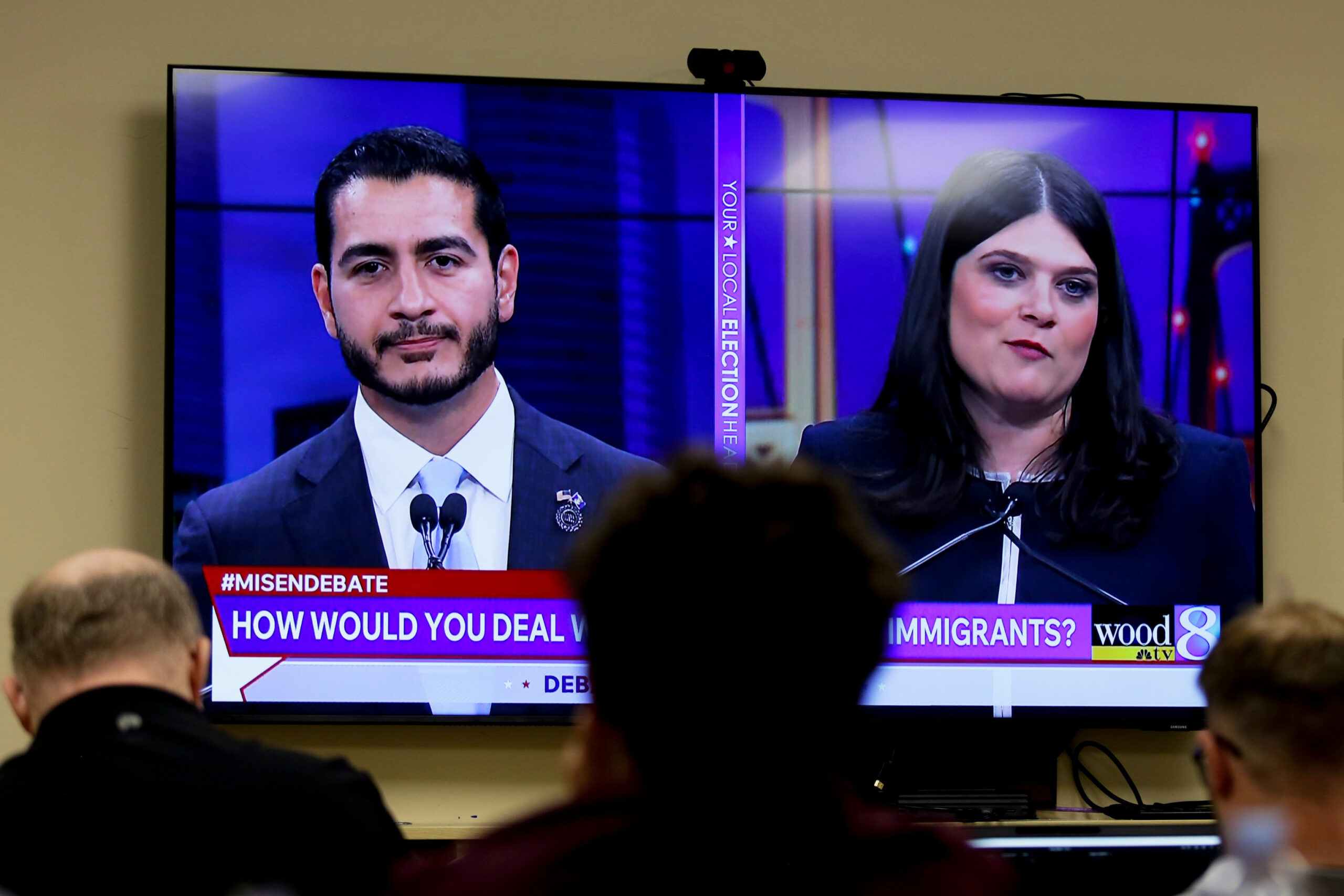
The selection of Michigan as an early Democratic primary state in the 2028 presidential nominating contest, approved on Friday by a panel of the Democratic National Committee, is prompting some concerns among Jewish and pro-Israel activists who fear the party’s sharp divisions over Israel and its recent controversies over antisemitism could create a volatile political landscape during the key contest, Jewish Insider’s Matthew Kassel reports.
Looking ahead: If the schedule is finalized, Michigan “figures to be one of the first anti-Israel or antisemitic states that has a vote,” said Dennis Bernard, a Jewish leader who advises members of both parties, told JI. The state’s Aug. 4 Senate primary — a bitter race between AIPAC-backed Rep. Haley Stevens (D-MI) and Abdul El-Sayed, whose rhetoric targeting Israel and ongoing refusal to recognize its right to exist has alarmed Jewish voters — is expected to offer an early read on how much that tension will shape 2028.
Moving the needle: With less than two weeks until Michigan’s contentious Democratic Senate primary, Michigan Gov. Gretchen Whitmer endorsed Stevens on Friday, offering a burst of momentum to the moderate Democrat’s campaign against progressive, anti-Israel firebrand El-Sayed, JI’s Gabby Deutch reports.
LEADER LIAISON

Israeli Prime Minister Benjamin Netanyahu is traveling to Washington on Monday, where he will meet with President Donald Trump and attend the funeral of Sen. Lindsey Graham (R-SC), his office announced on Friday, Jewish Insider’s Haley Cohen reports.
Honoring a friend: Netanyahu said that “Israel lost one of its greatest friends” after Graham died suddenly on July 11. The South Carolina senator’s funeral is scheduled for Tuesday at the National Cathedral in Washington.
POLLSTER PERSPECTIVE

Israelis generally don’t grasp the extent of the growing anti-Israel sentiment in the United States, Dahlia Scheindlin, an Israeli public opinion researcher and columnist, told Jewish Insider’s Marc Rod on the sidelines of the Aspen Security Forum this month.
Crying wolf: Speaking to JI hours before more than 100 House Democrats voted to cut U.S. military aid to Israel, Scheindlin said that most Israelis feel that warnings of slipping U.S. support have been repeated for years but haven’t come to fruition. “Israelis for a long time have been told ‘you have to worry about the America-Israel relationship’ and nothing ever really happened — they sort of took it for granted that the relationship would always be there, and in many ways they still do,” Scheindlin said. “From the Israeli perspective, there’s a little bit of a sense of crying wolf. We see that in the 53% who still think that the relationship will be fine.”
Policy perspective: Sen. Mark Kelly (D-AZ) said on Sunday on NBC’s “Meet The Press” that he will “always stand by Israel as a nation,” while adding that he hopes Israelis will oust Prime Minister Benjamin Netanyahu in the elections later this year.
ACCOUNTABILITY FIGHT

Shockwaves from the Tisha B’Av stabbings on the Upper West Side reverberated through New York’s Jewish and Democratic Party elected leadership on Friday, as some blamed New York City Mayor Zohran Mamdani’s invective against Israel, while others called more broadly to turn down the temperature on the rhetoric in the city, Jewish Insider’s Will Bredderman reports.
Words of warning: Of the officials who participated in a press conference outside the Modern Orthodox Jewish Center, only Assemblymember Micah Lasher — who won a primary last month to succeed Rep. Jerry Nadler (D-NY) as congressional representative for the Upper West Side — openly called out Mamdani. “When a place, and by extension the people who are inextricably linked with that place, are singled out, compared to the worst evildoers in human history, blamed for problems half a world away, the space between rhetoric and violence can vanish,” warned Lasher.
BEE’S KNEES
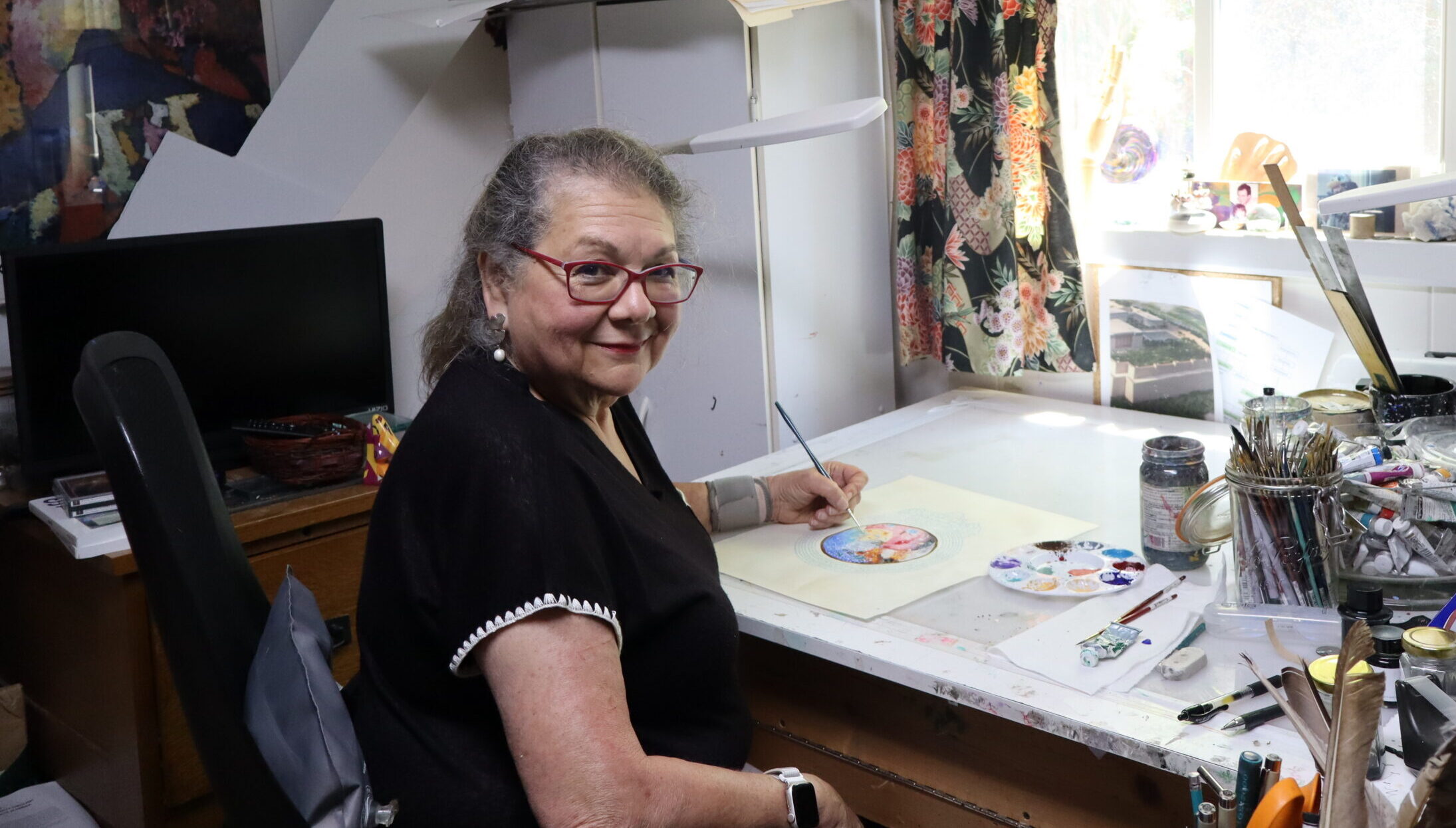
For 30 years, Debra Band built a career in health policy — but in her Maryland studio, surrounded by kosher parchment, gold leaf and an unfinished manuscript or three, she’s spent the last quarter-century quietly reviving a Jewish art form: the illuminated manuscript. Five of her books now sit in the Library of Congress’s permanent collection, Jewish Insider‘s Christina Sher reports.
Illuminating tradition: When Band first brought her Song of Songs book to the library to show its then-head of the Hebraica section, she watched him lay all 65 pages out on a long table and pull out a jeweler’s loupe. She assumed he was hunting for errors in her calligraphy, and started speaking quickly, over-explaining the iconography. In an interview with JI, Band recalled him cutting her off and saying: “Don’t worry, if anyone in the country reads this book when it comes out, it will be me. Right now, I just need to look for the honeybees.” The bees are Band’s signature; her Hebrew name is Devorah — honeybee. As a private joke with herself, she tucks a small painted bee into nearly every manuscript page she makes.
Worthy Reads
Ambassador’s Insight: In The Washington Post, Matthew Gould, who served as a British ambassador to Israel and a deputy ambassador to Iran, explains the decision-making processes of Iranian leaders. “First: Iranian leaders are focused single-mindedly on preserving their grip on power. They know that the overwhelming majority of Iranians despise them and that the people will not be forgiving if the regime is finally removed. … Second: Iran’s actions often have more to do with internal regime dynamics than with statecraft. Western governments tend to interpret Iranian actions as aimed at them. But often, they are aimed internally.” [WashPost]
Atomic Optics: In The Wall Street Journal, Matthew Kroenig and Henry Sokolski warn of the possible fallout from the U.S.-Saudi deal announced last week that could give Riyadh a civilian nuclear program. “Providing Saudi Arabia a pathway to build the capacity the U.S. Air Force is razing in Iran gives hypocrisy a bad name. It not only would make it more difficult to get Iran to restrict its own program, but also set a poor example and encourage other nuclear suppliers to misbehave. More important, it’s sure to spook Riyadh’s neighbors. … The U.S. got the United Arab Emirates to agree to forgo making nuclear fuel with the caveat that if Washington afforded any neighbor more-generous terms, the U.A.E. could renegotiate.” [WSJ]
Candidate Corner: The New Yorker’s David Remnick profiles Gadi Eisenkot as the former IDF chief of staff mounts a challenge to Israeli Prime Minister Benjamin Netanyahu, positioning himself as the “anti-Bibi” candidate. “Eisenkot is selling himself as the humble soldier, a political novice untainted by corruption or duplicity. After forty-one years in the Israel Defense Forces, including a stint under Netanyahu as chief of the general staff, the military’s highest post, Eisenkot served in the Knesset from 2022 to 2025. During that brief tenure, he says, he discovered that ‘Israeli democracy is far more fragile than I had imagined.’” [NewYorker]
A larger selection of Worthy Reads is available in our Live Briefing.
Word on the Street
A new CBS News/YouGov poll found that eight in 10 Americans think the Iran war was more challenging for the Trump administration than it had anticipated…
The Wall Street Journal spotlights Iran’s use of Kheibar Shekan missiles, which can be deployed more quickly than older weapons and some of which have advanced maneuvering features that have posed a challenge to interception efforts…
Israeli President Isaac Herzog spoke by phone on Sunday with Bahraini King Hamad bin Isa Al Khalifa in a conversation that was reportedly initiated by Al Khalifa, who asked for the discussion to be made public…
Board of Peace head Nickolay Mladenov said he welcomed “steps by Israel” that “enable the deployment” of the U.S.-led International Stabilization Force in Gaza…
Unreleased footage from a documentary filmmaker who was chronicling Sen. Lindsey Graham’s (R-SC) diplomatic endeavors showed the late senator expressing concerns over the involvement of White House Special Envoy Steve Witkoff and Jared Kushner in Middle East efforts, with Graham saying the two were “just too conflicted”; the footage, from documentarian Alex Holder, also includes Graham comparing Trump and Netanyahu to President Franklin Roosevelt and U.K. Prime Minister Winston Churchill…
Sen. Bernie Sanders (I-VT) told The Hill that he did not regret his previous support for former Maine Senate candidate Graham Platner, who ended his campaign after a slew of allegations ranging from a tattoo of a Nazi symbol to the sexual assault of a former girlfriend…
Morris Katz, a close advisor to Platner who stood by him until the final days of his Senate race, is now adopting a more contrite tone as he looks back on what went wrong in the campaign. “The tattoo should have been enough,” Katz said in an interview on “The Ezra Klein Show,” referring to Platner’s tattoo of a Totenkopf, a symbol associated with the Nazi regime’s elite SS unit, JI’s Gabby Deutch reports…
The New York Times examines what it describes as the “dysfunction and debt” wracking the Democratic National Committee and the “fraying nerves” of its chairman, Ken Martin, as the party seeks to capitalize on a favorable national environment to make sizable gains in the midterm elections…
The Department of Justice opened applications for a new grant program providing funding for local law enforcement agencies to deploy on-duty officers to protect houses of worship; the application closes on Sept. 2. The Department of Justice is set to provide more than $7.7 million for the program, more than the minimum $5 million budgeted by Congress…
A circuit court ordered the release of Georgetown researcher Badar Khan Suri, who had been held by immigration officials, a day after a federal appeals court overturned a lower court ruling ordering the release of Columbia University anti-Israel demonstrator Mohsen Mahdawi…
In eJewishPhilanthopy, Rabbi Yitz Greenberg honors his good friend Harold Grinspoon on the occasion of the philanthropist’s 97th birthday…
In a Washington Post op-ed, Ashley Jackson, a daughter of the late Rev. Jesse Jackson, reveals she converted to Judaism two years ago, a decision that was supported by her father…
Karim Khan, the chief prosecutor of the International Criminal Court who was suspended earlier this year over allegations that he’d sexually harassed a subordinate, was officially removed after 82 of the court’s 125 members voted on Friday to oust him from the role…
Authorities in Manchester, U.K., arrested two people who allegedly shot BB guns at Jewish pedestrians in what is being investigated as a religiously motivated crime…
Police in Canada are investigating attacks on two Jewish-owned bagel shops in Toronto on Sunday…
Brazilian politician Flávio Bolsonaro, the son of the country’s former president, secured the nomination of the country’s Liberal Party to challenge President Luiz Inácio Lula da Silva; Netanyahu sent a video expressing support for Bolsonaro during the party’s convention, which was held on Saturday…
The remains of Theodor Herzl’s grandparents will be moved from a Belgrade cemetery and reinterred at Jerusalem’s Mt. Herzl…
The New York Times does a deep dive into efforts by the Iran-backed Houthis in Yemen to use the current geopolitical situation to obtain concessions from Saudi Arabia…
The Wall Street Journal reviews Yitzhak Shalev’s 1964 novel The Gavriel Tirosh Affair, about a teacher in 1930s Mandatory Palestine who convinces his students to join a paramilitary group…
Japanese militant Kozo Okamoto, who served 12 years in an Israeli prison for taking part in a 1972 terror attack at Israel’s main airport in which 26 people were killed, died at 78 in Lebanon, which had granted him asylum…
Ida Schmertz, the founding director of Rutgers University’s Center for American Women and Politics, died at 91…
Pic of the Day

French Jewish DJ Barbara Butch performed on Saturday during the Hameau Festival in Saint-Martin-du-Tertre, France, a week after her concert in Grenoble was disrupted by anti-Israel activists. She has since filed a complaint against the organizers of the demonstration that forced her offstage while performing in Grenoble.
Birthdays

Comedian, writer, producer and actor, Carol Leifer turns 70…
Real estate developer who founded Aspen Square Management, he heads an eponymous foundation known for its flagship program PJ Library, Harold Grinspoon turns 97… Forensic pathologist known for his HBO show and his work investigating high-profile deaths, Michael M. Baden turns 92… Managing partner of Access Fund Management Company, he is a past president of the Jewish Community Federation of San Francisco, Harold Zlot… Former deputy secretary of defense and then CIA director in the Clinton administration, now a professor emeritus at MIT, John Mark Deutch turns 88… Steven M. Mizel turns 87… Artist and museum founder focused on Fusionism, Shalom Tomáš Neuman turns 79… Israeli author and television producer, he is best known for his documentaries of Israel’s intelligence agencies, Yarin Kimor turns 74… Washington bureau chief and White House correspondent for the Christian Science Monitor, Linda Feldmann… Former VP of global communications, marketing and public policy at Facebook, he previously held a similar position at Google, Elliot Schrage turns 66… U.S. Army colonel (retired), Jeffrey Brian Carra… Israeli television and radio personality, Erez Moshe Tal turns 65… Heir to the Hyatt Hotels fortune, now a film producer, Jean “Gigi” Pritzker turns 64… Former CEO of the Rabbinical Assembly, she is now the founder of Insight Eldercare, Rabbi Julie Schonfeld… Member of the European Parliament since 2009, Tamás Deutsch turns 60… Rabbi at Kesher Israel: The Georgetown Synagogue, Rabbi Hyim Shafner… Former national platform director for the Democratic National Committee, now a political consultant and recruiter, Andrew Grossman… Former chief of staff of the House Republican Conference, he is now the managing partner at Capitol Venture, LLC, Jeremy Deutsch… Head of marketing at Employee Navigator and winner on “Jeopardy!” in 2019, Aaron Lichtig… D.C. area political activist, Benjamin Rothenberg… SVP of communications at CBS News, Jeremy Adler…
The state has been the epicenter of the anti-Israel movement, and will play a key role in nominating the next Democratic presidential candidate
Kristen Norman/AP
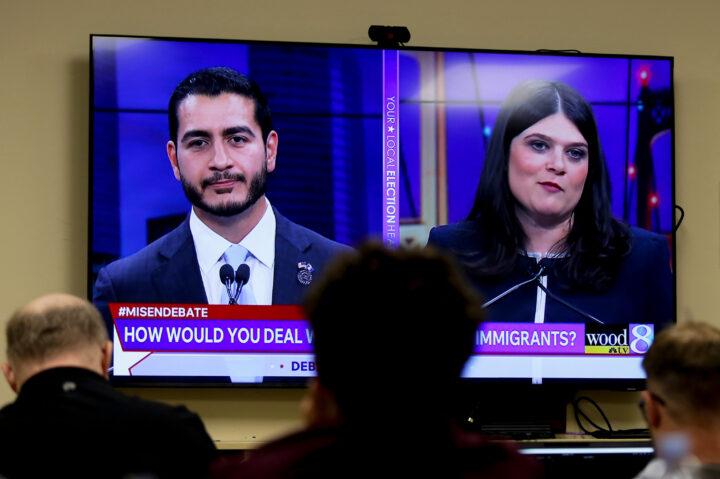
Michigan U.S. Senate candidates, Abdul El-Sayed, left, and Rep. Haley Stevens, D-Mich., are displayed on a television during a debate inside the spin room at WoodTV studios on Tuesday, July 7, 2026, in Grand Rapids, Mich.
The selection of Michigan as an early Democratic primary state in the 2028 presidential nominating contest, approved on Friday by a panel of the Democratic National Committee, is prompting some concerns among Jewish and pro-Israel activists who fear the party’s sharp divisions over Israel and its recent controversies over antisemitism could create a volatile political landscape during the key contest.
In recent years, Michigan has been at the center of some of the fiercest fights over Israel animating the Democratic Party. In the 2024 presidential race, for instance, the battleground state first laid the ground for the “uncommitted” movement that urged primary voters not to vote for former President Joe Biden as a protest against his support for Israel during the war in Gaza.
At Michigan’s state party convention in April, meanwhile, pro-Israel candidates were heckled by far-left activists, while an attorney with a history of praising Hezbollah was nominated for a position on the University of Michigan Board of Regents, episodes that left Jewish voters questioning if they belonged in a party they had long called home.
The state’s Democratic Senate primary, set for Aug. 4, has emerged as the latest high-profile proxy battle between the party’s mainstream and far-left factions. The most heated clashes have revolved around Israel and AIPAC, the pro-Israel advocacy group that is now spending millions to help Rep. Haley Stevens (D-MI), a close ally, in a bitter race against Abdul El-Sayed — whose rhetoric targeting Israel and ongoing refusal to recognize its right to exist has alarmed Jewish voters.
Michigan’s presidential primary will now tentatively go fifth among the six states chosen for early primaries, on Feb. 22 — a week after New Mexico and a week before Virginia. South Carolina will kick off the nominating contest on Jan. 22, followed by Nevada and New Hampshire. The newly proposed calendar will need to be ratified by DNC members at a meeting in Austin next month.
If the schedule is officially locked in, Michigan, which has the most delegates of the states chosen, “figures to be one of the first anti-Israel or antisemitic states that has a vote,” Dennis Bernard, a Jewish leader in Michigan who helps advise members of both parties, said in an interview with Jewish Insider on Sunday.
“I do think we will be very much a bellwether state” that “could be the first true test of the Democratic Party and how big their tent is,” added Bernard, the national chair of government relations for the Jewish Federations of North America. “You will potentially see a continuation of that war going on right now.”
Several Jewish leaders in Michigan said the Senate primary outcome would likely help crystallize their expectations about the degree to which Democratic conflict over Israel, and the state’s role in elevating that battle to the forefront, may end up influencing the presidential election.
“Those results will give us a better indication of 2028,” said Michael Horowitz, one such Jewish leader in Michigan, noting the positions espoused by El-Sayed are not a “national trend yet,” despite a recent series of primary wins by anti-Israel Democrats who ran in progressive House districts. “We’ll see how deep this well is. I’m not naive, but I don’t know.”
Still, the Democratic Party and pro-Israel community “have to get together and take control of the narrative again, because they’re winning the narrative,” he told JI, referring to the far left. “We have got our work cut out for us. We’ve lost the narrative.”
“If you talk to major Democratic donors, they’re concerned about Michigan because the moderate wing of the party is disappearing,” Ed Sarpolus, a Democratic pollster in the state, told JI. “Democrats could be worse off in 2028 if they don’t get back to the issues.”
By contrast, Asher Lopatin, a rabbi who serves as director of community relations at the Jewish Federation of Greater Ann Arbor, cited Gov. Gretchen Whitmer’s endorsement of Stevens last week as a sign that “may indicate the direction Michigan Democrats are going in for 2028,” which he called “not falling into the anti-Israel obsession trap.”
“I realize it’s a rosy scenario, but I am hopeful,” he told JI.
Political strategists who spoke with JI shared mixed predictions about Michigan’s early place on the 2028 primary calendar. Ed Sarpolus, a Democratic pollster in the state, said it could “exacerbate tensions within the Democratic Party” over Israel, disrupting a fragile effort to show unity ahead of what is expected to be a bruising general election to reclaim the White House.
“If you talk to major Democratic donors, they’re concerned about Michigan because the moderate wing of the party is disappearing,” Sarpolus told JI. “Democrats could be worse off in 2028 if they don’t get back to the issues.”
But Adrian Hemond, a Democratic strategist in Michigan, said it “is way too early to predict with confidence” how Israel “will play as an issue” in the 2028 Michigan presidential primary, arguing that “a lot will depend on how hard candidates lean into the issue.”
“If the situation in the Middle East deteriorates further,” he explained to JI, “this issue could look very different.”
Some experts have also speculated that Michigan’s position could lead to uncomfortable confrontations for pro-Israel centrists like Pennsylvania Gov. Josh Shapiro, a Jewish Democrat who is frequently cited as a prospective presidential candidate and who has faced antisemitism over his views on the Middle East.
Some Jewish leaders, however, said a pro-Israel win in Michigan could help defang the far left at what may be a key inflection point in the race. If an openly pro-Israel candidate emerged in the state, “I think it would be a surprise as to the traction they got,” since it “would stand out as authentic,” said one prominent pro-Israel activist in Michigan, granted anonymity to speak candidly about a sensitive issue.
He was not hopeful that such a candidate would step up. “I don’t see why Michigan is the venue in which someone does a complete paradigm shift” on Israel, he told JI, citing the existing political headwinds. “I think we are kind of a laboratory for the Democratic Party across the nation.”
One pro-Israel strategist in Michigan, speaking on condition of anonymity, said that several potential 2028 contenders have already visited the state and have had private meetings with Jewish donors and groups — including Rahm Emanuel, the Democratic operative and former Chicago mayor, and Maryland Gov. Wes Moore.
“A couple others have had meetings with prominent Jews while in Michigan, but I can’t say for sure if the reason for meetings was to lean into the Jewish vote,” the strategist told JI.
While Michigan also went fifth in 2024 after it had lobbied for an early slot, the state promises to play a more consequential role in the next election because it will be a competitive primary, as opposed to the last cycle in which Biden faced no serious opposition before dropping out of the race.
Anti-Israel activists have insisted that former Vice President Kamala Harris lost Michigan, home to the largest concentration of Arab American voters in Dearborn, due to her alignment with Biden’s support for Israel during the war in Gaza.
But many Jewish Democrats in Michigan, who make up a sizable and politically engaged constituency, say the left’s vilification of Israel as well as AIPAC is not only misguided but also a distraction from more urgent concerns that are much more relevant to swing voters who will ultimately decide the election. Some suggested that Michigan’s status in 2028 as an early nominating state could stoke those tensions and overshadow other issues, in a repeat of the last cycle.
“The antisemitic rhetoric that we have observed on the right and the left, the attacks on Israel’s right to exist as a Jewish state, are, sadly, going to be issues that both parties have to address in 2028,” Robert Zimmerman, a longtime DNC member, told JI while assessing the 2028 primary landscape. “Democrats have to do a much better job of standing up to that hateful rhetoric.”
“It means that the real issues facing Michigan will continue to be less important” than the hostility to Israel now energizing the activist left, Hannan Lis, a Democratic fundraiser and Jewish community leader in the state, told JI. “I cannot tell you I’m optimistic. I’m a realist,” he said.
Even as he acknowledged “two years is a long time,” he voiced anxiety that “support for Israel has become a litmus test for a lot of Democratic candidates,” as it has grown increasingly politicized in party primaries.
“The antisemitic rhetoric that we have observed on the right and the left, the attacks on Israel’s right to exist as a Jewish state, are, sadly, going to be issues that both parties have to address in 2028,” Robert Zimmerman, a longtime DNC member, told JI while assessing the 2028 primary landscape. “Democrats have to do a much better job of standing up to that hateful rhetoric.”
Despite reservations about Michigan’s potentially divisive role in the presidential race, some Jewish leaders in the state and beyond said they were still staying positive.
In a statement to JI, Jessica Alexander, chair of the Michigan Democratic Jewish caucus and a vice chair of the Michigan Democratic Party, said party activists had “worked hard to make the case for Michigan to be an early primary state, because the state reflects the country’s diverse demographics culturally and geographically.”
“Yes, there is a vocal virtual subset of folks who want to make not the Middle East, but Israel and the U.S.’s engagement in and with it the center” or “soul” of the campaign, she said, “but the reality on the ground is that it’s not the most formidable issue no matter how the press skews it.”
Noah Arbit, a Jewish Michigan state representative who has been outspoken against rising antisemitism in his own party, said that the Democratic Socialists of America and other groups “seem to feel that Israel is a galvanizing wedge issue they can employ to take over the Democratic Party” and for now “seem intent on putting it at the forefront of the primary debate in 2028, regardless of Michigan’s place in the calendar.”
“I’m resigned to the issue being at the forefront of the primary conversation,” he told JI last week, “despite the fact that I would argue Americans have far more pressing concerns about the state of and future of our country than an interminable conflict 5,000 miles away.”
Please log in if you already have a subscription, or subscribe to access the latest updates.
 Continue with Google

 Continue with Apple