






































































Republican and Democratic senators paid tribute to his legacy, while wondering if anyone will be able to fill the leadership vacuum

Anna Moneymaker/Getty Images
Sen. Lindsey Graham (R-SC) in the Senate Judiciary Committee on January 30, 2025 in Washington, D.C.


 Add JewishInsider on Google
Sen. Lindsey Graham’s (R-SC) sudden death last weekend is complicating an already difficult dynamic between Senate Republicans and President Donald Trump, as legislators try to muster enough support in the caucus to pass the president’s key legislative priorities.
Graham’s committee chairmanships, vast donor network and his close relationship with Trump and Secretary of State Marco Rubio made him a critical leader in Washington whose presence helped move forward multiple bipartisan efforts, especially on foreign policy. He became one of the most geopolitically connected members of Congress, with world leaders and captains of industry on speed dial.
“It’s impossible to fill that void, number one, so I’ll just take that off the table,” Sen. Tim Scott (R-SC), the chairman of the National Republican Senatorial Committee, told Jewish Insider at a press conference at NRSC headquarters on Capitol Hill on Wednesday.
Scott, who represented South Carolina alongside Graham for 13 years, said he has spoken with Senate Majority Leader John Thune (R-SD) about the challenges Graham’s death creates for the party and detailed several areas where Senate GOP leadership is hoping some of their members will attempt to step in on the late senator’s behalf.
The first of those “three layers,” Scott said, is “the foreign policy front.” The second was Graham’s “budgetary responsibilities” as chair of the Senate Budget Committee. The third area, he said, was “bridging the gap between the two sides of the aisle.”
“Those are the three areas that I know that we’ve been consciously considering,” Scott said. “I have spoken to Leader Thune as well. I think those are three big areas that we’d love to see, probably, a couple people step into.”
On the foreign policy front, Scott noted, “There’s no doubt that when you’re looking at leaders around the world who disagree vehemently with each other, the one guy you might be willing to sit at the table with was Lindsey Graham. He just did a really good job.”
“Frankly, you go to the Middle East and without any question, I’m not sure that there was a bigger, more enthusiastic supporter of the president’s actions in Iran — I happen to be one of them as well — than Lindsey Graham,” Scott said. “[Israeli Prime Minister] Bibi [Netanyahu] calling him at lunch was kind of fun to watch. I’m a big fan of Bibi myself, and just knowing the relationship that they had when I spoke with Bibi myself years ago, I would say without question, Lindsey Graham’s name always came up. You know why? Because, frankly, he took the time to make the trip there.”
“Whether it’s the European front, the Middle East, or frankly, his enthusiasm around Venezuela, he was always in the midst when it came to solving problems around the world because he believed in peace through strength,” he continued. “It was not just a tagline. It was not just a philosophy. It was embedded in his DNA.”
Scott said Republicans will need to focus on “finding someone who has that passion” that Graham applied to his foreign policy dealings. Graham spearheaded the passage of the second Trump administration’s two reconciliation packages — the One Big Beautiful Bill last July, which made the tax cuts implemented in the first Trump administration permanent and enacted a wide range of spending cuts, and the Secure America Act in June to fund Immigration and Customs Enforcement (ICE) and Customs and Border Protection (CBP).
“We are living in polarizing times politically. Lindsey Graham was not completely aware of that. He thought you could still find common ground to get something done,” Sen. Tim Scott (R-SC) said. “He turned out to be right. Being able to have [Sen. Richard] Blumenthal (D-CT) knocking on the door for Russian sanctions is only possible because Lindsey Graham spends so much time talking to people that vehemently disagree with him on 85% or 90% of topics. Find that one, you march together.”
As to the budget reconciliation process, Scott said, Sen. Ron Johnson (R-WI) would step in as budget chair. “Big shoes to fill,” Scott added.
Scott touted his late colleague’s ability to reach across the aisle and argued that “bridging that gap is going to be really important.”
“We are living in polarizing times politically. Lindsey Graham was not completely aware of that. He thought you could still find common ground to get something done. He turned out to be right. Being able to have [Sen. Richard] Blumenthal (D-CT) knocking on the door for Russian sanctions is only possible because Lindsey Graham spends so much time talking to people that vehemently disagree with him on 85% or 90% of topics. Find that one, you march together.”
As one of the few lawmakers capable of closing the gap between Senate Republicans and the president, Graham became somewhat of a mediator.
“Lindsey left an indelible mark on the Senate, on the nation and on the hearts of his colleagues,” Sen. Ted Cruz (R-TX) told JI. “At times when senators were at each other’s throats, were angry, Lindsey could cut the tension with a self-deprecating quip that brought everything to a stop and brought people back together again.”
Leading Democrats also paid tribute to Graham’s legislative acumen. “Lindsey was part of every important policy issue and an indispensable player in every Senate ‘gang.’ He was a fierce Republican partisan one day and a key bipartisan ally the next,” Senate Minority Whip Dick Durbin (D-IL) said of Graham after his death was announced.
“I don’t know who can play this role going forward. I just don’t see it,” Sen. Chris Coons (D-DE) told JI on Sunday of Graham. “He’s just not replaceable. There’s not going to be anyone like him again.”
Graham was involved in every successful bipartisan piece of legislation that Trump has signed into law thus far in his second term. During the Biden administration, Graham was one of the 19 Republican senators who crossed party lines to support the bipartisan infrastructure bill, and his decision to come out against the bipartisan immigration reform deal organized by Sens. James Lankford (R-OK), Chris Murphy (D-CT) and former Sen. Kyrsten Sinema (I-AZ) has been described as the final death knell that sealed the legislation’s fate.
Graham was also the Republican in Trump’s orbit to whom Senate Democrats would go when trying to settle a legislative dispute or join forces on an issue of bipartisan concern.
“I don’t know who can play this role going forward. I just don’t see it,” Sen. Chris Coons (D-DE) told JI on Sunday of Graham. “He’s just not replaceable. There’s not going to be anyone like him again.”
Graham’s passing puts the longtime legislative and geopolitical priorities he fought for in jeopardy.
The South Carolina Republican spent the last five years lobbying Saudi Crown Prince Mohammed bin Salman to bring Riyadh into the Abraham Accords. Graham tried to secure an agreement on several occasions under Trump and former President Joe Biden, and said repeatedly that he was on the verge of reaching a deal that would see Saudi Arabia normalize relations with Israel in exchange for Israel recognizing a Palestinian state.
After Hamas’ Oct. 7, 2023, attacks on Israel, Graham maintained that Iran ordered the attacks to upend his Saudi-Israeli normalization efforts.
Graham was one of the most outspoken and effective Republican advocates in Congress for increasing military funding. Prior to his death, he had been lobbying the president to get behind the Russia sanctions bill he co-sponsored with Blumenthal, and expressed optimism in his final phone call with Morgan Ortagus, the former deputy presidential envoy for Middle East peace in the second Trump administration, that Trump was coming around to the idea.
Trump said on Tuesday that he was considering supporting the bill, which he has long hesitated to get behind, “in honor of Lindsey.”
“This was his thing, he wanted this more than any other thing. You know how he felt,” Trump said from the White House. “There’s a good chance that it gets done. But they’d like to add Iran. And they’d like to add Hezbollah to it. That’s what I’m hearing.”
Ortagus told JI, “There was not a fight on domestic or foreign affairs that he didn’t want to jump into. If he believed in an issue and believed that a particular policy was the right thing, he really didn’t care about the politics.”
The South Carolina Republican had recently returned from a trip to Kyiv, Ukraine, and Ankara, Turkey
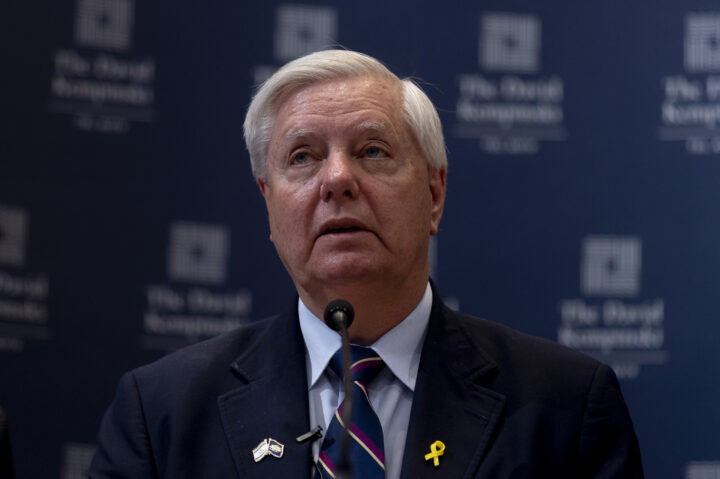
Amir Levy/Getty Images
Senator Lindsey Graham (R-SC) speaks at a press conference on US-Israel relations on February 17, 2025
Sen. Lindsey Graham (R-SC), who represented South Carolina in the Senate for more than two decades and was a stalwart supporter of Israel during his time in office, died on Saturday, his office announced. He was 71.
Graham, who served in the House of Representatives for more than a decade before being elected to the Senate in 2002, had recently returned from Ukraine, where he met with Ukrainian President Volodymyr Zelensky. Prior to Ukraine, he had been part of a bipartisan U.S. delegation in Ankara, Turkey, for the NATO summit.
Sen. Lindsey Graham (R-SC) @LindseyGrahamSC died Saturday following what his office described as “a brief and sudden illness.”
— Jewish Insider (@jewishinsider) July 12, 2026
Israeli Prime Minister @netanyahu called him “a great American patriot and a great champion of the Israel-American alliance.”
President Donald Trump… pic.twitter.com/sKzQc2XnmT
NBC News reported that emergency personnel had responded on Saturday evening to a call regarding a cardiac arrest at Graham’s home on Capitol Hill.
A longtime advocate for Israel, Graham traveled to the country in the immediate aftermath of the Oct. 7, 2023, Hamas terror attacks, making at least 10 trips to the region since the onset of the Israel-Hamas war. He last traveled to Israel days before the outbreak of the Iran war in February 2026, during which he met with Israeli Prime Minister Benjamin Netanyahu.
Graham was openly critical of Iran and skeptical of Western engagement with the Islamic Republic. He was a vocal opponent of the 2015 Joint Comprehensive Plan of Action and favored military engagement to address the threats posed by the Islamic Republic. He defended the Trump administration’s recent negotiations with Tehran, but said in June that he thought those talks were “going to fail.”
The South Carolina Republican had been up for reelection in November after easily clearing the GOP field in the state’s primary last month. Graham’s death is expected to trigger a special primary in the state to determine who will replace him on the ballot.
The Republican lawmaker was swiftly eulogized by top Israeli political figures.
Israeli Prime Minister Benjamin Netanyahu said Israel had “lost one of its greatest friends.” Graham, Netanyahu said, “understood that the security of Israel and America are inseparable. He devoted his life to defending America, strengthening our alliance and standing up for the free world.”
Israeli President Isaac Herzog said in a statement that he was “shocked and heartbroken” to learn of Graham’s death, calling the senator a “dear friend” and a “great American patriot, a great friend of Israel.”
“Senator Graham was a beacon of moral clarity and a true leader of the U.S.-Israel partnership,” Herzog said. “We will never forget how he stood by the people of Israel in our most difficult moments, and we will remain eternally grateful for his sense of justice, truth, and loyalty.”
In a social media post, former Israeli Prime Minister Naftali Bennett, who is running in the current election, mourned Graham as one of the country’s “greatest friends,” who “stood with Israel through our darkest hours, with courage.”
An Iranian missile struck Dimona, about eight miles from Israel’s Shimon Peres Negev Nuclear Research Center, wounding 31 people
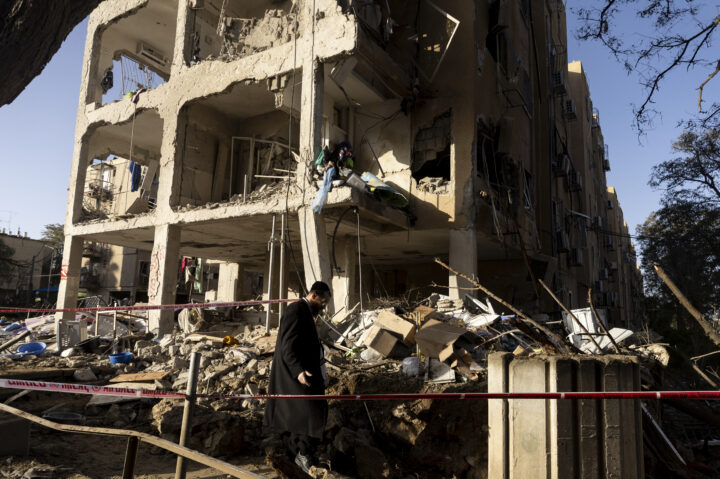
Amir Levy/Getty Images
A man looks at destroyed buildings after an Iranian missile strike on March 22, 2026 in Arad, Israel. Iran has continued firing waves of drones and missiles at Israel after the United States and Israel launched a joint attack on Iran early on February 28th.
Missile strikes from Iran and Hezbollah in Lebanon resulted in over 100 casualties between Saturday night and Sunday morning.
One person was killed and another injured after two cars caught fire in the Upper Galilee from errant IDF shells that fell inside Israel, rather than Lebanon, an investigation by the military found on Monday.
MDA reported 15 wounded from missile fragments landing in numerous sites in Tel Aviv and central Israel on Sunday.
EMTs from the Magen David Adom emergency services, Taysir Subah and Safa Abu Rafea, said they “arrived at the scene and saw two vehicles on fire. During the firefighters’ extinguishing operations, we identified a man in the driver’s seat. We conducted medical assessments, he had no signs of life, and we had to pronounce him dead.”
On Saturday night, an Iranian missile struck the city of Dimona, about eight miles from Israel’s Shimon Peres Negev Nuclear Research Center. The direct hit caused extensive damage to several buildings in the city, injuring 31 people, including one who is in serious condition, according to MDA.
MDA EMTs Shai Binyamin and Gadot Vaknin said they were alerted by civilians on the street to elderly residents trapped in a safe room, whom they helped treat.
Three hours later, an Iranian missile struck Arad, a city near the Dead Sea. Emergency services in the area, which has seen fewer alerts than the rest of the country, evacuated 84 patients to Soroka Medical Center in Beersheba, including 10 in serious condition, among them children as young as four years old.
Yakir Talker, an MDA EMT, described “extensive destruction and chaos” at the scene. Another EMT, Riyad Abu Ajaj, said that “together with security forces, we conducted searches to locate additional patients. We provided medical treatment to many patients, including children.”
At both scenes in southern Israel, the IDF Home Front Command led efforts to free people trapped in the rubble.
Schools in much of the Negev, which had been hit by fewer missiles than Israel’s center and north, were meant to reopen on Sunday. The IDF Home Front Command revised its guidelines to keep schools closed after Saturday night’s strikes. Schools have been closed since the start of the war with Iran late last month, and gatherings have been limited to 50 people near a shelter or safe room.
IDF Chief of Staff Eyal Zamir met with the mayors of Metula and Kiryat Shmona, on the Lebanon border, saying that the IDF is “prepared for the enhancement of the forward defensive posture in the north.” In a later statement on Saturday, he added: “There is no more containment; there is initiative; there is preemptive action.” Last week, the IDF said it would increase ground operations in Lebanon.
“The more we strike and weaken Iran, the more we weaken Hezbollah,” Zamir added.
He also praised the “steadfastness and the resilience” of Israelis in the north, saying that they “enable us to continue striking and degrading the enemy.”
“We will not stop until the threat is pushed away from our border and long-term security is ensured for our residents,” he said.
This story was updated on March 23, 2026, to add the IDF investigation findings.
Please log in if you already have a subscription, or subscribe to access the latest updates.
 Continue with Google

 Continue with Apple