




















The resolution came after a pro-Israel student group hosted IDF soldiers, which protesters disrupted by calling them ‘baby killers’ and comparing the IDF to the KKK
G Fiume/Getty Images
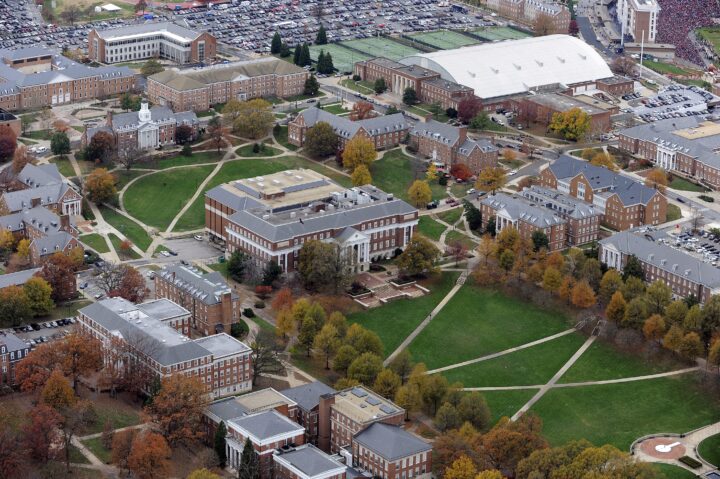
An aerial view of the University of Maryland campus in College Park, Maryland.


 Add JewishInsider on Google
The University of Maryland, College Park student government unanimously passed two resolutions hostile towards Israel on Wednesday night, including one that called for the school to ban members of the Israel Defense Forces from speaking on campus.
The resolution, targeting Israelis, called for the university to prohibit people who are “committing war crimes” and “genocide” from speaking on campus.
It came as a response to an event hosted by the campus chapter of Students Supporting Israel on Oct. 21 featuring former IDF soldiers who spoke to students about their experiences serving during Israel’s war with Hamas.
During the event, protesters packed the outside hallway shouting “baby killers” and “IOF [Israel “Occupation” Forces] off our campus,” while several others protested from outside of the building with chants comparing the IDF to the Ku Klux Klan, the university’s student-run Jewish newspaper, The Mitzpeh, reported.
The second resolution called on the university to issue an apology to students who faced disciplinary action for protesting that event. The resolution stated that “two student journalists were wrongfully detained by the University of Maryland Police Department for over an hour while attempting to document the event.” At the time, UMPD said in a statement that the student journalists refused to provide identification or credentials.
Both resolutions passed 25-0, with one abstention.
UMD has one of the largest Jewish student populations in the country — nearly 20% of the College Park undergraduate student body of more than 30,000 students is Jewish, according to Hillel International. But there are “very few” Jewish students remaining in student government, junior criminology and criminal justice major Meirav Solomon told Jewish Insider.
Solomon was removed as a student government member in 2023 after being put on a “blacklist” of students who she said were accused of “not believing in human rights.” She told The Mitzpeh at the time that the list profiled candidates with “Jewish-sounding names,” and most students denounced by the document had never voiced a public opinion on the Israeli-Palestinian conflict.
The current student government is mostly composed of Students for Justice in Palestine members, or people who support the group, Solomon said.
The latest resolutions follow the passing of a separate resolution — voted on at the start of Yom Kippur — calling on the university and its charitable foundation to implement a boycott of companies and academic institutions with ties to “Israel’s regime of apartheid and occupation.”
“Jewish students on campus are already feeling very unsafe,” said Solomon. “But these resolutions have the most shocking language I’ve seen. This is extreme language and doubles down on making Jewish students feel that they don’t have a voice in student government.”
When the BDS vote was announced in October, UMD President Darryll Pines told the university’s newspaper, The Diamondback, that the university supports SGA’s right to debate the issue. But he added that the university wants to ensure the process is “open and fair and has dialogue from all parties of our broad student body.”
“Resolutions voted on by the Student Government Association are student-led and reflect perspectives of voting members of the SGA,” a university spokesperson told JI at the time of the BDS resolution vote. “They have no bearing on university policy or practice.”
This story was updated on Thursday to reflect the outcome of the vote.
SJP filed the First Amendment suit when UMD revoked its permit for an anti-Israel protest on the Oct. 7 anniversary

Loop Images/Universal Images Group via Getty Images
The McKeldin Library at the University of Maryland
The University of Maryland, College Park and Maryland’s attorney general have asked the state to approve their joint request to settle a First Amendment lawsuit brought by the school’s Students for Justice in Palestine chapter.
The request to settle the case, which was not previously publicly available information, was revealed in a memo detailing the agenda for an impending meeting of the Maryland Board of Public Works, which oversees matters impacting the state university system. The university’s settlement, according to the agenda posted to BPW’s website ahead of a Wednesday board meeting, would provide $100,000 to defendants through the CAIR Legal Defense Fund, an arm of the Council on American-Islamic Relations.
“The University of Maryland College Park and the Office of the Attorney General recommend paying $100,000 to settle all claims, including attorneys’ fees, as in the best interest of the State,” the memo reads.
The University of Maryland declined to comment to Jewish Insider about its request to settle and Maryland Attorney General Anthony Brown did not respond to JI’s request for comment.
On behalf of UMD SJP, CAIR and Palestine Legal filed a lawsuit against the university’s College Park campus last September alleging a violation of the students’ free speech after UMD President Darryll Pines announced that the school had canceled an SJP-sponsored anti-Israel rally slated for the first anniversary of the Oct. 7 terrorist attacks.
UMD initially granted SJP a permit last August to hold the Oct. 7 demonstration on the campus’ central McKeldin Mall, prompting swift backlash and calls from campus groups including Hillel and the Jewish Student Union — and from former Maryland Gov. Larry Hogan, who was running for the Senate at the time — for the school to reverse course.
After the university canceled the protest, SJP filed a lawsuit stating that its First Amendment rights had been violated and a federal judge wrote in an opinion that the group “has demonstrated a substantial likelihood that it will prevail [in its lawsuit] on the merits of its freedom of speech claim.” The university then backtracked a second time and ultimately allowed the demonstration to take place, but the lawsuit moved forward.
Pines said at the time that the initial decision to cancel the event — and all events scheduled for Oct. 7, other than university sponsored ones — was made following a “safety assessment,” which, he added, did not identify any threats to the campus.
Einav Tsach, a rising senior studying journalism and business, told JI that amid turmoil around the SJP demonstration, Jewish students still “came together as a strong, vibrant Jewish campus community to mark the one-year anniversary of the horrors perpetrated by Hamas.”
As the second anniversary of the Oct. 7 attacks approaches this fall, Tsach, the former leader of Mishelanu, an on-campus Israeli-American cultural association, said that Jewish UMD students “remain focused on marking this solemn day in the most meaningful way possible.”
Other than the controversy around last year’s demonstration, UMD, which has one of the largest Jewish student populations in the country — nearly 20% of the College Park undergraduate student body of more than 30,000 is Jewish — has largely avoided egregious incidents of antisemitism that have occurred on other college campuses.
Please log in if you already have a subscription, or subscribe to access the latest updates.
 Continue with Google
 Continue with Apple