







































































While emerging technologies will be a major topic of conversation during the three-day trip, most eyes — and markets — are on the tenuous ceasefire between the U.S. and Iran
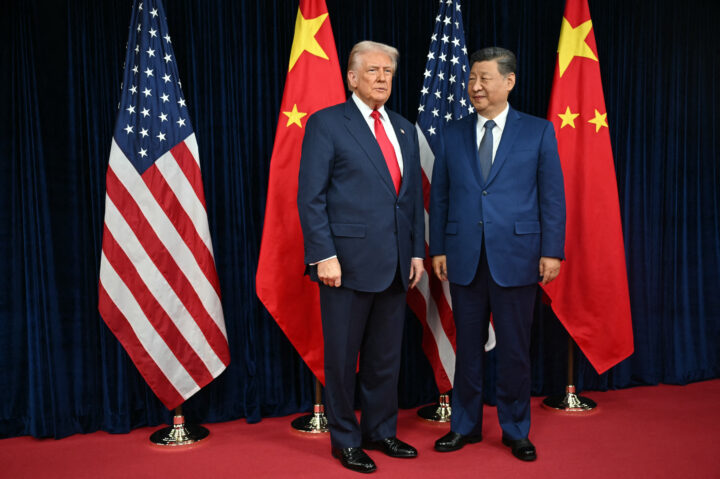
ANDREW CABALLERO-REYNOLDS/AFP via Getty Images
President Donald Trump (L) and Chinese President Xi Jinping arrive for talks at the Gimhae Air Base, South Korea, on October 30, 2025.


 Add JewishInsider on Google
There will be a number of items on the agenda when the two most powerful men in the world — President Donald Trump and Chinese President Xi Jinping — meet in Beijing tomorrow, chief among them tech and AI. The president is bringing with him a roster of top business leaders, including Elon Musk, Nvidia’s Jensen Huang, Apple’s Tim Cook, Goldman Sachs’ David Solomon, Meta’s Dina Powell McCormick, BlackRock’s Larry Fink and Blackstone’s Stephen Schwarzman.
And while emerging technologies will be a major topic of conversation during the three-day trip, most eyes — and markets — are on the tenuous ceasefire between the U.S. and Iran.
“We have a lot of things to discuss,” Trump told reporters before departing for China. “I wouldn’t say Iran is one of them, to be honest with you, because we have Iran very much under control.” Nonetheless, the president said, “We’re going to have a long talk about [Iran]. I think he’s been relatively good, to be honest with you.”
Beijing has, after all, been playing a major role in the U.S.-Iran conflict — even if it has done so from the margins: serving as the largest importer of oil from the Islamic Republic in violation of U.S. sanctions, meeting with top Iranian officials (including last week’s sit-down between Xi and Iranian Foreign Minister Abbas Araghchi) and transferring weapons to Iran through third countries.
Indeed, the summit, delayed from earlier this year due to the war, comes amid reports of a U.S. intelligence assessment that Iran has restored access to 30 of its nearly three dozen missile sites, and days after Washington rejected an Iranian response to a U.S. proposal that fell short of the Trump administration’s demands.
China’s interest isn’t purely power-driven: it’s also economic. Being able to purchase Iranian oil at steeply discounted prices — owing to Tehran’s global economic isolation — has meant that China has not felt the same financial pressures as the West.
Trump, who has spent much of his second term welcoming leaders to Washington, will be on Xi’s home turf, face-to-face with a leader who is opting not to use his leverage to push Iran into making concessions. The longer the uncertainty continues, the more restless even the president’s most fervent supporters will get — especially with the midterms approaching.
That dynamic is already beginning to play out on Capitol Hill. Yesterday, JI reported on divisions among Republican senators over whether the U.S. should reengage militarily with Iran, while last week, Rep. Tom Barrett (R-MI), who is facing a tough reelection battle in his swing district, became the first GOP lawmaker to introduce an authorization for use of military force in Iran.
All of that is good for Xi, and gives him little incentive to use China’s economic and diplomatic leverage over the Islamic Republic, which while knocked down a few pegs, has managed to maintain control despite the severe blows it has been dealt.
The Iranian regime has been able to survive in large part because it knows how to play the long game: to drag out negotiations, give breadcrumbs instead of the whole loaf and wreak just enough havoc to serve as a disruptor without prompting massive retaliation. It has enough to survive, for now.
Xi finds himself in a similar dynamic: unbound by pending elections, unaffected by rising energy costs and distanced from military action in the Middle East, Beijing is — unlike Trump — does not need a quick resolution to the conflict.
Adams would have to win over most New York City Republicans while remaining competitive with Democrats and winning over independents who weren’t eligible to participate in the Democratic primary

Yuki Iwamura-Pool/Getty Images
Democratic mayoral candidate Zohran Mamdani
Mainstream political and business leaders in New York City, including the organized Jewish community, will soon need to decide whether to coalesce against far-left presumed Democratic mayoral nominee Zohran Mamdani — by rallying behind the candidacy of scandal-plagued Mayor Eric Adams despite his significant political baggage.
Adams, who is running as an independent in the race, appears to be the only alternative candidate capable of putting together a campaign rallying anti-socialists across the city to stop Mamdani. It won’t be easy, given Adams’ own low approval ratings and record of alleged corruption, but the makings of an anti-Mamdani coalition are there — at least on paper.
For Adams to win plurality support in a general election, it would require most Republicans to put partisanship aside and vote for Adams to stop the socialist, and hold onto most of the Black, Jewish voters and moderate Democratic voters who voted in large numbers for former New York Gov. Andrew Cuomo in the primary. Adams benefits from the name recognition of incumbency, and the potential to receive support from outside centrist groups spending on his behalf.
Keeping a bipartisan coalition of that nature will be challenging, especially given the mayor’s own unpopular record. It would require a number of lucky breaks, from Cuomo opting not to run in the general election (he appears to be staying on the ballot without an active campaign) to Republicans effectively nudging their voters to back Adams when there’s a Republican already on the ballot. But if the campaign is less about Adams and more about stopping left-wing radicalism on crime, the economy and antisemitism, it’s not implausible to see a campaign coalescing around a “block socialism, vote Adams” type of message.
Here’s the political math: Adams would have to win over most New York City Republicans — President Donald Trump won 30% of the citywide vote in 2024 — while remaining competitive with Democrats and winning over independents who weren’t eligible to participate in the Democratic primary.
An Emerson College poll conducted amid Mamdani’s surge in late May offers some empirical evidence that such a coalition has an outside shot at victory in a general election, with a broader, more-moderate electorate. The survey found that with Mamdani as the Democratic nominee, he leads with 35%, Republican Curtis Sliwa finishes with 16%, Adams holds 15% and independent Jim Walden tallied 6%.
Put together the Sliwa, Walden and Adams votes, and you’ve got yourself a competitive race.
There’s already a lot of rumbling that Trump administration officials, eager to see Sliwa off the ballot, are looking at offering him a job in the administration to help nudge GOP voters into the Adams column to stop Mamdani. But Sliwa has given every indication so far that he’s not dropping out, which would force Republican leaders to more subtly nudge GOP partisans towards Adams.
The big red flag for anti-Mamdani moderates? Adams’ favorability rating in the same poll was a dismal 19%, with 69% viewing him unfavorably. That said, given the changed nature of the contest, the perception of Adams could change amid the shifting strategic environment. He’s already running a more energetic campaign than Cuomo did in the primary. (And it’s a safer bet to hope Adams’ numbers improve as an anti-Mamdani vehicle than betting on a total outsider with minimal name ID to play that role, as a few business leaders have suggested.)
There is some precedent for mainstream forces working to block a far-left or far-right candidate after an unexpected primary outcome. One of the most recent examples is socialist India Walton’s out-of-nowhere upset against Buffalo Mayor Byron Brown in a 2021 Democratic primary. Many analysts attributed her victory to a left-wing surge; it turned out to be a mirage of a low-turnout election before a broader array of voters really had a chance to scrutinize her record and background. Brown easily won the general election — as a write-in candidate.
There’s also former Sen. Joe Lieberman winning as an independent in 2006 after losing the Democratic primary, with Republicans signaling to their voters to back the senator over the also-ran GOP nominee on the ballot. And there’s the 1991 Louisiana governor’s election where scandal-plagued Democratic Gov. Edwin Edwards beat David Duke, whom Republican voters knowingly nominated. Edwards’ slogan? “Vote for the Crook. It’s Important.”
To be sure, any anti-Mamdani effort will be something of a long shot. Mamdani is now winning support from elected New York Democratic leaders all too willing to accommodate his radical record, and he generated strong turnout in the primary that underscores his natural charisma and strength as a politician. He’s got more starpower than many of the other aforementioned extreme nominees.
But if Jewish leaders believe Mamdani would pose a serious threat to Jewish life and safety in the city if elected, you’d expect they would make every effort to stop his candidacy — especially since there’s a chance, albeit a small one, that his momentum could be stunted as his record draws closer attention.
Please log in if you already have a subscription, or subscribe to access the latest updates.
 Continue with Google

 Continue with Apple