




















A U.S. official said the longstanding designation could be removed by the end of the summer
Syrian Presidency
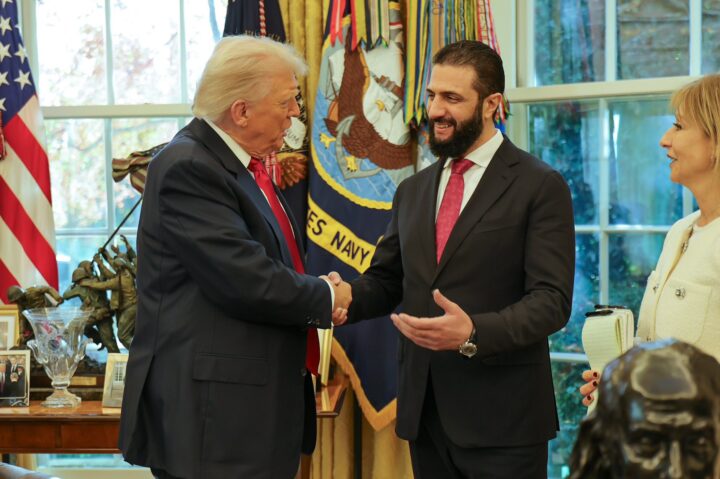
President Donald Trump greets Syrian President Ahmad al-Sharaa in the Oval Office on Nov. 10, 2025.


 Add JewishInsider on Google
As the Trump administration moves to dismantle much of the decades-old U.S. sanctions regime imposed on Syria, one major obstacle remains: Damascus is still designated as a state sponsor of terrorism by the U.S. The White House and lawmakers have signaled that could be about to change, in another move to attempt to pull Syria back into the global order.
Syria remains one of just four countries — alongside Cuba, North Korea, and Iran — designated as an SST. It is a status Damascus has held since 1979 and its current government, led by President Ahmad al-Sharaa, has actively sought to shed.
During the second Trump administration and following the ouster of former Syrian President Bashar al-Assad, President Donald Trump and Congress have worked to rapidly unwind U.S. sanctions on Damascus in an effort to integrate the country into the global economy.
Congress repealed the Caesar Act last year, which had long imposed crippling secondary sanctions on Syrian individuals, companies and entities tied to the Assad regime. Under the direction of an executive order from Trump, the Treasury Department subsequently reviewed and waived a sweeping array of sanctions, though Washington still maintains targeted restrictions on Assad and his immediate associates.
As part of Trump’s executive order last year, the administration mandated a formal review of Syria’s SST designation. While the State Department has publicly maintained that there is no specific timeline for a conclusion, a U.S. official said the sanctions “will be off by end of summer,” Politico reported on Thursday. Trump “made [Secretary of State Marco] Rubio move it forward after Sharaa asked him,” the official said in messages to Mouaz Moustafa, executive director of the Syrian Emergency Task Force.
The prospect of delisting has also garnered support from members of Congress. Senate Foreign Relations ranking member Jeanne Shaheen (D-NH) told Politico that “other sanctions like the State Sponsor of Terrorism designation remain obstacles in Syria’s path to economic recovery and stability.”
On the other side of the aisle, Rep. Joe Wilson (R-SC) said in a video alongside the Syrian American Council’s Mohammed Ghanem this week that he has “an agreement with Secretary of State Marco Rubio … to eliminate the State Sponsor [of Terrorism] sanctions.”
“I’m just so confident that it would be bipartisan … because the American people are united in the hopes and dreams and possibility of a sovereign, peaceful and prosperous Syria,” Wilson said. “We have faith in the people of Syria, we want the best for the people of Syria to have the freedoms that can be enjoyed in all of the Middle East.”
Ahmad Sharawi, a senior research analyst at the Foundation for Defense of Democracies, told Jewish Insider that Washington would like to see Syria removed from the list in an effort to “pull Damascus out of the Iranian-Russian orbit and move it toward a U.S.-aligned regional order.”
“That shift is already underway, given that President Trump has rolled back most Syria sanctions,” Sharawi said. “For Damascus, removal from the list is essential to unlocking investment and reconstruction, especially as Gulf states signal a willingness to pour money into the country. Syrian officials have argued that the designation continues to limit the country’s recovery.”
However, Sharawi said that Syria should not be removed “unconditionally.” He argued that while Syria has taken important steps — such as joining the anti-ISIS coalition and “disrupting some Hezbollah weapons flows through Syria” — that Damascus still has work to do.
“The right approach is conditional delisting,” Sharawi said. “There are still designated foreign jihadist factions that have been integrated into the Syrian army, and ISIS has reportedly infiltrated parts of Syria’s new security structures. The United States should use the designation to demand measurable progress that brings Syria closer into the regional order.”
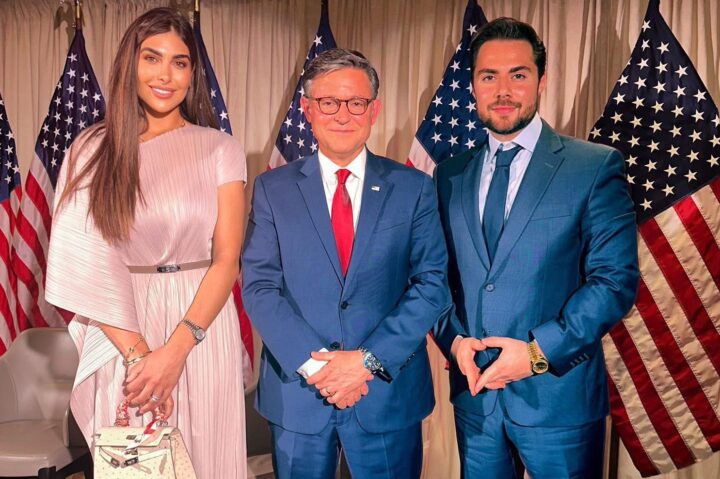
Jasmine Naamou and Tarek Naemo, a Florida couple advocating closer U.S.–Syria ties, have courted lawmakers including Sen. Jeanne Shaheen, Rep. Joe Wilson and even House Speaker Mike Johnson as they promote Damascus in D.C.
X/Syrian American Alliance for Peace & Prosperity
asmine Naamou and Tarek Naemo meet with House Speaker Mike Johnson (R-LA), June, 10, 2025
The fall of Bashar al-Assad’s brutal regime in Syria last December happened slowly, and then all at once — leaving a region reeling from whiplash and a country digging itself out from the rubble, now under the leadership of a former militia head who cut his teeth as an Al-Qaida terrorist.
This week, that leader, Syrian President Ahmad al-Sharaa, is coming to Washington, the first time a Syrian president has ever been invited to the White House.
Alongside al-Sharaa’s rise in Damascus has been a flurry of activity in Washington, as lawmakers tried to make sense of a country that one day was considered a rogue nation locked in protracted civil war and the next was viewed as a free state on the path to stability.
Two people in particular have become fixtures on Capitol Hill, pushing the message that Washington should lift sanctions on Damascus and build stronger ties with Syria: Jasmine Naamou and Tarek Naemo, a married couple who live in Daytona Beach, Fla., with a knack for social media self-promotion and a willingness to strike up a conversation with anyone.
On the eve of al-Sharaa’s meeting with President Donald Trump, the couple arranged a meeting with the Syrian leader and Rep. Brian Mast (R-FL), chair of the House Foreign Affairs Committee.
Naamou and Naemo first came to Capitol Hill this year as activists with the Syrian American Alliance for Peace and Prosperity, a nonprofit that emerged early this year to advocate for closer ties between the U.S. and Syria, though Naamou said she doesn’t work directly with them anymore. The organization arranged meetings for Syria’s foreign minister in New York this year, and in April it brought two members of Congress — Reps. Cory Mills (R-FL) and Marlin Stutzman (R-IN) — to Syria for the first visit by U.S. officials in years. Naamou and Naemo were on the trip with them.

Mills and Stutzman’s visit preceded a more senior delegation, with Sen. Jeanne Shaheen (D-NH), the top Democrat on the Senate Foreign Relations Committee, and Rep. Joe Wilson (R-SC), who has held several senior foreign policy roles, visiting the country together.
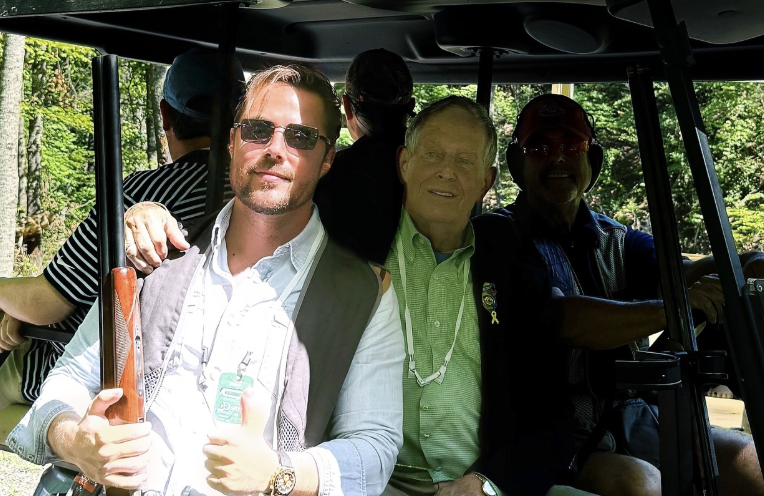
All of those lawmakers have met with either Naamou or Naemo this year, documented with slick photos shared on the couple’s Instagram accounts. Naamou has 319,000 followers, and a pinned photo with House Speaker Mike Johnson (R-LA); Naemo has 2.2 million followers and flaunts photos with the Saudi investment minister and Turkey’s ambassador to Syria — plus an image of him holding a rifle and sitting on a golf cart with Wilson. He refers to Wilson as “my dearest friend.”
Naamou spoke to Jewish Insider on Friday ahead of al-Sharaa’s visit to preview what she hopes the Syrian leader will discuss with Trump, with normalization with Israel high on the list.
“We want regional stability. Israel’s a neighbor. They’re a friend of America. We want them to be friends of Syria. We want to normalize relations,” said Naamou, who was driving to the airport, bound for Washington to be there for al-Sharaa’s visit. She also expressed hope for a U.S. security presence in Syria: “I believe they’re moving in the right direction of getting that security agreement in place. From what I’ve heard, they are in discussions of having a U.S. air base in Damascus to help with those security discussions between Syria and Israel. So I really do see the steps moving in the right direction.”
Ahead of his visit, the United Nations lifted sanctions on al-Sharaa, a move that followed a similar executive order by Trump in June. “President Trump is committed to supporting a Syria that is stable, unified and at peace with itself and its neighbors,” the White House said at the time.
Naamou and her husband both work in real estate in central Florida, though they also have ties to a Saudi sovereign wealth fund, according to Intelligence Online, a publication focused on diplomacy. Naamou said investment is a focus of their advocacy to American officials.
“They’re also going to have discussions on reintegrating investments in Syria because President Trump, when he went over to Saudi Arabia on his Middle East trip, he had announced the whole cessation of sanctions,” said Naamou.

Florida oceanside city become such fixtures on Capitol Hill? Naamou, who is 30, dates her own advocacy to her college days at the University of Florida, where she studied international relations and political science because of what was happening in Syria. She said the political relationships started back home in Florida, too.
“I live in Volusia County, and it’s a relatively small county, and everyone kind of knows each other,” she said. “You just go to events, and you meet people, and things happen, and you discuss things, and then you find things in common.”
They’ve also met with Reps. Byron Donalds (R-FL), who is running for governor of Florida; Anna Paulina Luna (R-FL); Maxine Waters (D-CA) and Abe Hamadeh (R-AZ), who is the child of Syrian immigrants.
“I see huge bipartisan support now,” Naamou said. “We like to term Syria as a swing state. Syria is multi-layered. Syria is one of the only countries in the Middle East that is so complex. You have all three Abrahamic religions present in Syria. You have all different types of ethnicities present. And so Syria is very key in the region, because it can be swung either way.”
“Either way,” in this case, means West or East — bringing Syria into the U.S.-led Western world, or into the Russia-Iran-China orbit.
“They want the U.S., and they want to acclimate here with our values,” said Naamou, who was born in Michigan to a Syrian father. She described the rapid changes in Syria as a “snowball effect.”
“I’ve never seen, when a regime has fallen, such a fast paced amount of change happen in such a short period of time,” said Naamou. She wants to see it continue: all sanctions lifted, American investment, closer ties.
“I’m hoping that we see a larger acceptance of Syria in general,” she said. “I’m hoping that we’re able to somehow, in any way, reshape the narrative into a positive light.”
Please log in if you already have a subscription, or subscribe to access the latest updates.
 Continue with Google
 Continue with Apple