
































































The Anti-Defamation League and Academic Engagement Network flagged sessions at the AAG's conference that promoted BDS and labeled Israel as genocidal and an apartheid state
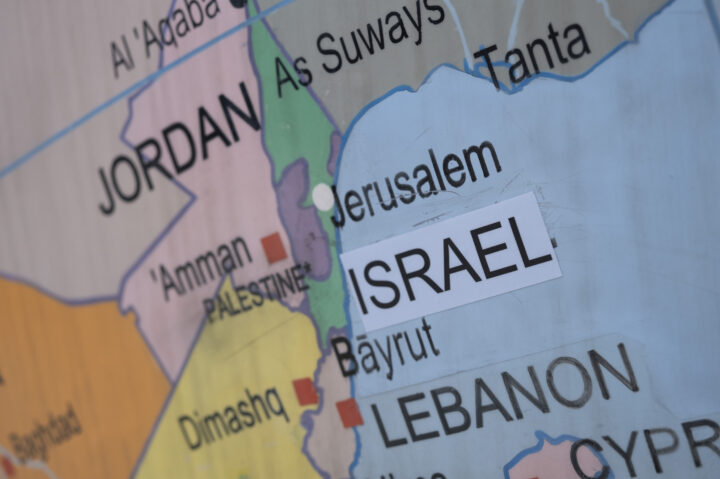
Mike Kemp/In Pictures via Getty Images
Israel on the public art sculpture The World Turned Upside Down by artist Mark Wallinger on June 10, 2024 in London, U.K.


 Add JewishInsider on Google
Jewish groups criticized the American Association of Geographers after its members pushed for an academic boycott of Israel at the organization’s annual meeting, which featured overwhelmingly one-sided presentations against the Jewish state.
The Anti-Defamation League and Academic Engagement Network highlighted biased programming including sessions called “BDS and the AAG,” “Mapping and Counter-Mapping Genocide” and “No Geographic Technology for Apartheid” at the AAG’s March 17-21 conference in San Francisco.
The sessions, which were organized by an unofficial group of AAG members called Geographers for Justice in Palestine, “did not appear to encourage balanced discussion or meaningful debate, and in some cases exhibited a marked erosion of scholarly standards,” the Jewish organizations said in a joint statement on Tuesday.
Some Jewish members began to feel alienated from the association during last year’s annual meeting in Detroit, which also featured programming that was hostile to Israel.
“I was deeply disturbed by the inclusion and promotion of sessions that allowed for inflammatory, biased and harmful rhetoric, far removed from academic rigor or geographic inquiry,” Liora Sahar, an Israeli-American member of AAG, told Jewish Insider last year.
Shira Goodman, vice president of advocacy at the ADL, and Miriam Elman, executive director of AEN, said they raised concerns with the organization last March following its meeting and expressed worry that anti-Israel programming has become a pattern within the association.
“At that time, we urged AAG leadership to review its session selection and vetting processes. The apparent lack of progress on these matters raises serious questions about the association’s commitment to maintaining academic integrity and ensuring that its convenings reflect the highest standards of scholarship and discourse,” said Goodman and Elman.
“Academic conferences should be spaces that foster rigorous inquiry, respectful debate, and the exchange of diverse perspectives. While critical discourse — including criticism of government policies — is a legitimate and essential component of academic life, we are concerned that these standards were not upheld at the recent AAG Annual Meeting, where some sessions lacked factual accuracy, intellectual openness, and a commitment to civil engagement,” continued Goodman and Elman.
They warned that the “continued pattern of programming that lacks civility, disregards factual complexity, and promotes exclusionary academic practices risks causing reputational harm to the association and to the broader academic community it represents.”
The groups called on “AAG leadership to take these concerns seriously and implement meaningful reforms.”
Over the summer, AAG joined a growing list of professional associations facing pressure to adopt a boycott of Israel after a member petition urged the association “to endorse the campaign for an academic boycott of Israeli academic institutions.”
Last month, AAG said there has not yet been a vote on the petitioners’ demands.
AAG did not respond to a request for comment from JI asking about this year’s conference.
The AAG is the latest professional association to face calls from its members to adopt a boycott of the Jewish state
Mike Kemp/In Pictures via Getty Images
Israel on the public art sculpture The World Turned Upside Down by artist Mark Wallinger on June 10, 2024 in London, U.K.
The American Association of Geographers became the latest professional association to face pressure to adopt a boycott of Israel after a recent member petition urged the association “to endorse the campaign for an academic boycott of Israeli academic institutions.”
The campaign also calls for “financial disclosure and divestment of any AAG funds invested in corporations or state institutions profiting from the ongoing oppression of the Palestinian people.”
A special member meeting is scheduled for Oct. 3 to move toward a vote on the resolution after the group behind the petition succeeded in reaching the required 10% of member signatures. An AAG spokesperson told Jewish Insider that the organization has “no statement or resolution about Israel-Palestine.” AAG did not respond to a follow-up inquiry asking which Israeli institutions the association currently invests in.
“I was absolutely shocked,” Liora Sahar, an Israeli-American member of AAG, told JI.
Sahar, a geospatial expert with a PhD from Georgia Tech, said that she first noticed anti-Israel rhetoric within the association at this year’s annual meeting, held in Detroit in March.
“I was deeply disturbed by the inclusion and promotion of sessions that allowed for inflammatory, biased and harmful rhetoric, far removed from academic rigor or geographic inquiry,” said Sahar.
“Sessions, organized by a group calling itself ‘Geographers for Justice in Palestine,’ centered not on scholarly exploration, but on academic boycott and divestment campaigns. These are political actions, not scientific ones, and they directly undermine the values of academic freedom and open discourse.”
Sahar, who attended the conference virtually, said that she came across a session titled “Dismantling the Palestine Exception” as well as six other “related abstracts [that] accused Israel of ‘ethnic cleansing’ and a ‘U.S.-enabled genocidal war.’”
“It had nothing to do with geography,” she said. Geographers for Justice in Palestine’s “entire goal was to get 10% of the AAG membership to sign the petition.”
The Anti-Defamation League urged the AAG to reject the resolution in a statement, highlighting “its divisive impact on academic communities and violations of AAG’s own ethical guidelines. We have previously expressed concerns about similar issues at AAG meetings and are ready to help AAG understand the potential harm of this resolution before the meeting.”
The campaign comes as members of other professional associations have also called for the adoption of academic boycotts of the Jewish state, a movement that has gained momentum in the aftermath of the Oct. 7, 2023, terrorist attacks and the ensuing Israel-Hamas war.
Last September, for example, the American Association of University Professors reversed course and dropped its longtime opposition to academic boycotts. Faculty members on several campuses soon after started implementing non-official boycotts of Israel by not assigning articles written by Israeli scholars, refusing to invite Israeli academics to conferences and declining to write study abroad letters for students wishing to spend a semester in Israel.
Please log in if you already have a subscription, or subscribe to access the latest updates.
 Continue with Google
 Continue with Apple