
























































Indonesia turns to Iran as relations with Israel worsen
Before the Oct. 7 terror attacks, Indonesia had planned to announce diplomatic relations with Israel — but the majority-Muslim country became a leading critic of Israel’s war in Gaza and has cooled on such efforts
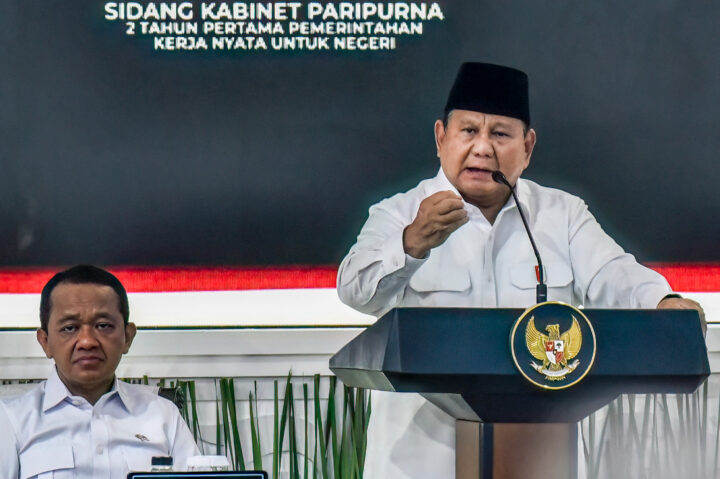
(FATIH MUBAROK/AFP via Getty Images)
Indonesian President Prabowo Subianto (R) delivers his remarks while leading a plenary cabinet meeting next to Indonesian Investment Minister Bahlil Lahadalia (L) at the Presidential Palace complex in Jakarta on October 21, 2026.


 Add JewishInsider on Google
Indonesia’s recent expressions of support for Iran and the Palestinian cause have raised about questions whether Jakarta is once again becoming more hostile towards Israel and engaging in closer ties with Tehran, or continuing its diplomatic balancing act.
Indonesia, the world’s largest Muslim-majority country, has never had formal diplomatic relations with Israel, though previous Indonesian administrations pursued informal ties with the Jewish state while maintaining support for Palestinian independence. Israel and Indonesia had reportedly planned to announce the normalization of relations shortly before the Oct. 7, 2023, Hamas terror attacks, but following the attacks, former Indonesian President Joko Widodo — known as Jokowi — became one of the leading critics of the Jewish state and its war in Gaza.
President Prabowo Subianto, elected in October 2024, has remained critical but softened his language — declining to use the word genocide — and joined the U.S.-led Board of Peace, which local activists saw as capitulating to Israel. In a September 2025 speech at the United Nations, he called for coexistence between Israelis and Palestinians, concluding his remarks with interfaith greetings that included the Hebrew word “shalom” and the Hindu mantra “Om Shanti Shanti Shanti.”
This week, though, Indonesia’s ambassador to Iran reportedly reaffirmed Jakarta’s support for Tehran, according to Iran’s official news agency, IRNA, while Prabowo called for a “free Palestine” during remarks at an Islamic boarding school in September. While experts differ on whether the rhetoric signals a change in policy under Prabowo, they agree that prospects for normalizing relations with Israel remain unlikely in the near term.
Joshua Kurlantzick, a senior fellow at the Council on Foreign Relations, told Jewish Insider that he sees the recent comments as part of a broader shift that is also taking place in other Indo-Pacific countries — one in which Jakarta is willing to be more critical of Israel and seeking to hedge against the possibility that Iran emerges from the war empowered.
“I think we should take [the recent statements] as signs of a somewhat shifting stance and them hedging their bets more strongly,” Kurlantzick said. “They believe that it’s very possible, no matter what Trump and Israel do after the midterms, Iran is going to come out of the war … with the same regime and also as empowered and even possibly as the regional hegemon along with their allies, and so they do not want to be on the wrong side of Iran.”
The Iran war has exposed Southeast Asian countries’ dependence on energy supplies from the Persian Gulf, prompting governments to reconsider their energy strategies and diplomatic relationships with Tehran, according to Kurlantzick.
Jonathan Ruhe, a fellow at the Jewish Institute for National Security of America, similarly said, “Tilting toward Tehran is good politicking in Indonesia right now, given recent domestic backlashes both to rising fuel prices triggered by the Iran war and to Jakarta’s decision to join the Board of Peace.”
Indonesia’s ambitions for a greater role in the Muslim world are another factor in Jakarta’s calculations, Kurlantzick argued, stating that Prabowo wants Indonesia to have greater influence in international Muslim affairs, particularly relative to Saudi Arabia and other Gulf states.
“They want to be seen as a power broker in the Middle East,” he said. “They want to be seen as a power equivalent with their size and their economy.”
“If Iran comes out looking like they’re gonna be … a power, and if the UAE and Qatar and Bahrain and Saudi even are going to bend the knee to them, Prabowo wants to be in the middle of deals, and so that matters,” he continued.
Daniel Samet, a fellow at the American Enterprise Institute, offered a different assessment, arguing that recent statements from Indonesian officials are consistent with its longstanding approach to balancing domestic political pressures with the possibility of establishing diplomatic relations with Israel.
“This is nothing new from Jakarta,” Samet told JI. “Indonesian officials have walked a fine line between … domestic constituencies and pursuing normalization with Israel. Recent events don’t mean that the latter is off the table.”
Ruhe similarly argued that Indonesia’s recent actions reflect its historic foreign policy stances.
“Joining the Board [of Peace], punting on normalization, and alternating between pro-Israel and pro-Iran rhetoric all seem to reinforce Indonesia’s longstanding non-aligned ethos,” Ruhe said. “Joining the Board doesn’t entail moving closer to Israel, and it could be framed as helping Palestinians and easing tariff pressure from President Trump.”
Kurlantzick argued, however, that the shift is a reflection of Prabowo’s more active role than his predecessors in directing foreign policy as public attitudes toward Israel have grown increasingly negative.
“If you look at surveys of public opinion now in Indonesia and Malaysia, they have turned incredibly sharply against the U.S. and Israel,” he said. “Although [Prabowo] has some authoritarian tendencies, he is still the president of a democratic country, and he has to respond, to some extent, to public opinion. Public opinion [of the U.S. and Israel] is extremely negative.”
One source with knowledge of the matter told JI that Prabowo is facing a “growing influence of hardline Islamist voices” and increased pressure to “demonstrate … hostility toward Israel.” It has become “politically costly” for Probowo to pursue pragmatism toward Israel “with little upside to challenging the hardliners,” they said.
Kurlantzick said the changing political and strategic environment makes normalization between Indonesia and Israel unlikely in the foreseeable future, despite Jakarta’s earlier consideration as a potential Abraham Accords candidate.
“It’s definitely not happening until after the Iran war, but I’d be pretty shocked if it happened at all,” he said.
He added that the outcome of Israel’s upcoming election is unlikely to significantly influence Indonesia’s approach.
“I don’t think it really matters who wins … in terms of determining Indonesia’s policy towards Israel and the Middle East,” Kurlantzick said. “I think that it has to do with Indonesia’s own considerations, and those are going to be based on how the Iran war turns out and how some of the Gulf states respond.”
Ruhe similarly said he sees little prospect for normalization under current conditions, but attributed the impasse primarily to the changes in the regional diplomatic environment following Oct. 7.
“Like Malaysia and other Muslim-majority countries outside the Middle East, it was simpler for Indonesia to openly contemplate normalization before Oct. 7,” Ruhe said. “Saudi Arabia was moving in that direction, which would have provided diplomatic top cover and religious legitimacy for Indonesia to follow suit, and Gaza was relatively quiet and stable.”
“Since Oct. 7, Indonesia’s price for normalization now includes concrete movement on a Palestinian state, like it does for Saudi Arabia, thus effectively putting normalization on ice,” he continued.
William Daroff, CEO of the Conference of Presidents of Major American Jewish Organizations, told JI that Indonesia is “one of several important Muslim-majority countries where we are working to encourage dialogue, build relationships, and explore opportunities for engagement.”
He agreed that while the war in Gaza “did not create Indonesia’s longstanding opposition to relations with Israel,” it “intensified anti-Israel sentiment and raised the domestic political price of engagement with the Jewish state.”
Shira Loewenberg, director of the Asia Pacific Institute at the American Jewish Committee, said she has remained doubtful about the prospects of diplomacy between Israel and Indonesia even during times when diplomacy between the two nations appeared to be within reach.
“I was and remain extremely skeptical that Indonesia was on the brink of recognition of Israel then or at any time in recent history,” Loewenberg said. “I know of no such plans, and am deeply skeptical of the enthusiasm that greeted Prabowo’s remarks at the U.N. as though they indicated some sort of breakthrough.”
She noted that any advancement between Jerusalem and Jakarta would require U.S. and Saudi involvement. But while they would have a “big impact,” she explained that “nothing is guaranteed.”
“The question now,” Daroff said, “is whether [anti-Israel] political pressures will dictate Indonesia’s future relationship with Israel or whether its leaders will recognize the opportunities that engagement presents.”
More Stories
FIGHT ON THE RIGHT
Cotton takes veiled swipe at Vance over Iran deal, calls for ‘victory strategy, not an exit strategy’
analysis
Jewish voters stuck with Democrats in 2026 — but were the only group to drift right
pushed back
Senate Judiciary Committee postpones vote on religious institution buffer zone bill
MR. (VAN) HOLLEN'S OPUS
Van Hollen leads push to remove U.S.-Israel cooperation provisions from defense funding bill
CONDITIONAL CONFIRMATION
Cruz ties support for Somalia ambassador nominee to U.S. recognition of Somaliland

PAGE TO SCREEN
Gal Gadot to bring Golodryga and Levi’s ‘Don’t Feed the Lion’ to the big screen
Please log in if you already have a subscription, or subscribe to access the latest updates.
 Continue with Google

 Continue with Apple