














































Modi’s visit puts Israel-India alliance against regional terror on display
The real impact is likely the ‘special strategic partnership,’ as the countries are calling it, that bolsters Israel's global position at a time when many of the Jewish state's traditional partners have turned away
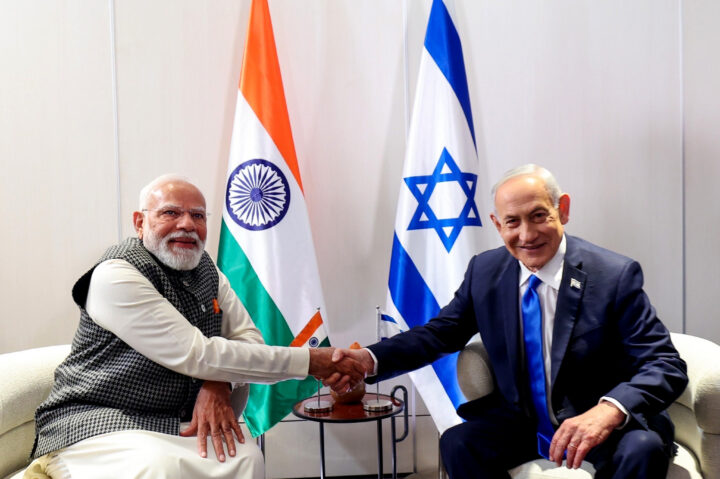
Press Information Bureau (PIB)/Anadolu via Getty Images
Indian Prime Minister Narendra Modi meets with Prime Minister of Israel Benjamin Netanyahu in New Delhi, India on February 25, 2026.


 Add JewishInsider on Google
Indian Prime Minister Narendra Modi’s visit to Jerusalem this week was an important geopolitical moment for Israel.
The biggest tangible outcome of the visit is that, according to Indian media, Israel plans to transfer Iron Dome and Iron Beam missile-defense technology to India, as part of a defense deal reaching as much as $8 billion-$10 billion. The governments only officially acknowledged “significant growth made in defense cooperation … both in scope and scale.”
As for confirmed deliverables, Israel launched expedited free-trade negotiations with the world’s most populous country and fastest-growing economy. The governments released a nine-page statement announcing agreements in a range of areas, including mineral exploration, AI, agriculture, cultural exchange and recruitment of up to 50,000 Indian workers to Israel in the next five years — fulfilling a major need for Israel, which revoked most work permits for Palestinians after the Oct. 7, 2023, attacks.
But the real impact is likely greater than any specific agreement. It’s the alliance on display between Israel and India — a “special strategic partnership,” as the countries are calling it — that bolsters Israel’s global position at a time when many of the Jewish state’s traditional partners have turned away.
Lauren Dagan Amoss of Bar-Ilan University’s Begin-Sadat Center for Strategic Studies and a leading India analyst in Israel, characterized Modi’s speech to the Knesset as “a threshold moment … designed to justify an upgrade from cordial relations to a partnership with strategic depth and deliverables. … The message was aimed at external stakeholders … especially Washington, the Gulf states, and the broader economic-technological community … rather than treating Israel as a standalone bilateral track.”
That dovetails with Israeli Prime Minister Benjamin Netanyahu’s remarks at a Cabinet meeting on Sunday, where he described his vision of a “hexagon of alliances around or within the Middle East. This includes India, Arab nations, African nations, Mediterranean nations (Greece and Cyprus), and nations in Asia that I won’t detail at the moment.” That “hexagon” creates “an axis of nations that see eye-to-eye on the reality, challenges, and goals against the radical axes, both the radical Shia axis, which we have struck very hard” — i.e. Iran — “and the emerging radical Sunni axis,” meaning Qatar, Turkey, and perhaps India’s historic adversary Pakistan, which signed a defense pact with Saudi Arabia less than six months ago.
Modi’s visit came as the world is watching the U.S. and Iran to try to understand if a military conflict is on the way, and while he did not make any specific reference to the Islamic Republic or nuclear weapons, the Indian leader spoke about terrorism, of which Iran is the leading state sponsor. Modi spoke about Israel and India both having “endured the pain of terrorism for a long time,” and said that “countering terrorism requires sustained and coordinated global action, because terror anywhere threatens peace everywhere. That is why, India supports all efforts that contribute to durable peace and regional stability.”
At a time of acute security needs for Israel, the Indian prime minister showed his understanding of Israel’s “security ethos,” Dagan Amoss wrote, and Modi signaled a shift towards deepening the countries’ defense ties, “from a procurement-centric logic to a capability-building approach: industrial integration, supply-chain resilience, and strategic connectivity through corridors, critical infrastructure, and technology as an enabling platform rather than one-off transactions.”
More Stories

on the agenda
Trump meeting with Netanyahu at Mar-a-Lago later this month

NORTHERN FRONT
Israel expands strikes in Lebanon after major Hezbollah barrage
ON THE HILL
2026 defense bill includes unconditional repeal of Syria sanctions, Iraq war authorizations

Primary Pressure
DMFI focusing ire on anti-Israel Democrats running in swing districts

analysis
Josh Shapiro and the politics of faith
TEAM EFFORT
U.S., Israel worked for months on Iran strikes with ‘unprecedented cooperation,’ IDF chief of staff says
Please log in if you already have a subscription, or subscribe to access the latest updates.
 Continue with Google
 Continue with Apple