













































Jewish health-care professionals demand action against ‘anti-Zionism’ in medicine
The letter argues that anti-Israel extremism has become systemic in leading medical institutions

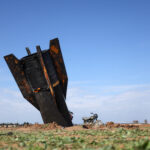
Michael M. Santiago/Getty Images
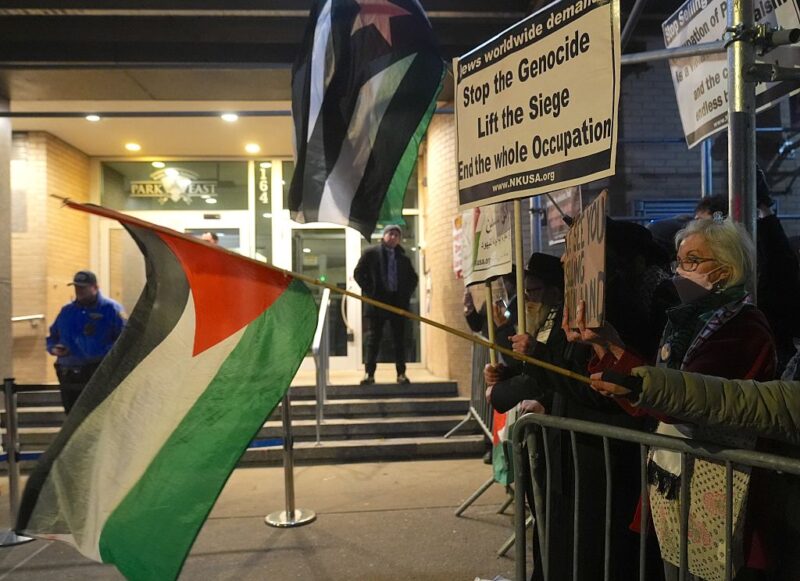
People watch as Pro-Palestinian activists gather for a rally in solidarity with Hesen Jabr in front of Tisch Hospital at NYU Langone Health on June 14, 2024 in New York City.


 Add JewishInsider on Google
Jewish medical practitioners have faced “two years of near-constant abuse and a far longer erosion of professional norms,” according to an open letter published this week decrying the reach of anti-Zionist ideology in the medical field.
More than 1,000 health-care professionals signed onto the letter, the latest of several similar attempts by Jewish doctors, therapists and nurses to garner attention about the exclusion and harassment that many say they have faced in their fields since the Oct. 7 terror attacks in Israel two years ago.
But in this latest missive, its authors and signatories allege that anti-Zionism is a problem unto itself in the medical field — an argument that comes as many people who face accusations of antisemitism defend themselves by saying they are merely opposed to Israel, and not to Jews. The letter marks a rhetorical shift by medical professionals that reflects a broader set of concerns about the influence of anti-Israel ideas in medicine. Anti-Zionism, the letter’s authors write, presents a risk not just to Jewish patients but to the medical field’s integrity.
“Our purpose is to document and expose the pattern by which anti-Zionism has instrumentalized medicine and health, abroad and at home, endangering patients and corroding the ethics of medicine itself,” the letter states. “We must therefore recognize the growing presence of anti-Zionist ideology in contemporary healthcare as an urgent threat.”
Anti-Zionism is just the latest incarnation of thousands of years of antisemitism, according to the letter’s signatories. They trace the arc of antisemitism’s evolution from Christian blood libels about Jews purportedly killing Jesus to Nazi eugenics and, ultimately, to anti-Zionism.
“In the twentieth century, anti-Zionists reconfigured these libels around Israel, the ‘Jew among nations,’” the letter’s writers declare. “Today, anti-Zionism deploys contemporary libels — ‘colonizer,’ ‘apartheid agent,’ ‘genocidaire,’ ‘Zionazi’ — while reproducing the same libel-cycle of earlier eras.”
The letter’s signatories write that American medical institutions are accommodating of anti-Zionist professionals and their influence in the field in a way they might not if the antisemitism exhibited by practitioners had nothing to do with Israel.
“In medicine, institutions both tolerate anti-Zionist rhetoric and permit its operationalization in clinical settings, professional training and organizational policy,” the letter states.
Anti-Israel rhetoric has become widespread at medical schools, showing up in public health trainings and curricula about diversity, equity and inclusion. Since Oct. 7, anti-Israel protesters have demonstrated outside of hospitals in San Francisco, Toronto and New York. Some medical residents have called for boycotts of Israeli institutions.
The new letter calls on institutions including medical schools and professional associations to recognize anti-Zionism “as a form of anti-Jewish hate … and embed this standard into medical and health professions education, DEI programs and professional ethics.” It also urges hospitals and medical offices to “enforce clinical neutrality by banning political insignia in care spaces,” and to better train practitioners to identify anti-Zionism.
“Left unchecked, [anti-Zionism] will corrode ethics and evidence, endanger patients and erode public trust in healthcare,” according to the letter’s signatories. “Name this hatred, educate your institutions and prevent medicine, public health and healthcare from once again becoming a conduit for bigotry, purges and violence.”
More Stories
PLAYING AGAINST TYPE
Pat Ryan endorses Zohran Mamdani for New York City mayor

RIYADH REFLECTIONS
Saudi pivot could have implications on antisemitism globally, Lipstadt contends
ON THE AGENDA
White House religious liberty commission to hold first antisemitism hearing next month

TAKING AIM
Chris Van Hollen, in J Street address, calls AIPAC anti-American
TAX TACTIC
Trump official says tax code could be tool in fight against campus antisemitism

ALARM BELLS
Leading Jewish organizations disturbed by Saudi Arabia’s Islamist turn
Please log in if you already have a subscription, or subscribe to access the latest updates.
 Continue with Google
 Continue with Apple