














































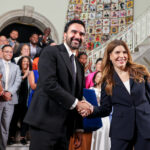

Activist Sameerah Munshi was appointed by the White House to the commission’s advisory board; the two women have jointly posted antisemitic content online
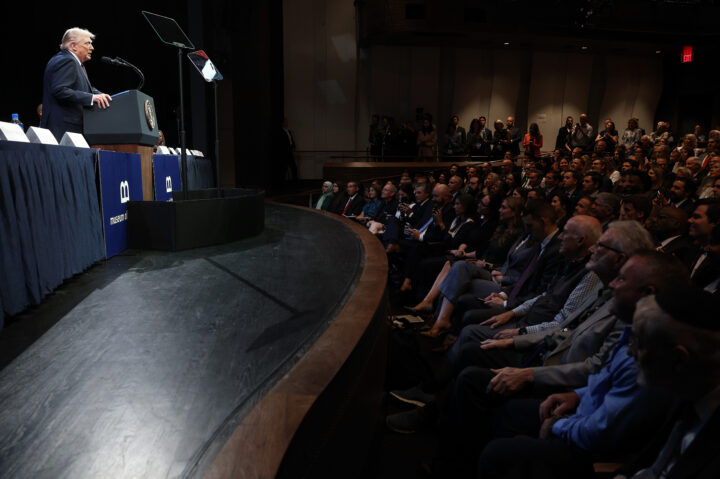
Win McNamee/Getty Images
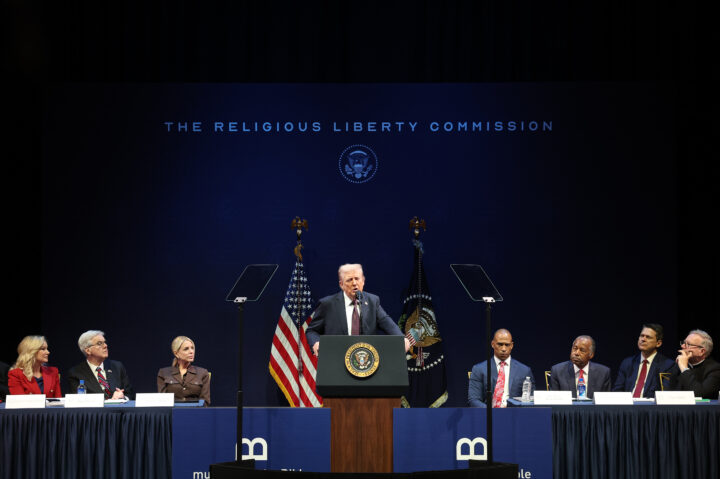
President Donald Trump speaks to the White House Religious Liberty Commission at the Museum of the Bible September 8, 2025 in Washington, DC.


 Add JewishInsider on Google
For the first hour and a half of the White House Religious Liberty Commission’s Monday hearing on antisemitism, the Jewish witnesses testifying about their experiences of antisemitism seemed to be in alignment with the commission’s members — all generally conservative and eager to see antisemitism stamped out.
Then Commissioner Carrie Prejean Boller began questioning the witnesses with a sharply anti-Israel bent, in an adversarial tone. Following public backlash, she was removed from the commission two days later by the commission’s chair, Texas Lt. Gov. Dan Patrick. (Prejean Boller insists Patrick does not have the authority to remove her.)
Prejean Boller, who wore a Palestinian flag pin at the hearing, has used the criticism to deepen her line of attack against so-called “Zionist supremacy in America,” doubling down on her opposition to Israel. “I am a free American. Not a slave to a foreign nation,” she wrote on X on Tuesday.
While Prejean Boller may have been removed from the body, she found an ally who has stood by her this week and who remains on the commission’s advisory board: Sameerah Munshi, a Muslim activist who first gained a public profile in the summer of 2023, when she testified at a Montgomery County, Md., school board hearing against the inclusion of LGBTQ-related material in elementary school classes.
That moment thrust Munshi briefly into the national spotlight, where she worked alongside conservative Christians who also opposed the liberal Maryland county’s approach to educating about LGBTQ issues. Prejean Boller, too, first gained national attention for her opposition to gay marriage at a beauty pageant in 2009.
The two women — both of whom were appointed by President Donald Trump — have now joined together as the anti-Israel wing of the commission. Both of them have publicly defended antisemitic commentator Candace Owens, who uses conspiracy-laden language to discuss Jews and Israel. In a shared Instagram post last week, Prejean Boller and Munshi pointed fingers at a shadowy cabal that they blame for both the humanitarian crisis in Gaza and the alleged crimes of Jeffrey Epstein.
“The politicians who refuse to condemn the Israeli government’s starvation and genocide on the Palestinians are the same ones unmoved by the Epstein crime files,” Prejean Boller and Munshi wrote. “Gaza was a precursor to the release of the Epstein files. Their goal: normalize and justify the torture and killing of innocent children … Arrest these monsters. Drain the evil swamp. End Palestinian genocide. Defund Israel.”
Prejean Boller and Munshi said in another post that they had submitted an alternative list of “fair witnesses” to the commission whom they hoped would present at the antisemitism hearing. The list included Norman Finkelstein, a discredited Holocaust scholar who has publicly defended the Oct. 7, 2023, Hamas attacks, as well as Miko Peled and Yaakov Shapiro, two anti-Zionist Jewish activists.
“Antisemitism should never be conflated with anti-Zionism or pro-Palestinian advocacy,” the two women wrote.
When former UCLA law student Yitzy Frankel spoke at the hearing about his experience of antisemitism on campus after Oct. 7, and described a statement he wrote condemning Hamas’ “rape, beheading of children and taking of hostages,” Munshi muttered under her breath that Hamas had not beheaded anyone, a member of the audience who was seated near her told Jewish Insider.
What remains unclear is who at the White House appointed Prejean Boller and Munshi to their roles on the commission and its advisory board, of which Munshi serves as a lay leader. Several members of the advisory board who spoke to JI said they did not know how they had been selected. A White House spokesperson declined to comment. Munshi did not respond to a request for comment.
Neither Munshi nor Prejean Boller had a history of posting anti-Israel content online prior to late last year.
Prejean Boller’s X account was used only infrequently, mostly to share content about Trump, illegal immigration, Christianity and gender issues. In early 2024, Prejean Boller began to come to Owens’ defense when Owens left The Daily Wire amid concerns about her antisemitic views. Munshi was also an infrequent user of X, and very occasionally posted pro-Palestinian messages over the last two years. Following Monday’s hearing, both women have taken to posting often and highlighting their opposition to Zionism.
“We condemn Zionist supremacy and the demanding we deny our individual faith for the fear of being called an antisemite. Religious freedom lives on,” Prejean Boller posted on Tuesday alongside a photo of the two women.
Carrie Prejean Boller, a member of the commission and a former Miss California, said she opposes Israel and defended Candace Owens from allegations of antisemitism
Win McNamee/Getty Images
President Donald Trump speaks at the Museum of the Bible September 8, 2025 in Washington, DC.
When the White House Religious Liberty Commission gathered in Washington on Monday for the body’s first public hearing focused on antisemitism, attendees expected an informative if subdued meeting, meant to gather testimony from Jewish Americans who have faced antisemitism. The commission’s members are tasked with drafting a report with recommendations for President Donald Trump about how to promote religious liberty.
The speakers were mostly conservative, like the 13 members of the commission, which was created by Trump last year.
The conversation was largely friendly, barring one member of the commission, Catholic conservative activist and former Miss California Carrie Prejean Boller, who acted as more of an interrogator. She pushed back on witnesses’ testimony, arguing that they had defined antisemitism too broadly and questioning whether she would be considered an antisemite because she does not support Zionism and because she believes the Jews killed Jesus.
She also defended right-wing influencer Candace Owens from accusations of antisemitism.
“I listen to her daily,” said Prejean Boller, who appeared to be wearing a Palestinian flag pin. “I haven’t heard one thing out of her mouth that I would say is antisemitic.” In 2024, Owens was dropped from a Trump campaign event where she was slated to speak alongside Donald Trump Jr. after the campaign faced backlash for including Owens, who regularly shares antisemitic commentary in social media posts and on her podcast.
The first panel of speakers featured former UCLA law student Yitzy Frankel, who sued the university over its handling of antisemitism during the 2024 encampments; Yeshiva University President Ari Berman; Harvard alum Shabbos Kestenbaum; and former Auburn basketball coach Bruce Pearl. Each of them talked about their experiences of antisemitism — or combating it — in the United States after the Oct. 7, 2023, attacks in Israel.
After nearly an hour and a half, Prejean Boller revealed that she had been counting each mention of Israel in the course of the discussion.
“Since we’ve mentioned Israel a total of 17 times, are you willing to condemn what Israel has done in Gaza?” said Prejean Boller. “You won’t condemn that? Just on the record.”
Prejean Boller insisted that she opposes Israel because of her Catholic faith.
“Catholics do not embrace Zionism, just so you know. So are all Catholics antisemites?” Prejean Boller asked the panel, earning some boos from the audience, a mix of Jewish professionals, Christian activists and members of the Washington Jewish community. “I want to be clear on what the definition of antisemitism is. If I don’t support the political state of Israel, am I an antisemite, yes or no?”
At the end of the first panel, the Religious Liberty Commission’s sole Jewish member, Rabbi Meir Soloveichik of Congregation Shearith Israel in New York, offered a pointed response to Prejean Boller’s commentary about Catholics.
“This is an incredibly diverse country, and the one thing we should be careful about is speaking on behalf of all members of a religious community, even if one is a member of that religious community. I certainly wouldn’t claim to speak for all Jews on all subjects,” said Soloveichik. “We’re not known for agreeing on everything, and that certainly should be said for speaking about Catholics in America.”
Soloveichik then quoted Secretary of State Marco Rubio, “who also happens to be a very devout Catholic,” and who spoke about the Jewish people’s connection to the land of Israel during a visit to Jerusalem last year.
Prejean was a member of Trump’s campaign advisory board in 2020. The next year, she began using social media to rally against COVID-19 mask mandates. “You’re the next Rosa Parks. You’re the next Martin Luther King. This is so important that you stand,” she told a group of girls in 2021, urging them to go to school without masks, according to a video she posted on her Instagram.
At the time, she had 11,000 followers. Now she has 124,000 followers. She is also an advocate against transgender women and girls participating in female sports, and an opponent of same-sex marriage. Recently, she began regularly posting videos from Owens and Tucker Carlson, along with sharp criticism towards Israel. Her biography on the commission’s website lists only her beauty pageant title and a book she authored about it. A White House spokesperson did not respond to a request for comment.
“They mocked her. They censored her. They called her a ‘crazy conspiracy theorist’ simply for asking questions,” Prejean Boller wrote in a recent post about Owens. “I stand with Tucker,” she wrote in another post.
“I would really appreciate it if you would stop calling Candace Owens an antisemite,” Prejean Boller said at the hearing. “She’s not an antisemite. She just doesn’t support Zionism, and that really has to stop.”
Other commission members include Cardinal Timothy Dolan, the former Archbishop of New York; Pastor Paula White, a senior advisor to the White House Faith Office; and Pastor Franklin Graham, president and CEO of the Billy Graham Evangelistic Association and of Samaritan’s Purse. It is chaired by Texas Lt. Gov. Dan Patrick.
The rest of the Monday hearing proceeded as planned: bureaucratic, genial, straightforward. The commission’s membership is mostly Christian, and much of the discussion of antisemitism presented it as a problem for those who believe in Judeo-Christian values, and an issue for Jews and Christians to combat together — with an understanding that the government should be in the business of supporting Americans’ freedom of religion. The event took place at the Museum of the Bible, a private institution established by the evangelical founder of Hobby Lobby.
“I want to thank everyone who is part of this fight,” Housing and Urban Development Secretary Scott Turner said at the start of the event. “It’s a battle that President Trump will continue to wage for Jewish Americans, for Christians, and for all Americans of all faiths whose First Amendment freedoms are under attack. I know it’s fitting that we’re here at the Museum of the Bible. The word of God is powerful, and it’s a powerful reminder of the importance of the First Amendment.”
Please log in if you already have a subscription, or subscribe to access the latest updates.
 Continue with Google

 Continue with Apple