




























































Senators say the department of defense undersecretary for policy was evasive, unresponsive and even disrespectful at a classified briefing regarding the implementation of the National Defense Strategy
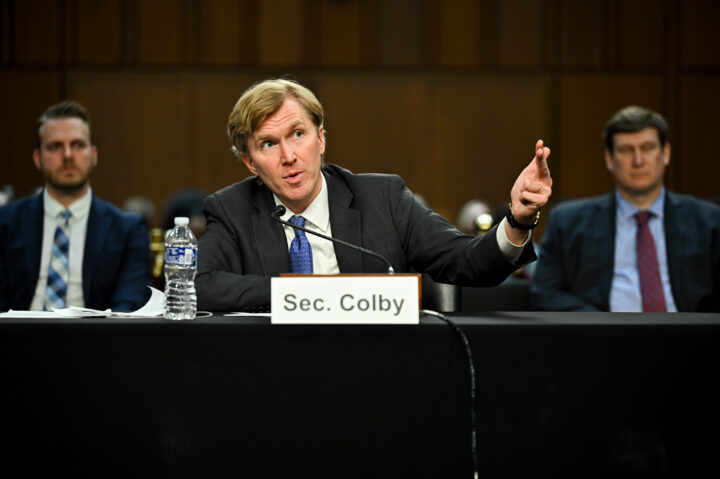
Graeme Sloan/Bloomberg via Getty Images
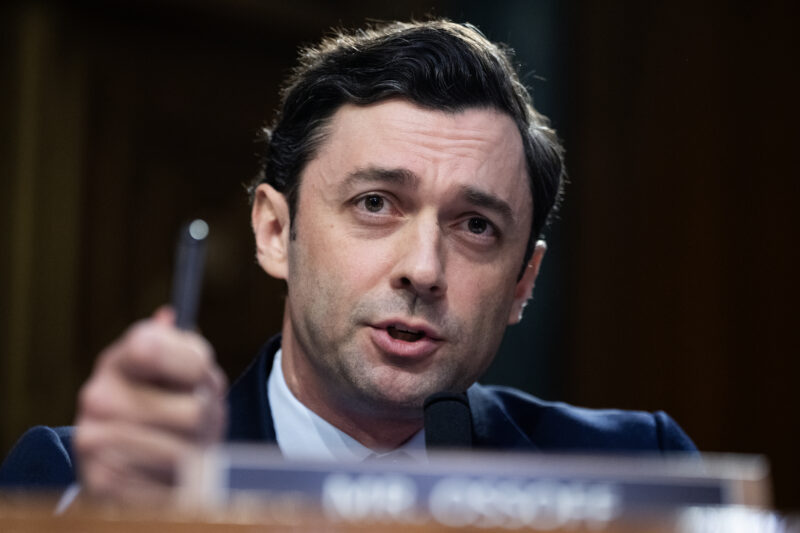
Elbridge Colby, under secretary of defense for policy, during a Senate Armed Services Committee hearing in Washington, DC, US, on Tuesday, March 3, 2026.


 Add JewishInsider on Google
Elbridge Colby, the Pentagon’s under secretary for policy, is once again facing criticism from senators who said he was evasive, unresponsive and even disrespectful at a classified briefing on Thursday regarding the implementation of the National Defense Strategy.
Senators said that, among other issues, Colby had failed to provide clear answers regarding the war in Iran.
“The most telling thing I can tell you is that he didn’t have an opening statement, and he’s there to give us an update,” Sen. Kevin Cramer (R-ND) told reporters. “That seemed weird. You’re the policy undersecretary and you come before the Armed Services Committee and you don’t have an opening statement? That seemed contemptuous.”
In comments to The Hill, Cramer described the exchange with Colby as “very disrespectful to say the least” and as a “dodge and punt.”
Sen. Joni Ernst (R-IA) said Colby “was not giving any clear responses” and that she was “very disappointed” by the briefing.
“Right now, I don’t think any of us are happy with the amount of information being shared by the administration,” Sen. Mike Rounds (R-SD) said after Thursday’s briefing with Colby.
Sen. Roger Wicker (R-MS) attempted to avoid commenting on the subject to reporters on Thursday. “It was a confidential, classified meeting and I’m declining to comment,” Wicker told reporters, when asked if he was satisfied with the briefing.
Sen. Richard Blumenthal (D-CT) told Jewish Insider Colby had been “disastrously unresponsive and evasive, which prompted a lot of concern on both sides.”
“My impression [was] that he was lacking in candor and a lot less than forthcoming,” Blumental continued.
Sen. Tim Kaine (D-MD) told JI that Colby had been evasive on questions about his specific involvement in various discussions and decision-making, and that Colby had responded that he would have to follow up with senators in writing after the briefing.
“Those are easy to answer yes or no. So a lot of frustration,” Kaine said.
Sen. Jacky Rosen (D-NV) said that Colby “did not really address our concerns or issues” and “he was not forthcoming in how the National Defense Strategy should have been changed or updated since the illegal war in Iran.”
Sen. Mark Kelly (D-AZ), said, “Like a lot of these, with this administration, you walk out with more questions than you had when you went in. For me, that was the case today.”
Kelly said he pressed Colby on the planning for the war in Iran. “You always get answers — now is it the answer you would expect? Not always.”
Rep. Seth Moulton (D-MA): ‘We have one commander in chief. It’s not Bridge Colby or Pete Hegseth’

Getty Images
U.S. Capitol Building
Members of the House Armed Services Committee sparred on Tuesday at their annual meeting on the National Defense Authorization Act, the massive annual defense and national security policy legislation, over reportedly rogue actions by Secretary of Defense Pete Hegseth and Under Secretary Elbridge Colby to pause U.S. aid to Ukraine without White House knowledge or support.
In debate on an amendment by Rep. Seth Moulton (D-MA) that sought to block Hegseth from halting Ukraine aid without Trump’s direct authorization, Democrats argued that Hegseth and Colby were subverting the command structure, while Republicans dismissed the concerns and insisted that Trump was in full control of the administration’s policy. The amendment failed along party lines.
“I’ve not been a fan of President [Donald] Trump’s Ukraine policy up until this week … but I do believe in the chain of command and the role of the commander in chief,” Moulton said. “Regardless of my disagreements with the president, we have one commander in chief. It’s not Bridge Colby or Pete Hegseth.”
“When the Department of Defense freelances with lethal aid, it sends mixed signals to our allies and emboldens our adversaries,” Moulton continued.
Rep. George Whitesides (D-CA), also calling out Colby and Hegseth directly, said, “decisions of this magnitude do not belong to a single cabinet official with a political agenda.”
Rep. Mike Rogers (R-AL), the committee chairman, responded that “the president is in full control of America’s Ukraine policy. Yesterday’s announcement to accelerate weapon deliveries with NATO support made that crystal clear. Therefore, this amendment does nothing more than add red tape.”
Rep. Pat Fallon (R-TX) said the amendment is “nothing more than political theater,” “sticking the congressional nose where it does not belong” and “a waste of time.” He said that it’s up to Trump to fire Hegseth if he’s dissatisfied with him, but that the cabinet exists to delegate responsibilities.
The committee also voted down, on party lines, an amendment by Rep. Joe Courtney (D-CT) that aimed to block the conversion of a Qatari jumbo jet into Air Force One as well as its transfer to Trump’s presidential library, as well as several amendments related to Hegseth’s transmission of Houthi attack plans on the unsecured messaging app Signal.
The committee approved several amendments relating to the Middle East in bipartisan amendment packages. The amendments request briefings and reports from the administration on potential risks to the Al Udeid airbase in Qatar, which was attacked by Iran last month, the potential for defense partnership with the new Syrian government, the U.S. weapons stockpile in Israel and its replenishment needs and potential integration of the U.S. defense industrial base with Israel.
Those amendments were led by Reps. Ronny Jackson (R-TX), Abe Hamadeh (R-AZ), Elise Stefanik (R-NY) and Joe Wilson (R-SC), respectively.
It also approved three amendments relating to antisemitism as part of amendment packages.
One, led by Jackson, would ban any funding for colleges and universities that have had antisemitic demonstrations and “failed to take action to mitigate and prevent” future ones, as defined by the International Holocaust Remembrance Alliance’s working definition of antisemitism.
A second, led by Rep. Sarah Elfreth (D-MD), would require a report on antisemitism training and efforts to combat antisemitism inside the Pentagon.
The third, by Rep. Eugene Vindman (D-VA) would request a report on “the threat posed by violent antisemitism as a component of transnational extremist movements,” including the spread of their ideologies and propaganda, the threat they pose to U.S. and the history of violence motivated by antisemitic ideologies.
The bill includes provisions establishing a new program pursuing defense applications of technologies like artificial intelligence, cybersecurity, quantum computing and automation with Israel and other partners; authorizing the U.S. to maintain its weapons stockpile in Israel and its counter-tunnelling cooperation program with Israel through 2028; and expanding an existing U.S.-Israel counter-drone and missile cooperative program to include other types of unmanned systems in addition to airborne threats.
It proposes $35 million for the emerging technology cooperation program, $50 million for anti-tunneling cooperation and $70 million for counter-unmanned systems cooperation, a $15 million boost.
The bill also requests a briefing on the findings that Western components have been used in Iranian attack drones, in spite of sanctions and export restrictions, and ways that the problem can be addressed.
The committee rejected an amendment from Rep. Nancy Mace (R-SC) that would have eliminated Ukraine aid in the bill by a voice vote, and voted 47-10 in favor of an amendment by Rep. Adam Smith (D-WA) that would boost Ukraine aid by $100 million, bringing the total to $400 million.
The Senate Armed Services Committee’s version of the NDAA was also released on Wednesday. That bill includes the same extension of counter-tunneling programs through 2028, but proposes increasing funding to $80 million. It proposes increasing funding for the existing counter-drone and missile program to $75 million, and also extends that program through 2028. It provides $15 million for emerging technology development with Israel.
The Senate bill also instructs the Defense Department to work to provide additional “training, equipment, logistics support, supplies, and services” to Jordan and Lebanon to protect their territorial security.
Amid debate over withdrawing troops from Syria, the Senate bill would require the Defense Department to certify that withdrawing or reducing U.S. troop presence in Syria would not compromise U.S. priorities. It also instructs the Pentagon to “take appropriate measures to support the defenses” of camps in Syria holding ISIS prisoners and report to Congress on the subject.
As previously reported by Jewish Insider, the bill also pushes to advance Middle East air defense integration.
Please log in if you already have a subscription, or subscribe to access the latest updates.
 Continue with Google

 Continue with Apple