























































The U.S. Commission on Civil Rights suggested that the Trump administration’s efforts to combat antisemitism at colleges and universities has ‘sometimes represented a departure from established practice,’ among other concerns
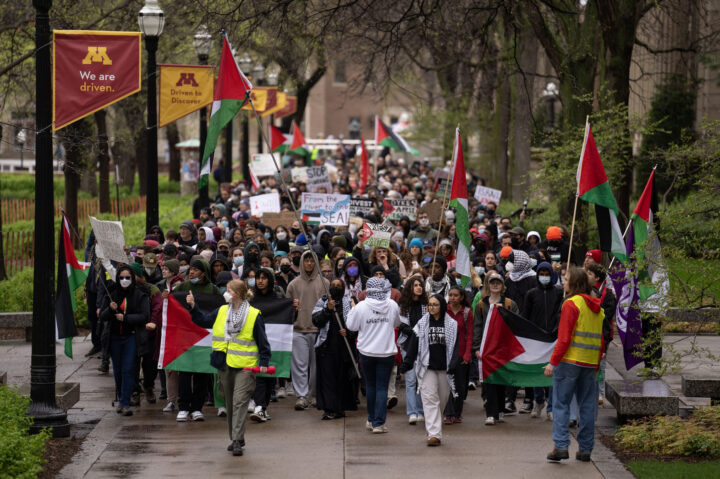
Jeff Wheeler/Star Tribune via Getty Images
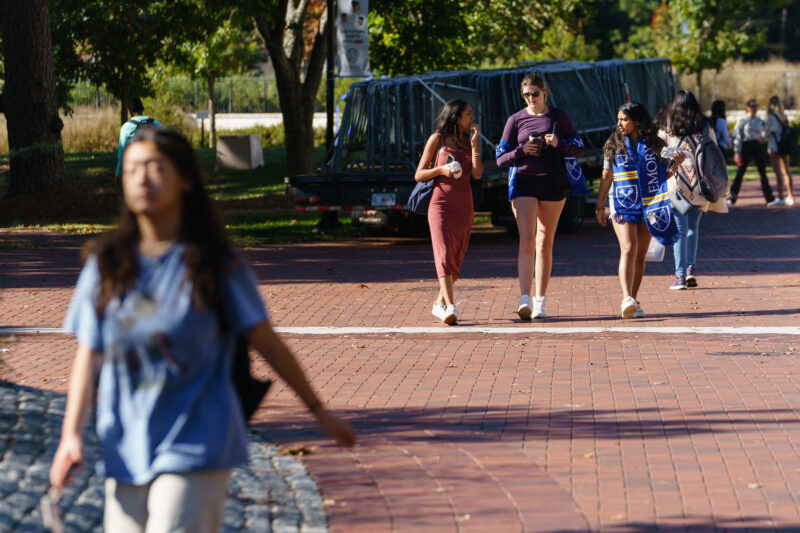
Demonstrators marched on the Northrop Mall before setting up tents on the lawn in April 2024.


 Add JewishInsider on Google
An independent federal commission on civil rights concluded, following a yearlong probe, that campus antisemitism is a “serious and growing civil rights concern,” but also suggested the Trump administration’s efforts to combat it went against both statute and established procedure.
The report by the U.S. Commission on Civil Rights highlights that “recent federal enforcement has sometimes represented a departure from established practice” and that some of the administration’s punitive measures have been overturned in court. It also notes that funding cuts and institutional penalties might cause unintended harm to Jewish students by “disrupt[ing] research, harm[ing] uninvolved students and programs, chill[ing] lawful speech, and generat[ing] resentment toward Jewish students.”
The commission said it did not receive any of the information or documents it requested from the Department of Education, Department of Justice or Department of Health and Human Services regarding its investigations into campus antisemitism, in spite of statutory requirements mandating their cooperation.
“Because agencies did not respond to the Commission’s interrogatories and document requests, and publicly available data on Title VI enforcement efforts is incomplete and outdated, a fully clear picture of how the federal government proceeded and whether it met all of its legal obligations remains unavailable,” the report states.
The report emphasizes that the Trump administration bypassed established procedure and statutory requirements to move to “the last resort funding withdrawal options,” did not limit funding cuts to impacted programs and, according to federal courts, may have overreached the “stated purpose of combatting antisemitism.”
The report notes that “not every offensive or antisemitic incident constitutes” a federal civil rights violation, that “opposition to Israel or Zionism” is distinct from “discrimination based Jewish ancestry or national origin” under civil rights law and that peaceful campus protests enjoy “substantial protections.”
“While overt instances of hostility to people of Jewish ancestry are unquestionably prohibited and rightfully condemned, more complex cases regarding anti-Zionist or anti-Israeli rhetoric and protest activity, for example, are highly context-specific and still being adjudicated by the courts,” the report states.
The report’s authors also said that universities face a “difficult legal and operational balance” in protecting Jewish students while also protecting First Amendment rights and that universities’ responses “remain inconsistent.”
The report found, based on a sample of nine public and private schools, that universities had “slow and opaque” processes for assessing discrimination complaints and that universities struggled with “how to distinguish between protected political speech and unlawful harassment.”
It also found that universities rarely concluded that complaints constituted violations of civil rights law, in many cases because they lacked sufficient information about the complaint or the complainant did not further pursue their case. The report concluded that “complaint data can overcount antisemitism,” but also that it fails to capture all antisemitic incidents, as some who do experience antisemitism do not submit complaints.
“It is important to note that complaint data for this sample of universities do not reflect reports of spikes in physically violent antisemitic incidents after October 7, 2023,” the report continues. “The small share of physical violence in this sample points to the need to flesh out the lived experience of antisemitism so that solutions can be tailored to different types of incidents.”
But it also highlights that, under federal civil rights law, it is a “central concern of the federal government” to investigate campus antisemitism and uphold antidiscrimination law where appropriate.
And, it states, “antisemitism poses a threat not only to Jewish communities but also to American democracy as a whole, threatening to simultaneously undermine civil rights for Jewish Americans and destabilize the rule of law for all U.S. residents.”
The report concludes that 97% of campus protests between Oct. 7, 2023, and May 2024 were “peaceful,” in spite of “media narratives.” It also notes that many post-Oct. 7 bias complaints were linked to protests, particularly “antisemitic messages or objects,” including some that were “overtly antisemitic” and “others [that] were protected speech that could still be offensive depending on the context, such as pro-Palestine messages.”
The report calls for greater staffing and better training for the Department of Education’s Office for Civil Rights — which the Trump administration slashed even as complaints grew significantly — to ensure adequate responses to campus antisemitism, and states that former OCR staffers believe the office was understaffed even before the Trump administration layoffs.
It further states that it is “difficult to accurately assess the true scope of unlawful campus antisemitism” given the “inconsistent or unreliable data” from universities, advocacy groups, scholars and the federal government, emphasizing the need for better, more comprehensive and more transparent data.
“Strengthening federal coordination, improving transparency in civil rights enforcement, adequately staffing civil rights offices, expanding data collection on campus climate and incidents of antisemitism, and supporting colleges and universities in developing clear and consistent policies are all critical elements of an improved federal response to campus antisemitism,” the report states.
It urges Congress to exercise oversight powers to obtain greater information about the Department of Education’s investigations into campus antisemitism — a provision included in multiple proposed bills relating to campus antisemitism.
It also calls for “consulting Jewish students, improving institutional policies and developing approaches suited to each campus rather than relying solely on broad punitive action from the federal government.”
Members of the panel are appointed by Congress and act independently, providing nonbinding recommendations to lawmakers and the executive branch on responding to civil rights issues. The report was unanimously approved by the commission.
The investigation was led by commissioners Peter Kirsanow and former Democratic Rep. Mondaire Jones.
“This bipartisan, unanimously adopted report sends a clear message that protecting students from antisemitism is a shared civil rights responsibility,” commission Chair Rochelle Garza said in a statement. “Students deserve protection from discrimination and harassment while colleges and universities uphold free speech and expression. This report provides a factual foundation to help policymakers and higher education leaders move that work forward.”
The report’s comments on the Trump administration’s efforts could provide further fuel to Democratic efforts to investigate the White House’s responses to campus antisemitism.
Rep. Jake Auchincloss (D-MA) led a bipartisan congressional letter in 2024 urging the USCCR to conduct an investigation into campus antisemitism — the first such investigation by the panel since the early 2000s when there were fewer than 100 complaints of campus antisemitism per year.
“After October 7th, I went to Boston-area campuses to meet with Jewish & Israeli students & faculty. What I saw and heard was unacceptable: Jewish students socially marginalized and Israeli students downright discriminated against,” Auchincloss said in a statement to Jewish Insider following the release of the report.
“Federal and university leadership must not accept hostile learning environments for any students, and should insist on open inquiry and free debate untarred by zealotry.”
Trump’s campus crackdown dominates U.S. civil rights commission’s first campus antisemitism hearing in 20 years
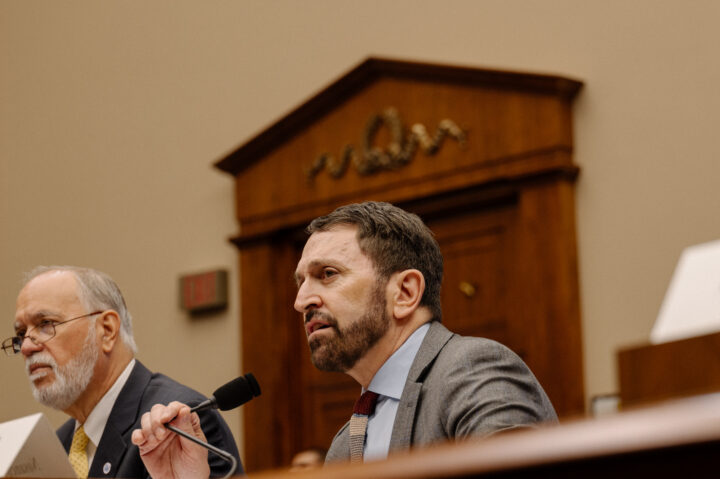
Caroline Gutman for The Washington Post via Getty Images
Matt Nosanchuk speaks at the House Education and Workforce Committee hearing on "Antisemitism in Higher Education: Examining the Role of Faculty, Funding, and Ideology, in the Rayburn House Office Building.
The U.S. Commission on Civil Rights met in Washington on Thursday to hold its first hearing on campus antisemitism in more than 20 years.
The commission — a bipartisan federal fact-finding agency established in 1957 — is chaired by a Democrat and also includes two Republicans appointed by President Donald Trump, yielding a diverse group of witnesses who sparred over Trump’s approach to campus antisemitism and his administration’s firing of more than half of the attorneys in the Education Department’s Office for Civil Rights.
The 22 witnesses included Craig Trainor, who served as acting director of OCR during Trump’s first year in office; several former OCR attorneys; Matt Nosanchuk, a former deputy assistant secretary at DOE during the Biden administration now at The George Washington University Law School; Brandeis Center CEO Ken Marcus, who led OCR during Trump’s first term; National Jewish Advocacy Center CEO Mark Goldfeder; Jewish Council for Public Affairs CEO Amy Spitalnick; J Street U Director Erin Beiner; and students from Harvard, American University and Cal Poly San Luis Obispo.
Two former OCR attorneys who lost their jobs last year after Trump slashed thousands of jobs at the Education Department, which he has said he hopes to shutter entirely, testified that the office’s civil rights monitoring and enforcement team had been pulverized, leaving the agency less equipped to investigate complaints of antisemitism at schools and universities.
“The issue now, in the wake of these cuts, is whether sufficient resources remain to combat the ongoing threat of antisemitism in our nation’s schools,” said Linda Mangel, who served as enforcement director at OCR until last March. “Unless immediate and significant steps are taken now to rebuild the agency so it can respond to complaints from students in harm’s way, hate will win.”
Beth Gellman-Beer, who was director of OCR’s Philadelphia office until it was shuttered last year, said she worried the dramatic reduction in staff in the civil rights office would lead to a diminished ability to monitor universities’ handling of antisemitic discrimination.
“I didn’t have the opportunity to complete the monitoring for all of the cases that my office helped resolve, and that is going to weigh heavily on me into my career in the future, because I know, from my 18 years of experience at OCR, that the power doesn’t lie in the terms of the agreement, but in rigorous enforcement of that agreement,” Gellman-Beer said.
Nosanchuk — who was a political appointee at the Department of Education during Biden’s term — said that an effective, if bureaucratic, approach to combating antisemitism that he argued was working had since been abandoned for political reasons.
“What has replaced this approach? In the name of combating antisemitism, the current administration has built a Trojan horse to unleash a frontal ideological attack on higher education,” said Nosanchuk.
A cadre of more conservative witnesses pushed back, arguing that fewer staff at OCR does not mean less enforcement of federal civil rights statutes, particularly when it comes to antisemitism. Instead, they said the onus has now been taken up by a slew of other federal agencies, including the Justice Department and the Department of Health and Human Services. Even if OCR’s team has resolved fewer cases related to antisemitism than the Biden administration, the forceful strategy by Trump has been more impactful, they argued.
“If we need to understand what’s happening with the Trump administration, we’re seeing a whole of government approach using not just the Education Department, but also HHS, Justice, the Federal Acquisition [Service] and other agencies in an extraordinary way,” said Marcus. “It’s far more comprehensive than anything we’ve seen before.”
Trainor, who led OCR until he left for a position at the Department of Housing and Urban Development this month, clapped back at critics of Trump’s approach and his cuts to OCR.
“What I just hear is sort of desperate attempts to justify being complicit in a failed OCR operation that was politicized under the Biden administration, and the results and the efforts that were taken by the Trump administration speak for themselves,” said Trainor. “The Biden OCR’s response to these hateful hordes was equivocal, craven and pathetic.”
At other sessions, witnesses addressed the constitutionality of Trump’s higher education policies, particularly as he has cut funding from universities. A group of law professors debated whether certain efforts to combat antisemitism infringe on students’ and professors’ constitutionally protected free speech. Students discussed whether they felt their concerns had been taken seriously by government officials.
The members of the commission told witnesses that they intended to use the testimony from Thursday’s hearing, as well as public testimony gathered over the coming weeks, to publish a bipartisan report about federal civil rights laws as related to antisemitism. One of the Trump-appointed commissioners said that the witnesses criticizing Trump’s cuts to the Education Department jeopardized that task.
“I think the problem that is sought to be addressed here is so wicked and evil that bickering about federal bureaucrats losing their jobs is not serving any purpose,” said J. Christian Adams, the Trump-appointed commissioner, who is the president and general counsel at the conservative Public Interest Legal Foundation. “I think complaining about Donald Trump is not going to get a report passed by this commission, because you won’t get the votes.”
The last time the commission produced a report on campus antisemitism was in 2006. One of its findings proved particularly prescient, as witnesses on Thursday discussed the antisemitism that followed the Oct. 7, 2023, attacks in Israel: “Anti-Semitic bigotry is no less morally deplorable when camouflaged as anti-Israelism or anti-Zionism,” the commission wrote 20 years ago.
Please log in if you already have a subscription, or subscribe to access the latest updates.
 Continue with Google

 Continue with Apple