












































































Oren urged Israel to quickly pivot towards a strategic military partnership, while Schanzer warned a hasty move could leave Israel vulnerable
92NY
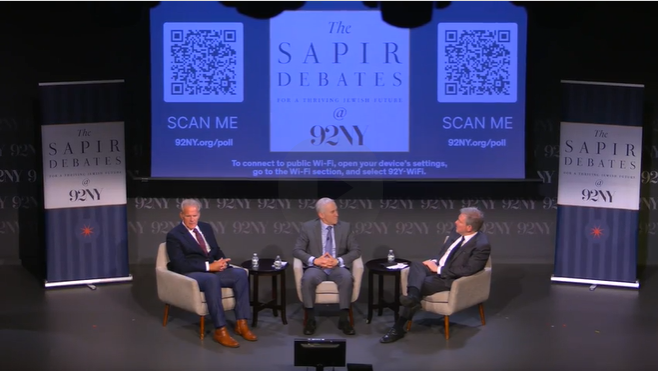
Michael Oren and Jonathan Schanzer debate over U.S. aid to Israel, moderated by Bret Stephens.


 Add JewishInsider on Google
Former Israeli Ambassador to the U.S. Michael Oren and Foundation for Defense of Democracies executive director Jonathan Schanzer squared off Monday evening in New York over whether Israel would be better off weaning itself from U.S. military aid.
Oren argued that Jerusalem should shift toward a strategic partnership before political winds in Washington dictate more unfavorable terms, while Schanzer warned that abandoning the arrangement mid-war could leave Israel exposed.
Audience members were unswayed by either argument: Polled before and after the debate, 39% still agreed that Israel would be better off without American aid, while 61% disagreed. The discussion, part of the 92nd Street Y’s SAPIR Debates series, was moderated by Bret Stephens, editor-in-chief of SAPIR and a New York Times columnist.
Despite taking opposing sides, Oren and Schanzer largely agreed that the U.S.-Israel relationship should eventually move from a traditional military aid arrangement toward a strategic partnership centered on shared defense technology and cooperation. Their disagreement focused on how quickly to make that transition and whether Israel could afford to do so amid continuing regional threats.
“I’m not sure we have more than a couple of months, and so we have to move very, very quickly,” Oren said, warning that a potentially less supportive Congress after the midterm elections could leave Israel with little control over the timing of a transition away from American assistance. He also noted that “there’s already a dialogue going on with the Trump administration about how we can move [the U.S.-Israel relationship] to a partnership.”
Oren argued that Israel’s reliance on U.S. assistance gives American administrations leverage over Israeli military decisions, particularly during wartime, while projecting an image of dependence that he said undermines Israel’s standing as a sovereign nation, pointing to the Obama administration’s withholding of certain munitions shipments during the 2014 Gaza conflict and the Biden administration’s decision to hold shipments of 2,000-pound bombs during the more recent Gaza war.
“Being dependent or being perceived as being dependent on America, it was unbecoming to our status,” Oren said. “It was sending the wrong message to our neighbors in the region — a message of weakness, a dependency — and it was exposing us to blackmail.”
Oren also argued that the existing aid arrangement restricts Israel’s ability to independently develop, purchase and sell military technology, potentially limiting the growth of its defense industry.
As an example, Oren criticized the phaseout of offshore procurement – the portion of U.S. aid Israel could spend on its own defense industry. He said the previous MOU allowed Israel to spend 26.3% of the funds in Israel, supporting local jobs and the development of capabilities tailored to Israel’s needs. However, he claimed that under the Obama-era MOU, offshore procurement was gradually eliminated.
“We cannot sell to whom we want to sell. We have to buy what we’re told to buy,” Oren said, arguing that such restrictions impact Israel’s economy and its ability to develop “capabilities that we need that the United States doesn’t necessarily need.”
Schanzer acknowledged that American assistance can come with political constraints but argued that the immediate military risks of relinquishing it outweigh the potential benefits of greater independence.
“I don’t believe that Israel would be winning the war that it’s winning right now were it not for this aid, and not just the money, but the weapons, the training, everything,” Schanzer said. “The United States has helped to create the army that Israel has, and I don’t like the idea of Israel without this moving forward.”
Furthermore, Schanzer argued that the loss of U.S. assistance would also carry diplomatic weight that extends beyond the battlefield.
“If the United States cuts off Israel or if Israel decides that it no longer wants to take aid from the United States, there is literally no other country out there that will be willing to defend Israel at the U.N.,” Schanzer said.
Schanzer argued Israel should try to maintain the assistance for now, while warning that building a defense industrial base and replacing U.S. systems could take years.
“To develop a fifth-generation fighter [jet] takes 23 years, with multiple countries,” Schanzer said. “Is Israel going to try to do that in the middle of this war? That feels like an enormous undertaking.”
He also emphasized the financial importance of American assistance during wartime, arguing that its contribution to Israel’s defense budget increases significantly when the country is engaged in prolonged military operations.
“It’s only 15% except when war breaks out. Then it’s 35%,” Schanzer said, referring to what he described as the share of Israel’s defense budget covered by American assistance in 2024.
Schanzer further warned that ending U.S. military financing could have consequences beyond the loss of direct assistance, potentially jeopardizing Israel’s ability to purchase American weapons in the future.
“You start with the financing, and then it goes to sales, and then who knows where it goes? Goes to punitive measures. Goes to sanctions,” Schanzer said.
Oren agreed that “the greatest significance of the aid was strategic and psychological. It sent a message, an unequivocal message to everybody in the region: the United States stands behind this country, the State of Israel.” However, he rejected Schanzer’s concerns, arguing that American defense manufacturers have strong economic incentives to continue selling weapons to Israel, while the Israeli military’s use of American equipment serves as a valuable demonstration of its effectiveness.
The former ambassador also suggested that Washington and Jerusalem could restructure their defense relationship by placing certain forms of military support under Pentagon programs rather than traditional foreign assistance, similar to arrangements with other major U.S. allies.
Schanzer, meanwhile, reiterated his support for eventually pursuing such a partnership but maintained that Israel should preserve American military assistance for as long as possible while its current conflicts continue.
“I think Michael and I, we’re probably 100% in agreement that that’s where it needs to go,” Schanzer said. “The question is, in my mind, can Israel get rid of the aid quickly?”
“I think doing it in the middle of a war is, well, scary at best, reckless at worst,” he added.
Mohamed Hagi: ‘Somaliland is deliberately cultivating relationships with partners that value stability, innovation or responsible governance’
Shlomi Amsalem, GPO
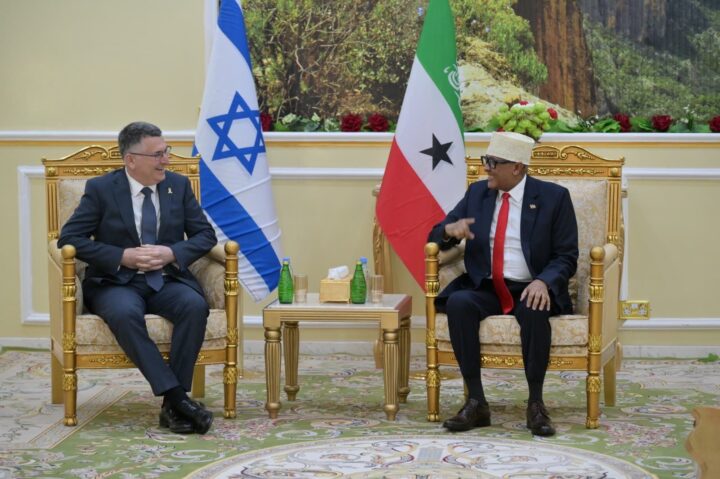
Israeli Foreign Minister Gideon Sa’ar meets with Somaliland President Abdirahman Mohamed Abdullahi in Hargeisa, Somaliland, Jan 6, 2026
Mohamed Hagi, Somaliland’s newly appointed envoy to Israel, spoke on Wednesday about the country’s “special relationship” with the Jewish state, saying that the ties are built on mutually beneficial economic and security interests.
“Our relationship with Israel should be understood as part of a purely strategic orientation,” Hagi said on the podcast “Ask Haviv Anything,” hosted by Israeli journalist Haviv Rettig Gur. “Somaliland is deliberately cultivating relationships with partners that value stability, innovation or responsible governance.”
Hagi said that the relationship will be “based on economic development,” noting that the two countries could benefit from “practical cooperation” in areas such as technology, water management, agriculture and security.
“We have natural resources in Somaliland, we have rare earth minerals in Somaliland, we have oil and gas. We have a lot to offer to our partner Israel,” Hagi said. “And Israel is a manufacturing industry.”
“They [Israel] have the know-how, we [Somaliland] have the natural resources, so in that way we benefit economically and we look at one of the most strategic areas in the world when it comes to security and when it comes to the economy and trade,” he added. “We are benefitting Israel for many, many areas.”
In addition to economic cooperation, Hagi noted that the two countries share “common enemies.” He said that Israel and Somaliland are “working together” to combat “terrorists and piracy.”
“These are our common enemies for Israelis and also for Somalilanders,” he said. “What we are going to build with the Israelis is a strategic partnership that can last forever.”
He also said the relationship being built between Israel and Somaliland is based on “interests” and is “not about religion.”
“It’s about engagement, it’s not about religion,” Hagi said. “Countries engage always on interests. Our people are not ignorant. They understand that the relationship between Israel and Somaliland has nothing to do with religion.”
He added that Israel’s decision to recognize Somaliland carries significant weight in the relationship.
“We see Israel as a very important country for us. It is the first country that recognized Somaliland,” Hagi said. “Our hearts and minds are always with Israel because of recognition.”
Israel became the first nation to formally recognize Somaliland’s independence from Somalia in December 2025 in a move that has since drawn waves of sharp condemnation from several Arab and Muslim countries. As part of the agreement, both nations agreed to open embassies and appoint ambassadors.
Following the announcement, Israeli Foreign Minister Gideon Sa’ar made a historic diplomatic visit to the Somaliland’s capital city of Hargeisa, in which he met with Somaliland President Abdirahman Mohamed Abdullahi.
Israel appointed Michael Lotem, who currently serves as an economic ambassador to Africa, to be its first ambassador to Somaliland earlier this month. The move also received criticism from Arab and Muslim countries.
“We need to build a relationship that is mutually beneficial — for the Israeli people, for the Israeli government, for our people and our government as well,” Hagi said. “We want to build this relationship and you will witness that this relationship will be one of the best special relationships in the world. We want to strengthen and deepen the relationship in a way that no one can imagine.”
Please log in if you already have a subscription, or subscribe to access the latest updates.
 Continue with Google

 Continue with Apple