









































































Iran had said it would not continue striking Israel as long as the IDF ceased its campaign against Hezbollah
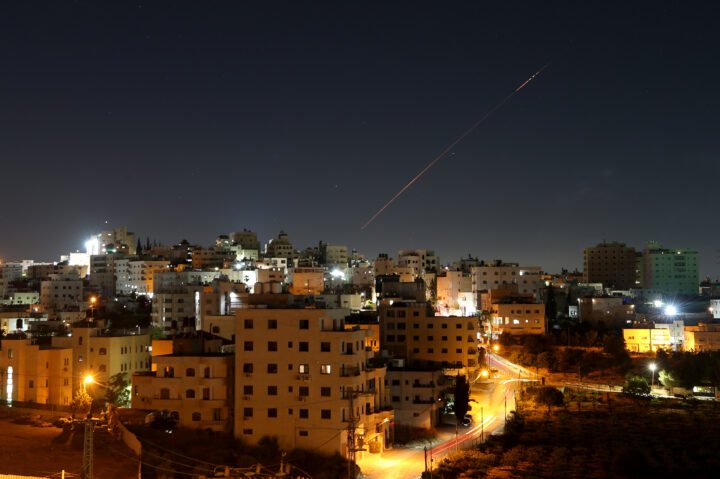
Wisam Hashlamoun/Anadolu via Getty Images
Missiles launched from Iran toward Israel are seen in the sky over Hebron on June 7, 2026


 Add JewishInsider on Google
Israel will abide by a request from the Trump administration to pause its strikes on Iran, two Israeli sources told CNN, though Jerusalem plans to continue its operations against Hezbollah targets in southern Lebanon.
The halt comes after Iran announced earlier Monday that it would suspend its military operations against Israel, after having launched a number of missile barrages at the Jewish state since Sunday evening. However, Tehran has threatened to resume strikes should Israel continue its campaign in Lebanon, which the IDF did on Monday after Hezbollah fired rockets at Israeli troops in southern Lebanon.
Israeli Defense Minister Israel Katz said in a statement on Monday that “any attack on [northern Israel] will lead to a strike on Dahiyeh,” referring to the Beirut suburb and Hezbollah stronghold that the IDF struck on Sunday in response to Hezbollah attacks targeting northern Israel earlier in the day. “We completely reject Iran’s threat,” Katz added. “Any Iranian attempt to link Lebanon and Iran and attack Israel will be met with great force, as happened yesterday.”
Israel had fired on Iranian strategic air defense systems and an Iranian petrochemical plant earlier on Monday after Tehran launched waves of ballistic missiles at northern and central Israel, the first such attacks since the U.S. and Iran reached a ceasefire in early April. Iran said it was retaliating for IDF strikes in Dahiyeh, which came after Hezbollah fired on northern Israeli towns.
After Israel’s strikes on Iran, the Houthis, an Iran-backed proxy group in Yemen, launched a ballistic missile at Israel and declared a ban on Israeli shipping in the Red Sea.
The exchange marked the most significant military hostilities between the two sides in months and prompted immediate diplomatic intervention from President Donald Trump, who called on both sides on Monday to “stop shooting.”
He had also reportedly urged Israeli Prime Minister Benjamin Netanyahu in a phone call to hold off on retaliatory strikes against Iran, though Israel fired on Iran afterwards. Trump also said that “Israel and Iran must immediately stop ‘shooting,’” in a post on Truth Social early Monday morning.
Although a U.S. official initially told CNN that American forces played no role in intercepting the Iranian missiles, officials later confirmed that Washington did fire interceptors at the incoming projectiles. The success of those intercept attempts remains unclear. The U.S. military stated it did not conduct any joint strikes in Iran alongside Israel.
Trump also said he was “not happy” about the Israeli strikes in Beirut on Sunday, after he attempted to broker a ceasefire between Israel and Hezbollah last week, which the terror group quickly rejected.
Netanyahu will reportedly convene a full Security Cabinet meeting Monday evening local time.
The diplomatic scramble unfolds as the U.S. and Iran attempt to maintain a fragile truce while negotiators seek to hammer out a comprehensive end to the conflict. Iranian President Masoud Pezeshkian stated that his nation has “abandoned neither the battlefield nor the negotiating table.”
“Our priority is national security and the peace of our people. We will firmly defend the rights of the nation and will not back down in the face of any threat,” Pezeshkian wrote on X on Monday, describing diplomacy and defense as the “two wings of national power.”
This story was updated on June 8 to reflect an updated CNN report that U.S. forces did attempt to assist Israel in intercepting Iranian missiles.
IDF chief announces offensive campaign against Hezbollah after overnight attacks against Israeli by the Iranian proxy
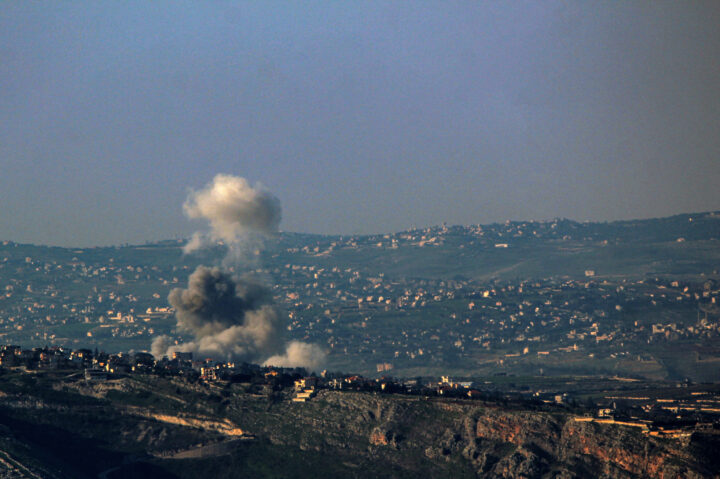
Stringer/picture alliance via Getty Images
Smoke from an Israeli air raid billows from Hezbollah positions in the southern Lebanese village of Dier Siran
Israel expanded its war effort against Iran to southern Lebanon on Monday after Iranian proxy Hezbollah launched rockets and drones at Israel overnight.
“We have launched an offensive campaign against Hezbollah,” Lt.-Gen. Eyal Zamir, the IDF’s chief of staff, said in a situational assessment on Monday. “We are not only operating defensively — we are now going on the offensive as well. We must prepare for many prolonged days of combat ahead.”
The war against Iran and Hezbollah “requires strong defensive readiness and sustained offensive readiness, operating in continuous waves while constantly utilizing opportunities,” Zamir said.
On Sunday, Zamir also spoke of Israel’s “close cooperation with our most important partner — the United States of America. We are working in coordination with CENTCOM, with AFCENT, CENTCOM’s Air Force, and there is undoubtedly tremendous force here.”
Hours after Hezbollah launched rockets and drones at Israel at about 1 a.m. Monday, the IDF carried out strikes against dozens of Hezbollah targets in southern Lebanon and as far north as Beirut that extended into the morning. Targets included senior Hezbollah terrorists, command posts, infrastructure and a vehicle carrying operatives from the Sh’ia militia’s elite Radwan force.
Israeli Defense Minister Israel Katz said on Monday that Hezbollah leader Naim Qassem “decided on the attack under pressure from Iran [and] is from this moment a marked target for elimination.”
The IDF will “act forcefully against Hezbollah,” Katz added, “while continuing to advance the primary objective: crushing and defeating the Iranian terror regime and neutralizing its capabilities in Operation Lion’s Roar in order to remove the threats against the State of Israel and enable the citizens of Iran to rise up against the regime and overthrow it.”
The IDF’s Arabic-language spokesperson issued evacuation notices for 53 villages in southern Lebanon.
“The IDF had previously prepared for the possibility of Hezbollah joining the hostilities,” the military spokesperson’s office stated. “In the Northern Command, combat forces were significantly reinforced along the border with both defensive and offensive capabilities. This preparation enabled a rapid and robust counterattack while maintaining full operational protection across all scenarios.”
The expansion of the war to a second front followed a month of smaller IDF strikes in southern Lebanon, as Hezbollah continued efforts to rebuild after Israel killed Hezbollah leader Hassan Nasrallah and many other leading figures in the Iranian proxy group in late 2024.
As Operation Roaring Lion, as the IDF called its strikes on Iran, was launched on Saturday, the IDF called up 70,000 reservists to bolster its forces in all sectors, including the northern border, as well as Central Command, focusing on counterterrorism activity in the West Bank, and Southern Command, to defend the Yellow Line in Gaza and protect residents of southern Israel.
The IDF continued intercepting Iranian missiles on Monday, including over Jerusalem, where the Iranian Revolutionary Guard Corps said it was targeting the Prime Minister’s Office and the home of Air Force Commander Tomer Bar.
Israel confirmed that on the first day of the war, it eliminated 40 commanders, including the Iranian Armed Forces’ Chief of Staff Abdolrahim Mousavi, whose predecessor was eliminated by the Israeli Air Force last year.
In addition, the IDF targeted the Iranian Intelligence Ministry, killing Sayed Yahya Hamidi, deputy minister of intelligence for ‘Israel affairs,’ who directed attacks on Jews around the world, and Jalal Pour Hossein, head of the espionage division, among others.
The Intelligence Ministry reported directly to Iran’s supreme leader and was also a central tool through which Iran monitored citizens and provided intelligence for the violent suppression of protests. It has long been under U.S. sanctions.
The IDF said that, in addition to missiles, the air force and navy have intercepted dozens of Iranian drones launched toward Israel.
Late Sunday and early Monday, Iranian missiles struck Jerusalem twice, including one that landed right outside the walls of the Old City.
The second strike, in a residential neighborhood, injured five, Magen David Adom reported.
On Sunday, 10 were killed as a result of missile strikes, mostly in a barrage that decimated a residential area in Jerusalem suburb Bet Shemesh.
Since the beginning of Operation Roaring Lion, there have been 12 fatalities in Israel. MDA reported 228 injuries.
Also Monday, Israel’s Energy Ministry instructed a halt on gas production at the Leviathan platform in the Mediterranean Sea.
The LAF said ‘The Israeli enemy persists in its violations of Lebanese sovereignty’
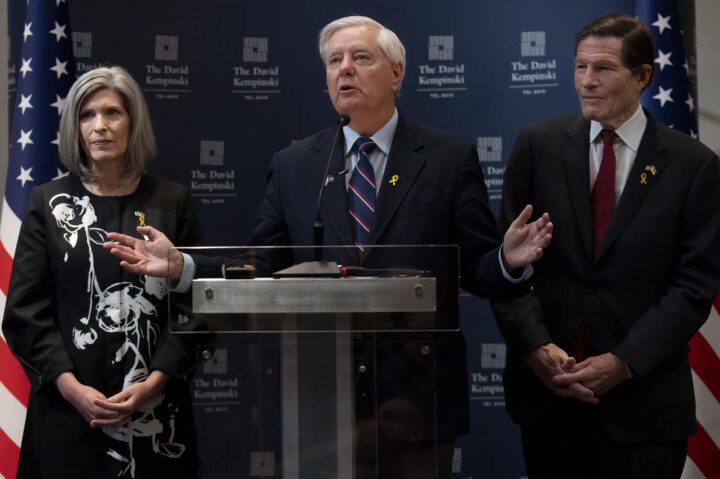
Maya Alleruzzo/AP photo
Sen. Lindsey Graham, R-S.C., center, speaks to journalists at a press conference with Sen. Joni Ernst, R-Iowa, left, and Sen. Richard Blumenthal, D-Conn., as part of a bipartisan U.S. Senate delegation during their visit to Israel, in Tel Aviv, Monday, Feb. 17, 2025.
The Lebanese Armed Forces is facing pushback from two U.S. lawmakers over a statement it posted to social media on Sunday blaming Israel for flare-ups with Hezbollah in southern Lebanon.
The LAF wrote in a post on X, “The Israeli enemy persists in its violations of Lebanese sovereignty, causing instability in Lebanon, obstructing the completion of the army’s deployment in the south.”
“The latest of these condemned aggressions was its targeting of a patrol of the United Nations Interim Force in Lebanon” on Sunday, the post added.
The IDF said that the U.N. soldiers had been “classified as suspects due to poor weather conditions” and that the incident was under investigation.
The LAF post went on to state that it is “working in coordination with friendly countries to put an end to the ongoing violations and breaches by the Israeli enemy, which require immediate action as they represent a dangerous escalation.”
The Lebanese government has agreed to begin efforts to disarm Hezbollah, though reports indicate the terror group is attempting to rebuild its stockpiles after Israel degraded its weapons capabilities over the past several years.
Sen. Joni Ernst (R-IA) responded to the post later that night, writing that she was “disappointed by this statement.”
“The LAF are a strategic partner, and — as I discussed with the CHOD in August — Israel has given Lebanon a real opportunity to free itself from Iran-backed Hezbollah terrorists,” Ernst wrote. “Instead of seizing that opportunity and working together to disarm Hezbollah, the CHOD [Chief Head of Defense] is shamefully directing blame at Israel.”
Sen. Lindsey Graham (R-SC) also weighed in, criticizing the LAF for the statement and its failure to target Hezbollah militarily.
“It is clear that the Lebanese Chief Head of Defense — because of a reference to Israel as the enemy and his weak almost non-existent effort to disarm Hezbollah — is a giant setback for efforts to move Lebanon forward,” Graham wrote on X.
“This combination makes the Lebanese Armed Forces not a very good investment for America,” he added.
Ernst and Graham have both visited Lebanon in recent months amid efforts to encourage Lebanon to disarm Hezbollah and stabilize its border with Israel.
Please log in if you already have a subscription, or subscribe to access the latest updates.
 Continue with Google

 Continue with Apple