










































































Lawmakers also expressed concern over the administration waiving sanctions on Iranian oil: ‘Iran has ended up stronger than they started,’ Sen. Bill Cassidy said
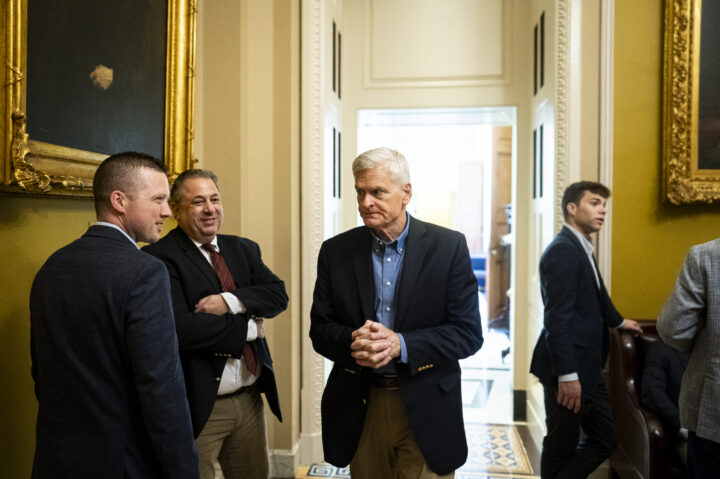
Photo by Al Drago/Getty Images)
Sen. Bill Cassidy (R-LA) departs a meeting with Senate Republicans in the U.S. Capitol on June 28, 2025 in Washington, DC.


 Add JewishInsider on Google
Senate Majority Leader John Thune (R-SD) said that Israel’s right to self defense must be protected in U.S. talks with Iran, after administration officials publicly urged Israel to cease operations against Hezbollah as part of the recent memorandum of understanding — even though Israel, Hezbollah and Lebanon are not parties to that agreement.
Hezbollah has continued to attack Israel, killing Israeli soldiers last week.
“I just want to make sure that Israel is able to defend itself, and I think whatever happens as a result of these talks, that is something that needs to be maintained,” Thune said. “Hopefully the U.S.-Israeli relationship will remain such that we fully understand their need to be able to defend themselves, and right now on their northern border, they’re being attacked daily.”
Asked if he had received any word from the White House on when the administration plans to brief members of Congress, or even senior congressional leadership, on the MOU, Thune replied: “I haven’t. My assumption is because, again, all the briefers are over there [in Switzerland], but hopefully soon. We’ve asked for it, and hopefully we’ll get it.”
Senate lawmakers, including Thune, also expressed some reservations about the waiver lifting U.S. sanctions on Iranian oil sales, which was issued on Monday without any specific nuclear concessions by Iran.
Thune told reporters earlier Monday that he’d “like to see the lifting of sanctions connected to steps taken by the Iranians to shut down their nuclear program,” which he said he had not observed yet.
Sen. John Cornyn (R-TX), recently defeated in his primary election by a Trump-backed challenger, also objected to efforts to prevent Israeli operations against Hezbollah as part of the MOU.
“The whole idea that you would basically tell Israel it can’t defend itself from Hezbollah is to me a nonstarter,” Cornyn said. “The Iranians, if they were actually serious about a ceasefire and about a peace agreement, then they wouldn’t have insisted upon that in the MOU.”
The U.S. is set to host separate talks between Israel and Lebanon in Washington this week.
Asked if he thought it was a good idea to provide economic sanctions relief to Iran before a final deal is struck, the Texas senator expressed skepticism. “Not to me. This is the number one state-sponsor of terrorism. It’s just more money to fund their terror activities through their proxies and harass Israel,” he said.
Cornyn also expressed skepticism that the administration would give Congress the opportunity to review the MOU, describing it as “would be the last thing that they [the Trump administration] would do.”
“I think the president thinks he can do this on his own,” Cornyn said.
Cornyn said that “there [have] been a lot of robust discussions around” how Congress should respond if the Trump administration does not seek congressional approval on the current memorandum of understanding between the U.S. and Iran or the final deal reached through ongoing negotiations. “I don’t expect that to end,” he said of the talks on Capitol Hill.
Sen. James Lankford (R-OK) also expressed concern about the U.S. pushing for a permanent ceasefire in Lebanon as Hezbollah continues firing at Israel, which he said was placing the lives of the many Americans who live in the Jewish state at risk.
“I don’t understand how the issue with Lebanon actually affects what’s happening in the Strait of Hormuz. Those are two different issues, obviously. If Iran can’t stop attacking Israel, that’s a big issue. They continue to be able to drive weapon systems and people to go attack Israel,” Lankford told JI. “There are hundreds of thousands of Americans that also live in Israel, so it’s not just an issue of attacking Israelis, it’s also attacking Americans that live in Israel.”
Sen. Bill Cassidy (R-LA) called the sanctions relief “disappointing.”
“Iran has ended up stronger than they started. And we’ve achieved none of the objectives originally laid out,” Cassidy, who was also recently defeated by a Trump-backed challenger, said.
Sen. Ted Budd (R-NC) argued that the deal is performance-based so “they don’t get anything until they actually perform.”
Pressed on the fact that the sanctions had already been waived, Budd said, “If that helps to open the strait, that’s fine, but I am concerned what they use that money for — to support their terror proxies.”
Sen. John Kennedy (R-LA), who has argued in favor of the memorandum of understanding, said that he doesn’t want to “pick [the deal] apart” piece by piece, but instead wants to assess the net effects in 60 days. He argued that the deal was primarily a method to ensure oil flows were restored.
“I just don’t think it’s fair to take every little announcement and second guess it,” Kennedy said. “I’m very hopeful, but we’ll all know in 60 days.”
News of U.S. sanctions on Iran being lifted was also poorly received on the Democratic side of the aisle as well.
Sen. Chris Coons (D-DE) criticized the move as “such a terrible idea.”
“I don’t know if I could find a better example of unilateral disarmament. We are literally handing away what leverage we have over a regime that, if anything, is worse [than its predecessor],” Coons told JI. “Out of all the goals that Donald Trump said he had for this war: regime change, remember, ‘help is on the way’; ensuring they could never have a nuclear weapon, that’s still on hold; ending their ballistic missile program, he’s now saying, ‘Well, why shouldn’t they have ballistic missiles?’ I’m just shaking my head.”
The Senate is set to vote tomorrow on a procedural motion on an Iran war powers resolution passed by the House last month; whether the motion is approved will be largely contingent on attendance on both sides of the aisle.
Sen. Tim Kaine (D-VA), the lead sponsor of the only war powers resolution for which such a procedural motion has thus far been approved, did not tell reporters on Monday when he plans to bring up the next procedural vote to move that motion forward.
He said that “attendance generally is a factor on both sides of this.”
The Senate majority leader also said the deal triggers requirements for the administration to provide Congress with the opportunity to review the agreement under INARA

Kayla Bartkowski/Getty Images
Sen. Majority Leader John Thune (R-SD) calls on reporters following the weekly Senate Republican caucus policy luncheon at the U.S. Capitol on January 14, 2025 in Washington, DC.
With scant details provided by the Trump administration about the contours of the peace deal with Iran, Senate Majority Leader John Thune (R-SD) said on Monday afternoon that he doesn’t yet know enough about the administration’s deal with Iran to determine whether it is a good deal that will prevent Iran from acquiring a nuclear weapon.
“I don’t know enough about it to say,” Thune told reporters. “I think the issues are going to be compliance, and how you can enforce that, and what are the financial incentives that the Iranians have from our country, and what are they conditioned upon.”
The South Dakota Republican said that a positive deal would include financial incentives that are conditioned upon Iran winding down its nuclear program, the disposal of Iran’s enriched uranium and Tehran giving up its capacity to have a nuclear program in the future.
Thune also indicated that he believes the deal should be submitted to Congress for review under the Iran Nuclear Agreement Review Act.
“There are some requirements that are triggered because of the nuclear components of the deal, in terms of notification or informing Congress,” Thune said. “I know there is probably some expectation that there may be a vote at some point, whether that’s on a resolution of disapproval or something. We’ll see. I just don’t know enough about it yet. And I don’t think even the people who follow this stuff closely up here know that much.”
The administration hasn’t publicly commented on the issue of INARA yet, and has offered varying timelines for when it might release the text of the agreement. In media appearances, Vice President JD Vance has been framing specific nuclear issues as part of the next round of talks, rather than the current MOU, which could give the administration an avenue to attempt to dodge INARA review.
Thune said that “somebody” from the administration, whether that be Vance or other officials, “will need to” come to the Hill to brief members.
“For sure, our members are going to have a lot of questions about it,” Thune said.
Sen. John Barrasso (R-WY), the No. 2 Senate Republican, indicated he was similarly in the dark about the agreement.
“I haven’t seen anything from the president in terms of what’s in it. I’ve seen some press reports,” Barrasso told reporters. “I want to see what’s actually in it and I congratulate the president for his continued efforts.”
But asked whether he was concerned that the deal would be an effective surrender to Iran in providing sanctions relief, Barrasso rejected the idea out of hand.
“President Trump is never, ever going to do what you just suggested,” Barrasso said. “He’s not going to accept a deal that doesn’t eliminate nuclear weapons, isn’t enforceable, isn’t verifiable and doesn’t take Iran completely out of what they’ve been doing to try to undermine and attack us for the last 47 years.”
Majority Leader Thune said about a congressional vote to extend the war, ‘hopefully that question won't be a necessary one that we’ll have to answer’

Kayla Bartkowski/Getty Images
Sen. Majority Leader John Thune (R-SD) calls on reporters at the U.S. Capitol on January 14, 2025 in Washington, DC.
Senate Majority Leader John Thune (R-SD) said Tuesday that he’s hopeful that the war in Iran is close to winding down, in advance of a deadline that could require congressional action for the war to continue.
Under the War Powers Act, unilateral military action undertaken by the president without congressional authority is limited to 60 days — with a 30-day extension for draw-down purposes.
Thune emphasized that the administration’s current goal is to reopen the Strait of Hormuz, and that Senate Republicans support efforts to isolate the Iranian regime and their economy.
“We get the strait open again — and that’s sort of their last resort. The military effort here has been extraordinarily successful. This is sort of the last dying gasp of this regime, is to try and shut down the strait,” Thune said in a press conference after a GOP conference meeting. “The administration is making an effort to ensure that it’s open, that there’ll be traffic in and out there. And hopefully that will be successful and we can begin to see this thing wind down.”
Pressed on whether Republicans would be open to voting to continue the war if it extends beyond 90 days, Thune suggested that wouldn’t be necessary.
“At this point, most of us, I believe, feel pretty good about what the American military has achieved there in terms of its objectives,” Thune said. “It’s a hypothetical down the road. … I think the administration has a clear objective, a clear plan, and if they can execute on it, hopefully that question won’t be a necessary one that we’ll have to answer.”
Sen. Mike Rounds (R-SD) said that it’s “not quite time” yet for a full Senate discussion on the war, but said that he does want to see the administration more fully lay out its strategy and plan as the war continues and approaches the 60-day deadline at the end of April.
“We do expect that the administration will be laying out their plan for after the end of seven, eight, nine weeks,” Rounds said. “We have to know what the next steps are, and that’s part of our due diligence that we have to do.”
Sen. Steve Daines (R-MT) said that Republicans did not discuss the possibility of an authorization for the war during their meeting.
Other Republicans have argued that the provision of the War Powers Act that sets out the 60-day deadline, is not enforceable and that Republicans on Capitol Hill are not paying attention to it.
Sen. Lindsey Graham (R-SC) said that the U.S. should “finish the job” rather than extending a ceasefire agreement with Iran if the regime is not willing to agree to U.S. demands, including a permanent end to nuclear enrichment, surrendering all of its already enriched uranium, fully reopening the strait and abandoning its ballistic missile program and support for terrorism.
Senate Minority Leader Chuck Schumer (D-NY) said that Senate Democrats plan to bring forward another war powers resolution to stop the war on Wednesday, and will continue to force votes on similar resolutions weekly until the war ends. For now, most Republicans seem likely to continue to vote against the legislation.
Senate Republicans also indicated that they’re not likely to attempt to include supplemental funding for the Iran war in an upcoming partisan budget reconciliation package, which is focused on border security and immigration funding currently being blocked by Democrats.
Thune, who has said he wants an “anorexic-like” reconciliation package, again indicated on Tuesday at a press conference after a Senate Republican lunch meeting that the package will be tightly “focused” to fund immigration enforcement.
“I think we’re going to do a very skinny reconciliation,” Sen. Roger Wicker (R-MS), the chair of the Senate Armed Services Committee, said when asked about Republicans’ discussions on Iran during the conference meeting.
Sen. John Kennedy (R-LA) said that he has not heard anything about either the timing or the size of the supplemental request the administration plans to submit. Initial reports indicated that the Pentagon wanted to ask for $200 billion, but more recent reports have indicated that the final request will be lower.
Republicans have discussed advancing another reconciliation package before the end of the year, though some members of the conference, like Kennedy, have openly expressed skepticism that such an effort would be possible.
At this point, given the strong and widespread opposition among Democrats to the war in Iran, it’s unclear whether a funding package for the war would be able to clear the 60-vote filibuster threshold necessary for passage in the Senate.
Please log in if you already have a subscription, or subscribe to access the latest updates.
 Continue with Google

 Continue with Apple