














































































Shallal offered the drink for free to those who were willing to film a promotional video saying the anti-Israel slogan
Pablo Martinez Monsivais
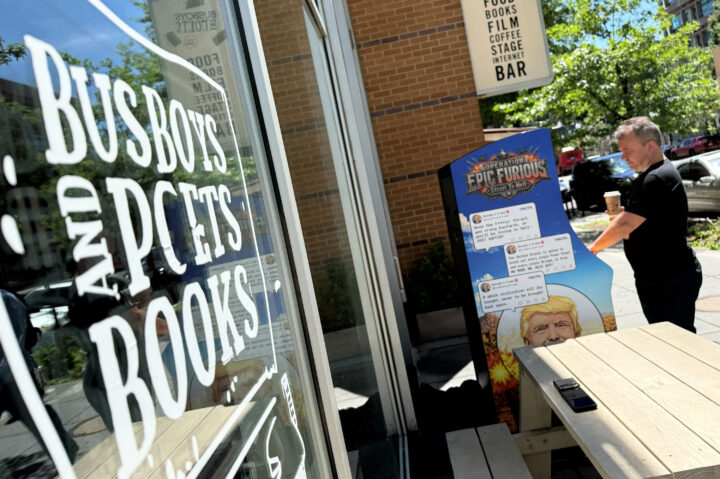
A man plays an arcade game titled, "Operation Epic Freedom Strait to Hell," outside Busboys and Poets Restaurant in the U Street neighborhood of Washington, Friday, May 15, 2026.


 Add JewishInsider on Google
Andy Shallal, the founder and CEO of the restaurant and bookstore chain Busboys and Poets, has spent two decades building the Washington-area chain into a hub for progressive politics and anti-Israel advocacy.
Now, that activism is literally on the menu.
The chain’s newest drink is a $14 cocktail called “Free Palestine,” which is made of Tito’s vodka and watermelon, and was offered for free earlier this month to the first 100 customers who filmed and posted a promotional video of themselves saying the slogan.
The drink launch follows a series of events that the restaurant has hosted featuring speakers hostile to Israel, even as Shallal says he has spent decades promoting dialogue between Arabs and Jews. The restaurant’s 2024 Palestine Week event series featured Linda Sarsour, a controversial Palestinian activist with a history of antisemitic and anti-Israel stances.
Busboys and Poets operates eight locations throughout the Washington metropolitan area. Its 14th Street location has a mural painted on the wall showing a group of left-wing leaders and activists sitting at a table together; one of the legs of the table has the words “Long Live the Intifada” painted on top of it, and another says “From the River to the Sea, free Palestine.”
Jewish patrons say the new drink signals the latest shift that makes them feel unwelcome in the restaurant. The slogan “Free Palestine” carries particular weight in the Washington area, where federal prosecutors allege the man accused of killing Israeli Embassy staffers Yaron Lischinsky and Sarah Milgrim outside the Capital Jewish Museum in May 2025 shouted the phrase after the shooting.
“That is not simply putting a political message on a menu,” Jacob Silver, a local political commentator writing for a Montgomery County Republican club blog, wrote. “It is a script. It is a social-media campaign. And in Washington, of all places, Busboys and Poets should understand why some Jewish customers are going to find it deeply offensive.”
Shallal, the Iraqi American owner, defended the “Free Palestine” cocktail in a Facebook post, publishing a letter from a longtime customer who asked him to remove the drink and said she would stop dining there.
The customer wrote that she associates the slogan with violence and efforts to destroy Israel, said she sees rising harassment of Jews as tied to the “Free Palestine” movement and called the “discrimination against a minority” inconsistent with the inclusive values she believed the restaurant intends to represent.
In his reply, Shallal said the name was meant as a gesture of solidarity with Palestinians, comparing it to the Black Lives Matter movement and arguing that highlighting one group’s suffering does not diminish another’s. He said he did not intend to alienate neighbors and pointed to his history of Arab-Jewish dialogue work, including co-founding the Peace Cafe with a Jewish colleague.
Shallal also described being treated in a demeaning way at checkpoints and at the airport during two trips to Israel and the West Bank, saying he was pulled aside and had his camera confiscated.
He did not specifically address the customer’s request to remove the drink from the menu.
The closure of Oro Nami after less than a year has reignited a long-running debate about why the nation's capital is stuck with just one full-service kosher option
Gabby Deutch
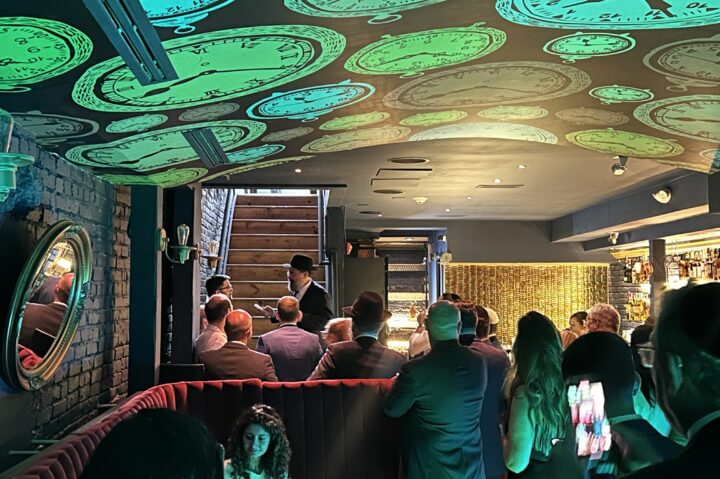
Rabbi Levi Shemtov, executive vice president of American Friends of Lubavitch (Chabad), prepares to hang a mezuzah on the doorpost at the grand opening of Oro Nami, a new kosher sushi restaurant in the West End neighborhood of Washington on June 25, 2025.
At last year’s grand opening for Oro Nami, a kosher sushi spot in Washington, the restaurant’s splashy aesthetic — red velvet booths, multicolor clocks projected on the ceiling, dark walls, a light-up floor — did not exactly align with the clientele: Capitol Hill staffers, new Trump administration appointees, K Street lobbyists and a handful of Orthodox rabbis.
But even if Oro Nami’s atmosphere felt slightly out of place in Washington’s quiet West End neighborhood, where the city’s small Orthodox community is centered, that incongruity was no match for the excitement among observant Jews living in the nation’s capital. For years, people had been clamoring for more kosher dining options in the city, and in particular one that would be open past 8 p.m. Oro Nami seemed like the answer.
That is, until it shut down in May, after less than a year in business.
Now Char Bar, the meat restaurant in the West End that has been serving observant Democratic and Republican officials — and their friends and colleagues — for years, is once again the only sit-down kosher restaurant with a liquor menu. Nearly all of the area’s kosher restaurants are located in Maryland suburbs like Silver Spring and Rockville, where the bulk of the region’s Orthodox community lives. In a city that thrives on power lunches, kosher-keeping Jews have only one option.
The closure of yet another kosher restaurant in the District has reignited one of Jewish Washingtonians’ favorite conversation topics: Why aren’t there more kosher restaurants in a city as important as the nation’s capital?
People with knowledge of the restaurant business say that the answer is straightforward, if unsatisfying: economics. The Washington metro area has more than 300,000 Jews, according to a community-wide study completed in 2017. Just 5% of them are Orthodox, and most of the Orthodox Jews live in Maryland.
“Kashrut in general in D.C. I think is tricky, because from a real estate perspective, everything is priced like a normal restaurant,” said Rabbi Charlie Schwartz, the director of Lehrhaus, a kosher restaurant in Boston that plans to expand to Washington. “It’s assuming that you’ll do a high volume of business on Fridays and Saturdays, and for larger restaurant spaces that you’ll have pretty high alcohol sales, and kosher restaurants just don’t operate that way.”
“There isn’t a concentrated district [in D.C.] where all the Orthodox Jews work. There isn’t a district where everybody is going to particular museums. Even the museums and the things that tourists do are spread out,” said Dani Klein, who runs the popular blog “YeahThatsKosher.”
In 2024, Lehrhaus announced to great fanfare that it planned to open in Washington, its second city, in 2025. But the restaurant, which bills itself as a “Jewish tavern and house of learning,” has not even broken ground on a location in D.C. yet. (“We’re 100% in on D.C,” Schwartz promised. “We’re not dismayed in any way.”)
Dani Klein, who runs the popular blog “YeahThatsKosher,” said that the layout of the city doesn’t help.
“There isn’t a concentrated district [in D.C.] where all the Orthodox Jews work. There isn’t a district where everybody is going to particular museums. Even the museums and the things that tourists do are spread out,” said Klein. He compared it to Midtown Manhattan, where he works in corporate marketing. Due to its proximity to major tourist attractions such as Times Square, Broadway and Central Park, along with scores of office towers, the neighborhood has a wealth of kosher options, though he noted several restaurants have closed recently.
He described Chicago as a more apt parallel to D.C., although Washington actually has more kosher options downtown.
“As you go further north [in Chicago], outside of downtown, and you start going to where the Jewish community lives, then you get massive pockets of kosher,” said Klein. Washington’s kosher restaurants are mostly in the suburbs, too.
Char Bar’s owner, Michael Chelst, does not primarily earn a living from running a kosher restaurant. He also works in the mortgage business, and he recently took over operating Moti’s Market, the kosher grocery store in Rockville.
“I call us a ‘likely for profit’ business. We’re not a nonprofit,” Chelst told Jewish Insider recently. “I get frustrated when people go, ‘Oh, why don’t you do more of this and that.’ I’m like, ‘Listen, we’re just trying to keep it open and keep it going for our community and for the people there.’” Still, the vast majority of Char Bar’s customers are tourists, according to Chelst.
Despite the addition of Oro Nami last year, 2025 was Char Bar’s highest-revenue year since it opened in 2014. (Chelst previously ran a different kosher spot, Eli’s, in the same location.) Chelst said he thinks Washington would benefit from a dairy restaurant, even if it competes with Char Bar.
“I’m sure that would hurt our business, but I wouldn’t be upset if one opened, because that would be good for the community,” said Chelst.
People know there’s an appetite for more options, even if the money isn’t quite there to support them.
“I get a call, I’d say, every other month or so from someone who’s very interested in starting up any of a range of Kosher cuisine enterprises here,” said Rabbi Levi Shemtov, executive vice president of American Friends of Lubavitch (Chabad). “I know of a few currently still considering doing so. They’re watching downtown business lunch traffic, and when that picks up, I think you’ll see another one or two actually get established.”
Other options have opened and closed over the years. Jack Abramoff, the Republican lobbyist who went to prison on corruption charges, ran a kosher deli for a period in the early 2000s. An upscale kosher French restaurant called L’Etoile closed in 2002 after three years. The local Israeli chain Shouk closed last year, in part due to boycotts by anti-Israel activists. In earlier eras, when the local Jewish community was actually centered in the District and not the suburbs, kosher options were not so hard to come by; following the Civil War, six kosher restaurants were operating in D.C.
“I urge the relatively new kosher-keeping residents of Washington, D.C., to understand the privilege that they have to live in this time,” said Aaron Keyak, a Democratic consultant who moved to Washington nearly 20 years ago. “And with the advent of all these food delivery apps, you can reach into the suburbs and get everything from kosher Chinese to pizza.”
But despite the kvetching from locals, Washington’s kosher restaurant scene has not actually been stagnant in recent years. Oh Mama Grill, a casual Israeli-style falafel and shawarma restaurant, opened in Adams Morgan in 2022 and is still operating. During the academic year, anyone — whether affiliated with George Washington University or not — can visit Zingers, a kosher restaurant in the GW Hillel that opened in 2023 and is operated by the university’s dining operation, as part of the school’s pledge to provide kosher options for Jewish students. Zingers serves sandwiches and bowls alongside what it deems “the best chicken sandwich in Foggy Bottom.” At $12, the sandwich can compete with non-kosher options.
“People eat there because the food is good,” said GW Hillel’s executive director, Daniel Novick. “A lot of non-Jewish students are eating there.”
There are even now kosher deli sandwiches available for purchase in the cafeteria at Longworth, one of the congressional office buildings.
Other kosher options in the city include Pow Pow, a vegan Asian restaurant with two locations in the city, and Baked By Yael, a bakery across from the zoo in Woodley Park that sells pastries, challah, bagels and cake pops. They are certified by a kashrut agency operated by local Modern Orthodox rabbis — so while some strictly religious Jews may not eat there, the creation of DC Kosher to give the seal of approval to local plant-based restaurants was a boon to most of the city’s observant Jews.
“I urge the relatively new kosher-keeping residents of Washington, D.C., to understand the privilege that they have to live in this time,” said Aaron Keyak, a Democratic consultant who moved to Washington nearly 20 years ago. “And with the advent of all these food delivery apps, you can reach into the suburbs and get everything from kosher Chinese to pizza.”
“People are always kvetching about why there aren’t more establishments,” said Rabbi Levi Shemtov, executive vice president of American Friends of Lubavitch (Chabad). “But once they open, the proprietors feel that the community doesn’t show enough support.”
D.C. is a foodie city, at least for the non-kosher keepers. Two Washington restaurants appeared on The New York Times’ vaunted “50 Best Restaurants” list last year. Don’t expect to find kosher restaurants on the list — but that doesn’t mean the city’s kosher food scene is a lost cause.
Shemtov, one of the best-known Orthodox rabbis in Washington, had a blunt message to Jewish Washingtonians about the local food scene.
“People are always kvetching about why there aren’t more establishments,” said Shemtov. “But once they open, the proprietors feel that the community doesn’t show enough support.”
It was like the now-famous Barack Obama line from the 2016 Democratic National Convention, when he urged Democrats to vote in that year’s elections. Don’t boo. Vote.
Shemtov’s message is similar. Don’t kvetch. Eat.
The two victims said they were approached by three assailants while speaking Hebrew
JCRC Bay Area/X
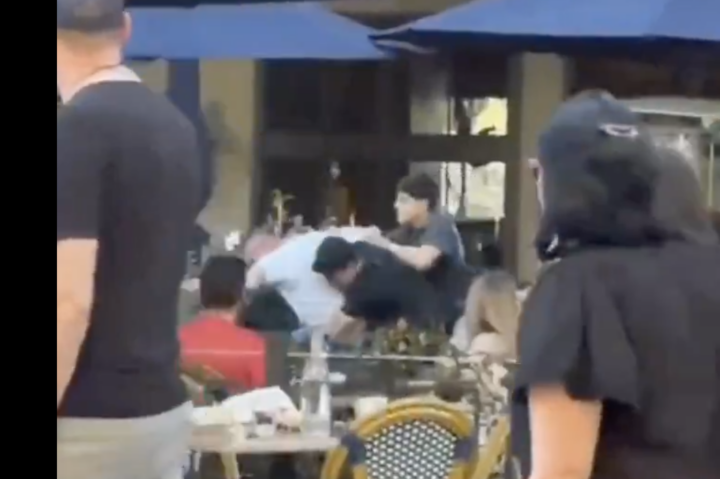
Video shows assailants attacking two Israeli-Americans in San Fransisco on March 9, 2026.
Police in San Jose, Calif., are investigating a violent attack against two adult men outside an upscale restaurant as an antisemitic hate crime, a spokesperson for the police department confirmed on Tuesday.
On Sunday afternoon, three assailants approached the two victims outside Augustine, a restaurant and cafe located in the Santana Row shopping mall. The two men — Israeli Americans — were speaking Hebrew when the attackers allegedly overheard them, according to the San Francisco Jewish Community Relations Council.
“The victims alleged that the suspects used antisemitic language during the altercation. The incident is currently being investigated by the Assaults Unit as a possible hate crime,” a spokesperson for the San Jose Police Department told Jewish Insider.
A video shows the three young men repeatedly punching and kicking the victims directly in front of other diners and as bystanders walked past. The assailants then fled before police arrived.
Tali Klima, a spokesperson for the grassroots advocacy group Bay Area Jewish Coalition, urged elected officials in the Silicon Valley community to speak out against the attack.
“We call on our local elected officials to finally take a strong stand against this hatred using not only their words but also concrete actions. It is time to take threats to the Jewish community seriously,” Klima said on Tuesday.
Please log in if you already have a subscription, or subscribe to access the latest updates.
 Continue with Google

 Continue with Apple