






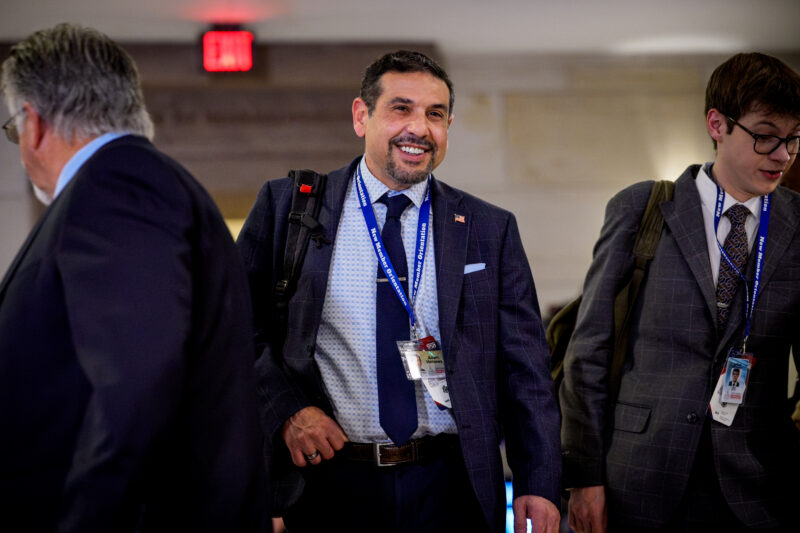































































DMFI President Brian Romick: ‘Our hope is that this pause will be temporary and that, through a candid conversation about the path forward, we can resume our endorsement’

Kayla Bartkowski/Getty Images
Rep. Pat Ryan (D-NY) speaks during a Democratic Steering and Policy Committee hearing in the U.S. Capitol on April 10, 2025 in Washington, DC


 Add JewishInsider on Google
DMFI PAC, Democratic Majority for Israel’s political arm, is pausing its endorsements of nine Democratic House members who voted this month to end all U.S. aid to Israel, underscoring the depth of its frustration even as the group also seeks to preserve relationships with lawmakers it had championed.
In a new letter that the group intends to circulate among the lawmakers, Brian Romick, the president of DMFI PAC, expressed his disappointment with their votes in favor of the amendment introduced by Rep. Thomas Massie (R-KY), which did not pass, and said their endorsements would be temporarily suspended with a goal of engaging in a constructive dialogue on the issue.
“Because of that vote, we are pausing our endorsement and taking your name off the list of supported lawmakers on the DMFI PAC website,” Romick said in the letter, the full text of which was shared exclusively with Jewish Insider on Sunday. “At the same time,” he added, “our hope is that this pause will be temporary and that, through a candid conversation about the path forward, we can resume our endorsement.”
The Democrats include Reps. Laura Friedman (D-CA), Josh Harder (D-CA), Chrissy Houlahan (D-PA), Glenn Ivey (D-MD), Kevin Mullin (D-CA), Richard Neal (D-MA), Joe Neguse (D-CO), Brittany Pettersen (D-CO) and Pat Ryan (D-NY).
DMFI PAC has previously backed other pro-Israel Democrats who also voted against funding to Israel, notably including Rep. Jake Auchincloss (D-MA). But the nine members now receiving letters were the only incumbents it had endorsed this cycle who approved the amendment, according to a spokesperson.
DMFI PAC’s diplomatic approach highlights the politically sensitive terrain that pro-Israel groups find themselves navigating after the controversial vote. The amendment drew backing from a total of 103 House Democrats, nearly half the caucus, many of whom were seen as supporters of Israel and said they approved the measure to register opposition to Israeli Prime Minister Benjamin Netanyahu as well as the Iran war.
The group’s decision comes after AIPAC retaliated against 18 of its Democratic endorsees who voted for the amendment by removing fundraising links from its online political portal or cutting language that had thanked some members for their support of Israel.
In an interview with JI on Sunday, Romick said the group’s intention with the letter is “to give people a path back to the pro-Israel movement” rather than permanently ending its longstanding relationships over a measure that it had strongly urged Democrats to vote against.
“Obviously it was a rough vote and it’s been a rough moment,” Romick acknowledged. “But the pro-Israel movement right now needs to be making friends, and I think being able to say ‘I support Israel’s security, I support Palestinians’ national aspirations over the long term, even if it’s not something today’ — I think that’s a reasonable position” and “we want to try to help Democrats land there and continue to support Israel’s security.”
He believes “members are looking for a path back to being in the pro-Israel movement,” he said, citing his recent conversations with House lawmakers. “I don’t think we should be pushing away friends right now.”
It remains to be seen whether all of the former DMFI PAC endorsees will be receptive to preserving “strong relationships and open channels of communication,” as described in the letter from Romick.
A spokesperson for Ryan, for example, said after the vote that he no longer wanted DMFI PAC’s support. The moderate New York lawmaker also promised to return his campaign donations from AIPAC, whose backing he likewise rejected in a social media post.
An AIPAC spokesperson told JI last week that its “members nationwide saw Rep. Ryan reject their participation in the political process,” and said the group is now “helping his donors receive a refund.”
Rep. Brad Schneider (D-IL), a pro-Israel stalwart who voted against the amendment, told JI he was encouraged by DMFI’s outreach to the lawmakers whose endorsements have been paused. “I think it’s the right decision,” he told JI.
“I know that if we’re going to improve the prospects for positive outcomes in the Middle East,” he added, “we need to find common ground with people across a lot of different ideas and ideologies, bring people together and move forward in a single direction, and that’s what I hope we can do.”
The strongest evidence that the controversies are taking their toll on Platner came from his own campaign, which released an internal poll Wednesday showing the Democrat leading Sen. Susan Collins (R-ME) by only four points

Joe Raedle/Getty Images
Democratic U.S. Senate candidate Graham Platner speaks at a “Fighting Oligarchy” tour stop held by Sen. Bernie Sanders (I-VT) at the Collins Center for the Arts on the University of Maine campus on May 24, 2026 in Orono, Maine.
The New York Times’ detailed exposé about Maine Senate candidate Graham Platner’s history of toxic, alcohol-laden and occasionally physically threatening relationships with three former girlfriends landed Thursday afternoon — with Platner’s campaign hoping to limit the fallout amid signs his campaign is losing support.
In an interview with MS NOW’s Chris Hayes Thursday evening, Platner denied the most serious allegations of physical abuse leveled by Lyndsey Fifield, who dated him from 2013-2015. Fifield recounted one incident where Platner “twisted her arm behind her back, shoved her into a bedroom and held the door closed from the other side so she couldn’t get out.”
She also said he knew about the Nazi origin of his Totenkopf tattoo — first reported by Jewish Insider in October — saying he taught her the word for it when they were dating.
“There are some allegations in this piece that I want to be unequivocal about — they’re not true. Anything alleging physicality, anything alleging I knew what my tattoo was, these are the statements of someone politically motivated,” Platner told Hayes.
The one-two punch of allegations this week of sexually explicit text messages to women while he was married now combined with reports of abuse in past relationships are merely the latest hits against the scandal-plagued candidate who, under normal political circumstances, would be a political nonstarter.
But given that so many other damaging reports barely dented his political standing — whether it was his Totenkopf tattoo, admiration of Hamas terrorist tactics, social media posts cheering the killing of American military heroes, along with dozens of misogynistic and bigoted comments online — it’s anyone’s guess whether the latest news will crater his campaign.
These latest allegations appear to be having more of an impact on Platner’s political standing in part because they contradict the narrative his campaign has presented that he’s become a changed man in the years since he wrote many of his extremist social media posts. In addition, reports of abuse and misconduct have lately been career-enders for many prominent politicians, most recently for former Reps. Eric Swalwell (D-CA) and Tony Gonzales (R-TX).
The strongest evidence that the controversies are taking their toll on Platner came from his own campaign, which released an internal poll Wednesday showing the Democrat leading Sen. Susan Collins (R-ME) by only four points — one of the smallest leads he’s had in the general election since he entered the race. The poll was conducted before the latest NYT story hit.
A newly-released poll conducted between June 1-4 by Trump pollster Tony Fabrizio (first reported by Politico this morning), shows Collins now tied with Platner at 46% apiece, with Platner’s unfavorables skyrocketing. The poll was in the field after the sexting story broke but before the latest allegations of physical abuse.
It won’t take long to get some more empirical evidence about how much Platner’s standing has slipped with Democratic voters.
Next Tuesday’s Maine primary, which looked like an afterthought since Gov. Janet Mills left the race, is suddenly looking a lot more consequential. Mills is still on the ballot despite suspending her campaign, and would be a logical vote for any Democrat uncomfortable with anointing Platner as their Senate standard-bearer.
If Platner underperforms in the primary — winning at least 65% of the Democratic vote is something of a necessity for him — it would suggest that he’s entering the general election wounded, with his candidacy potentially costing the Democrats’ a must-win Senate seat.
The whole episode is a reminder that the laws of political gravity still apply, and that 2026 could shape up as a year for Democrats akin to the GOP’s Tea Party year of 2010 — when deeply flawed candidates in swing states and districts cost the party winnable races despite running in an overall favorable environment.
Platner and Abdul el-Sayed’s Senate candidacy in Michigan are the most high-profile far-left candidates to fit the bill, but other lower-profile House candidates like Colorado state Rep. Manny Rutinel and California educator Randy Villegas could also potentially cost Democrats valuable swing seats — in a year in which every contest could determine which party holds the majority.
A new survey by Jewish Women International found that young women experienced major disruption to their dating lives in the aftermath of Oct. 7, with some now seeking out Jewish partners

Getty Images
Rear view of a young couple sitting side by side on a bench in a city park during autumn.
Nearly half (47%) of young Jewish women reported dating less as a result of increased antisemitism and other negative consequences of the Oct. 7, 2023, Hamas terror attacks, according to a new survey by Jewish Women International.
Over one-third (36%) of respondents said they’ve ended existing romantic relationships due to these dynamics, while 18% said they’ve stopped online dating altogether.
Many of the Jewish American women surveyed, who were between the ages of 20 and 34, reported other negative impacts to their romantic relationships including strained conversations (75%), arguments (53%) and decreased contact or connection (39%).
One respondent described ending a relationship over “our differing levels of Zionism” and while another experienced “tension in our relationship” on the “first anniversary of Oct. 7.” One said she “ultimately ended my relationship with my partner because he was always so angry about Gaza but never showed any anger toward antisemites, toward Hamas, or even to an antisemitic gunman who killed two of my peers.”
A vast majority (71%) of respondents said they’d changed what they’re looking for in a dating partner in the aftermath of the attacks, which for several meant seeking out exclusively Jewish partners,
“I decided to only date Jewish to avoid any blatant antisemitism, and also to ensure that there would be common ground,” one wrote. “Before October 7, like, sure, I wasn’t opposed to going on a date with someone who wasn’t Jewish, and exploring that opportunity. And now — not really so much,” another said. “Felt deeper connections to Jews I know and are strangers. Exclusively wanted to date only Jews,” another wrote.
Jewish singles have been grappling with the impact of increasingly heated antisemitic rhetoric on dating apps and among potential romantic interests for years now, as several told Jewish Insider in 2024 that they too had pivoted to seeking a Jewish partner as they waded through politically charged rhetoric on dating profiles.
Even more than their dating lives, survey respondents experienced negative impacts to their mental health (75%) and friendships (74%), with 80% reporting decreased contact in their platonic relationships. For those on college campuses, 68% said their sense of belonging was damaged in the aftermath of Oct. 7, and 63% said the same of their relationships with their classmates.
In professional settings, 39% of respondents said they’d felt pressured to minimize their Jewish identity and 18% said they’d removed Jewish content from their resumes. Several said in written responses that they’d been drawn to work in Jewish advocacy by their experiences.
“JWI has dedicated significant time and resources to a comprehensive national survey of the impact of antisemitism and misogyny on young Jewish women. Based on our findings, young Jewish women feel disenfranchised in the workplace, ostracized in social circles, and compelled to erase their Jewish identities for fear of personal safety,” said Meredith Jacobs, CEO of JWI, who added that the organization will focus its programming on “post-traumatic growth.”
“As the mothers of the next generation of the Jewish diaspora, the support these women receive will directly impact the future of Jewish peoplehood,” Jacobs continued.
The 514 respondents were largely reached through JWI’s networks, including focus groups at the organization’s leadership conference, between Nov. 11-Dec. 22, 2025.
Please log in if you already have a subscription, or subscribe to access the latest updates.
 Continue with Google

 Continue with Apple