











































































With Graham’s death, one chapter in U.S.-Israel relations has closed. Now, Rahm Emanuel and Ro Khanna are jockeying to write the next
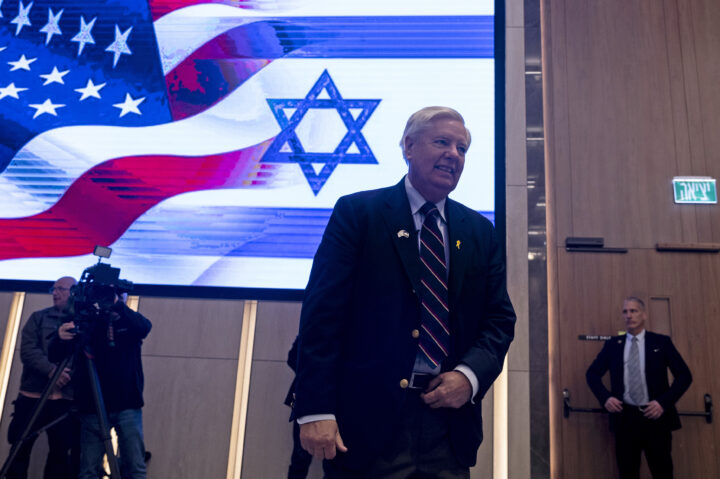
(Amir Levy/Getty Images)
US Senator Lindsey Graham (R-SC) attends a press conference on US-Israel relations on February 17, 2025 at the Kempinski Hotel in Tel Aviv, Israel.


 Add JewishInsider on Google
In the span of five days, one of Washington’s most vocal champions of the U.S. relationship with Israel died, while two prospective 2028 Democratic presidential contenders traveled to the Jewish state to define their approaches to the country. Though a coincidence of timing, those events, when taken together, underscored something much more significant: the passing of one generation of American politics vis-a-vis Israel and the opening contest over what will succeed it.
The events of the last week have distilled concerns that have repeatedly emerged at Jewish and Israeli gatherings, over Shabbat meals and in breakfast meetings: As the far left gains traction within the Democratic Party, and as the isolationist right increasingly finds support among Republicans, what does that mean for American Jews and U.S. support for Israel?
Sen. Lindsey Graham (R-SC), who died suddenly on Saturday, represented a generation of politicians — across the political spectrum — for whom support for Israel was tied to deep, long-standing relationships with the Jewish state’s leaders, the belief in the country’s strategic positioning as a key ally and the ability of Israel’s friends in Washington to challenge Jerusalem without imperiling the relationship.
His death sent shockwaves across the Jewish community at a time when U.S. support for Israel — including among Republicans — is on the decline.
Sen. Ted Cruz (R-TX), speaking to JI earlier this week, described Graham as “a passionate and formidable defender of Israel” and noted that Israeli Prime Minister Benjamin Netanyahu “trusted Lindsey and listened to him.”
Cruz pointed out that “Lindsey would sometimes tell his friends messages they didn’t want to hear. Lindsey was not one to just blow smoke. He would tell people exactly what he thought, but that made him an incredibly effective advocate for Israel.”
Days before Graham died, former U.S. Ambassador to Japan Rahm Emanuel was in Israel, where he delivered a speech — his own version of tough talk to Israelis — at Tel Aviv University on the future of the U.S.-Israel relationship. Speaking to reporters ahead of his speech, Emanuel, who served as White House chief of staff from 2009-2010, said that declining U.S. support for Israel “is not a Democratic Party problem. This is an American problem, and a generational problem.”
Emanuel pointed to an Associated Press/NORC Research poll released last week that showed declining support for Israel across both parties in the wake of the war in Gaza — though the erosion was considerably more pronounced among Democrats. The survey, which was conducted last month, also found that 3 in 10 Americans — including 2 in 10 Republicans under the age of 45 — believe Israel committed genocide in Gaza.
Meanwhile, a new survey from the Pew Research Center released on Friday found Israel underwater with young Americans across the political spectrum. Just 12% of Democrats between the ages of 18-29 have a favorable view of Israel, the survey found. Among young Republicans, that number is higher — but not by much. Twenty-eight percent of Republicans ages 18-29 had a favorable view of Israel. Contrast that with the 75% of Republicans (and 47% of Democrats) above the age of 65 who have favorable views of Israel.
Views of Israelis themselves are only somewhat less negative, with 33% of those surveyed between the ages of 18-29 having a favorable view of the people of Israel — not the government. Among young Republicans, that figure is 42% — something that should trigger flashing warning lights among those who have long relied on the support of an aging generation of politicians and voters who share Graham’s pro-Israel disposition.
While the shift among Republicans is happening at a slower rate, movement in the GOP regarding Israel is apparent as the party’s “restrainers,” led by Vice President JD Vance, gain traction among young conservatives. As if to underscore the changing party dynamics, Politico yesterday reported on concerns among Republican Jewish donors over Vance’s approach to the Jewish state, citing his tough rhetoric toward Israeli leaders and support for diplomacy with Iran.
Separate from Emanuel’s trip, Rep. Ro Khanna (D-CA) also traveled to Israel last week, gaining attention for an incident in the West Bank in which local security forces stopped Khanna, who was accompanied by two aides and an activist with Breaking the Silence, after the congressman entered what had been until recently a closed military zone. He has since called for Israel to investigate the incident, even as Israeli officials denied elements of the congressman’s account. Khanna has not provided any evidence to back up his claim of being detained by settlers.
Speaking to The New York Times after he returned to the U.S., Khanna said, “Free advice to the Israelis: It’s not a good idea to detain long-shot presidential candidates. Not how you’re going to build good will with the next American president, whoever that is.”
In his public comments and meetings, Emanuel conveyed a desire to halt the growing daylight between future generations of Israelis and Americans. Khanna, who a decade ago was a staunch supporter of close ties with Jerusalem, has adopted a different political calculation, leaning into the growing anti-Israel sentiment in his party as a launching pad for a national campaign.
It’s no coincidence that two 2028 hopefuls chose to soft-launch their campaigns in Israel, conveying caution rather than camaraderie. It’s a sharp pivot from 18 years ago, when Barack Obama and John McCain — then their parties’ respective presidential nominees — each visited Israel in the run-up to the election, meeting with Israeli leaders and expressing support with the Israeli people.
If candidates used to travel to Israel to reassure both their constituencies and the Israeli populace of the strength of the U.S.-Israel relationship, the candidates traveling to Israel in 2026 are doing so to define themselves, and in the process treating the Jewish state as a test of political identity.
The sort of stalwart support of generations past is rapidly eroding, leaving pro-Israel Americans on both sides of the aisle battling strong headwinds as those who represent the future of their parties shift their approaches to the Jewish state. With Graham’s death, one chapter in U.S.-Israel relations has closed. Now, Emanuel and Khanna are jockeying to write the next.
Five people are in custody after the FBI disrupted a plot that allegedly involved explosive-laden drones, a sniper team, and a plan to storm the White House gate
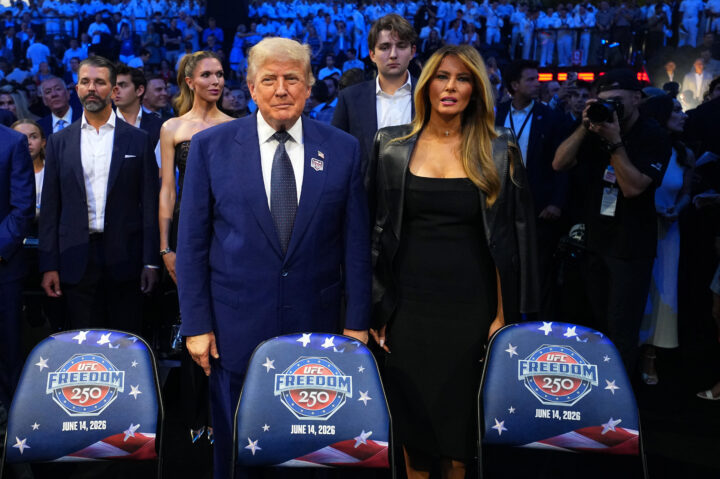
Jeff Bottari/Zuffa LLC
U.S President Donald J. Trump, First Lady of the United States Melania Trump attend the UFC Freedom 250 event on the South Lawn at the White House on June 14, 2026 in Washington, DC.
The FBI announced on Tuesday that it had disrupted a sophisticated attack targeting the UFC fight on the White House lawn on Sunday, with Fox News reporting that one suspect allegedly told investigators that the attack was targeting “capitalist elites,” “billionaires” and politicians who received donations from AIPAC.
FBI Director Kash Patel said on X that multiple individuals outside the D.C. area were in custody in connection with the attack in what he said was a multi-state operation. Fox News reported that five arrests had been made and 23 people were identified as being involved.
In an announcement, the Department of Justice said that the investigation is still ongoing and that arrests were carried out in Ohio, Missouri, Nebraska and California.
According to a criminal complaint released by the DOJ, one of the suspects, Tycen Proper, “appeared to identify potential US Congressional targets due to their support for the American Israel Public Affairs Committee (AIPAC), noting donations the members previously received from AIPAC” and identified several specific leaders he planned to focus on because they “were supportive of Israel.”
The targets included Sens. Marsha Blackburn (R-TN), Tom Cotton (R-AR), Shelley Moore Capito (R-WV) and Jim Justice (R-WV), Rep. Carol Miller (R-WV) and West Virginia state Del. Tristan Leavitt.
According to the complaint, another one of the suspects identified Israeli Prime Minister Benjamin Netanyahu, who some claimed would be attending the fight, as another primary target, alongside President Donald Trump, Vice President JD Vance and Elon Musk.
According to Fox News, the attack plot called for attacking buildings near the event using explosive-laden drones, forcing an evacuation from the UFC event into the path of a sniper team, followed by an attempt to storm the White House gate.
Fox News reported that authorities have identified no foreign connection to the attempted attack.
Experts are raising red flags on the technology’s ability to influence voters and the lack of regulations around its use

Haim Zach/GPO
Israeli Prime Minister Benjamin Netanyahu votes in the September 2019 national election.
The run-up to next year’s Israeli election will be the first in which artificial intelligence tools to create images and videos and rapidly compose texts are easily accessible, and experts are raising red flags over the technology’s ability to influence voters and campaigns and the lack of regulations around its use.
Israeli politicians have long been early adopters of technological tools to boost their campaigns, from bypassing traditional media through Facebook to using social media data to target key demographics before most liberal democracies were doing so, and AI will likely be no different.
Tehilla Shwartz Altshuler, head of the Democracy in the Digital Age program at the Israel Democracy Institute, told Jewish Insider that Israel is one of the countries with the largest market penetration of AI in the world — 85% of Israelis have used ChatGPT and 76% use it frequently, according to a study by the Israeli Internet Association published in October — so it is only a matter of time before politicians use it in their campaigns.
(National elections are legally required to take place on Oct. 26, 2026, at the latest, but political tensions make an earlier date possible.)
“AI chatbots have significant penetration in the public,” Shwartz Altshuler said. “They will be used to ask whether to vote and for whom to vote. We have not seen anything like this before. … People use chatbots as a companion for emotional support. The concern over the great influence of chatbots on voter behavior is significant.”
Shwartz Altshuler said that there have already been attempts to “give poison injections” to AI models, such as creating fake news sites and positions on subreddits to manipulate the bots into giving more pro-Israel responses to users abroad, and those tools can be turned inward, toward Israeli voters.
She also pointed out that Israel does not have any laws requiring machine-generated content to be labeled.
“This is the first time we have an election in which we are unable to differentiate between authentic and machine-generated photos and videos,” she said. “There is a fear that the perception of reality is being undermined. People can forge documents and make deepfakes of politicians. … Machine-generated content can create an alternative reality, a very dangerous prospect when the content is very emotionally attractive.”
Yuval Dror, the former dean of media studies in Israel’s College of Management Studies, who hosts a popular technology podcast in Hebrew, was skeptical that computer-generated photos and videos will have a major impact on the next election.
“With photos, sometimes we can tell if it’s AI or not. With video, people usually know that it’s AI,” he told JI. “The impact of [AI-generated] video will mostly be economic, because it will be much easier to produce. In the past, you needed an ad agency, actors, post-production work. Now it’s much easier, so [campaigns will] save money.”
“You can create a false presentation in which masses of people say this or that and look like a grassroots movement,” Yuval Dror, the former dean of media studies in Israel’s College of Management Studies, said. “There is [already] an army of bots echoing a few people on social media.”
Dror was more concerned about AI-generated texts, which he noted can be much harder to detect.
AI may be used in upcoming political campaigns to flood social networks with content, making a candidate, message or policy appear to have more support than it does in reality. This already happens on X, where much of the political discourse in Israel takes place, but also in more closed networks like WhatsApp and Telegram, Dror said.
“You can create a false presentation in which masses of people say this or that and look like a grassroots movement,” Dror said. “There is [already] an army of bots echoing a few people on social media.”
“We’ve seen this for years. It will just get more and more convincing,” he added.
Shwartz Altshuler said that social media companies have difficulty stemming mass-bot content. “Generative AI can create a lot of versions of the same content, so the result is inauthentic, coordinated behavior on social media,” she said. “If there are slightly different versions of the same content, the social networks don’t detect” that it comes from bots.
“Most of these [AI tools] are not mentioned in the law or by past Central Election Committee decisions. They are in a grey area. [Campaigns] will do what they want,” Tehilla Shwartz Altshuler, head of the Democracy in the Digital Age program at the Israel Democracy Institute, predicted.
In addition, developments in AI since the last Israeli election, in 2022, can help politicians use data even more effectively to target potential voters with different kinds of messages and ads, she said.
Shwartz Altshuler recounted speaking with a prominent Israeli political strategist who told her, “First we win elections, and then we see if what we did is legal or not.”
“Most of these [AI tools] are not mentioned in the law or by past Central Election Committee decisions. They are in a grey area. [Campaigns] will do what they want,” she predicted.
Despite the fertile ground for election fraud using AI, Shwartz Altshuler said it is unlikely that new laws will be passed before the next election. “This coalition has no motivation to pass such laws [and] usually the courts say laws [regarding elections] can only be applied after the next election.”
She also pointed out that the current Central Election Committee chairman, Noam Solberg, is a conservative Supreme Court justice, and therefore would be unlikely to instruct the Knesset to pass laws addressing the issue.
Despite all the advances in AI, it may not be enough to cover for a weak candidate.
Dror said that Israeli politicians are already using AI to write texts for social media or speeches: “Some politicians are not capable of stringing together two sentences, so they let AI do it, but the result is no less awkward.”
They have also generated all kinds of pictures to post online, which Dror said “makes [them] look stupid,” using Israeli Environmental Protection Minister Idit Silman, who posted a picture earlier this year depicting French President Emmanuel Macron kissing Hamas leader Yahya Sinwar, as an example. Israeli Defense Minister Israel Katz frequently posted AI-generated images ridiculing Israel’s enemies when he was foreign minister last year.
“I don’t know that there’s an audience for this stupidity,” Dror said.
Please log in if you already have a subscription, or subscribe to access the latest updates.
 Continue with Google

 Continue with Apple