




































































State lawmakers, lobbyists, interns and more joined for a Seder on the second night of Passover, held at the Capitol on the final night of the state legislative session
Courtesy
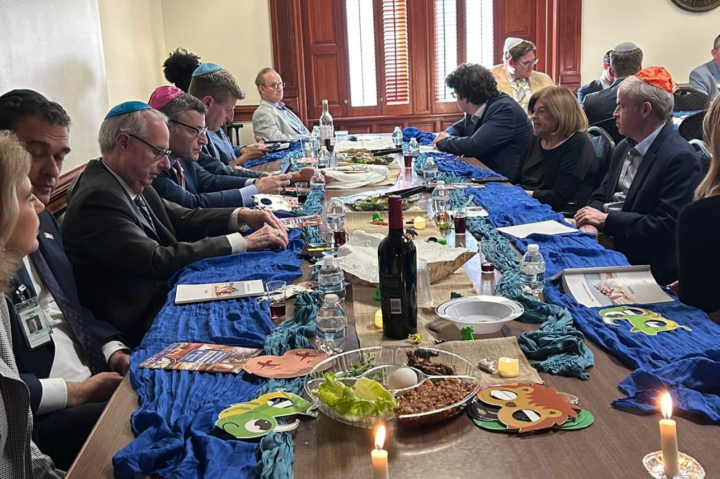
'Sine Die Seder' at the Georgia state Capitol on April 2, 2026.


 Add JewishInsider on Google
On Thursday, a group of Jewish Georgia politicos gathered for a first-of-its-kind-event at the Georgia statehouse: the “Sine Die Seder.”
Organized by state Rep. Esther Panitch, a Democrat and the only Jewish member of the Georgia General Assembly, the event brought together around 30 Jewish staffers, journalists, lobbyists, interns, a former attorney general and more to celebrate Passover on the final night of the legislative session, known as sine die.
Panitch said that she had asked the House majority leader to cancel the House session on Wednesday, the first night of Passover — and he obliged — but the House was still scheduled to be in session for the second night.
“And so I said, ‘Well, we’re going to be at the Capitol on the second night. Why don’t we have a Seder for probably the 10 of us in the building that are Jewish,’” Panitch told Jewish Insider, referring to herself and a handful of interns, staff and reporters, during the hour-long dinner break during the session.
Interest in the event ballooned, with the group ultimately growing to around 30, with non-Jewish lawmakers and family members of other attendees joining the event. Panitch’s husband led the Seder from their family Haggadah.
“It was very warm … the room was full. It was really special,” Panitch said. “I was really happy the way it turned out — it exceeded my expectations. Everybody participated. People sang.”
Georgia House Speaker Jon Burns, a Republican, joined the proceedings for around 20 minutes and read the “wise son” passage from the Haggadah — a reward, Panitch joked, for bringing up and passing a bill she authored earlier in the day.
Bryan Markowitz, the executive director of the Georgia Ophthalmologic Association, said he’s had to rush home in the past from Georgia statehouse sessions for Seders, “so it was really nice to have it right there and have everybody. Anybody who didn’t know about Passover was able to learn more about it through this experience. And all of us that were there anyway got to enjoy a Seder together, which I thought was really special.”
He said that having Burns in attendance, reading the Haggadah and wearing a yarmulke, was “really very, very powerful to me.”
The highlight of the night, Panitch and Markowitz said, was a custom rendition of the song “Dayenu” commemorating the last day of the House session, “Sine Die-yenu,” written specially for the event by a rabbi from the Atlanta suburbs.
“It was very creatively done and very witty and funny,” Markowitz said.
Greg Bluestein, a longtime political reporter for the Atlanta Journal Constitution, called the event, in a column, “one of the more meaningful seders I’ve ever participated in, an important reminder that some traditions endure even in the Capitol’s most frantic hours.”
The group took in a meal of matzo ball soup, brisket, chicken, mashed potatoes and vegetables over a table decorated with blue tablecloths along both sides to resemble the parted Red Sea — plus plastic frogs scattered along the length of the table to represent one of the plagues inflicted on the Egyptians in the Passover story.
Markowitz and his son, who is interning for a local public affairs firm, both jumped at the opportunity to join the “exciting” Seder when they heard about it. His wife and daughter, he said, “were both sort of jealous, and wanted to come and be part of this experience,” so they ultimately turned it into a full-family affair.
“It was fantastic, and the food was great. The company was great. It was really great to share a special day at the Capitol,” Markowitz told JI. “I can’t think of anything I’d rather be doing on Passover than singing and saying prayers and telling the story of Exodus with the members of the legislature at the Capitol.”
The president dialed in his daughter and son-in-law to speak to guests at an informal pre-gathering over speakerphone
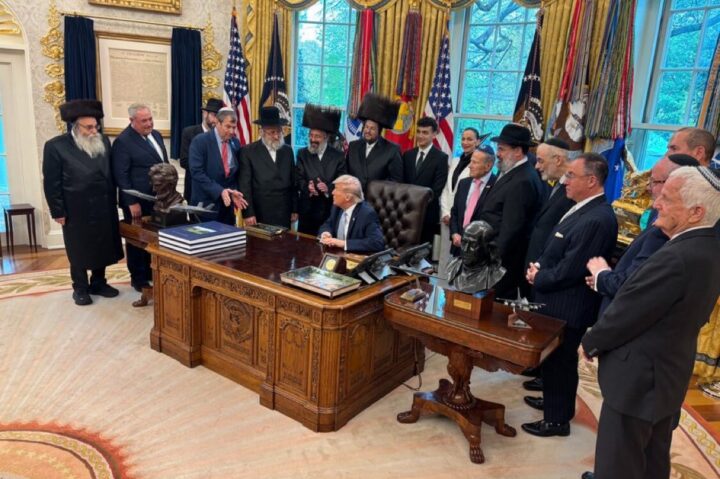
Prominent Jewish figures and senior Trump administration officials gathered at the White House on Monday afternoon for an event hosted by President Donald Trump commemorating the Passover holiday.
Administration officials in attendance at the event, which was closed to the press and took place in the Indian Treaty Room, included Commerce Secretary Howard Lutnick; White House Staff Secretary Will Scharf; James Blair, the White House deputy chief of staff for legislative, political and public affairs; Jacob Reses, chief of staff to Vice President JD Vance; Environmental Protection Agency Administrator Lee Zeldin; Martin Marks, the White House Jewish liaison; and Rabbi Yehuda Kaploun, the Trump administration’s special envoy to monitor and combat antisemitism.
Marks delivered comments to the crowd remarking on the holiday and the Trump administration’s record of support for Israel, according to an attendee.
Others spotted at the event were Rabbi Moshe Margaretten, president of the Tzedek Association; Matt Brooks, CEO of the Republican Jewish Coalition; William Daroff, CEO of the Conference of Presidents of Major American Jewish Organizations; Jeff Miller, chairman of the United States Holocaust Memorial Council; Jonathan Burkan, United States Holocaust Memorial Council member; Rabbi Levi Shemtov, the executive vice president of American Friends of Lubavitch (Chabad); Paul Packer, the former chairman of the U.S. Commission for the Preservation of America’s Heritage Abroad, Rabbi Chaim Dovid Zwiebel, executive vice president of Agudath Israel of America and Rabbi Meir Soloveichik, member of the Religious Liberty Commission and vice chair of the United States Commission on International Religious Freedom.
Jerry Wartski, a Holocaust survivor, and freed Israeli American hostage Edan Alexander were also in attendance.
Prior to the official reception, Trump invited about 20 guests to join him in the Oval Office. During the brief gathering, the president called Jared Kushner, an informal advisor to the White House and his son-in-law, and his daughter Ivanka. Kushner, who is Jewish, and Ivanka Trump, who converted to Judaism, spoke to attendees over speakerphone, one guest told Jewish Insider.
After a series of targeted attacks in Toronto and beyond, Jewish leaders are raising the alarms on Canada’s failure to properly protect its Jews amid ‘systemic’ antisemitism
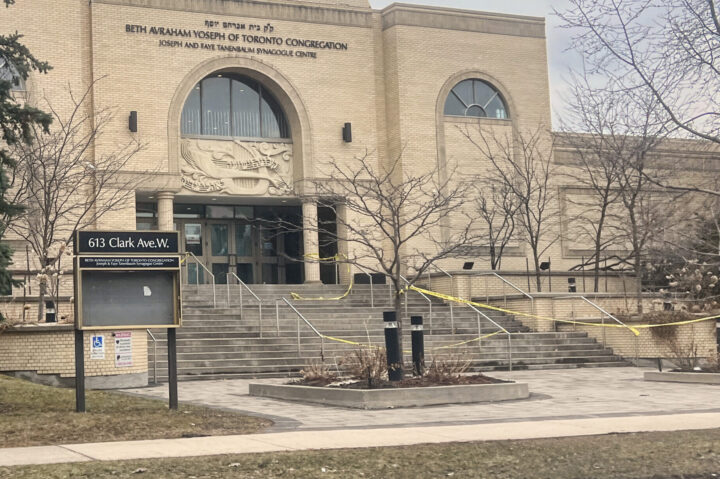
Creative Touch Imaging Ltd./NurPhoto via Getty Images
Police tape is seen outside the Beth Avraham Yoseph of Toronto (BAYT) synagogue following overnight gunshots fired at the building in Vaughan, Ontario, Canada, on March 21, 2026.
As Canadian Jewish families began celebrating the holiday of Passover, a commemoration of Jewish persecution and redemption, many found the ancient narrative colliding with a modern reality of rising fear at home.
Early Friday, a Jewish-owned restaurant in Toronto was struck by gunfire for the second time in weeks — a targeted, 14-bullet assault that police called a “glaring example of domestic terrorism.”
The incident marks the latest in a wave of antisemitic attacks, highlighting what Jewish leaders describe as “systemic” Jew-hatred in Canada. And it is even leading some Jewish Canadians to consider their own kind of exodus from their country, with one communal leader saying that “the promise” that Jews could practice their faith openly in the country “has been broken.”
“There’s a real sense — and I don’t want to overstate it — but that the Jewish community in Toronto has felt under siege since [the Oct. 7, 2023, terrorist attacks in Israel],” Rabbi Debra Landsberg, who leads Temple Emanu-El, a Reform synagogue in Toronto’s North York district, told Jewish Insider.
On March 2, Landsberg’s congregation was shot at several times, as her family and at least one staff member remained near the building following a Purim celebration. No injuries were reported, but the exterior and front lobby sustained significant damage.
The shooting was the first in a series of three synagogue attacks in Toronto last month. One week after Temple Emanu-El was targeted, the front doors of Shaarei Shomayim Synagogue and The Beth Avraham Yoseph of Toronto were shot at in the middle of the night, causing damage to both buildings.
In another recent incident, Canadian law enforcement arrested three Toronto-area men accused of planning violent kidnappings targeting women and members of the Jewish community.
Israel’s ambassador to Canada, Iddo Moed, said that last week’s restaurant shooting “the 12th incident of its kind in the latest wave of antisemitism and violence against the Jewish community in Canada.” UJA Federation of Greater Toronto warned that the incident should cause “all Canadians to be extremely concerned by what’s happening in our country right now.”
Toronto police have responded to the surge of violence by deploying armed officers at Jewish institutions around the city, an effort that was ramped up during the Passover holiday.
Canada has experienced some of the most severe manifestations of the global surge in antisemitism since Oct. 7. — with higher rates of antisemitic incidents than other countries but lower conviction rates.
In the first two months of 2026 alone, 22 antisemitic incidents were reported in Toronto, representing approximately 62% of all reported hate crimes in the country, according to police. Based on population, a Jewish Canadian is 25 times more likely to experience a hate crime than any other Canadian, according to the Centre for Israel and Jewish Affairs (CIJA).
Some Jewish leaders told JI they have come to expect sluggish or nonexistent responses from law enforcement and political leadership, a failure that they say exacerbates the problem.
One month after the synagogue shootings, no arrests have been made. Police say investigations are ongoing.
A spokesperson for the Toronto Police Department told JI last week that “the synagogue shootings are being examined for potential links … information, evidence, and intelligence are being shared to determine whether there are any connections.”
“There has been a systemic failure across jurisdictions to face antisemitism,” said Richard Marceau, senior vice president of strategic initiatives and general counsel at CIJA, an agency of the Jewish Federations of Canada. Marceau asserted that society has “a complete misunderstanding” of what antisemitism is, whether it stems from “the far left, far right [or] Islamic circles.”
“There’s also a reluctance to act,” he said. “There’s a desire to say ‘we’ll just let a little steam out and the pressure will go away.’ There’s no consequences to what’s happening [so] people feel emboldened.”
“In terms of fighting on the criminal legal side, the police are reluctant to press charges and go from a ‘let’s keep the peace’ mentality to ‘let’s enforce the law,’” continued Marceau, a former Bloc Québécois member of parliament. “Charges are dropped by the prosecution for no good reason. Often judges don’t understand what antisemitism is.”
“If there’s one thing that should be clear it’s that Jews are under threat and this type of thing should not take such a long time,” Marceau said of the investigations into last month’s synagogue shootings. “There should be infrastructure to make sure that the people who attack are quickly found and identified.”
“There’s also a reluctance to act,” Marceau said. “There’s a desire to say ‘we’ll just let a little steam out and the pressure will go away.’ There’s no consequences to what’s happening [so] people feel emboldened.”
Marceau noted some positive movement since the Toronto synagogue shootings. Bill C-9, which would amend the criminal code to strengthen penalties against hate-motivated crimes, protect religious spaces and ban public display of hate symbols, passed in the House of Commons last month. Marceau called for the Senate “to quickly pass it.”
“All around, the authorities have been given a failing grade on this. All the lights are flashing on Canada’s dashboard — things need fixing and the fixing needs to happen now,” said Marceau.
Landsberg, former president of the Toronto Board of Rabbis, said that among her congregants, “everybody is just a little jumpier” since last month’s attack. “The police are responsive but not forthcoming with information. Visible police presence has been noticeable here and at other Jewish institutions. The care and concern from our police has been real.”
But many questions remain, said Landsberg. “Whether or not they are able to solve this — and what it will take — and do they have the clear support of political leadership, to make Jews safe and feel safe? As time goes on, one imagines that we might live without ever having someone brought to account for this.”
“The political response has been complicated and underwhelming,” continued Landsberg. “Since Oct. 7 at least, the question of whether laws on the books are being implemented when it comes to hate crimes against Jews is an open question. I don’t know many people who are convinced that the law has been applied during some of these protests when there is classic imagery of Jews as rats.”
Few Jewish institutions have been targeted as severely as Kehillat Shaarei Torah, a Modern Orthodox synagogue that has endured 10 separate attacks in the last two years alone. The congregation is also located in North York, but about 2.5 miles from most of Toronto’s Jewish life.
Geographic distance hasn’t spared the synagogue from becoming a target of antisemitic incidents, the first of which occurred the Thursday before Passover two years ago when “about six or eight of our windows were smashed by somebody with a hammer who came in the middle of the night,” the congregation’s leader, Rabbi Joe Kanofsky, told JI.
“We got through Pesach and then there was another by the same person, judging by the security tapes, who came back to get what he missed,” said Kanofsky. “He missed our doors, he came back to smash our glass doors and some more windows. We had a couple more things throughout the summer into the next year.”
Other incidents included a sign outside of the synagogue calling for the release of the hostages kidnapped by Hamas on Oct. 7 being set on fire and dead animals being thrown onto the property. The windows were also smashed several more times.
Frustrated, synagogue leaders installed a black iron fence around the perimeter of the building in December 2024. That “slowed things down” until November 2025, said Kanofsky, “when we had somebody, possibly the same person, come smash the windows with a hammer again. That was our most recent and brought us up to 10 figures all together.” No arrests have been made in any of the attacks.
Canada operates under three levels of government — federal, provincial and municipal — and Kanofsky expressed dissatisfaction with the political response, noting that certain branches have performed worse than others.
“The municipal government seems to be wishing the problem away,” he said. “If they close their eyes they imagine it’s not so bad and maybe they’ll give a little money for increased security so the Jews can take care of that.” In March, days after the Toronto synagogue shootings, the Canadian government announced a new $10 million investment through the Canada Community Security Program to help Jewish institutions enhance security.
“I haven’t heard much from the provincial government until the three shootings in March happened. Right after that happened, the provincial government called the meeting of rabbis. [Doug Ford,] the premier of Ontario, asked a lot of questions and listened, sharing his plans for beefing up security. After a long time, finally there was some attention from the provincial government, which oversees prosecutions. That’s where things are falling apart, things do not go to trial and if they do they are dropped.”
“From the federal government, our representatives in Ottawa have been fairly supportive. There’s a bit of a degree of ‘it’s somebody else’s job’ and everyone points to someone else,” continued Kanofsky. “But the police are always there for us before and after we call. If the rest of the levels of government were as determined as the police, we probably would not have this problem.”
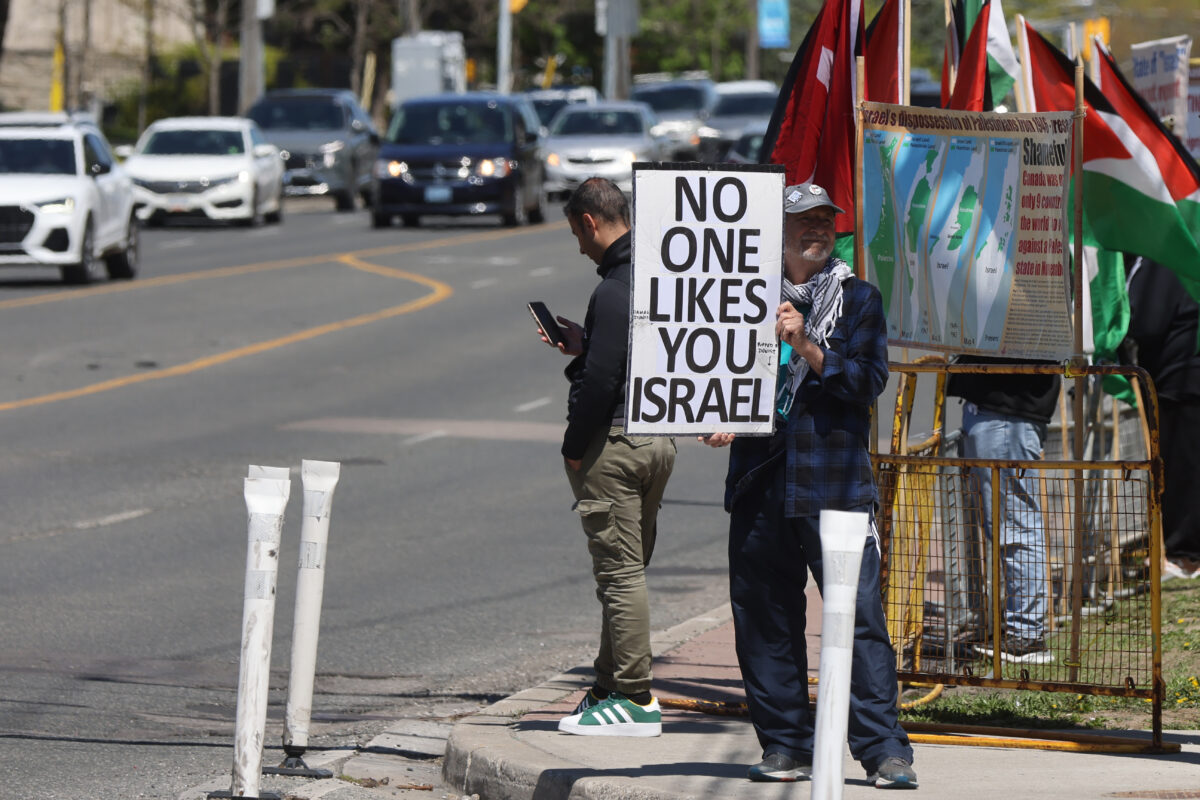
While nearly half of Canadian Jews reside in Toronto — which is home to about 150 Jewish institutions — the problem extends beyond Canada’s largest city. In Ottawa, the country’s capital, a Jewish grandmother was stabbed in August while shopping at a kosher supermarket. In 2024, Jews in Montreal were granted an injunction to prohibit the spate of anti-Israel protests, which included chants of “death to the Jews” in Arabic outside of a school, occurring within 50 meters of dozens of Jewish institutions.
In what The Atlantic recently called “Canada’s Polite Pogrom,” many incidents targeting Jews have been quieter, without broken glass or bones, but disruptive and exclusionary nevertheless.
Eighty percent of Jewish doctors and medical students surveyed by the Jewish Medical Association of Ontario reported experiencing antisemitism at work after the Oct. 7, 2023, attacks. In 2024, more than 100 Jewish doctors stopped acknowledging their affiliation with the University of Toronto’s Temerty Faculty of Medicine in protest of what they saw as the school’s failure to protect Jewish students and faculty. Almost a third of Ontario’s Jewish doctors say they are considering leaving Canada because of hostile work environments, according to the JMAO survey.
A group of Jewish teachers in British Columbia filed a human rights complaint against their own union, accusing the BC Teachers’ Federation of excluding, harassing and silencing its Jewish members. A federal investigation into Ontario’s K-12 schools found nearly 800 antisemitic incidents reported in elementary and high schools since 2023, many stemming from teachers’ conduct. The Toronto International Film Festival briefly dropped a documentary from its lineup that chronicled an Israeli grandfather’s experience rescuing his family from Hamas on Oct. 7, before a global effort successfully pushed for its reinstatement.
Jewish life in Canada wasn’t always this way, said Irwin Cotler, Canada’s former justice minister.
“When I was in the Ministry of Justice, at that time we had nowhere near the levels of antisemitism we’re witnessing now,” Cotler, who served as a member of Parliament, attorney general and Canada’s first special envoy on combating antisemitism, told JI. He called the current situation “an unprecedented explosion.”
“One would have thought that the times since [Oct. 7] would have resulted in actions to combat antisemitism. We’ve had on a public level, tragically almost, denials that Oct. 7 took place or support and justification — even celebration — for it in the public squares,” he said.
Upon completing his term as Canada’s special envoy on combating antisemitism in 2023, just before the Oct. 7 attacks, Cotler recalled reporting that “the conventional paradigm for combating antisemitism on the far right and far left was still true.” But, he continued, “the most important finding I had was that we were witnessing an increasing mainstream normalizing antisemitism and particularly in the campus culture, with an absence of outrage underpinned by indifference and a failure to appreciate that antisemitism is not only increasingly threatening Jews but that it’s toxic to democracies and an assault on our human rights values.”
If not addressed quickly, Cotler warned that there’s “a ticking bomb here in Canada for what will be the Bondi massacre occurring in Canada,” a reference to the December 2025 mass shooting at a Hanukkah gathering at Bondi Beach in Sydney, Australia, that killed 15 people.
“The synagogue shootings here are part of a pattern. We are experiencing not only the highest level of antisemitic incidents since tracking began in the 1970s, but the real disturbing data has been the dramatic increase in hate crimes targeting Canadian Jews. Hate crimes are different from other forms of antisemitism because they are identity crimes that target the whole community and reverberate within the whole community,” continued Cotler.
Cotler described law enforcement and government as ineffective. “Arrests are not made or if they are made then charges are not laid. If charges are laid, prosecutions are not proceeded with, or if prosecutions are proceeded with the courts do not sustain it,” he said.
Canada “needs a wake up call,” continued Cotler, “and it needs a whole government commitment at [all] levels to combat antisemitism. If the government gives a 10 percent increase in community security it’s basically telling Jews to protect themselves and giving a little more money to do that. That’s not a response. If you don’t have leadership at the governmental levels, lack of leadership will trickle down and start to become part of the culture of inaction. What we’re witnessing from the government are performative tweets and virtue signaling, but not effective leadership and action on the ground.”
Last month, frustration with political leadership deepened for many Jews with the election of Avi Lewis, a far-left Jewish anti-Zionist, as the leader of the New Democratic Party, widely described as Canada’s democratic socialist party.
“We are left with a deep sense of sadness,” Marceau and Rachel Chertkoff, senior vice president of community engagement at CIJA, said in a joint statement following the March 29 election. “When a leader declares that Zionism is inseparable from ethnic cleansing, he is not engaging in legitimate policy critique. He is telling Jewish Canadians that a core part of their identity is illegitimate. That is exclusion.”
Cotler, who was friends with Avi Lewis’ father, Stephen Lewis, said the election left him “concerned — not about criticism of Israel, but engaging in obsessive preoccupation in calling out alleged Israeli genocide.”
As a member of Parliament, Cotler said he was “close” with the NDP. “The astonishing difference [is] now we’ve gone down the road where NDP is no longer a place Jews feel they can be at home,” said Cotler. “It’s tragic because of the important role Jews played in the founding of the NDP.”

Landsberg noted that the writing was always on the wall: Canadian Jews would face a harsher reality than their American counterparts.
Canada is “50-plus years slower in reaching integration. In many ways the American story — of freedom and exodus — has been integrated naturally, the early Civil Rights Movement, for example,” Landsberg said. “There isn’t that comparable norming of the Jewish story [in Canada]. The first Jew who made it into a political cabinet position wasn’t until the late 1960s, decades after there were Jews on the Supreme Court in the U.S. Same thing with leadership in medicine and universities. It’s much later here. It’s a much smaller community that is made up of many more immigrants. It’s a different community in that this is home but these are people who have had to flee homes already. Canada’s understanding of Jewish citizens as part of the multicultural story that it has been trying to create has played out differently.”
Marceau, who splits his time between Montreal and Ottawa, has three friends who have left Canada because of antisemitism. “In discussions around Shabbat tables or at synagogue, [fleeing] is a constant conversation that is happening,” he said. “The promise that everyone could be openly themselves in Canada, to practice whatever faith they want — has been broken — certainly for Jews.”
Similarly, Kanofsky said that among his 200-family congregation, “people have already received second or third passports through their parents or grandparents. People are gathering their documents. Younger families are looking into Central America or other places that might be more hospitable. These are people that if you would have asked five years ago would have said they have deep roots and are not going anywhere for the long term. The Canadian Jewish community had a very deep-seated feeling of being part of society and being protected. A lot of that has been deeply damaged by the complacency of the government over the last couple of years.”
“Jewish communities will for sure learn from mistakes from the past and no one will stay longer than is necessary. People in our congregation have already gone on aliyah,” continued Kanofsky. “In a hurry, everybody gained a sense of mobility when they saw the inaction of the government.”
But, even when describing the boarded-up front lobby of her congregation — where leaders are still debating the type of shatterproof glass to install — Landsberg painted a picture of a resilient community with hope for the future.
“This is probably the same for Jews in the U.S.,” she said, “but there’s a sense of clarity that many people are really feeling a deep discomfort with how society here is handling this, and also the sense of strength [because] the Jewish people have been through a lot.”
Modi Rosenfeld’s manager said the Orthodox comedian was ‘blindsided’ with news of the mayor’s participation in the benefit with David Broza and Rabbi Amichai Lau-Lavie
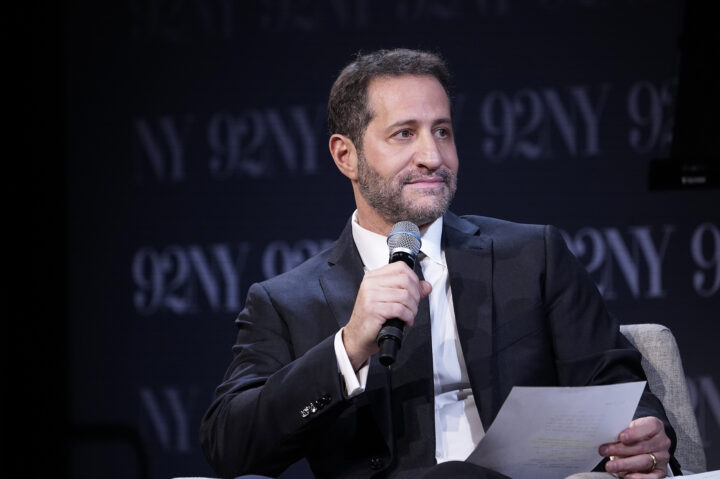
John Lamparski/Getty Images
Modi Rosenfeld speaks at 92NY on October 22, 2025 in New York City.
Israeli-American comedian Modi Rosenfeld, known simply as “Modi,” pulled out of a Passover-themed benefit Monday after his manager revealed that the entertainer had been “blindsided” with the news that New York City Mayor Zohran Mamdani would participate in the Lower Manhattan event.
Quoting Jewish Insider’s initial report on the mayor’s scheduled involvement in the 33rd Annual “Downtown Seder” at impresario Michael Dorf’s venue City Winery, Rosenfeld’s official Instagram account announced the Tel Aviv-born, Long Island-reared performer had withdrawn from the event.
“We were not told Mamdani was participating in this event until today,” the post read. “Modi will no longer be attending.”
Reached by phone, Rosenfeld’s manager told JI that they had committed to featuring in the festivities months ago — and said the venue should have notified them earlier that the mayor, whose political initiation began with anti-Israel campus activism, would be part of the program as well.
“It’s just inappropriate to be blindsided with that information the day of the event, regardless of anyone’s political feelings,” said Leo Veiga, who is also Rosenfeld’s husband. “That’s a very polarizing thing right now, so it’s not appropriate for us to be attending.”
Veiga declined to elaborate further on his and Rosenfeld’s feelings toward the mayor and the event, and expressed hope that any controversy provoked would “die down.”
Still set to appear alongside Mamdani is Israeli musician David Broza, while Israeli-American Rabbi Amichai Lau-Lavie will participate via a livestream from Israel. Broza and Lau-Lavie are both well-known liberals and peace activists, while Rosenfeld is known for performing to religious audiences.
“The Seder is about asking urgent questions — about freedom, responsibility, and how we care for one another,” said Dorf in the initial press release announcing the event. “Each year, we bring together voices who challenge, inspire, and reflect the world as it is — and as it could be.”
Dorf, who previously hosted then-candidate Mamdani for a Yom Kippur event last year, has criticized IDF policy in Gaza — but has rejected allegations that Israel has committed “genocide,” a claim the mayor makes frequently.
Net proceeds from the already sold-out tickets will go toward Seeds of Peace, an organization known for hosting Israel and Arab youth at dialogue forums in Maine, the press release said.
Other celebrities on the bill include Freakonomics co-author Stephen Dubner, news anchor Don Lemon, musician Meg Okura and comedienne Olga Namer.
What JI's wine columnist, Yitz Applbaum, will have on his Seder table this year

Getty Images
A table set for the Jewish holiday Passover
It has been quite some time since I’ve had the presence of mind to sit down and write my wine column.
Since I last wrote, I’ve welcomed a granddaughter, something I highly recommend, and started an early stage defense technology fund in Israel. Even with all of the changes in my life, the thing I’ve missed most is writing this column and hearing from readers.
As Passover approaches, I’ve received hundreds of emails asking for my Seder lineup, so I’m bringing the column back. I hope you enjoy reading it as much as I enjoy writing it.
Here’s what I’m drinking this year:
First cup: Psagot Sinai
I like to begin with something that sets the tone for the evening. The Psagot Sinai is a blend of Cabernet, Petite Sirah and Shiraz, aged in the ancient caves of the Psagot Winery.
There’s something about this wine that feels transportive. You can imagine what celebrating Passover might have felt like centuries ago. It is lively and expressive and gets the Seder off to the right start.
Second cup: Flam Noble 2023 & Matar Chardonnay 2024
Because the second cup flows directly into the meal, I like to have two wines on the table here, both with enough presence to stand up to the food.
The 2023 Flam Noble is elegant and understated. It is predominantly cabernet, with merlot and petit verdot rounding it out. It opens with a light cherry note and finishes with deeper, darker chocolate tones.
Alongside it, I always want a white. The 2024 Matar Chardonnay is a great partner for the meal. It is a full-bodied, almost meaty white, aged in oak for eight months, with a rich, buttery texture that pairs exceptionally well with heavier dishes.
Third cup: Ella Valley Red
For the third cup, I like something more classic and composed. The Ella Valley Red is a Bordeaux-style blend of cabernet, merlot and petit verdot. It has softer tannins and a deep purple color that invites you to pause for a moment, look at the glass, and slow the pace of the evening.
Fourth cup: Jezreel Valley Icon 2023
For the fourth cup, I want something that leaves an impression. The Jezreel Valley Icon is a blend of carignan and syrah, aged for 22 months in French oak. It is powerful from the start and builds into an even more intense finish, with notes of dark chocolate and a slightly smoky edge. It is the kind of wine that carries the Seder with you into the next day.
Matthew Kozma, under secretary for intelligence and analysis, spoke at a briefing for the Secure Community Network, a leading Jewish security organization
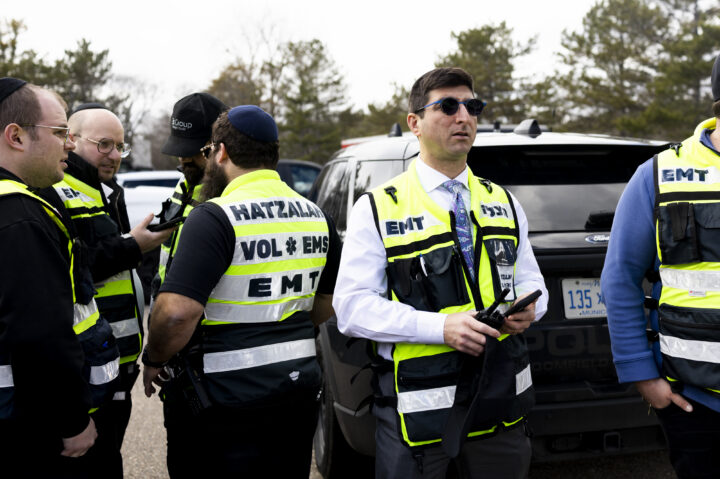
Emily Elconin/Getty Images
Members of Hatzalah of Michigan, a Jewish volunteer emergency medical service survey the area near Temple Israel following reports of an active shooter on March 12, 2026 in West Bloomfield, Michigan.
Extensive security “preparations, training and practice” that had taken place prior to an attack on a Detroit-area synagogue earlier this month “greatly helped to dramatically mitigate what could have been so much worse in Michigan,” a Trump administration intelligence official said on Tuesday.
During a security briefing webinar hosted by the Secure Community Network, a leading Jewish security organization, ahead of the Passover holiday, Matthew Kozma, under secretary for intelligence and analysis at the Department of Homeland Security, called for continued vigilance “given the threat that’s stemming from Iran, particularly in the Middle East, but also here at home.”
He said that Americans should remain cautious of threats from “malicious actors, particularly ones encouraged by or empathetic to Iran,” as two upcoming events in the country — the 2026 FIFA World Cup and America’s 250th anniversary — bring an influx of visitors into the U.S.
The briefing was held during what Michael Masters, CEO of SCN, described as “an elevated threat environment from Iran and its proxies,” ahead of the start of the Passover holiday next week.
Since the U.S.-Israeli war with Iran started nearly one month ago, Jewish institutions have seen a surge in attacks, including the one targeting Temple Israel in West Bloomfield Township, Mich. — one of the country’s largest Reform congregations — and three shootings outside of Toronto synagogues.
Masters said SCN monitored over 8,000 direct calls for violence against the Jewish community in North America over a six-day period this month, marking a 137% increase over the average tracked and “the highest number we’ve ever tallied in that timeframe.”
Oakland County, Mich., Sheriff Michael Bouchard, who was on the scene following the Temple Israel attack, shared with attendees that he himself has been the target of death threats for supporting the Jewish community.
Still, Bouchard doubled down on his support. “Something that I’ve said before, and I believe, is that if you target our Jewish community, we’re going to stand in front of them to protect them. And we’re coming for you.”
The briefing concluded with Eric Fingerhut, CEO of the Jewish Federations of North America, calling for “more resources at this time.”
“Temple Israel was one of the best, most secured buildings, having spent a significant amount of money of their dues budget and of their donors’ budgets on security, and yet we need additional levels of security,” Fingerhut said. “Our federations are committed to generating those additional resources, bringing those resources to our communities. But in addition, I have to mention that it’s the government’s responsibility, first and foremost, to protect its citizens in their places of worship, in their places of communal gathering.”
Last week, in a letter to the leaders of the House Appropriations Committee, a bipartisan group of 150 House members asked the committee to provide $1 billion in funding for the Nonprofit Security Grant Program in 2027, a massive expansion of the program that marks the first time lawmakers’ request aligns with the $1 billion that some Jewish groups have been advocating for. The program received $274.5 million in funding in 2025, but that funding has still not been distributed, according to the letter, which cited delays at FEMA, and lawmakers have not been provided customary data about supplemental funding rounds awarded last year.
“We need more resources and support from the government,” continued Fingerhut, who announced that JFNA will hold an advocacy fly-in in Washington in mid-May.
“We will be visiting every member of Congress, asking them for their support. We’ll be visiting the members of the administration, as well … to make sure that [they] know that every one of us has the right in this country to practice our faith and to gather together as a community in safety and security.”
Delta and United Airlines aren’t listing any direct flights to Tel Aviv until the summer amid the war with Iran
Chen Junqing/Xinhua via Getty Images
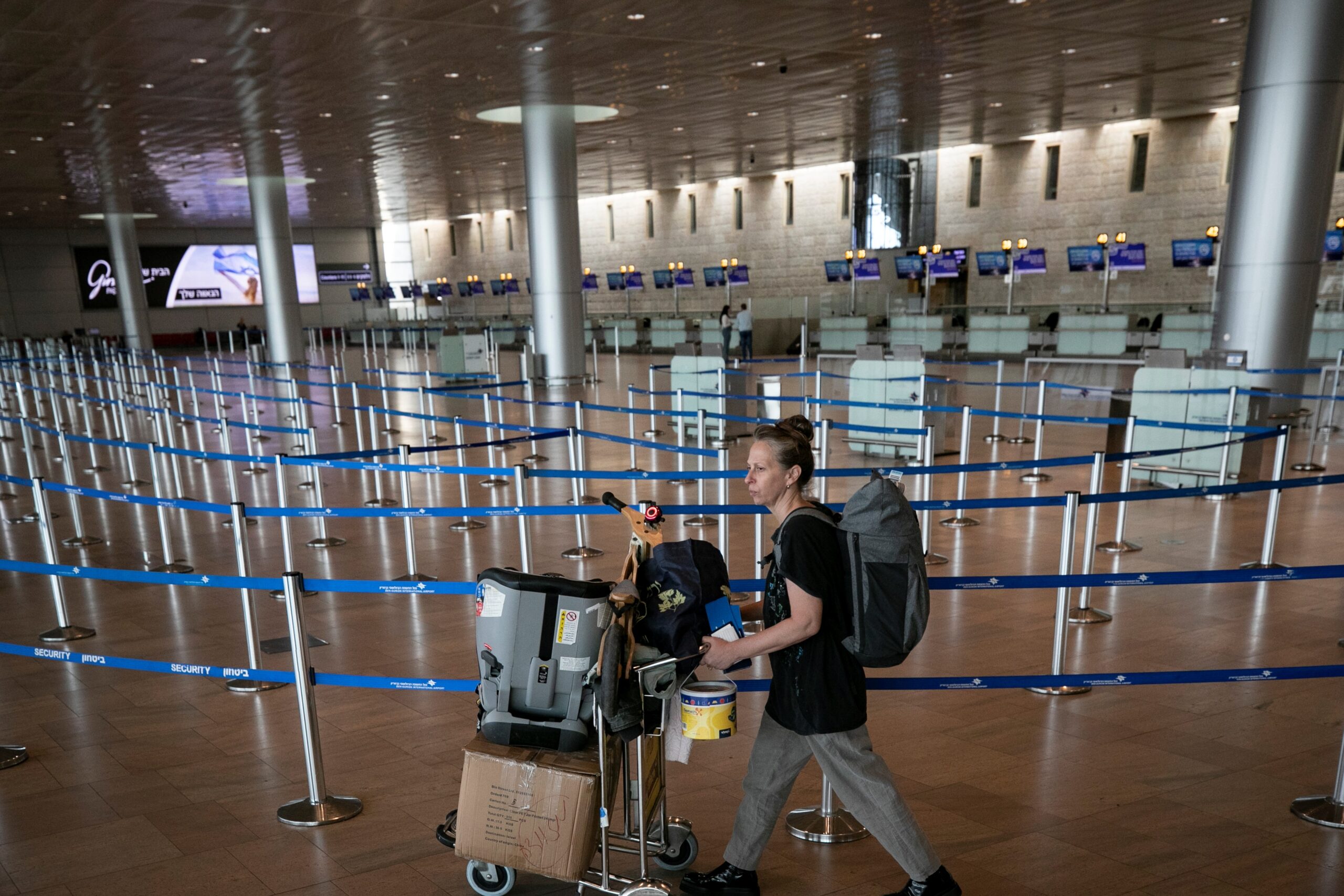
A passenger walks at Ben Gurion International Airport near Tel Aviv, Israel, Oct. 31, 2023.
As the Iran war continues, major U.S. airlines have extended suspensions of direct flights to Tel Aviv, upending travel plans for thousands hoping to visit Israel for Passover, when the country typically sees a surge in visitors, and beyond.
As of Tuesday, United Airlines’ website shows direct flights from the New York region’s Newark Liberty International Airport to Israel, a route that usually operates multiple times daily, are unavailable through June 16. The only available flights from Newark to Tel Aviv’s Ben Gurion Airport are operated by Lufthansa, United’s partner, and require a layover in Frankfurt.
Lufthansa has suspended its flights to Israel through April 9.
United’s direct flights from Israel to Chicago O’Hare and Washington Dulles International Airport, which typically each run a few times a week, are also suspended.
The first available direct New York to Tel Aviv flight on Delta Airlines website is available June 1. When the Iran conflict initially began, Delta said it would suspend flights from New York’s John F. Kennedy International Airport until at least April 1. The airline had been planning to restart its Atlanta-Tel Aviv flights in April for the first time since the Oct. 7, 2023, terrorist attacks, but now has postponed those plans until Aug. 4.
American Airlines, which has not flown directly to Israel since Oct. 7, has delayed the resumption of its service to Tel Aviv until April 23, a spokesperson for the airline told Jewish Insider on Tuesday. It also suspended operations to and from Doha, Qatar, through May 7 due to tension in the region.
Before the conflict with Iran began, American Airlines announced plans to resume direct flights to Ben Gurion from John F. Kennedy starting on March 28, just days ahead of the Passover holiday. Tickets went on sale in October. The announcement, which made American the last of the major U.S. carriers to resume flights to Israel after Oct. 7, came weeks after Israel and Hamas agreed to a ceasefire in the Gaza war.
Throughout much of the war, the Israeli carrier El Al was the only reliable option for direct travel to and from the U.S., leading to a shortage of flights to meet travelers’ demands amid soaring ticket prices.
United and Delta both briefly resumed service between Israel and the New York area for short periods in 2024 after suspending all flights on Oct. 7. Both airlines fully reinstated flights earlier this year until the Iran war started.
Speaking at a Rosh Hashanah reception at the Israeli Embassy in Washington, Leiter asked, ‘Where is the outrage? Where are we being called to order that this is no different than putting blood in the matzos on Passover?’
Shmulik Almany
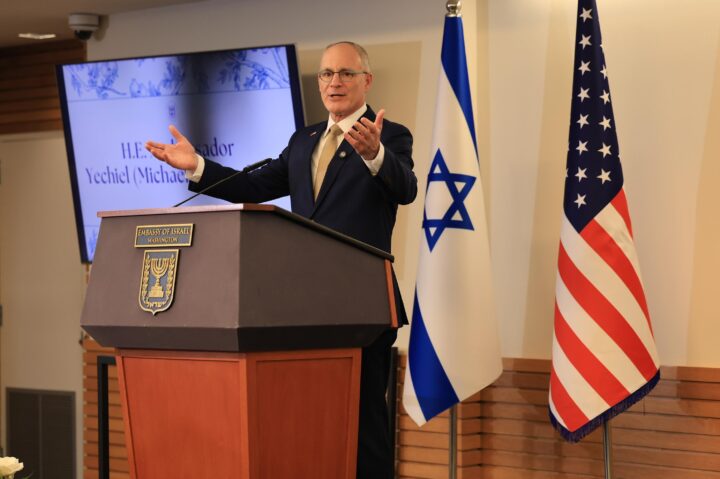
Israeli Ambassador to the U.S. Yechiel Leiter addresses Rosh Hashanah reception at the Israeli Embassy in Washington, Sept. 18th, 2025
Israel’s ambassador to the U.S. on Thursday compared congressional efforts to block U.S. weapons transfers to Israel to the antisemitic “blood libel,” the false accusation that medieval Jews used the blood of Christian children to cook Passover matzah — and he took aim at Sen. Bernie Sanders (I-VT) for leading the charge.
Speaking at a Rosh Hashanah reception at the Israeli Embassy in Washington, Ambassador Yechiel Leiter said in a fiery speech that Democratic proposals in Congress to restrict military aid to Israel during its ongoing conflict amounted to “a modern-day blood libel,” and warned that the rhetoric could have deadly consequences.
“I was told that if we really wanted to, we would feed the Gazans appropriately,” Leiter said of a recent conversation with a lawmaker. “I said, ‘Do you put blood in the matzos that you eat on Passover?’ There is no distinction between the two. This is a blood libel. Blood libels cost lives.”
Leiter did not refer to Sanders by name, but the Jewish Independent from Vermont has been at the forefront of a series of recent Senate resolutions calling on Congress to block certain arms sales to Israel. The most recent, in August, did not pass, but 27 Democrats, the majority of the caucus, voted for it.
“Somebody claiming the mantle of Jewish pedigree actually leads the charge — an embargo on Israel, an embargo on weapons to Israel at a time of a seven-front war,” he said. “Where is the outrage? Where are we being called to order that this is no different than putting blood in the matzos on Passover?”
The ambassador’s speech, delivered to a group that included Democratic and Republican lawmakers, Trump administration officials and Jewish communal leaders, came hours after two Israeli soldiers were killed at the Allenby Crossing from Jordan into the West Bank by a Jordanian driving a Gaza-bound truck of humanitarian aid, and after four Israeli soldiers were killed by a bomb in Gaza.
Leiter warned that Israel is “facing something now that we haven’t faced perhaps since the 1930s.”
“It’s a contagion of lies that we have to battle together, because if you don’t battle lies, you end up battling for your life,” said Leiter. “This era of Rosh Hashanah, please be aware: the Protocols of the Elders of Zion 2.0 are being written right now.”
He castigated European governments for moves toward recognizing a Palestinian state, calling it “an award for terrorism” and accusing France and Britain of “moral depravity.” He also directed his ire at the Jewish actress Hannah Einbinder, who in an Emmy acceptance speech last week said “F*** ICE, free Palestine.”
“Maybe you deserve an Emmy, but what you don’t deserve is a platform to libel your own people and to libel people standing opposed to moral depravity on the international stage,” said Leiter, who did not mention Einbinder by name.
“Israel is standing alone in the world,” the ambassador said — except for “with our dearest friends in the Congress of the United States and the Senate of the United States and the administration of President [Donald] Trump, the best friend Israel ever had in the White House.”
Israeli National Security Council releases travel warning for Israelis and Jews on Passover; Canada, Australia highlighted for anti-Jewish hate crimes

GIL COHEN-MAGEN/AFP via Getty Images
Passengers check their flights at Ben Gurion airport near Tel Aviv on August 6, 2024, amid regional tensions during the ongoing war between Israel and Hamas in the Gaza Strip.
Iran and global terrorist organizations, including ISIS, plan to target Jews and Israelis traveling during Passover, Israel’s National Security Council warned on Tuesday.
“Iran is the central generator of global terror, directly or through its proxies, against Israeli and Jewish sites around the world,” the National Security Council said in a statement released before Israeli schools go on Passover break on Sunday.
The Islamic Republic uses terror attacks as a policy and seeks to avenge the deaths of senior Hezbollah and Hamas officials, according to the travel warning.
In the last year, Iran has backed attempted terrorist attacks against the Israeli embassies in Sweden and Belgium, which were thwarted, as well as attempts to attack or abduct Israeli citizens around the world under the guise of making business contacts. Those attempts mostly began through e-mails and messages on social media.
Hamas has also attempted to attack Jews and Israelis outside of Israel, in light of the terror group’s weakened state in Gaza and the continuation of the war, the NSC stated. Hamas terror infrastructure was found in Denmark, Germany, Bulgaria and Sweden that aimed to attack Israelis.
In addition, in recent months, terrorist groups such as ISIS and Al-Qaida have increased their activities, especially in Europe. ISIS specifically has called on its supporters to strike Israeli and Jewish sites around the world.
The NSC said that “with the collapse of the ceasefire [last month] and the return to fighting in Gaza, an increase is expected in efforts to attack Jewish and Israeli sites abroad, including through local or individual initiatives.”
In addition, there continues to be a high-level threat in Egypt’s Sinai desert, where the beaches were once a popular travel destination for Israeli tourists.
The NSC also warned of possible hate crimes against Jews around the world, which have drastically increased since the Oct. 7, 2023, attacks on Israel.
Canada and Australia were singled out as potentially dangerous due to spikes in antisemitic attacks, including the burning of a Jewish preschool and a synagogue in Sydney, and the throwing of Molotov cocktails and shootings at Jewish schools and synagogues in Montreal and Toronto.
“The bottom line is that there remains a high motivation and activity of different terrorist factors to advance terrorist attacks against Israelis and Jews around the world,” the NSC statement reads. “An atmosphere of hate in many countries against Israel and Jews in light of the war continues to increase the motivation for individuals and independent cells to attack.”
The NSC recommended that Israelis be cautious when they travel and check their recommendations before buying tickets to go abroad.
Please log in if you already have a subscription, or subscribe to access the latest updates.
 Continue with Google

 Continue with Apple