









































































The race to the left on Israel in the primary underscores the extent to which Middle East politics have shifted and criticism of the Jewish state has become a litmus test in left-wing circles and districts
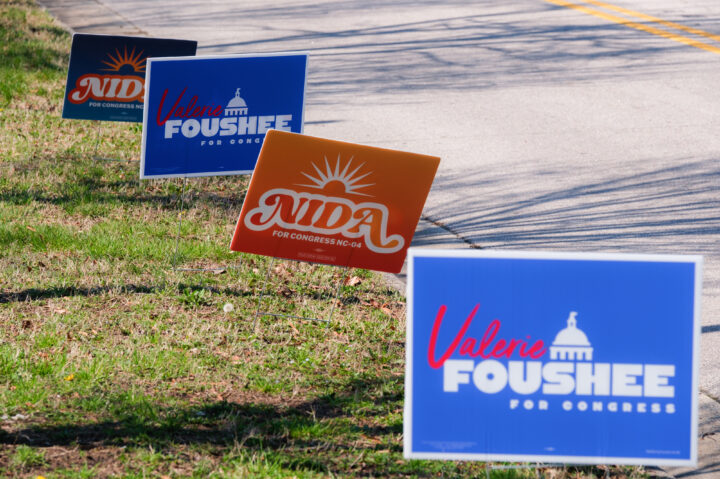
Cornell Watson/Bloomberg via Getty Images
Campaign signage for Democratic Congressional candidates Valerie Foushee and Nida Allam ahead of the North Carolina primary election in Durham, North Carolina, US, on Sunday, March 1, 2026.


 Add JewishInsider on Google
In the closing message of her campaign ahead of the North Carolina Democratic primary today, Durham County Commissioner Nida Allam, a far-left antagonist of Israel, is leaning into criticism of the war against Iran.
“President Trump just used our taxpayer dollars to bomb a school in Iran, killing over 100 elementary school children and starting another endless war abroad. This is reprehensible, and I strongly condemn it, as should every elected official,” Allam said in a direct-to-camera video ad posted on social media on Monday — despite no evidence that the U.S. or Israel were responsible for the strike.
Allam, who is Muslim, vowed that she would never accept support from defense contractors or pro-Israel groups, and said she “opposed these ‘forever wars’ my entire career, and I hope to earn your vote to be your proudly uncompromised pro-peace leader in Washington.”
By contrast, Rep. Valerie Foushee (D-NC), aiming to fend off a primary challenge from Allam, offered a condemnation of the “brutal and repressive” Iranian regime in a statement on Monday, while arguing that its “abuses do not give the president the authority to launch military strikes without Congressional approval.” She said Congress must vote to bring the war to an end.
In an initial statement on X over the weekend, Foushee issued an unequivocal condemnation of the operation, calling it “an unconstitutional escalation that risks dragging the United States into another catastrophic and endless war in the Middle East” that “ignores the will of the American people and recklessly puts our servicemembers in harm’s way” without making mention of the Iranian regime.
In 2022, Foushee won the seat in the 4th Congressional District against Allam with significant backing from the AIPAC-linked United Democracy Project super PAC, but Foushee has taken a more critical posture towards Israel over the last year. This year, significant outside spending has flowed into the race on both sides.
Allam’s allies have claimed that AIPAC is secretly spending to support Foushee, who vowed not to accept funding from the group last year. But AIPAC has strongly denied those claims. “Rep. Foushee rejected AIPAC support and we are not involved in or participating in any way in this race,” the group said Monday.
Foushee has faced a spate of attacks during the primary, including from the groups backing Allam, over her past support for Israel and relationship with AIPAC. She has gone to significant lengths to emphasize that she has cut ties with AIPAC, telling Politico, “My voting record and support for legislation to stop arms sales to Israel speaks for itself.”
The race to the left on Israel in the primary, in a deeply progressive district, underscores the extent to which Middle East politics have shifted and criticism of the Jewish state has become a litmus test in left-wing circles and districts. The shift comes as a new Gallup poll shows, for the first time, that Americans are now more sympathetic to Palestinians than Israelis.
Allam’s comments centering the U.S. as the perpetrator of atrocities in the Iran war also point to how radical she could end up being if elected to Congress.
The race also raises a key questionfor pro-Israel groups and voters going forward: when the two choices are a critic of Israel and an even more extreme critic of Israel, how should they respond? Is it worth backing someone critical of Israel to prevent someone with even stronger views from being elected?
Rep. Valerie Foushee was backed by AIPAC, but has since turned against supporting Israel. Her Democratic opponent is a virulently anti-Israel activist
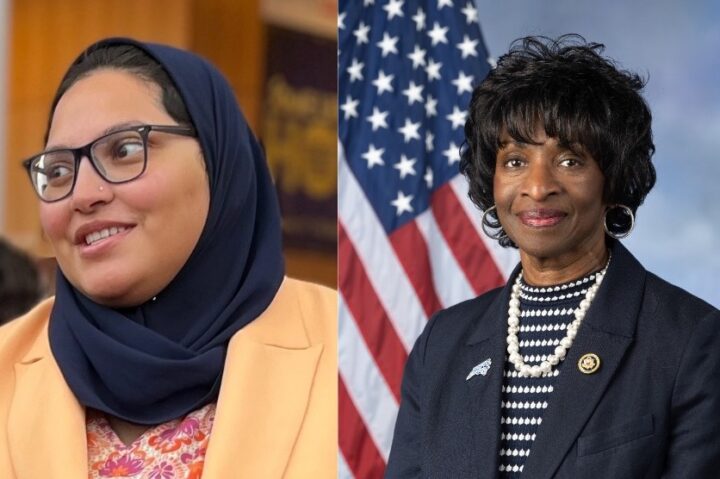
Wikimedia Commons
Nida Allam and Rep. Valerie Foushee (D-NC)
Four years after their first showdown, progressive anti-Israel activist Nida Allam and Rep. Valerie Foushee (D-NC) are facing off for a second time in the Durham, N.C.-based 4th Congressional District — but under very different circumstances.
While the pro-Israel community stepped in to back Foushee against the stridently anti-Israel Allam in 2022, Foushee has since shifted significantly to the left on Israel policy, leaving pro-Israel backers with no clear choice in the race between an incumbent who has abandoned her support of Israel and a challenger with a deeper hostility to the Jewish state.
In their first primary race against each other four years ago, Foushee beat Allam 46%-35%, with a third candidate, “American Idol” finalist Clay Aiken, claiming 7% of the vote.
Foushee, in that race, was backed by more than $2 million in outside spending by the United Democracy Project, marking one of the AIPAC-aligned super PAC’s early, defining victories. But this time, that pro-Israel support for Foushee is unlikely to materalize in what has become a sprint to the left.
Last year, Foushee, who had been inching left on Israel policy since taking office, sponsored the “Block the Bombs Act,” with the goal, she said, of “prevent[ing] the sale of offensive weapons to Israel,” accusing Israel of violating international law. She also said she would not accept any further support from AIPAC.
Even before her first run in 2022, and well before Democrats shifted left on Israel policy during the war in Gaza, Allam had assembled an extensive record as an anti-Israel activist.
In May 2021, during the previous war in Gaza, Allam participated in a rally where demonstrators accused Israel of apartheid and chanted, “From the river to the sea, Palestine will be free,” and where Nazi imagery was displayed. Speaking to a reporter at the event, she denounced the “ethnic cleansing of Palestinians and murder of children.”
Allam, as early as 2021, called for the U.S. to cut off aid to Israel — at the time a fringe stance.
And dating back to 2018, she signed onto a petition demanding Durham’s police department halt all partnerships with Israel, and describing the U.S. as “the United States of Israel.” She also condemned anti-Boycott, Divestment and Sanctions legislation and said she tries to “refrain from buying products from Israel.”
Allam has described the war in Gaza as a genocide, a term Foushee has not yet used.
But with no aligned candidate to support, pro-Israel groups look likely to throw in the towel on the race. AIPAC spokesperson Deryn Sousa confirmed that the group has no plans to be involved in the race this cycle. UDP and Democratic Majority for Israel did not respond to requests for comment.
This time, Allam is the candidate benefiting from outside spending: A new super PAC, whose backers are currently unknown, called American Priorities, has spent more than $500,000 boosting Allam in the primary race in recent weeks.
The group is also backing Rev. Frederick D. Haynes III, a Texas primary candidate who also has a strongly anti-Israel record, to the tune of $72,000 thus far.
Allam has the support of Sen. Bernie Sanders (I-VT), who held a rally with her last weekend, the Justice Democrats, Sunrise and the Working Families Party, while state Democratic leaders including Gov. Josh Stein and former Gov. Roy Cooper are supporting Foushee.
Though the candidates’ positions on Israel are now more similar than they were in 2022, the issue has still come up on the campaign trail. At a candidate forum last month, Foushee said that she only wants to see the U.S. provide humanitarian aid, not military support, in both the Middle East and South America.
“I, for one, do not approve my taxpayer dollars being used to fund a genocide,” Allam said. “And I’m proud to say… that I have never accepted corporate PAC checks and right-wing super PAC money from institutions that want the United States to continue to fund genocide,” she continued.
As of the end of 2025, the two candidates were essentially neck-and-neck in fundraising — Foushee having raised $362,000 to Allam’s $335,000 — but Allam had $306,000 remaining on hand compared to Foushee’s $194,000.
Christopher Cooper, a professor of political science at Western Carolina University, called the race a “black box,” noting that no polling — independent or from either campaign — has been released, a signal that the campaigns’ internal polling is finding the race too close to call.
But Cooper emphasized that the race is largely identical to 2022 — “it’s not as if these are new fights or new fractures. It’s not even old wine in new bottles. It’s old wine in old bottles.”
He said that a lack of AIPAC support this time around would likely not be a “death knell” for Foushee, given her name recognition from two terms in office, adding that Foushee does not seem to have any major vulnerabilities or baggage from her time as an incumbent.
“This is a race that is about a primary electorate in Durham County, which is about as left-leaning as you get in the state of North Carolina,” Cooper said. “It’s progressive versus more progressive.”
He said that Allam has been trying to hit Foushee over Israel policy issues, as well as characterize her as “too moderate to fit the district.”
Please log in if you already have a subscription, or subscribe to access the latest updates.
 Continue with Google

 Continue with Apple