














































































The Israeli prime minister called the focus on settler violence an ‘obsession’ and declared that Israel ‘prevented genocide’
Alexi J. Rosenfeld/Getty Images
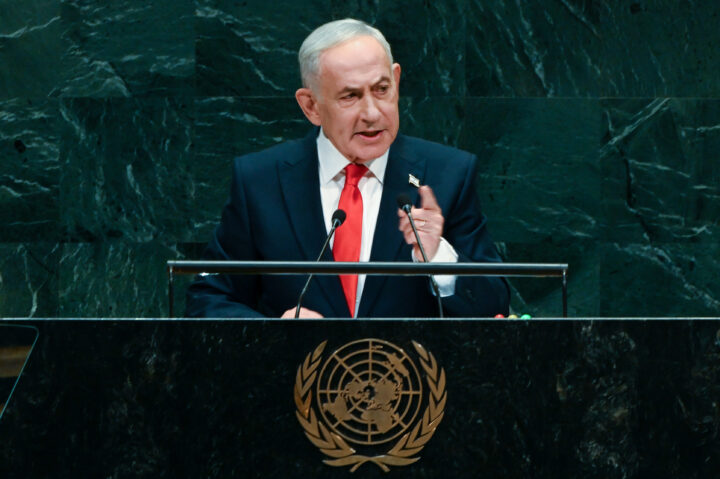
Israeli Prime Minister Benjamin Netanyahu speaks during the 81st session of the United Nations General Assembly at U.N. Headquarters on September 24, 2026 in New York City.


 Add JewishInsider on Google
Israeli Prime Minister Benjamin Netanyahu pushed back against criticism of Israel over Gaza and the West Bank in his address to the United Nations General Assembly on Thursday, taking aim at New York City Mayor Zohran Mamdani, French President Emmanuel Macron, Qatar and Turkey.
After most of the hall conducted a walkout at the outset of his speech, Netanyahu condemned violence by Israeli settlers while dismissing the international focus on settler violence as an “obsession.” He said roughly 150 young Israelis were responsible for throwing stones, destroying olive trees and setting fires in the West Bank and said Israel had deployed the Shin Bet against them.
“I can’t stand that. I won’t stand for vigilantism,” Netanyahu said, before arguing that the attention paid to such attacks was disproportionate to Palestinian terrorism. “We can’t stand settler violence. You don’t know what you’re talking about.”
In his UNGA address, Netanyahu alleged that "several foreign countries have spent untold billions to spread lies" about Israel, calling out Qatar for "massively funding American universities and toxic media outlets like Al Jazeera … [to] brainwash young minds to hate Israel." pic.twitter.com/3yhyYfgy9z
— Jewish Insider (@jewishinsider) September 24, 2026
Netanyahu directly addressed Macron, pointing to the killing of Netanel Shukrun, a French citizen and father of six who was shot in a West Bank terror attack on Sunday, and the serious wounding of IDF reservist Neria Leiter, son of Israeli Ambassador to the U.S. Yechiel Leiter, in a car-ramming attack on Wednesday.
Macron had said in his UNGA address that Hamas had “never operated” in the West Bank, while criticizing Israeli policy there. A French diplomatic official later clarified that Macron meant Hamas does not govern the West Bank.
The prime minister also rejected accusations that Israel committed genocide in Gaza, directly addressing Mamdani, who has repeatedly called Netanyahu a war criminal.
“Israel didn’t commit genocide. Israel prevented genocide,” Netanyahu said. He also raised that Mamdani’s wife, Rama Duwaji, had liked multiple Instagram posts celebrating Hamas’ Oct. 7, 2023, attacks. “You try to silence me. Well, you can’t silence me. You can’t silence the truth,” the prime minister said.
In response, Mamdani accused Netanyahu in a statement of using his U.N. address “to repeat baseless lies meant to sanitize his genocide of Palestinians.”
Netanyahu went on to accuse foreign countries of spending “untold billions” to spread anti-Israel messages through traditional and social media, singling out Qatar for “massively funding American universities and toxic media outlets” in what he alleged was an effort to “brainwash young minds to hate Israel, hate America, hate the West.”
He called Turkey the latest “superspreader of antisemitic lies” and Turkish President Recep Tayyip Erdoğan a “tyrant,” accusing Ankara of supporting Hamas and seeking greater influence in Syria.
Netanyahu also responded to Syrian President Ahmad al-Sharaa, who said in his UNGA address on Wednesday that the Golan Heights “will remain Syrian territory.”
“Mr. al-Sharaa, you should know the Jews have been on the Golan Heights since the days of Moses,” Netanyahu said. “You can read it in the Bible.”
The mayor and NYPD commissioner said there are ‘no known, specific or credible threats’ against the gathering where Trump and Netanyahu will speak
Michael M. Santiago/Getty Images
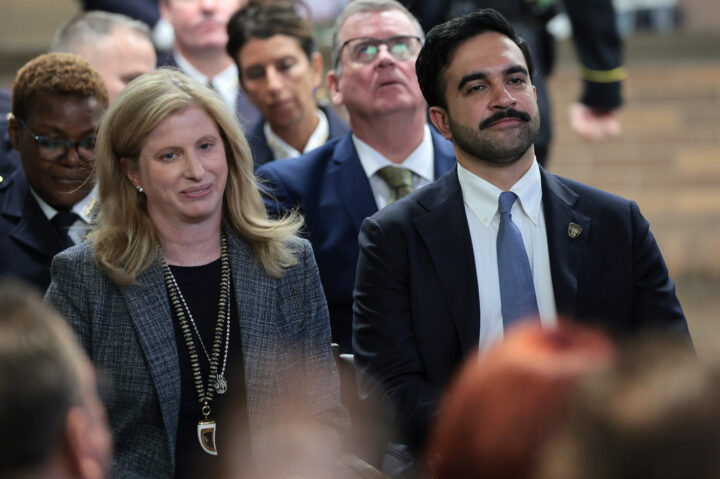
NYPD Commissioner Jessica Tisch and New York City Mayor Zohran Mamdani attend an unveiling ceremony for a new 9/11 Memorial Wall at One Police Plaza on Sept. 9, 2026 in New York City.
NYPD Commissioner Jessica Tisch told reporters on Thursday that her department expects a wave of protests around the U.N. General Assembly next week, set to feature President Donald Trump, Israeli Prime Minister Benjamin Netanyahu and Iranian President Masoud Pezeshkian — even as she and New York City Mayor Zohran Mamdani maintained little would change regarding the police response compared to years past.
The two joined officials from the Secret Service and State Department at One Police Plaza to brief the press on security measures and what the mayor described as a “whole-of-department response” to head off any risks to the international gathering. This will include “full deployment” of patrolmen and elite police units, as well as restrictions on traffic, flight patterns and pedestrian access in the area around the U.N. headquarters.
But both took pains to emphasize that, despite ongoing conflict between the U.S. and Iran — and despite Mamdani’s since-abandoned threat to arrest Netanyahu if he visited the city — these precautions were largely the same as those the city always takes around the annual geopolitical conference.
“This is standard procedure,” Mamdani asserted. “There are no known, specific or credible threats against the United Nations General Assembly or our city.”
Nonetheless, Tisch acknowledged that protests would greet world leaders as the high-level gathering begins on Tuesday. The summit of top global statesmen will see Netanyahu arrive in New York on Sept. 23, the same day Pezeshkian is scheduled to address the session. Yet Tisch said her agency did not intend to take steps “out of the ordinary” for the event.
“I can tell you we’re expecting multiple protests every day,” she said. “As always, we have no tolerance for violence or destruction of property or breaking the law.”
Mamdani in recent days has dampened his own fiery rhetoric around Israel and Netanyahu, backing off prior suggestions that his fellow critics of the Jewish state and its military actions in Gaza take their grievances into the street. But he told reporters no figure from the NYPD had asked him to do so.
“The conversations that I’ve had with the PD have been purely about standard preparations for the event, as well as standard preparations for keeping New Yorkers safe,” he said.
Speaking to JI about ‘I Disagree: Winning Arguments Without Losing Friends,’ the liberal Fox News co-host also shared her conflicted views on Zohran Mamdani and how Oct. 7 deepened her Jewish identity
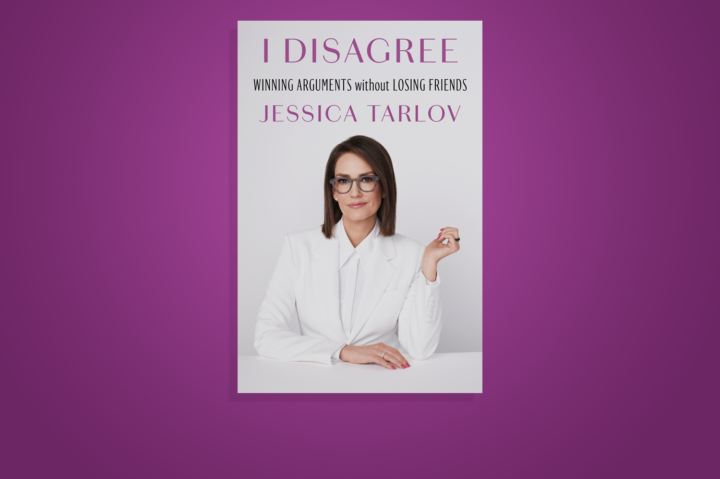
In her new book, Fox News co-host Jessica Tarlov advocates for constructive disagreement — “acknowledge without accepting,” or hearing someone out, hard as it may be, without torching the relationship or one’s own beliefs.
In an interview with Jewish Insider ahead of Tuesday’s release of I Disagree: Winning Arguments Without Losing Friends, Tarlov pointed to her closely watched sit-down last year with far-left streamer Hasan Piker as evidence that her framework holds even when strained against its limits. Piker was “incredibly nice and gracious,” she recalled, arguing that calls for him to be shut out of Democratic circles are misguided.
The exchange highlights the balancing act central to both Tarlov’s book and her on-air image as the primary liberal co-host on the Fox News talk show “The Five.” But in her conversation with JI, Tarlov, who is Jewish, noted that there is sometimes discomfort in that instinct to engage across lines — the thesis of her book. She said she finds unease in New York City Mayor Zohran Mamdani’s campaign appearance with Columbia University anti-Israel activist Mahmoud Khalil, accusations that Israel committed “genocide” and just how much attention Piker’s commentary is getting in a divided Democratic Party.
“How much the discourse is dominated by Hasan Piker and those kinds of discussions is just a general turnoff” of the Democratic Party, Tarlov told JI, “and people don’t necessarily feel like we’re getting the news because there’s so much focus on the infighting.” She pointed to Michigan’s upcoming Senate race between Democrat Abdul El-Sayed and former Rep. Mike Rogers (R-MI) as a key test of just how deep those divisions run. “It will be a really interesting test as to how divided the party actually is along the lines of this issue — and who comes around to El-Sayed, who goes through with voting for Mike Rogers, or sitting home.”
Despite her willingness to engage with Piker, Tarlov argued the wall-to-wall focus on him has become its own kind of distraction from the issues actually most important to voters.
“I do think the discourse being about him 24/7 is really ignoring what most people are concerned about in their lives,” she said. “They’re thinking ‘my gas prices are up’ and we’re like, ‘Hasan Piker.’ That’s just really missing the mark.”
Last November, when Tarlov found herself seated next to Piker on a panel at Crooked Media’s Crooked Con, she said she was “nervous” going in, given how divisive of an issue his past rhetoric — including justifying Hamas’ Oct. 7, 2023, terrorist attacks and saying America deserved 9/11 — had already become. But she found him friendly, and even took some of his feedback under consideration: “The one thing he did say to me, which did resonate, was that the only criticism of what I do is that I’m too hard on the progressive left. I spent a lot of time thinking about that and ultimately I do think that he’s right.”
“It had been much easier for me to insult AOC for instance and it was kind of low-hanging fruit and there are enough people now who aren’t even necessarily in the far-left party who want things like universal health care. The center part of the party hasn’t been talking about affordability issues in a way that is connecting like Mamdani did in the mayoral election, or that we’re not talking enough about building affordable housing. I thought that was a good note,” she added.
Asked if Democrats should more vigorously condemn Piker — who has over 3 million Twitch followers — or banish him from party circles, Tarlov rejected the premise.
“The idea of us deciding who has legitimacy or platforming when someone has a platform of that size already is really missing the point,” she said. “I show up everyday and talk to people who I disagree with, in some cases people who believe in things I am deeply against. If you don’t engage you leave open this chasm for other people to fill it. I’m not running to be on Hasan’s stream — I wasn’t invited either — but I do think this idea of we’re not going to platform him when he has a bigger platform than most of the people who are saying they have no interest in having him is a little bit embarrassing.”
“In terms of being more culturally Jewish, I do think Oct. 7 changed everything for many nonpracticing Jews in this country, where it became such a bigger part of our identity, where we’re more attuned to discussions around Judaism and Israel in general and it has made us more interested in being affiliated with the religion. It just becomes a more prominent part of your identity when something like that happens,” Tarlov said.
Tarlov’s prominent role as the only Jewish panelist on “The Five” has coincided with Fox News catching the eye of some liberal-leaning American Jews who felt that in the aftermath of the Oct. 7 attacks, much of the mainstream coverage was biased against Israel.
Tarlov said she brings up her Jewish background on air, including her family’s history of fleeing Europe ahead of the Holocaust and her own run-in with rising antisemitism as a student in London two decades ago, “because I think it is relevant and I have a pretty mainstream Jewish perspective on what’s going on in the Middle East and what [Israeli Prime Minister Benjamin] Netanyahu has done and the aftermath of Oct. 7,” she told JI. “I draw on it explicitly because I think it’s important for viewers to know there is a Jewish person who is saying this who is not just someone with an opinion and that I have real connective tissue to the religion and to Israel.”
“In terms of being more culturally Jewish, I do think Oct. 7 changed everything for many nonpracticing Jews in this country, where it became such a bigger part of our identity, where we’re more attuned to discussions around Judaism and Israel in general and it has made us more interested in being affiliated with the religion. It just becomes a more prominent part of your identity when something like that happens,” she continued.
While her cultural connection to Judaism deepened after Oct. 7, Tarlov is no stranger to antisemitism. In her book, she recounts heated politics over Israel during her time at the London School of Economics and former London Mayor Ken Livingstone’s controversial rhetoric during his 2012 campaign to reclaim the office. Tarlov told JI that the period “shaped my current political perspective” and felt like a foreshadowing of the current climate on U.S. college campuses.
“You can draw a straight line from those experiences to what happened at Columbia,” she said. “If there had been an igniting event like Oct. 7 you could easily see how it would spill over into something like that. I’m a little bit embarrassed that I didn’t understand the gravity of it in full back when it was going on. But I definitely see important comparisons — and as someone who likes to look at politics from a sociological lens — how much writing was on the wall. This was really an international movement that got so powerful in what feels like a short period of time.”
“And then working on [then-Mayor] Boris Johnson’s 2012 campaign and following Ken Livingstone, the labor candidate, and seeing him speak at town halls and mosques and how much widespread acceptance there was for antisemitism, was very jarring for me,” said Tarlov. “That stuck with me.”
Tarlov is seeing similar dynamics play out where she lives now, in Manhattan. She writes in her book that “making Jewish New Yorkers feel safe” was on her checklist for the city’s mayoral candidate, and Mamdani didn’t meet it. Eight months after he moved into Gracie Mansion, Tarlov told JI she’s “conflicted” about that view.
“I think he’s been better than a lot of people expected,” she said. “I’m close with a lot of people in the Modern Orthodox community of Riverdale and I pay a lot of attention to how they’re feeling and where they’re going for their information. If you ask them, they’d say there are [good policies like] universal childcare, not related to the Jewish community. But they feel he’s fallen short when it comes to [other issues]. I’m in the realm of neutral based upon my expectations.”
Still, she noted that “one of the difficult moments for me in his campaign was when he campaigned with Mahmoud Khalil.”
“Khalil represents somebody that infringed upon Jewish students at Columbia’s civil rights,” she said. “I was overwhelmed by the feeling that if that happened to Black students, trans students, any other protected sect that would never have been tolerated. So to see him as a campaign surrogate was very difficult for me. I understand that the Trump administration unfairly targeted [Khalil with deportation threats] and I know that’s the thrust of why he was part of the campaign, and he’s been to Gracie Mansion since then, but that was quite jolting to me.”
Asked whether she agreed with Jewish leaders who’ve blamed Mamdani’s rhetoric on Israel for fueling New York’s rise in antisemitism, Tarlov pushed back, framing the criticism as part of a broader pattern she sees playing out with Piker. “This gets back to the Hasan Piker discourse,” she said. “Everyone is going crazy about his comments and then there’s a lot of footage of other people saying similar things, and people said Hasan was antisemitic for saying that.”
She traced the surge in antisemitic rhetoric more broadly to the aftermath of the Oct. 7 attacks rather than to any one figure. “I wouldn’t put it at Mamdani’s feet like that,” she said, though she added she understood the impulse among Jewish leaders trying to reassure anxious congregants: “People are trying to manage a congregation full of people who are afraid and angry, and a lot of them are disappointed that there wasn’t a candidate that they were excited about.”
The book’s core idea is “acknowledge without accepting,” something Tarlov has proven she can do across many political subjects. But does that framework still work when the disagreement is about something like Israel’s right to exist?
Tarlov’s advice is to “find a way to slide in your perspective without making it a knockdown, drag-out fight.” She pointed to a recent appearance by Ryan Grim — the co-founder of the Hamas-sympathetic outlet Drop Site News — on “Raging Moderates,” the podcast that she co-hosts with Scott Galloway. On air, Grim referred to Israel’s “genocide” in Gaza.
“The point of my book was for people to have a longer-term perspective on these tough issues and tips and tricks that could help them do better in these fraught conversations,” Tarlov told JI.
“When he was finished talking, I said, ‘I don’t use that term, I don’t see it that way,’ and then moved on,” Tarlov recalled. “So there are ways to acknowledge without accepting, as per the book, but to make sure it doesn’t cut off all conversation.”
“I think you should always have the conversation — I believe in that,” she continued.
“Understanding other people’s point of view is really of value. I also understand how deeply personal [Israel] is for people. It’s a little different than hearing someone’s view of immigration, let’s say, where they want mass deportations. Saying there should be a one-state solution in the Palestinian direction feels different than that.”
“The point of my book was for people to have a longer-term perspective on these tough issues and tips and tricks that could help them do better in these fraught conversations,” Tarlov told JI.
“That absolutely does apply to being able to dialogue with people over something like Israel and its right to exist. On an emotional level, I think it is more complicated than your average policy issue but I still think the framework applies, and I did have it in mind as I was writing the book. It’s up there as a top five difficult issue for people to talk about and was pulling my political party — and relationships — apart.”
Mamdani’s antisemitism czar invited a cross-section of rabbis and Jewish leaders broadly sympathetic to the mayor for the candid conversation

Spencer Platt/Getty Images
New York City Mayor Zohran Mamdani speaks at a food distribution center on July 27, 2026 in the Brooklyn borough of New York City.
A roundtable with New York City rabbis held at City Hall on Monday gave participants a chance to voice growing concerns about New York City Mayor Zohran Mamdani’s Israel rhetoric they felt had before gone unheard — with several attendees telling Jewish Insider the strong collective message, and Mamdani’s reaction, gave them hope he would change tack.
Multiple attendees of the meeting told JI that they had been in contact with Mamdani’s Office to Combat Antisemitism for months about his “single fixation” on Israel and his characterization of the Jewish state’s most politically active supporters as “monsters,” only to see the mayor dismiss such criticism. They said they viewed the gathering as an opportunity to bring their fears directly to him and to demonstrate communal unity amid a period of spiking antisemitic hate crimes.
“People talked about their own concerns, their families’ concerns, their congregations’ concerns. I think he heard them,” said one participant, who requested anonymity to speak freely about their ongoing contact with Mamdani’s antisemitism czar, Phylisa Wisdom, and her deputy, Josh Binderman. “When they framed the meeting, they said it was going to be an ‘open, honest dialogue.’”
A City Hall official said in a statement to JI that Mamdani’s team had “brought together a group of rabbis that reflects the diversity of New York’s Jewish community — including leaders from several major denominations and four of the city’s five boroughs who have leadership roles in some of the city’s largest congregations and denominations — so the mayor could hear directly from rabbis with a broad range of experiences and viewpoints.”
Several participants JI spoke with similarly remarked on the multi-denominational nature of the meeting, though one attendee noted the absence of more religiously conservative Orthodox leaders. The mayor met last week with leaders of Brooklyn’s anti-Zionist Satmar community.
Even as some critics of Mamdani said they were pleased he had taken the meeting on Monday, they expressed skepticism that the mayor would be open to acting on the message the group of rabbis shared.
The New York Board of Rabbis, the organization that has historically represented the city’s Jewish religious leadership, was not involved in planning the meeting, and an executive of the group suggested that Mamdani’s team had deliberately handpicked rabbis and Jewish leaders sympathetic to his political agenda.
Howard Wolfson, a longtime advisor to former New York City Mayor Michael Bloomberg, said that he was “glad” Mamdani had heard the feedback from Jewish leaders, but argued that “action, not just talk,” would help “create the conditions for a new relationship.”
“A good start would be to stop referring to American orgs that represent many Jews as monsters,” Wolfson said in a text message to JI, referring to controversial June remarks in which the mayor had singled out the pro-Israel group AIPAC while speaking at a campaign rally. Mamdani defended his rhetoric after it sparked an outcry from Jewish organizations that said he had invoked an antisemitic trope.
Meanwhile, Israeli Prime Minister Benjamin Netanyahu’s anticipated visit to New York City next month for the U.N. General Assembly “will be a big test,” Wolfson added of the mayor, who encouraged protests of the prime minister even as he acknowledged he cannot order his arrest. “How much does he want to focus on it? How much does he want to grandstand?”
Rabbi Ammiel Hirsch of the Stephen Wise Free Synagogue, a Reform congregation on Manhattan’s Upper West Side, who serves as the president of the New York Board of Rabbis, said he was not asked to attend the meeting on Monday but was encouraged by what he had heard about it. “If in fact it was a very frank conversation,” he told JI, “then that’s a good thing.”
“It’s not that the mayor is not aware of this. He’s heard it many times,” Hirsch added. “Hopefully it’ll make a difference,” he said, particularly ahead of the High Holy Days of Rosh Hashanah and Yom Kippur, when security concerns are top of mind for synagogues across the city. “It hasn’t made a difference so far.”
“He knows our fear, he is aware of our fear” and “he is pursuing it nonetheless,” Hirsch said.
One of the attendees, who asked for anonymity to talk openly, told JI that he came away suspecting that the Office to Combat Antisemitism had selected himself and his peers as a group that could communicate anxieties over the mayor’s heightened focus on Israel and its local repercussions in a manner Mamdani might be receptive and responsive to.
“The consistent message was, we have to address the mayor’s rhetoric around Israel, because that’s an obstacle to addressing anything else effectively,” said the attendee, who noted that the mayor’s team had told him they would be discussing an upcoming report on antisemitism in the city and initiatives to confront it at the meeting. “I shared similar sentiments to my colleagues about the desire to work together on so many issues of shared concern, and the feeling of alienation as a result of the mayor’s rhetoric, and the belief that it could be different.”
Both attendees who spoke to JI on the condition on anonymity praised Mamdani’s handling of the meeting, characterizing him as an active listener who asked thoughtful questions and took notes throughout the discussion, and who acknowledged synagogues’ charitable work assisting immigrants and feeding the needy. They admitted, however, that the gathering ended without any specific concessions or commitments.
“I’m suspending judgment and waiting to see,” one said.
Rabbi Rick Jacobs, president of the Union for Reform Judaism, came away from the gathering with similar impressions.
“Look, they picked a minyan of rabbis to come sit with the mayor, and I’m sure there are rabbis who just really would’ve just, you know, laid into him,” said Jacobs, known for both his pro-Israel record and outspoken criticism of the Israeli government. “Everybody was thoughtful, everybody was respectful, but everybody made sure that he knew that this is really deeply harmful to our community.”
Jacobs said he had brought his concerns to Mamdani personally in the past, but said he hoped that hearing the same message from so many rabbis would bring about change.
Wisdom said in a statement that the hourlong discussion had “focused on strategies to strengthen Jewish safety and belonging, maintain candid lines of communication and collaborate on issues where we have shared values and goals.”
“It was an open, positive and constructive conversation,” she added. “Mayor Mamdani has and will continue to engage with Jewish life in New York City in order to meet the needs of our communities and reaffirm his commitment to the thriving of Jewish communities across the five boroughs.”
The administration has been increasing its engagement with Jewish leaders ahead of the unveiling of the citywide strategy to combat antisemitism, expected next month.
One Jewish leader who was not invited to the Monday gathering, speaking on the condition of anonymity to address a sensitive issue, said he also met privately a few weeks ago with Wisdom and Binderman and raised concerns about Mamdani. “They listened,” he told JI. “They didn’t argue.”
After Mamdani shot a lengthy video last month in which he walked back his campaign vow to arrest Netanyahu while calling the prime minster a “war criminal” and “the architect of a horrific genocide,” the Jewish leader said he followed up with Wisdom and Binderman in a phone call to voice reservations. There was “not a lot of pushback,” he recalled of their conversation.
Rabbi Joseph Potasnik, executive vice president of the New York Board of Rabbis, lamented that the mayor had not reached out to his group and urged the mayor to engage more with the city’s longstanding Jewish communal organizations.
“When you’re the mayor of New York City, you have to be accustomed, or have to learn to deal with people who like you, don’t like you, agree with you, don’t agree with you. That comes with the territory,” he said. “I was glad to hear the people in the room pushed back on the rhetoric. That was heartening to hear.”
Please log in if you already have a subscription, or subscribe to access the latest updates.
 Continue with Google

 Continue with Apple