













































































The debate comes amid a yearslong campaign by the Trump administration to pressure universities to crack down on antisemitism — an effort that has included federal funding cuts affecting dozens of schools
Israel on Campus Coalition
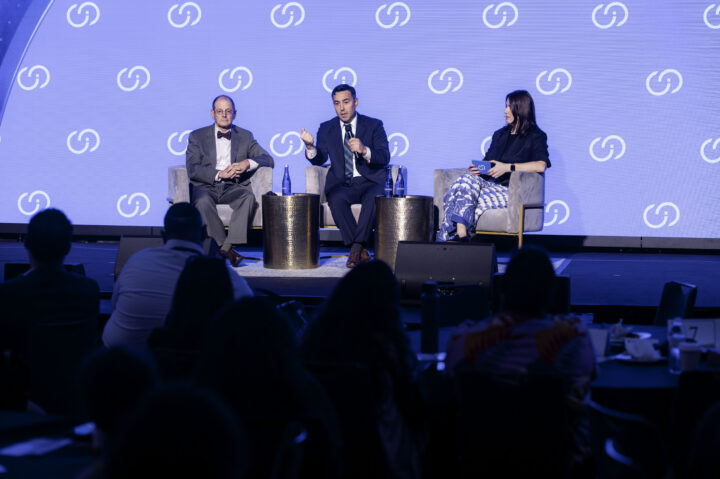
From left: Jonathan Rauch, Noah Pollak and moderator Aviva Klompas at the Israel on Campus Coalition's National Leadership Summit on Monday, Aug. 3, 2026.


 Add JewishInsider on Google
A senior Trump administration official and a journalist clashed during a Monday debate over whether the White House’s crackdown on campus antisemitism protects or threatens America’s liberal norms.
The debate — sponsored by SAPIR and held at the Israel on Campus Coalition’s National Leadership Summit in Washington — featured Noah Pollak, a senior advisor at the Education Department, who argued that the controversial crackdown is good for the country, and Jonathan Rauch, a senior fellow at the Brookings Institution and contributing writer for The Atlantic, who made the counterargument.
Some of the college students in attendance shifted their views on whether the Trump administration’s crackdown is good for America. Voting was conducted through scanning a QR code. At the start, 69% of students agreed the crackdowns were good for America and 31% disagreed; by the end, 57% of participating students said the crackdowns were good, while 43% said they were not.
After the Oct. 7, 2023, Hamas terror attacks in Israel, “university leaders chose not to enforce the rules for one group of people,” said Pollak. “As long as it was leftists and pro-Palestine people [leading protests], it was considered fine. I don’t want any special treatment for Jews or anyone … The problem is we have had a fundamental breach on the part of a lot of universities with the basic bargain that should govern how a university functions in the United States.”
“The situation was very dire so we felt our response had to be strong. The leadership of those schools have shown over and over again unwillingness to govern the institution they led,” said Pollak. “Those institutions are very intertwined with the federal government.”
The debate comes amid a yearslong campaign by the Trump administration to pressure universities to crack down on antisemitism — an effort that has included federal funding cuts affecting dozens of schools. Most of the Ivy League schools targeted by the government, including Columbia University, entered settlement negotiations with the administration last year, issuing reforms and paying millions of dollars to the government.
Federal judges have ruled that parts of the administration’s actions, including funding freezes, violated the First Amendment and federal law. However, schools have experienced much quieter semesters since the oversight began, though some attribute the calmer climate to fatigue from protesters and the Israel-Hamas war ending.
“Noah and I agree on the use of legitimate legal process by this or any administration to ensure that everyone’s civil rights are protected,” said Rauch. “Where we disagree is that the line has got to be due process. They must not go beyond that. It’s bad for Jews because we of all people know the importance of law. Second, it’s bad for America because a lawless country is first and foremost bad for Jews, but bad for everyone. Finally, I’m going to argue we Jews need to be very careful about running to the government for help, because it shows weakness … the government can never protect us from antisemitism, we must protect ourselves.”
Rauch argued that the Trump administration had crossed a line from oversight into overreach, and that while campus antisemitism is real, it has been overblown.
“It is dangerous to give this administration, or any administration, the leeway to decide that private sector institutions, like businesses, law firms and universities, are ‘out of control,’” he said. He asserted that universities, especially elite ones, have work to do to improve viewpoint diversity and get rid of “oppressive” diversity, equity and inclusion rules. But claims made by the government to describe the overall state of campuses are “a wild exaggeration,” he said.
“A lot of places are real problems, we found that out on Oct. 8. [But] most academics in most departments are still trying to do good research and it is still the case that America’s university system is the crown jewel of research in the entire world… it is advancing science at a rate that has never been seen before, and the federal government should not be used as a cajole to shut that down,” said Rauch.
“We have work to do but that work should be limited to working within the rule of law,” he continued. That includes allowing speech such as “globalize the intifada,” depending on the context, he added.
Pollak argued that the government did not overreach because if it had, there would be more significant changes on campuses following settlements.
“Other than the absence of tent encampments, most of these campuses are largely unchanged. Columbia remains largely undedicated to any substantive reforms. Their Middle East studies department is chock-full of Hamas supporters just like it was three or four years ago,” he said. “If it was true we were these big bullies dropping sledgehammers on these campuses, you would see big changes on these campuses.
Pollak lauded some “good policy reforms that will take time,” but he dismissed the notion “that we’ve set off nuclear bombs on campuses, campuses look just like they did several years ago.”
Pollak also asserted that the solution to campus antisemitism is “not speech regulation” in most cases, but “the restoration of basic liberal norms.”
“That is a bigger reform challenge that the schools themselves have to take when they consider hiring and admissions,” said Pollak. “One of the big problems with the protest climate on campus after Oct. 7 was the type of students that universities have [admitted]… far-left political activists so you had this disproportionate presence of those students.”
Addressing Harvard, the only school that chose to litigate the cuts instead of negotiating — and remains in litigation — “all Harvard needed to do to not have those grants threatened was bring itself in compliance with civil rights law,” said Pollak.
“Maintaining Harvard’s ability to continue to engage in racial discrimination, to continue allowing its radical faculty and students to harass Jews on campus, was so important to Harvard that they were willing to risk funding for cancer research in order to allow that stuff to continue. I was shocked at this,” he said.
Even after many elite universities agreed to the administration’s reforms and paid settlements, some Jewish students say that while protests have dissipated, a quieter pressure remains on campus — a lingering sense of exclusion.
The debate concluded asking what universities can do to address this.
Rauch said it’s up to student activists, including the ones in the room, to make the difference. “You guys are doing the work. The work of changing hearts and minds is the work of Jews on campus being visible, kind and outspoken. By forcing yourselves to be heard and telling our story of the Jewish people and what we stand for, you are the ones who can solve the problem.” Other than enforcing safety, he said universities can’t make the change.
Pollak said that while he appreciates that sentiment, he has a “darker view of what is going on on campuses.”
While the severity of campus antisemitism has eased — something Pollak attributes to the Trump administration — “the problem is that the system is basically rigged,” he said.
“As part of these negotiations with schools you have the opportunity to really go deep on the professors who are in different departments and administrators. The schools have made a choice. [Leaders] make a decision everyday about what kind of campus their school is going to look like, and they defer to radical faculty.”
“Where we are right now,” continued Pollak, “is at the culmination of decades of all of those small decisions, which have turned many of our campuses, especially the elite ones, into political monocultures that are incredibly radical.”
“That’s the true source of antisemitism on campus, you have intentional choices by schools to make political environments that are radical… students hear over and over again that Israel is evil, that Zionism is racist. Until the schools undergo serious reform in how they operate, the kind of people they hire, the kind of classes they teach, the kind of departments they have, this problem is not going to get better.”
‘The assumption is that it’s better by virtue of there being no encampments right now, there's no buildings being sieged. But that being the bar is ridiculous,’ Columbia student Noah Lederman said of the challenges on campus
Mostafa Bassim/Anadolu via Getty Images
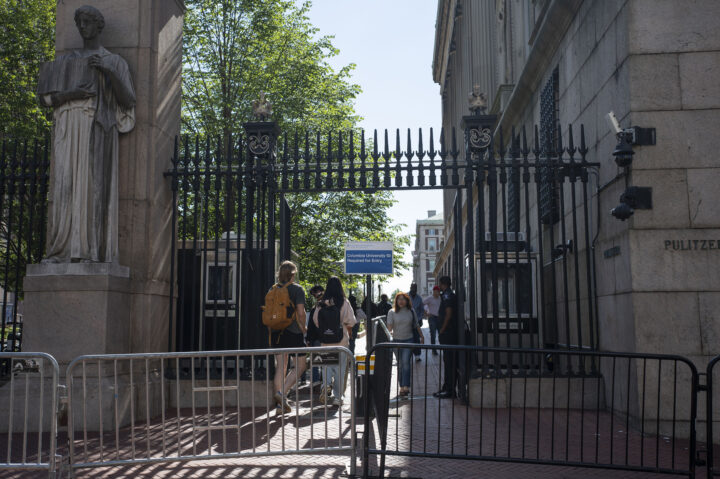
Students enter campus on the first day of the fall semester at Columbia University in New York City, United States on September 2, 2025.
As close to 1,000 pro-Israel students from around the country gather in the nation’s capital for the Israel on Campus Coalition’s annual National Leadership Summit, they’ll do so against a backdrop of seemingly quieter campus antisemitism than in the years immediately following the Oct. 7, 2023, terrorist attacks in Israel. But students are still seeking tools to navigate a campus climate they’ve come to see as permanently changed.
“My main concern [on campus today] is every time I sit down with a classmate I have to wonder whether the person next to me was at the [anti-Israel] encampment,” Noah Lederman, an incoming senior at Columbia University majoring in philosophy and Jewish ethics, told Jewish Insider. In February 2024, Lederman said he was shoved and pinned against a wall by an anti-Israel protester as he donned a shirt with an Israeli flag on it during a pro-Israel demonstration right outside of the Morningside Heights campus.
More than two years later, Lederman still feels wary on campus. “Did the person sitting next to me siege Hamilton Hall?” he said, referring to the April 2024 occupation of the academic building at Columbia by anti-Israel student demonstrators, who barricaded the doors. “Because those students have yet to receive consequences or be identified because they wore masks to cover their faces. Are they the person who pushed me up against a wall?” he said.
“Campus is not better, it’s just different,” said Lederman. “The assumption is that it’s better by virtue of there being no encampments right now, there’s no buildings being sieged. But that being the bar is ridiculous. What we saw my freshman year was so beyond the pale that people are inclined to say campus is better just because we don’t have people storming buildings, disrupting classes and Jewish students being told to go home because campus isn’t safe.”
He views the ICC conference as a place to help “further my skills in having civil dialogue” before returning to Columbia in the coming weeks.
The program spans a wide range of topics, from making sense of Middle East tensions to addressing antisemitism at home.
The summit opened Sunday with a moderated conversation featuring former Israeli Defense Minister Yoav Gallant about the future of the region. It was followed by a security update by IDF Col. (ret.) Miri Eisin; former Knesset member Ruth Wasserman Lande and Jonathan Schanzer, executive director of the Foundation for the Defense of Democracies. The panel was moderated by JI Executive Editor Melissa Weiss.
Last year’s conference came at the height of the Trump administration’s pressure campaign on universities to crack down on antisemitism, which has included federal funding cuts from dozens of schools.
Monday’s opening session will address the implications of those cuts, when Noah Pollak, a senior advisor at the Education Department, and Jonathan Rauch, a senior fellow of the Brookings Institution, debate whether the federal government’s campus crackdown is good for America.
Other speakers scheduled to address the gathering throughout the three-day conference include Rachel Goldberg-Polin and Jon Polin, parents of the late Israeli hostage Hersh Goldberg-Polin; former hostage Omer Shem Tov; Sen. John Fetterman (D-PA); Rep. Elise Stefanik (R-NY); and Harmeet Dhillon, assistant attorney general for civil rights at the Department of Justice.
“With respect to [campus] antisemitism, we’ve seen improvements over the last year,” Ken Marcus, founder and chairman of the Louis D. Brandeis Center for Human Rights Under Law and a former Education Department official, told JI. “[That is] thanks, in part, to the efforts of many different organizations and government agencies.”
“But we’re still seeing a level of challenge that is near historic levels,” said Marcus. “In other words, we don’t have encampments and similar problems to the extent of previous semesters, but we are receiving intake calls that are significantly higher in number and severity than we had in all the worst of the last few years.” The Brandeis Center has filed numerous lawsuits and federal complaints against universities on behalf of Jewish students alleging a failure to address antisemitism since Oct. 7.
“There’s no sugarcoating what Jewish students are living through,” Jacob Baime, CEO of ICC, told JI. “Campus life has grown more hostile, and the antisemitism more brazen, than at any point in memory: it’s on the quad, in the classroom, and online. But something profound is happening at the same time. This generation refuses to hide. They are prouder, better organized and more determined than any pro-Israel student cohort in history.”
The goal of the conference, Baime said, is “to train them, connect them and send them back to school ready to stand tall and proud.”
One of the most profound changes since Oct. 7, Lederman said, is a shift in how professors behave. Before the attacks, he said, “antisemitism was subtle and professors were afraid.”
“Now they are brazenly antisemitic under the guise of anti-Zionism,” he continued. The biggest difference, Lederman added, is that professors “are no longer afraid to incite Jew hatred in their classes.”
Lederman said he expects the conference to give students tools to deal with that shift. “We are not going to run away and hide,” he said. “[ICC] teaches students to be unashamedly Zionist and Jewish. They teach them how to advocate for Israel, while also thinking for themselves.”
Please log in if you already have a subscription, or subscribe to access the latest updates.
 Continue with Google

 Continue with Apple