









































































The unfolding situation in Maine comes amid a broader trend in American politics in which immoral or questionable behavior by one’s peers has at times been ignored or obfuscated to serve a perceived 'greater good'
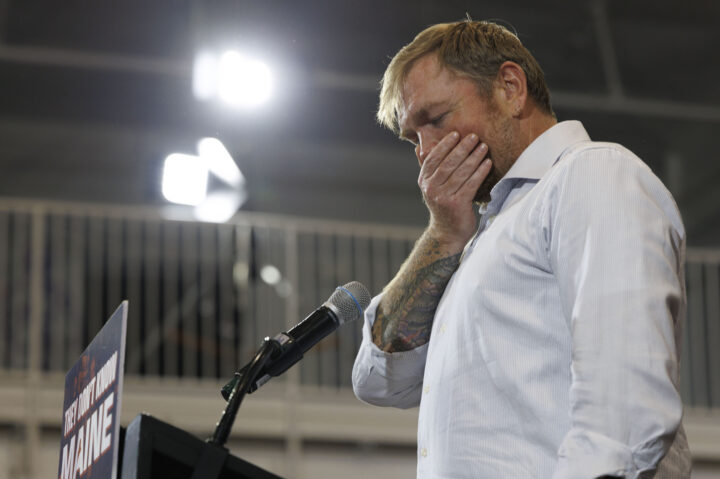
(CJ Gunther/Getty Images)
Democratic U.S. Senate candidate Graham Platner speaks at his Primary Election event on June 9, 2026 in Blue Hill, Maine.


 Add JewishInsider on Google
When an ex-girlfriend of Graham Platner told Politico in a story published on Monday that the Maine Democratic Senate candidate had raped her in 2021 after entering her home while heavily intoxicated, she said she did so because the response to a recent New York Times report on Platner’s past dubious behavior had focused on discrediting Lyndsey Fifield, one of the women who featured prominently in the story, over her ties to the GOP.
Jenny Racicot, a Democrat, hadn’t wanted to go public with the rape accusation (which she had shared off-record with the Times), in part because she and Platner were largely politically aligned. “One of the reasons I didn’t come forward sooner was, the huge moral conflict that I had between supporting his politics, but not supporting him as a person,” Racicot told Politico. “My part of the story [in the NYT] was just a read-over,” Racicot said. “And the story was Lyndsey, and the accusations of her being politically motivated.”
The unfolding situation in Maine comes amid a broader trend in American politics in which immoral or questionable behavior by one’s peers has at times been ignored or obfuscated to serve a perceived “greater good” of electing a political ally despite their failing moral standards.
In recent years, both major parties have increasingly tolerated conduct that would have once been considered disqualifying — even as the #MeToo movement briefly changed the nature of the discourse. Similar arguments have surfaced across political controversies over the last decade (including against President Donald Trump), with supporters of embattled candidates and officials insisting that policy positions outweigh personal conduct and dismissing allegations as politically motivated.
In a short span of time, the 2017 rallying cry of “Believe women” gave way to “Believe women whose politics align with ours” — a mindset that extended to the widespread denial of Hamas’ sexual violence during the Oct. 7, 2023, terror attacks and against the Israeli hostages kept in captivity in Gaza.
But yesterday’s Politico report, which prompted calls from Platner’s most prominent backers — including Rep. Ro Khanna (D-CA) and Sens. Elizabeth Warren (D-MA) and Ruben Gallego (D-AZ) — for him to end his bid, may mark the point at which previous defenses of the Maine Democrat become politically untenable.
Since shortly after the launch of his campaign, Platner — a virtual unknown before last summer — has faced numerous controversies, from his tattoo of an SS totenkopf to Reddit comments praising Hamas tactics to the revelation that he exchanged inappropriate messages with numerous women despite being married. The Wall Street Journal reported last month that Platner’s vetting process — normally a weeks-long process — took place in a matter of days, expedited by Platner’s top strategist and done at a fraction of the cost of a standard background check, which likely would have flagged at least some of these issues.
Yet none of those allegations proved politically fatal — and Platner ended up winning the Democratic primary with 72% of the vote. Platner’s defenders echoed the rhetoric of many of Trump’s early backers: that the party establishment had targeted him, that the media had unfairly covered the incidents and that a candidate’s positions, rather than their personal lives, should be on the ballot.
Unlike Trump, who was weeks away from his 2016 presidential victory when the infamous “Access Hollywood” tape leaked, Platner had only recently clinched his party’s nomination after Gov. Janet Mills ended her bid. He can still be replaced on the ballot, provided he exits the race by next Monday, though any new candidate will face a much more difficult battle against Sen. Susan Collins (R-ME) in what had been the Democrats’ best hope for a pickup and control of the Senate.
Now, the question is whether American politics still has a meaningful threshold beyond which partisan leanings give way to concerns about character and ethics — or whether that threshold has simply become much higher than it once was.
The strongest evidence that the controversies are taking their toll on Platner came from his own campaign, which released an internal poll Wednesday showing the Democrat leading Sen. Susan Collins (R-ME) by only four points

Joe Raedle/Getty Images
Democratic U.S. Senate candidate Graham Platner speaks at a “Fighting Oligarchy” tour stop held by Sen. Bernie Sanders (I-VT) at the Collins Center for the Arts on the University of Maine campus on May 24, 2026 in Orono, Maine.
The New York Times’ detailed exposé about Maine Senate candidate Graham Platner’s history of toxic, alcohol-laden and occasionally physically threatening relationships with three former girlfriends landed Thursday afternoon — with Platner’s campaign hoping to limit the fallout amid signs his campaign is losing support.
In an interview with MS NOW’s Chris Hayes Thursday evening, Platner denied the most serious allegations of physical abuse leveled by Lyndsey Fifield, who dated him from 2013-2015. Fifield recounted one incident where Platner “twisted her arm behind her back, shoved her into a bedroom and held the door closed from the other side so she couldn’t get out.”
She also said he knew about the Nazi origin of his Totenkopf tattoo — first reported by Jewish Insider in October — saying he taught her the word for it when they were dating.
“There are some allegations in this piece that I want to be unequivocal about — they’re not true. Anything alleging physicality, anything alleging I knew what my tattoo was, these are the statements of someone politically motivated,” Platner told Hayes.
The one-two punch of allegations this week of sexually explicit text messages to women while he was married now combined with reports of abuse in past relationships are merely the latest hits against the scandal-plagued candidate who, under normal political circumstances, would be a political nonstarter.
But given that so many other damaging reports barely dented his political standing — whether it was his Totenkopf tattoo, admiration of Hamas terrorist tactics, social media posts cheering the killing of American military heroes, along with dozens of misogynistic and bigoted comments online — it’s anyone’s guess whether the latest news will crater his campaign.
These latest allegations appear to be having more of an impact on Platner’s political standing in part because they contradict the narrative his campaign has presented that he’s become a changed man in the years since he wrote many of his extremist social media posts. In addition, reports of abuse and misconduct have lately been career-enders for many prominent politicians, most recently for former Reps. Eric Swalwell (D-CA) and Tony Gonzales (R-TX).
The strongest evidence that the controversies are taking their toll on Platner came from his own campaign, which released an internal poll Wednesday showing the Democrat leading Sen. Susan Collins (R-ME) by only four points — one of the smallest leads he’s had in the general election since he entered the race. The poll was conducted before the latest NYT story hit.
A newly-released poll conducted between June 1-4 by Trump pollster Tony Fabrizio (first reported by Politico this morning), shows Collins now tied with Platner at 46% apiece, with Platner’s unfavorables skyrocketing. The poll was in the field after the sexting story broke but before the latest allegations of physical abuse.
It won’t take long to get some more empirical evidence about how much Platner’s standing has slipped with Democratic voters.
Next Tuesday’s Maine primary, which looked like an afterthought since Gov. Janet Mills left the race, is suddenly looking a lot more consequential. Mills is still on the ballot despite suspending her campaign, and would be a logical vote for any Democrat uncomfortable with anointing Platner as their Senate standard-bearer.
If Platner underperforms in the primary — winning at least 65% of the Democratic vote is something of a necessity for him — it would suggest that he’s entering the general election wounded, with his candidacy potentially costing the Democrats’ a must-win Senate seat.
The whole episode is a reminder that the laws of political gravity still apply, and that 2026 could shape up as a year for Democrats akin to the GOP’s Tea Party year of 2010 — when deeply flawed candidates in swing states and districts cost the party winnable races despite running in an overall favorable environment.
Platner and Abdul el-Sayed’s Senate candidacy in Michigan are the most high-profile far-left candidates to fit the bill, but other lower-profile House candidates like Colorado state Rep. Manny Rutinel and California educator Randy Villegas could also potentially cost Democrats valuable swing seats — in a year in which every contest could determine which party holds the majority.
Please log in if you already have a subscription, or subscribe to access the latest updates.
 Continue with Google

 Continue with Apple