














































Budd says Qatar should hand over Khaled Mashaal because he has the ‘blood of Americans on his hands’

Kevin Dietsch/Getty Images
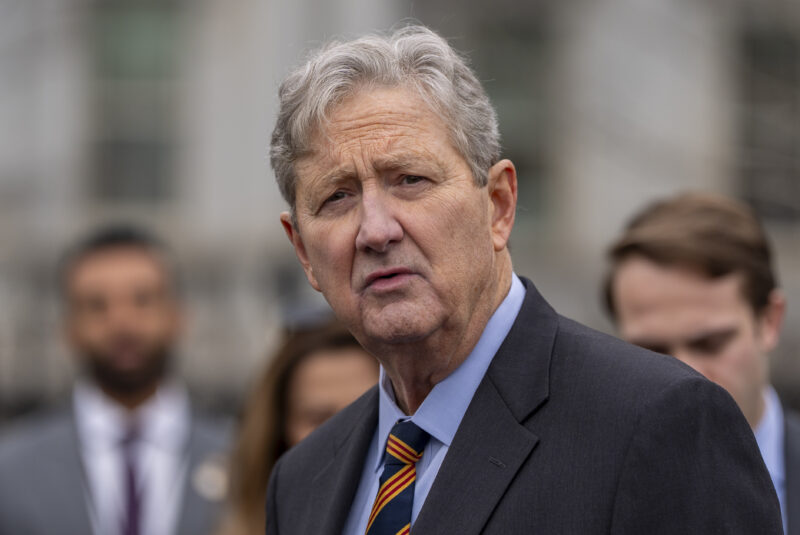
Sen. Ted Budd (R-NC)


 Add JewishInsider on Google
Sen. Ted Budd (R-NC) called on Qatar to extradite Hamas operative Khaled Mashaal to the U.S., telling Jewish Insider on Wednesday that the leader has the “blood of Americans on his hands.”
Mashaal, who is under U.S. indictment on terrorism-related charges, appeared this past weekend at the Al Jazeera Forum in Doha, where he rejected the U.N. Security Council-backed plan for Gaza — a move that could further complicate U.S. efforts to advance Phase 2 of President Donald Trump’s Gaza peace initiative.
“[Mashaal] is responsible for plotting the brutal massacre of Americans and Israelis on Oct. 7, 2023,” said Budd. “He should absolutely be extradited to the U.S. to face justice for his appalling crimes, not walking free to make public appearances in Qatar calling for Hamas to maintain its weapons and deny foreign intervention in Gaza.”
Budd also told JI that he wants to see Qatar crack down on the content disseminated by state-backed Al Jazeera.
Sen. Pete Ricketts (R-NE) said that he wasn’t familiar with Mashaal’s case in particular, but told JI that “one would like to see the that Qataris, who are supposed to be helping us out, participate or cooperate with us when we’re trying to bring terrorists to justice.”
Also featured at the forum was Francesca Albanese, the U.N. special rapporteur, who was sanctioned by the U.S. in July 2025. Appearing by video, she told forum attendees that humanity has a “common enemy” in Israel.
Middle East policy experts have cautioned that Qatar’s hosting of prominent Hamas and U.S.-sanctioned individuals allows those figures to circumvent U.S. restrictions, while promoting anti-American sentiment. The U.S. does not currently impose any direct sanctions on Qatar.
“The Qataris are not inherently violating U.S. sanctions by inviting these guys to speak,” said Natalie Ecanow, senior research analyst at the Foundation for Defense of Democracies. But, she added, “that’s not to say that this isn’t a latent disregard for U.S. sanctions by a country that’s supposed to be an ally and a partner.”
Ecanow said it is “not the first time” the Qataris have “thrown a finger in the face of American sanctions.” She noted Doha’s significant and long-term investment in Russia’s energy sector amid the ongoing war in Ukraine, as well as Qatar’s continual hosting of Hamas officials.
“The Qataris say that they were asked by the Americans to host Hamas. I have not seen documentation to prove that,” said Ecanow. “Hamas leaders have been living there for over a decade, and they amass multi-billion dollar fortunes.”
Edmund Fitton-Brown, a former British diplomat and senior fellow at FDD, called the forum in Doha a “convention of enemies of America,” telling JI that the decision to give Hamas leaders a platform is “thoroughly obnoxious.”
“The fact that this is happening doesn’t seem to me to be a significant evolution from what has been completely normal practice in Qatar throughout the year and during the Trump administration,” said Fitton-Brown. “How do you have a close relationship with Qatar when it evidently supports Hamas?”
Ecanow said Doha’s actions are especially troubling as a country that is supposed to be a U.S. partner. During Trump’s second term, the White House has worked to strengthen bonds with Qatar; the president visited last May and signed an executive order in September that regards “any armed attack on the territory, sovereignty, or critical infrastructure of the State of Qatar as a threat to the peace and security of the United States.” The two countries also finalized an agreement in October that allows Doha to build an air force facility in Idaho.
“These guys are supposed to be our allies,” said Ecanow. “It’s not just some random country that’s disrespecting U.S. sanctions. It’s a major non-NATO ally. It hosts the largest American military base in the region and invests billions of dollars in the U.S. education system.”
Michael Jacobson, a senior fellow at The Washington Institute for Near East Policy, said the issue has become a “continuous source of angst and irritation in Washington circles.” He said that entities and individuals in Qatar are involved in “sanctionable activity.”
“I’m sure there’s still Qatari entities and individuals involved in trying to send money to Hamas,” said Jacobson. “It’s interesting that this administration has sanctioned many entities and pushed other governments to sanction entities tied to Hamas and its fundraising, meanwhile I don’t think there’s been any in Qatar that have been sanctioned over the last year.”
Jacobson described the issue as a “long-standing problem” and said the Trump administration’s inaction is “telling,” adding that there is “certainly stuff you could sanction if you wanted to.” However, he also argued that the U.S. relationship with Qatar does carry upside.
“It’s not like [Qatar is] doing nothing to help us,” said Jacobson. “They did serve as a liaison to Hamas, and they were able to, with the Turks, put pressure on Hamas to release the hostages and agree to a ceasefire.”
Regardless, analysts suggested that the Trump administration is unlikely to alter its current approach to Doha.
“It would have to be something really headline-grabbing that would have the president look at it and say, ‘Hang on a minute,” said Fitton-Brown.
“In my view, the nearest we’re going to get to [sanctions] is going to be some of the actions of the Qatari state in U.S. academia, where they’re putting money into universities with completely unacceptable conditions about not criticizing Qatar or appointing totally unsuitable faculty,” said Fitton-Brown.
He added that Qatar’s influence in education “crosses over with some of the anti‑Israel, anti‑Jewish, anti‑American manifestations on U.S. campuses that have certainly been a focus of concern from this administration.”
Even if Washington stops short of imposing new penalties, Fitton-Brown argued that the larger strategic question about Qatar’s role in the U.S. and the region remains unresolved.
“[Qatar] is not a friend,” said Fitton-Brown. “At best it’s a frenemy, and at worst it’s actually a systematic and insidious and sustained threat to America, its way of life, and its values.”
The two scenes underscored the striking contrast between the rhetoric Qatar promotes at home and the reception its officials enjoy abroad
Rob Kim/Getty Images for Fanatics
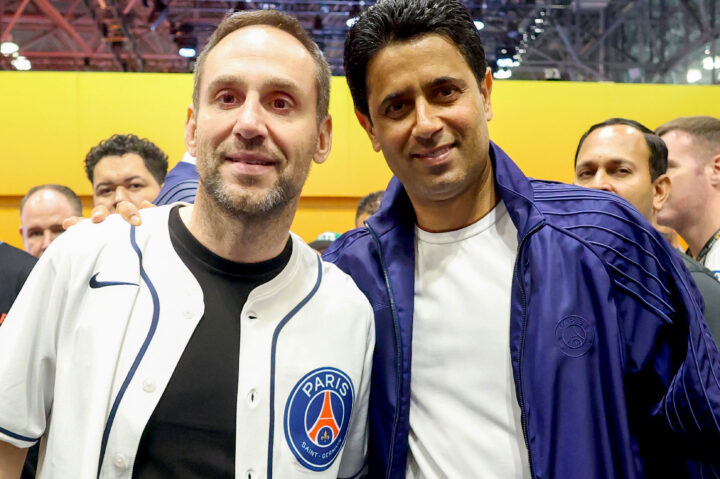
Michael Rubin and Nasser Al-Khelaifi attend Fanatics Fest NYC 2025 at Javits Center on June 22, 2025 in New York City.
As the Al Jazeera Forum, which features Hamas leader Khaled Mashaal among other speakers defaming Israel on the gathering’s main stage, takes place in Doha, Qatari minister Nasser Al-Khelaifi was being feted by Fanatics CEO Michael Rubin at another high-profile convening — Super Bowl weekend, taking place in Santa Clara, Calif.
Al-Khelaifi is the chairman of Qatar Sports Investments (QSI), one of the Qatari sovereign wealth funds that invests heavily in international sports and entertainment. Among his other titles, Al-Khelaifi is also a board member of the Qatar Investment Authority, a minister of state and the president of the Paris Saint-Germain Football Club in France and the Qatar Tennis Foundation.
Rubin posted a picture with Al-Khelaifi from his annual Super Bowl luncheon on Instagram with the caption, “Incredible lunch with amazing people across sports, business, and culture.”
Rubin and Al-Khelaifi have developed a friendship in recent years, including a long-term partnership between Fanatics and Paris Saint-Germain. Rubin posted a photo with Al-Khelaifi at the F1 Qatar Grand Prix last November, where he called the Qatari minister his “brother” and said, “What you did for both the city of Paris and country of Qatar is truly amazing.” The two spent time together at the World Cup finals in July at MetLife Stadium in New Jersey, where Al-Khelaifi’s team, Paris Saint-Germain, was playing Chelsea.
Al-Khelaifi also spoke at Fanatics Fest NYC last June, an event that kicked off a five-year strategic partnership between the Fanatics and Qatar’s Government Communications Office. Rubin appeared in Doha in December at the inaugural Wall Street Journal Tech Live Qatar summit. The Qatar Investment Authority, of which Al-Khelaifi is a board member, also holds a minority stake in Fanatics.
While the Super Bowl festivities were underway, the 17th annual Al Jazeera Forum was taking place back in Doha, where Mashaal applauded the group’s Oct. 7, 2023, attacks on Israel as having “brought the Palestinian cause back to the forefront of the world.” Mashaal, who resides in Doha, also hailed Qatar’s “honorable role in the [Palestinian] cause.”
Other speakers at the forum included Iranian Foreign Minister Abbas Araghchi, Somali President Hassan Sheikh Mohamud and U.N. Special Rapporteur Francesca Albanese, all of whom used their speaking time to denounce Israel. Albanese, who addressed the gathering virtually, claimed all of humanity “now has a common enemy” in Israel, while Mohamud accused Israel of “preparing or positioning itself” for an attack in the region. Al Jazeera is backed by the Qatari government and ruling Al Thani family.
Pictured alongside Rubin and Al-Khelaifi was Ari Emanuel, CEO of TKO Group Holdings, which owns the UFC and WWE. The Qatar Investment Authority is a key investor in Emanuel’s new entertainment holding company, MARI, which raised over $2 billion last October.
Among other A-listers at Rubin’s annual lunch were NFL great Tom Brady, New England Patriots owner Robert Kraft, TikTok CEO Shou Zi Chew, Netflix Chief Content Officer Bela Bajaria, quarterback Joe Burrow, former tennis player Roger Federer, actress Emma Roberts and rappers Jay Z, Meek Mill and Travis Scott.
Mashaal, who resides in Doha, hailed Qatar's ‘honorable role’ in the Palestinian cause
Ali Altunkaya/Anadolu via Getty Images
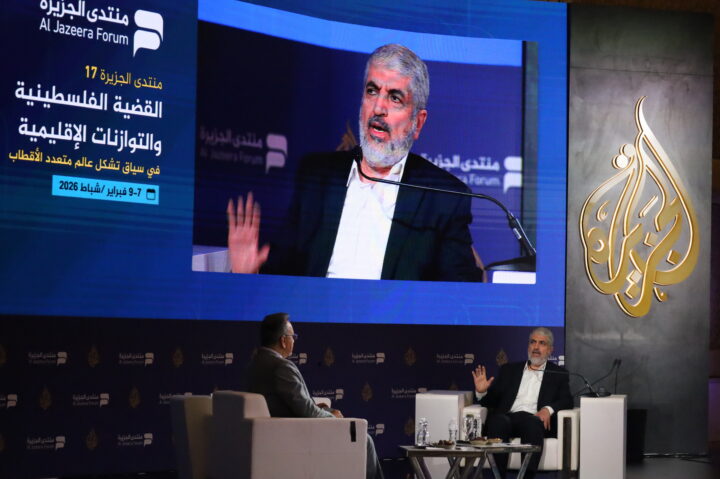
Hamas leader Khaled Mashaal speaks on the second day of the 17th Al Jazeera Forum held in Doha, Qatar on February 8, 2026.
Hamas leader Khaled Mashaal addressed Qatar’s 17th Al Jazeera Forum on Sunday, at a conference that focused heavily on denigrating Israel, while featuring senior officials from Iran and Somalia.
Mashaal applauded the group’s Oct. 7, 2023, attacks on Israel as having “brought the Palestinian cause back to the forefront of the world” and said that Palestinians “take pride” in “resistance,” a euphemism for violence against Israelis. He called to “pursue Israel and establish that it is a pariah entity that is losing its international legitimacy,” noting the “changes in the elites, universities and social networks” against Israel.
The Hamas leader, who resides in Doha, also hailed Qatar’s “honorable role in the [Palestinian] cause.”
Hamas is designated by the U.S., European Union and other countries as a terrorist organization, and Mashaal is wanted in the U.S. for terrorism, murder conspiracy and sanctions evasion relating to his role in planning the Oct. 7 attacks.
Mashaal was listed on the conference’s program and list of speakers in versions of the Al Jazeera Forum website archived by independent researcher Eitan Fischberger, but as of Sunday Mashaal was no longer listed. At the same time, the Al Jazeera Forum X account extensively promoted Mashaal, with 19 posts about the terror leader’s remarks. The account featured two posts about conference keynote speaker Abbas Araghchi, the foreign minister of Iran.
This year’s Al Jazeera Forum theme is “the Palestinian cause and the regional balance of power in the context of an emerging multipolar world.” The conference website suggests that Israel committed a “genocide in Gaza,” and that Israel “has sought to reoccupy Gaza … or establish settlements in it.” It also argues that Israel faces strategic setbacks as a result.
The speakers’ remarks reflected the forum’s hostile position on Israel.
Araghchi lamented a double standard toward “Israeli expansionism,” arguing that “other countries are demanded to disarm, pressured to reduce defensive capacity, punished for scientific advancement … This is not arms control, not non-proliferation, not security. It is enforcement of permanent inequality. Israel must have a military and strategic edge and others must remain vulnerable.”
Araghchi, speaking a day after he led his country’s negotiations with the U.S. in Oman on dismantling its nuclear program, said that it has an “inalienable right to enrich uranium.”
The Iranian foreign minister also said that “Palestine is the defining question of justice … The strategic and moral compass of our region.”
Somali President Hassan Sheikh Mohamud floated the possibility of war with Israel in a pre-conference interview aired on Al Jazeera. He questioned why Israel would want to build a military base “in Somalia,” referring to reports of activity in Somaliland, whose sovereignty Israel recognized in December. He argued a base could only be offensive, ignoring repeated attacks by the Iran-backed Houthis, from nearby Yemen, on Israel.
“Israel is preparing or positioning itself to attack someone else,” he said. “We will fight in our capacity; we will defend ourselves, and that means that we will confront any Israeli forces coming in, because we are against that and we will never allow that.”
Another speaker was Francesca Albanese, the U.N. special rapporteur who has been sanctioned by the U.S. for “infringement on the sovereignty” of Israel and the U.S. by pursuing International Criminal Court prosecutions of citizens of both countries, as Secretary of State Marco Rubio described her actions last year.
Albanese claimed in her remarks, delivered via video, that Israel had committed a premeditated genocide of Palestinians in Gaza, and that all of humanity “now has a common enemy” in Israel.
Please log in if you already have a subscription, or subscribe to access the latest updates.
 Continue with Google

 Continue with Apple