










































































David Haskell promised future story assignments tied to Sephardic and Mizrahi heritage but declined to issue a correction to the controversial cover issue that spurred the discussion
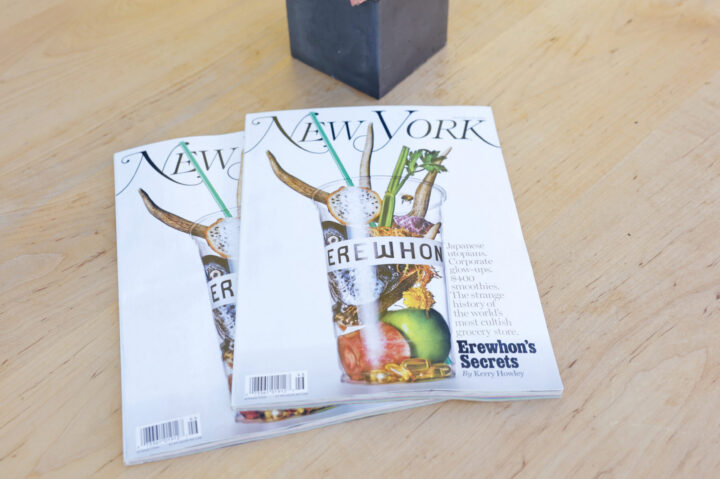
Emma McIntyre/Getty Images for VOX Media
New York magazine issues are displayed during New York Magazine's Vulture Festival LA at Goya Studios on November 11, 2023 in Los Angeles, California.


 Add JewishInsider on Google
Weeks after meeting privately with a group of Mizrahi and Sephardic leaders to address their concerns about a recent New York magazine cover package accused of erasing Jews from its narrative, the outlet’s editor-in-chief, David Haskell, vowed in response “to publish journalism that’s both accurate and empathic about the Jewish experience,” even as he otherwise declined to add a requested correction, according to an email he sent on Thursday.
Haskell’s note to the Jewish leaders, which was reviewed by Jewish Insider, came as New York has faced mounting scrutiny over its hostile turn against Israel in the years since Hamas’ Oct. 7, 2023, attacks, an ideological shift that has sparked internal tensions with some Jewish staffers who have raised objections to the magazine’s direction.
The new correspondence provides insight into Haskell’s approach to the broader topics covered in the widely debated package, which he has not addressed publicly, even as it has drawn intense backlash.
In his email, Haskell reassured the Jewish leaders that the magazine’s editors “intend to be careful and precise in our coverage, including in the words and terms we use.”
“I am in conversations with editors here at the magazine for future coverage, including making assignments directly pulled from some of the stories I heard on the call,” he confirmed, while defending the package that the Jewish leaders and other critics had accused of bias.
The meeting on Sept. 17 followed the publication in August of a controversial cover issue that had hailed a thriving Middle Eastern cultural scene in New York. The issue centered on a feature that identified what it called a “SWANA” renaissance, using the acronym for Southwest Asia and North Africa.
But in highlighting a proud network of Arab and Muslim trendsetters, the story pointedly suggested that Jews could not participate in a community the author characterized as emerging in response to “the genocide in Gaza.” The article also questioned if “Israelis can claim a connection” to the region, citing “ethnic background” as a complicating factor, and it cast Zionism as a uniquely menacing ideology akin to Islamophobia and xenophobia.
Haskell later agreed to meet for an off-the-record call with the representatives of several leading Sephardic and Mizrahi organizations that had released an open letter urging the magazine to issue a public correction acknowledging “its framing excludes the Jews of the Middle East and North Africa except on ideological terms.”
During the meeting two weeks ago, which was organized by the nonprofit Jews Indigenous to the Middle East and North Africa, the participants also pressed for “stronger editorial standards” concerning the magazine’s coverage of “Zionism, Jewish identity and Middle Eastern people,” according to one Jewish leader who joined the conversation and spoke with JI recently.
In his follow-up note on Thursday, Haskell thanked the Jewish leaders for what he called “an informative, productive and moving conversation,” saying that he had “appreciated in particular the personal stories of heritage, and the historical background” they shared on “Jewish communities across the Middle East and North Africa.”
“I very much want to publish journalism that’s both accurate and empathic about the Jewish experience, and the conversation we had deepened my awareness and sensitivity of the Sephardic and Mizrahi Jewish communities indigenous to the region,” he went on.
With regard to the magazine’s August cover issue, however, he explained that editorial leadership had “decided not to alter it or append a correction, as we believe that it clearly spoke about a specific New York City community with roots in the region and a shared political identity.”
While Haskell said it “is fair criticism for others to note that, as a geographic term, SWANA includes a broader range of identities and political beliefs, we don’t believe a correction or an addendum from the magazine is the appropriate place to do that,” since the community featured in the issue “self-identifies as SWANA.”
A spokesperson for New York did not immediately return a request for comment from JI on Thursday afternoon.
Since the publication of its cover package, New York has doubled down on its approach to Israel, writing in a subsequent letter to readers that its editors had last fall chosen to use the term genocide to describe Israel’s actions in its war in Gaza after an “extensive review of genocide scholarship and interviews with multiple experts” on the topic.
Before the institutional review, the magazine’s editorial director, Gazelle Emami, who assumed her role in October 2023, had signed a statement weeks after Hamas’ attacks calling Israel’s war in Gaza “an attempt to conduct genocide against the Palestinian people.” One source familiar with the publication’s internal dynamics told JI that Emami is among the “key instigators” driving the magazine’s increasingly antagonistic reporting and commentary on Israel.
The magazine has faced some internal pushback from Jewish writers who took issue with the content of the recent cover package, as JI reported earlier this week. Their complaints followed objections from former Jewish staffers who had raised concerns over previous stories they viewed as biased against Israel, which they detailed in a lengthy memo sent to editorial leaders in the weeks after Oct. 7.
Former Jewish employees, who spoke with JI on the condition of anonymity, said their pleas were largely met with indifference in their time at the publication, which was acquired in May by the media scion James Murdoch.
American University Professor Pamela Nadell: ‘The closing off of spaces to Jews today is happening once again’
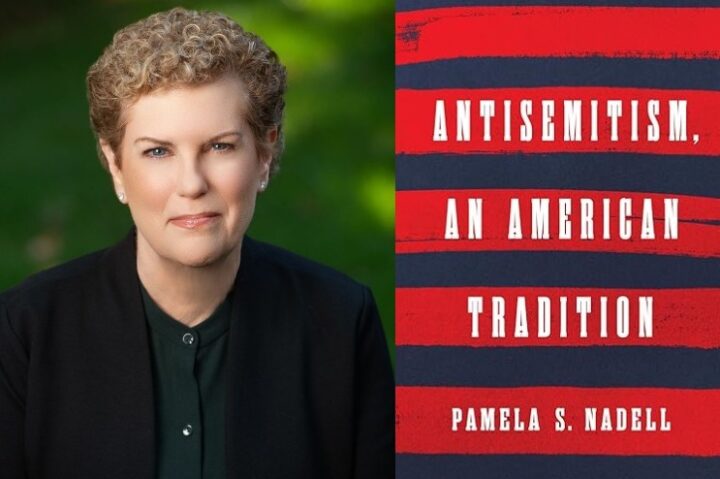
Pamela Nadell
Historian Pamela Nadell is very familiar with the rituals of publishing a book, as she has written nine of them: Secure a release date, present at academic conferences, maybe headline a handful of general-public events. Although she is at the forefront of her field at American University — chair in Women’s and Gender History, director of the Jewish studies program and past president of the Association of Jewish Studies — Nadell knows that success in academia does not often translate to strong book sales.
Things appear to be different for her latest book, Antisemitism: An American Tradition.
Nadell began to understand how much interest a book on antisemitism would generate when her publisher assigned a full-time publicist to promote the book, which will be published on Oct. 14. Nadell is booked at speaking engagements across the country into 2027, starting with an event at the Washington bookstore Politics and Prose this week.
The book that she began researching six years ago will now appear on bookshelves at a time when antisemitism has reached record levels since the Anti-Defamation League began tracking data in 1979.
“I had hoped, frankly, that the subject would be seen as a historic subject by the time [the book] came out into the world,” Nadell told Jewish Insider in a recent interview. “And that’s absolutely not the case.”
Nadell argues in her book that antisemitism is not an aberration in the United States. Instead, she writes, it is intricately woven into the American experience — as American as, say, apple pie.
Jews came from Europe seeking freedom from religious persecution, and while they escaped the pogroms that had haunted them overseas, they did not arrive in a world magically free from antisemitism. She traced the history of anti-Jewish sentiment in America from colonial days to the present, identifying the aftermath of the Civil War as the moment it really gained a foothold in American society.
“America is different [from Europe] in that we never had state sponsored violence against American Jews,” Nadell said. “But the roots of anti-Judaism in America start immediately … the roots of anti-Judaism in America rest on traditional Christian ideas about who the Jews are and what they did to Jesus.”
While antisemitism has always been present in America, the tenor and intensity of it has ebbed and flowed. “We’re in a moment,” she said, “where it’s really bad.”
The reason she is most concerned about the state of antisemitism in America is not just the frequency of antisemitic incidents or the toll of violent attacks on Jews. According to a study published this week by the Anti-Defamation League and Jewish Federations of North America, more than half of American Jews now say antisemitism is a normal part of the Jewish experience.
It’s that doors are once again closing to Jews in a way that reminds her of the quotas, housing covenants and employment restrictions that were baked into American life until the 1950s and 1960s.
“The perception that [antisemitism] was over was because of how much American Jews ascended into American life as those structural barriers fell,” Nadell said. “The doors to corporations opened up, the doors to the colleges opened up. But antisemitism — it’s like it was a nagging factor.”
America is now experiencing another period “where Jewish life once again seems to be constricting,” Nadell argued. “Not in exactly the same ways that it did in those years between World War I and World War II, when there were so many structural limitations. But the closing off of spaces to Jews today is happening once again.”
She pointed to boycotts of Jewish and Zionist writers in the publishing industry, and antisemitic litmus tests appearing in unexpected places like the mental health profession.
“Being told that you have to denounce Israel in order to join a student club? Those students are going to carry those memories forward into their future,” said Nadell.
In recent years, and particularly following the wave of antisemitism that was unleashed after the Oct. 7 attacks two years ago, several Jewish thinkers have posited that the American Jewish community’s best days are behind it. Franklin Foer wrote an Atlantic cover story under the alarming headline, “The Golden Age of American Jews is ending.”
Nadell argues that the notion that there ever was a “golden age” is a myth. “The idea that there was a golden age of Jews in Spain actually emerges during the Dreyfus Affair [in 1894], when things are so terrible in Europe,” she noted. Similarly, Nadell argues that the supposedly now-over golden age for American Jews after the end of quotas and de jure discrimination is not really so straightforward.
“By the time we get to the late ‘60s and on in the 20th century, American Jews feel really secure. The places that used to be closed to us have now opened, and that’s what leads to the perception of the golden age,” said Nadell. “The problem … is the assumption that antisemitism disappeared, but it didn’t.”
Still, Nadell considers herself an optimist. Antisemitism is part of the American fabric. And while that might be a demoralizing conclusion, she views it the other way: Jews have thrived in this country despite antisemitism, and they will continue to do so.
“The reality is that it is part of the normative Jewish experience to experience antisemitism,” said Nadell. “But I think ultimately, American Jews will be okay in the United States.”
Please log in if you already have a subscription, or subscribe to access the latest updates.
 Continue with Google

 Continue with Apple