


























































More than a dozen Democratic operatives told JI that the party’s support for Israel has declined, but hope that the end of the war will create space for skeptics to reengage with the Jewish state

Eric Lee/Bloomberg via Getty Images
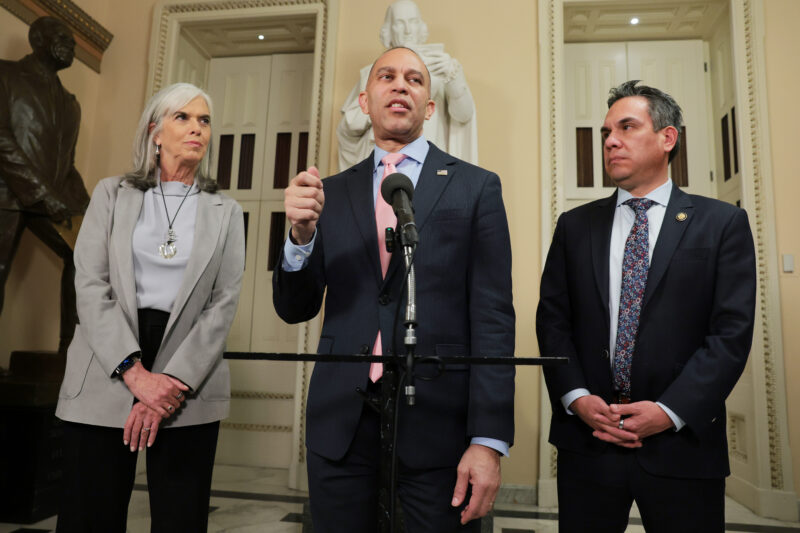
Representative Katherine Clark, a Democrat from Massachusetts, center left, and Representative Hakeem Jeffries, a Democrat from New York, center right, arrive for a news conference with House Democrats outside the US Capitol in Washington, DC, US, on Wednesday, Oct. 15, 2025.


 Add JewishInsider on Google
One thing Betsy Sheerr knows for sure is that most Democratic lawmakers still believe in Israel’s right to exist. She also knows that needing to reestablish this basic fact may not be a good sign for her party, and, more broadly, for American support for Israel.
“I can’t believe the bar is so low that that’s where we have to start,” said Sheerr, a longtime Democratic activist and a board member of the Jewish Democratic Council of America.
That’s the position in which many pro-Israel Democratic advocates find themselves as they begin to take stock of the domestic political damage wrought by Israel’s two-year war with Hamas that followed the Oct. 7, 2023, terror attacks.
Unlike naysayers on the right who suggest Democrats have abandoned Israel — a claim made frequently by President Donald Trump — the Jewish activists and communal leaders who advocate for a strong U.S.-Israel relationship and for U.S. aid to Israel still insist that support for the Jewish state remains bipartisan, and that congressional Democrats remain broadly pro-Israel. That proposition faced its toughest test during a two-year war, when Democrats became increasingly sympathetic to the Palestinians as Israel’s effort to eradicate Hamas left the Gaza Strip in ruins and claimed thousands of lives.
As a fragile ceasefire holds, Jewish Democrats see an opportunity to reengage party activists and elected officials who have grown frustrated with Israel’s actions in Gaza.
Jewish Insider spoke to more than a dozen fundraisers, activists and professionals in the pro-Israel space, most with a long history of involvement in Democratic politics. Their pitch to Democrats at this precarious moment involves two parts: First, push to make Trump’s peace plan a reality. Second, ensure that Democrats understand that the value of America’s relationship with Israel is independent from the leader of either country — and that Israeli Prime Minister Benjamin Netanyahu, who remains unpopular with the American left, won’t be in power forever.
“I think ending the war turns the temperature down pretty dramatically,” said Brian Romick, CEO of Democratic Majority for Israel. “Right now, what we’re saying is, no matter where you were in the previous two years, we all need the deal to work, and so being for the deal [and] wanting the deal to work is a pro-Israel position right now, and then you build from there.”
At the start of the war, 34% of Democrats sympathized more with Israel, and 31% sympathized more with Palestinians, according to New York Times polling. New data released last month shows that 54% of Democrats now sympathize more with the Palestinians, compared to only 13% with Israel. That stark shift in public opinion corresponded to more Democratic lawmakers voting to condition American military support for Israel than ever before.
This summer, 55 Democrats in the House co-sponsored legislation that would significantly restrict arms sales to Israel. Twenty-seven Democratic senators voted in July to support a bill put forward by Sen. Bernie Sanders (I-VT) that aimed to reject Israeli arms sales. The bill failed, but it marked a watershed moment for the party, with more than half of all Democrats voting in support of the measure. Not long ago, voting to condition aid to Israel would have been seen as a red line by pro-Israel groups. But with a growing number of Democrats who have already done so, such threats could ring hollow.
“I do think that there is room to build forward,” said Jeremy Burton, CEO of the Jewish Community Relations Council of Greater Boston, which works closely with Democratic lawmakers in deep-blue Massachusetts. “We have to be secure enough in our own belief in the future and our hope for the future to say ‘OK, if your point was that you’re committed to the long-term project of Israel’s security and safety, and you were looking for short term ways to pressure the government of Israel, then let’s move forward with the long-term project, even if we disagreed with you in the short term.’”
The pro-Israel lobby AIPAC maintains that it is committed to bipartisanship on Capitol Hill, even as the group has faced sharp criticism from progressive activists — including some who have pressured political candidates to swear off donations from the group. A spokesperson for the organization downplayed the shifting political headwinds, noting that American military aid to Israel continued throughout the war.
“It is important to separate the noise from anti-Israel extremists of the right and left and actual impact,” AIPAC spokesperson Marshall Wittmann told JI. “For example, time and time again Congress has resoundingly rejected the efforts of those extremists to cut defense assistance to Israel.”
AIPAC has a long-standing policy of not criticizing the Israeli government no matter who is in power, and that isn’t shifting. But other pro-Israel advocates believe that approach may not work with Democrats who are fed up with Netanyahu’s governance.
“We know that can one be critical of certain Israeli government policies and still be pro-Israel, and we also know that’s increasingly the case for many Democrats, just as it is for a majority of Jewish Americans,” said Halie Soifer, CEO of the Jewish Democratic Council of America.
“The vast majority of Democrats are far more sympathetic to the people of Israel than its current leadership,” echoed Tyler Gregory, who leads the Bay Area JCRC and works closely with progressive leaders in San Francisco. “We need to bring it to a human level.”
Andrew Lachman, president of California Jewish Democrats, was more overt in his hope that Israel elects a new leader in its next election, set to take place next October, unless it’s called sooner.
“If there’s a new change in leadership in Israel, that has the opportunity to be able to reset some of those relationships,” Lachman told JI.
It’s a sentiment echoed by Sheerr, who regularly interacts with Democratic lawmakers on Capitol Hill. “I think a lot of people, both lawmakers and others, are looking forward to the next Israeli elections, frankly, and life after Bibi,” she said. That is, of course, assuming that Netanyahu isn’t reelected — a risky bet given that Netanyahu has held the role through multiple elections since 2009, except for one 18-month stretch.
Rep. Seth Moulton (D-MA), who is challenging Sen. Ed Markey (D-MA) in Massachusetts’ Senate primary next year, said this month that he would return donations from AIPAC, an organization that has previously endorsed him. He told JI last week that he took issue with the group’s “steadfast support for the Netanyahu government.”
“My views on Israel as an essential partner of the United States and our most important ally in the Middle East have not changed,” Moulton said.
Markey, for his part, has been one of Israel’s leading critics in the Senate, making next year’s Democratic primary one between a candidate who condemns the leading U.S.-Israel advocacy group and a candidate with a record of voting against military aid to Israel.
Ron Halber, who leads the Jewish Community Relations Council of Greater Washington and maintains close ties with Democratic lawmakers in Maryland and Virginia, said that Israeli leaders also have a responsibility to repair ties between Democrats and the Jewish state.
“For Israel to align itself, or for the current government or for advisors to think that working with the Republican Party is the way to the future, is about the dumbest strategic mistake I can imagine,” said Halber. “The bipartisan nature of the U.S.-Israel relationship is the fundamental blanket of Israel’s support in the world.”
The leftward shift of Democratic lawmakers has come despite advocacy campaigns by major Jewish groups who urged senators to vote against Sanders’ resolutions restricting aid to Israel. But some within the mainstream Jewish community recognize that the longtime approach of offering unequivocal support to Israel’s government is not sustainable.
“My opinion is that this government is harmful,” said Sam Lauter, a public affairs consultant in San Francisco and Democratic fundraiser who helped create DMFI in 2019. “I used to be one of those people who would be sort of silent about that, because ‘I’m a diaspora Jew, and I don’t get a say.’”
Halber said he believed that many Democrats supporting Sanders’ bill “did so symbolically,” because they knew it was going to fail. “They were trying to send a message to Israel that this is a bridge too far, when they believed humanitarian aid [to Gaza] was being cut off,” he added.
The “million-dollar question,” according to Ilan Goldenberg, J Street’s vice president of policy, is whether lawmakers’ support for conditioning military assistance to Israel will continue after the war, when they have to vote to approve the annual $3.8 billion security package to Israel.
“I think it’s going to be, ‘We need accountability, and we need certain behavior that we would like to see,’ and if you’re not getting that out of the Israelis, then a willingness to use more leverage and pressure and accountability,” said Goldenberg, who served as Jewish outreach director on Vice President Kamala Harris’ presidential campaign last year. “I think that is where the center of the Democratic Party is likely to settle, which is a very different place from where we were before the start of the war.”
J Street has supported Sanders’ resolutions restricting arms sales to Israel.
If any of the support for the bills that sought to reject certain weapons sales carries over into the regular appropriations process, it would mark a significant shift.
“It seems indisputable that the Overton window has shifted dramatically over the last two years in terms of what ‘the left’ broadly deems acceptable about Israel, Zionism and even the Jewish American community,” said Amanda Berman, CEO of the progressive group Zioness. “This kind of rhetoric doesn’t just disappear when the news cycle moves on. That said, the vast majority of liberals and progressives are not uniquely obsessed with Jews or Israel, and have any number of urgent issues of concern.”
Even as pro-Israel activists seek to rebuild frayed ties with erstwhile allies, they recognize that not everyone should be welcomed back into the tent, even if the tent is bigger than it was before.
“We don’t need to be forgiving or ignoring those who chose to just demonize and be dismissive of our anxieties, our fears, our hopes over the last two years,” said Burton.
The dust has hardly settled in Gaza, and it is too soon to know what the lasting impact of the war will be. But given that this was Israel’s longest war, and that it played out under scrutiny of the traditional media and social media, “it’s going to be a lot harder to put the genie back in the bottle than previous times,” as one person involved in Jewish philanthropy and Democratic politics quipped.
Speaking on a Jewish Democratic Council of America webinar, Sherrill said she’s willing to call out antisemitism among her political allies

Steve Hockstein/NJ Advance Media via AP, Pool
New Jersey Rep. Mikie Sherrill speaks during the New Jersey Democratic gubernatorial primary debate at NJ PBS Studios, Monday, May 12, 2025, in Newark, N.J.
Speaking on a Jewish Democratic Council of America webinar on Thursday, Rep. Mikie Sherrill (D-NJ) outlined a plan of action on antisemitism she said she would implement statewide if she wins next month’s gubernatorial race in the Garden State.
Sherrill is running against Republican Jack Ciattarelli in a race that polls show is tightening ahead of Election Day on Nov. 4.
“We have seen a really terrible rise in antisemitism,” Sherrill said, emphasizing the need for everyone in the state to “double down that religious hatred is always unacceptable, that we are going to make sure that here in New Jersey, we can chart a path forward that protects all of our constitutional rights, including religious freedom and free speech. And we can do both, and we can be a really strong state that models that for the rest of the nation.”
Sherrill said she’s heard disturbing stories from constituents of antisemitic hate in schools and online, in addition to attacks on synagogues in the state, highlighting that she plans to implement a state plan of action on antisemitism, based on the Biden administration’s 2023 national antisemitism strategy.
She emphasized her willingness to call out antisemitism among her political allies, pointing to the example of an employee of the New Jersey Educational Association — which endorsed Sherrill — who had made “horrible antisemitic [comments] online.” Sherrill said she had condemned the individual and demanded she be fired.
“I’m going to call out anybody in this space that is promoting hate in any way against all of our citizens, but especially our children,” Sherrill said.
Addressing recent revelations of antisemitic messages in a Young Republican leadership group chat, Sherrill said, “I don’t think that should have been a surprise to anyone because we’ve seen it starting at the top with President [Donald] Trump and the antisemitism that he promotes, and I will continue to fight against that.”
Sherrill said her statewide plan will include mandating comprehensive reporting of hate crimes, directing the attorney general to “aggressively combat and prosecute antisemitism,” a “stronger interfaith advisory council” and holding state universities accountable.
The New Jersey congresswoman also expressed her joy and relief at the release of the remaining living hostages from Gaza this week. She said she is hopeful that the ceasefire deal leads to “real peace” and that the effort remains nonpartisan.
“I think we have to hope that this agreement holds, that Hamas is demilitarized, that humanitarian aid is surged into Gaza because the famine there is preventable and we’ve got to address that and then achieve a lasting peace in the region,” Sherrill said.
She added that she felt the region was on a path toward peace with the Abraham Accords before Hamas’s Oct. 7, 2023 attack on Israel, and can continue to pursue that path with rebuilding and a new government in Gaza, with Israel taking a leading role in strengthening the region economically and militarily.
One Jewish leader in New Jersey said that the community appears split in the gubernatorial race — committed Democrats are sticking with Sherrill but Ciattarelli has gained some steam among undecided Jewish voters.
The leader, speaking on condition of anonymity, said multiple people have told them they’re voting for Ciattarelli because of recent comments by Sherrill about state legislation codifying the International Holocaust Remembrance Alliance’s working definition of antisemitism. Sherrill previously said she supports the bill and would sign it, but has recently offered some caveats to that stance, according to the source.
Another local source familiar with the Jewish community said they expect the Orthodox Jewish population to support Ciattarelli by a wide margin.
To mark the second anniversary of the Oct. 7 attacks in Israel, the Jewish Insider team asked leading thinkers and practitioners to reflect on how that day has changed the world. Here, we look at how Oct. 7 changed American Politics

Worawat/Adobe Stock
The United States Capitol with reflection at night Washington DC USA
Democratic insiders told JI that DNC chair Ken Martin withdrew his Israel resolution largely to avoid a disruptive floor debate over Israel on Wednesday

Audrey Richardson/Bloomberg via Getty Images
Ken Martin, chairman of the Democratic National Committee , speaks during a news conference in Aurora, Ill., on Tuesday, Aug. 5, 2025.
Pro-Israel Democrats expressed cautious optimism about the unexpected decision by Democratic National Committee Chairman Ken Martin to withdraw his resolution pressing for humanitarian aid to Gaza and for the release of hostages held by Hamas, which was unanimously approved by party members on Tuesday at the DNC’s annual summer meeting held in Minneapolis.
Martin, in a sudden reversal, announced he would pull the resolution after DNC members rejected a dueling measure, opposed by pro-Israel groups, that had endorsed an arms embargo and a suspension of U.S. military aid to Israel. Instead, he said he would create a task force “comprised of stakeholders on all sides” of the Israel debate to pursue what he called a “shared dialogue” on an increasingly divisive issue.
“This was a surprise ending to this meeting,” Halie Soifer, the CEO of the Jewish Democratic Council of America, which helped draft the pro-Israel measure and privately advocated for its passage, told Jewish Insider on Tuesday.
Despite Martin’s 11th-hour reversal, Soifer said she was satisfied with the outcome, noting the DNC also passed a resolution condemning antisemitism that, coupled with its rejection of the arms embargo proposal, “reflects where the party stands” on major issues concerning Israel and the Jewish community.
“It’s my sense,” she added of Martin, “that he introduced and ensured passage of this resolution to defeat the other resolution,” which she said “was completely out of step with the views of the party.”
Soifer said she hopes to join the proposed task force “to discuss the path forward” on approaching Israel, acknowledging internal tensions that have roiled the party in recent years. Martin “clearly recognized that there are a range of strongly held views on this matter, and he wants to make sure that those voices are heard,” she told JI.
Martin has not yet shared additional details on the task force, and the DNC did not return a request for comment from JI. Latonya Reeves, a DNC member in Minneapolis, told JI on Tuesday that she had not been further informed of the task force — which she called “the best way to move forward” on the issue.
Sara Forman, who leads the New York Solidarity Network, a local pro-Israel group that aligns with Democrats, said she was broadly “encouraged” that the DNC had chosen “not to recommend” what she dismissed as a “one-sided resolution against Israel,” arguing that the party “represents far more than its progressive base.”
“I’m always one for conversation, and think that talking about things is an important step, so I’m going to offer grace to Martin in this regard,” she said of his announcement. Still, she added of the failed resolution, “I think it’s a bigger concern overall that the Democratic Party seems to be uniquely singling out Israel for rebuke or scrutiny in a way that no other U.S. ally is rebuked or scrutinized.”
A spokesperson for Democratic Majority for Israel, which released a statement praising the DNC’s votes before Martin revealed he would pull the resolution, said it was “pleased that the anti-Israel measure was decisively defeated by the committee,” but declined to comment more broadly on what transpired at the end of the meeting.
Brian Romick, DMFI’s president and CEO, said in an interview with JI that he viewed the outcome on Tuesday as “a win” for the pro-Israel community, in light of the potential for a more hostile debate. “The bad resolution was rejected and Ken’s compromise resolution also passed the committee,” Romick said. “That all happened publicly” and “reaffirmed where the party stands on Israel,” he said. “Anything else beyond that is just inside baseball.”
Some Democratic insiders familiar with internal party dynamics indicated that Martin had chosen to change course because he anticipated a disruptive floor debate over his resolution, which was poised to face broader scrutiny during the DNC’s general session on Wednesday.
“He’s worried about what would happen at the meeting,” one party source informed of the matter said on Tuesday. “On one hand, viewed from there, it makes sense and seems like a rational move,” the source reasoned, while also noting that it has “some real downsides.”
On the other hand, “when you punt something to a task force you actually continue the debate, because now it’s going to be a big fight” over who is included in the committee, the source said. “Then it becomes hard to move past.”
Manny Houle, a Democratic pro-Israel strategist in Minneapolis, said Martin’s maneuver was tactically smart — as DNC leadership seeks to avoid “internal proxy fights and focus messaging on pushing back against” the Trump administration in advance of the upcoming elections. “It is often a tactic to give your most ardent detractors busy work so you can focus on the work that matters,” he explained.
The party’s pro-Israel wing knows it has “the power to push back,” Houle told JI. “It’s not worth giving more air to the extremist factions.” The debate over Israel “is not going away anytime soon,” he added. “But we’ve shown where we stand and hopefully there are more pressing things that we need to give oxygen to.”
Whatever Martin’s intentions, Susan Turnbull, a former DNC vice chair, said she was excited by the prospect of a task force, suggesting that it would be well-timed to take place between the conventions.
“What I think is the case is that this, of all issues, needs to have consensus and that what he wanted in his first meeting is not to have winners and losers,” she told JI. “He wanted to come to a good result for collaboration.”
“I’m giving him a lot of credit because we have a hard enough time within the Jewish community dealing with this issue,” she said, adding that it will be “important that every perspective be considered” as the DNC hones its approach to the Middle East.
It remains to be seen if Martin, who on Tuesday acknowledged a “divide” in the party over Israel, will find partnership on the opposing end of the issue. Allison Minnerly, the 26-year-old DNC member who had introduced the failed measure on Gaza, which faced criticism for not mentioning Hamas, voiced disappointment with his decision and said he was “prolonging” the conversation rather than taking a position to align the party with a base she views as amenable to her views on Israel.
Still, as the DNC moves to reach a tenuous detente on Israel, some pro-Israel Democrats said that any future resolution on the issue should reflect values that have long been espoused by the party, even as they have faced ongoing pushback from the activist left.
“The vast majority of American Jews, and Americans more broadly, understand the complexity of the conflict — wanting to see Israel’s security protected and the remaining hostages released, the humanitarian crisis in Gaza truly addressed, and all parties work toward a future in which both Israelis and Palestinians are safe and free,” Amy Spitalnick, CEO of the nonpartisan Jewish Council for Public Affairs, told JI. “Any resolution on Gaza should reflect those widely-held values.”
Amanda Berman, CEO of the Zioness Action Fund, a progressive pro-Israel advocacy group, said on Tuesday that “there is legitimate critique and concern about this devastating war dragging on — and Democrats should stand staunchly with the Israeli public as it models dissent, protest and a pro-democracy movement the American left should emulate.”
“To the extent that any fringe element of the Democratic Party is willing to abandon Israel and the American Jewish community,” Berman said, “they will be abandoning true progressive values, liberation for persecuted minority communities, our historic alliances and America’s national security.”
Please log in if you already have a subscription, or subscribe to access the latest updates.
 Continue with Google
 Continue with Apple