










































































‘I've become used to the right-wing, nationalist, nativist, antisemitic tone, but I'm really shocked about what I'm seeing from the far left — the DSA wing, that is deeply troubling, Vindman said
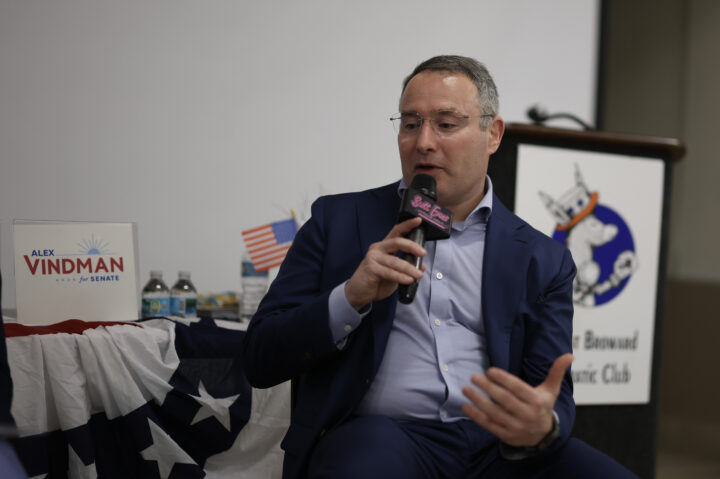
(Joe Raedle/Getty Images)
Retired Lt. Col. Alexander Vindman speaks during a campaign event at the Broward County Democratic Clubs and Caucuses on February 09, 2026 in Sunrise, Florida.


 Add JewishInsider on Google
Alexander Vindman, a former Army officer who became nationally known as a National Security Council whistleblower during the first Trump administration and is now running for Senate in Florida as a Democrat, called out rising antisemitism and anti-Israel sentiment on the left in a Zoom meeting with the Florida Democratic Party Jewish Caucus on Tuesday.
Vindman, who is Jewish and who fled the Soviet Union as a child, said he felt protected from antisemitism during his career in the military in the occasional times he experienced it, but faced a wave of antisemitic hatred from the right when he became a whistleblower during the first Trump administration.
He said that he had experienced a significant rise in antisemitic harassment when he declared his Senate campaign, in large part from the left.
“I’ve become used to the right-wing, nationalist, nativist, antisemitic tone, but I’m really shocked about what I’m seeing from the far left — the DSA wing, that is deeply troubling,” Vindman said. “It is not simply criticism of Israel but a conflation of Israel and Judaism, and a rise of antisemitism within what should be a portion of our own big tent.”
He said that leaders have not done enough to address the issue or hold the perpetrators accountable, on all sides of the political spectrum.
“When we fail to do that, we breed impunity and we encourage that kind of behavior,” Vindman said.
He said that challenging antisemitism is a personal issue for him, including protecting his own daughter — whom he said has felt the need to hide her Star of David necklace.
“That is not the world that I grew up in,” Vindmans said. “That is not the world that my daughter should be living in, and that is absolutely something I will fight tooth and nail to make sure that she feels comfortable living her Jewish American life.”
The Senate candidate, whose twin brother, Eugene, represents a Virginia district in the House, also said he believes that Israel has a right to exist, and that as a Jewish refugee from the FSU he feels personally close to the Jewish state. He’s faced attacks on the campaign trail for refusing to describe the war in Gaza as a genocide.
“I’m pretty deeply disturbed by the trend lines that we’re hearing on both sides of the political spectrum, but frankly, to be fair, from the far left that takes up a cry for Palestine, not a two-state solution, which I’m very much in favor of,” Vindman said. “A path that advocates for Palestine and that completely dismisses a safe homeland for the Jewish people … that’s the part that’s deeply troubling to me.”
Vindman, citing his military, intelligence and diplomatic background, said that he would seek a position on the Senate Foreign Relations, Intelligence or Armed Services Committees if he’s elected.
In a statement, the caucus said the speaker selection ‘sent Jewish students a clear message that they were not welcome’
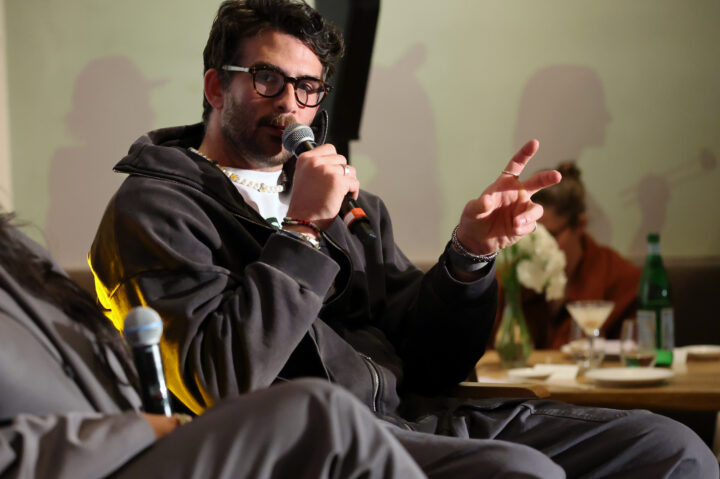
Amy Sussman/The Hollywood Reporter via Getty Images
Hasan Piker speaks during The Hollywood Reporter Creators A-List Dinner presented by Facebook at Matsuhisa on October 15, 2025 in Beverly Hills, California.
The College Democrats of America’s decision to platform far-left, antisemitic influencer Hasan Piker at its recent conference was “a direct threat to Jewish safety and inclusion,” the group’s Jewish Caucus said on Tuesday.
Piker, who has a long-standing history of antisemitic rhetoric — including justifying Hamas’ Oct. 7, 2023, terrorist attacks, calling Orthodox Jews “inbred” and asserting that America deserved 9/11 — was announced on Friday as the convention’s “surprise speaker,” just hours before it began. CDA is the official collegiate arm and student outreach branch of the Democratic National Committee
In his speech on Saturday, Piker distanced himself from the mainstream wing of the Democratic Party, condemning “Democrats who compromise, who conciliate and who betray us,” to loud applause. “No more to the Democrats who collaborate and cooperate with the fascists, who will fund ICE, who will fund Israel … we don’t need those Democrats anymore,” Piker said.
“The normalization of Piker and his rhetoric in CDA-sanctioned programming is a direct threat to Jewish safety and inclusion within the College Democrats community,” the CDA Jewish Caucus said in a statement. “Elevating Piker at this convention sent Jewish students a clear message that they were not welcome.”
“The same standard CDA would rightly apply to bigotry on the right must also be applied within our organization,” the statement continued.
According to the caucus, attendees were prevented from conducting a walkout during Piker’s appearance by national board members, who cited security concerns. Delegates from at least one state were advised not to post photos with Piker on official accounts to avoid further controversy, the caucus said.
The caucus called on CDA’s national leadership to issue a formal apology for platforming Piker and for restricting members from exiting the room. The group also urged the CDA to commit to ongoing dialogue with all caucuses, including the Jewish Caucus, regarding future programming.
J Street U, the student organizing arm of J Street, was a sponsor of the convention, though the group told Jewish Insider it had no role in speaker selection.
Neither the CDA nor the DNC responded to requests for comment about their decision to invite Piker.
Jewish Democrats described a ‘shell-shocked’ atmosphere at their statewide convention that saw marked hostility to pro-Israel voices
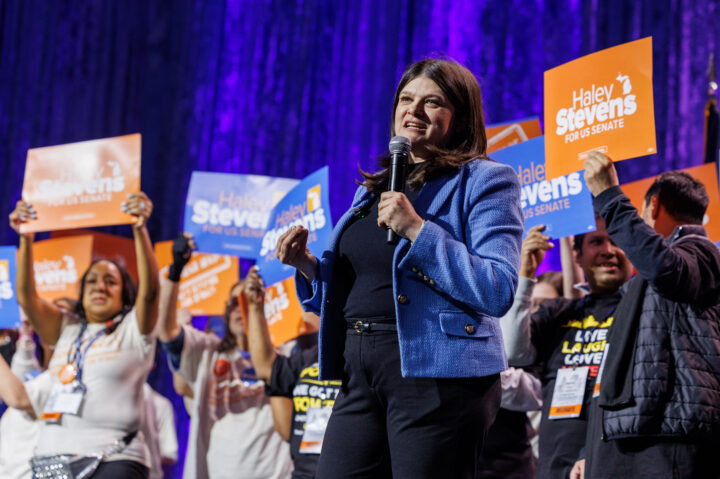
Andrew Roth/Sipa USA via AP Images
U.S. Rep. Haley Stevens speaks at the Michigan Democratic Party Endorsement Convention in Detroit, Mich., on April 19, 2026.
When thousands of Michigan’s most ardent Democratic activists gathered in Detroit on Sunday for the party’s nominating convention, Decky Alexander was thrilled: 200 people were in the room for a Jewish Democratic Caucus meeting, more than double the 70 people who showed up last year in its first official gathering.
Candidates for statewide office, from the U.S. Senate to attorney general, came by to pitch voters as activists schmoozed over bagels.
“It was incredibly energizing and affirming. That’s how the day began,” Alexander, who chairs the caucus, told Jewish Insider in an interview on Tuesday. “It didn’t end that way.”
As the day went on, Jewish Democrats were alarmed to see pro-Israel voices within the party marginalized and shouted down.
“Our Jewish caucus brought a lot of people to the convention, and I was with many of those people who were first-time conventiongoers. They were — I would use the term shell-shocked,” said Joan Lowenstein, a lawyer and former Ann Arbor city councilmember.
Rep. Haley Stevens (D-MI), a moderate and pro-Israel candidate for Senate, faced loud, sustained boos when she spoke in front of the main convention room. One person spotted an attendee on Sunday wearing a shirt that said “Resistance until liberation,” with an image showing someone wearing a keffiyeh throwing rocks.
The main reason that activists gathered that day was to vote to nominate candidates for a range of positions, including attorney general and secretary of state, distinct from other states where voters directly elect their party’s primary nominees.
The outcome of one relatively low-level race generated the most headlines: delegates’ decision to nominate Amir Makled, a Dearborn attorney with a history of social media posts praising Hezbollah, for a position on the University of Michigan Board of Regents. He unseated incumbent Jordan Acker, who is Jewish and was in part targeted due to his calls to discipline anti-Israel student protesters during the 2024 encampment at the Ann Arbor campus.
Acker told The Detroit News afterward that the level of antisemitism among Michigan Democrats is “extensive.”
“The question we have to ask as Jews is whether we still belong here,” said Acker, a Democrat.
The Democratic Party congratulated Makled in social media posts. What remains unclear is just how far party leaders will go to support Makled as he proceeds to the general election. Curtis Hertel, the chair of the Michigan Democratic Party, did not respond to a request for comment.
But Makled’s nomination is cause for concern among many Jewish Democrats.
“I certainly cannot vote for somebody who praises Hezbollah and uplifts posts that use ‘Jew’ as a slur. This was an unacceptable nomination, and I simply cannot affiliate with somebody who harbors those views,” Jeremy Moss, a state senator who is running for Congress in the Detroit suburbs, told JI on Tuesday.
Rep. Kristen McDonald Rivet (D-MI), a moderate Democrat representing a swing district, who is not Jewish, on Tuesday described the scenes from the convention as “deeply troubling,” and in particular criticized the party’s nomination of Makled.
For Jewish Democrats who are not willing to disavow Israel, the question of what to do in a race like the Board of Regents is uncertain. Lowenstein, the Ann Arbor activist, said she would “never” support Makled, but that she also would not vote for a Republican.
“I think Jewish voters are now in a position where we have to look at each person, and not look at their party, but look at what they stand for,” she said.
“I need to create the table, not just always be invited to the table. I just don’t know what that looks like,” said Decky Alexander, the Jewish caucus chair. “It’s a heartbreak. I felt, in moments, is this going to be a breakup? I don’t think so, but we’ve been feeling this way, a lot of us, for a long time.”
The Jewish voters who attended the convention on Sunday are among the most committed Democrats in the state, which makes it more notable that some were left questioning their place in the party.
“They think that there’s shrinking room for them in spaces that claim to be inclusive,” said Elyssa Schmier, the Anti-Defamation League’s Michigan director. “That’s kind of the saying of the Democratic Party: ‘We have a big tent, big-tent politics.’ It did not feel that way at the convention.”
Even the activists most disillusioned by Sunday’s events acknowledge that the convention attendees are not necessarily representative of the state’s Democratic electorate. All it took to attend the convention was registering as a party member a month beforehand and paying a nominal fee.
“I don’t know that it was an accurate representation of where the broader Democratic electorate would be, say, in a primary,” said Moss. “But there’s no question, there was incivility at best [and] displays of Jewish antagonism at worst in the convention hall.”
Jewish activists hope this moment of upheaval can be a chance for Jewish Democrats to reassert their place in the party, even if things feel tenuous and difficult at present.
“I need to create the table, not just always be invited to the table. I just don’t know what that looks like,” said Alexander, the Jewish caucus chair. “It’s a heartbreak. I felt, in moments, is this going to be a breakup? I don’t think so, but we’ve been feeling this way, a lot of us, for a long time.”
Between now and the general election, Alexander wants to talk to as many candidates as possible about whether they plan to take the concerns of Jewish voters seriously.
“I haven’t changed. I am not a Republican or a conservative. I cannot win my district as an independent. But I also wonder how I can continue to carry this party banner with anything approaching pride, or rather, without anxiety and ambivalence,” state Rep. Noah Arbit, a Democrat who represents West Bloomfield, told JI.
“This isn’t identity politics. This is figuring out, in a pluralistic nation like the United States, does everyone have a place? And we want the people who are running for office to answer: Do the Jews have a place in your vision and your platform?” she said.
Moss said he intends to use his platform as a state lawmaker and congressional candidate to answer that question clearly: Jews do have a place in the Democratic Party.
“My solution is to offer my candidacy for everybody and to ensure that folks know that there is a lane for Jewish Democrats in this moment, that we don’t have to feel hopeless, we don’t have to feel politically homeless, that this is a lane that we have to solidify here,” said Moss. “My core values as a Democrat are really Jewish values.”
For state Rep. Noah Arbit, a Democrat who represents West Bloomfield, the site of an antisemitic attack last month, Sunday’s convention adds to angst he has been feeling about his party for years. He was the one who founded the Jewish caucus in 2019, in response to rising antisemitism on the political left.
“I haven’t changed. I am not a Republican or a conservative. I cannot win my district as an independent. But I also wonder how I can continue to carry this party banner with anything approaching pride, or rather, without anxiety and ambivalence,” he told JI. Yet he said he will not cave to pressure from the party’s far-left flank.
“I certainly won’t be run out of representing my community by a band of extremists,” said Arbit. “So I need to stay.”
The congressional candidate faced blowback from state Jewish leaders after flip-flopping on his genocide accusation, a word that he previously opted not to use

Yalonda M. James/San Francisco Chronicle via Getty Images
California state Sen. Scott Wiener (D-San Francisco) on Tuesday, November 18, 2025.
California state Sen. Scott Wiener announced on Thursday that he is stepping down from his role as one of the co-chairs of the California Legislative Jewish Caucus, capping off nearly two weeks of controversy and frustration among Jewish leaders in the state after the San Francisco Democrat declared Israel’s actions in Gaza to be a genocide.
Wiener said in a statement, which was obtained by Jewish Insider, that the decision was prompted in part by the fallout of his genocide comments.
“My campaign is accelerating, and my recent statements on Israel and Gaza have led to significant controversy in the Jewish community. The time to transition has arrived,” Wiener said. He will remain in the role until Feb. 15.
Wiener, who is running for Congress in a competitive Democratic primary to fill the seat being vacated by retiring Rep. Nancy Pelosi (D-CA), has long declared himself a progressive Zionist while also criticizing the government of Israeli Prime Minister Benjamin Netanyahu and Israel’s actions in Gaza.
But after a candidate forum this month where his two competitors were quick to say Israel has committed genocide in Gaza, Wiener faced pressure from his left to use the word himself, and released a video a few days later changing his stance.
“I’ve stopped short of calling it genocide, but I can’t anymore,” Wiener said. A coalition of local and statewide Jewish advocacy groups responded with a statement saying his position “is both incorrect and lacks moral clarity.”
Wiener said Thursday that the American Jewish community “is navigating an extremely difficult moment in time,” and called for more dialogue.
“As we move through this moment, it is even more important for Jews here and globally to foster open dialogue and acceptance of disagreement, even on the hardest of issues,” Wiener said. “Since I stated my view that the Netanyahu government committed a genocide in Gaza, I have had many in-depth conversations with members of the Jewish community with a range of perspectives. While many in the community strongly disagree with my view, I am grateful for their willingness to engage with me and hear my perspective, showing once again the deep respect for difference in our community.”
In an interview with Politico this week, Wiener said he had avoided using the word “genocide” until now because of the harm and hurt it would cause the Jewish community.
“Until now, I have not used the word genocide really for two reasons: First of all, it is an extremely sensitive issue in the Jewish community,” Wiener said. “And [second] particularly because the word genocide has been weaponized against Israel and against Jews for a long time. There are people who think Israel’s mere existence is genocide.”
He said he’s heard from Jewish voters and leaders in the days since who are unhappy with his statement, but asked them to remember his record.
“If you’re mad at me, if you feel betrayed, I respect and honor that. But just also remember how many times I’ve gone to the mat for this community, and the bullets I’ve taken for this community,” Wiener said.
Please log in if you already have a subscription, or subscribe to access the latest updates.
 Continue with Google

 Continue with Apple