






























Young American Jews between the ages of 18-29 have faced the brunt of rising antisemitism, with 47% saying they were a target of antisemitism over the last year, compared to 28% among those 30 and over
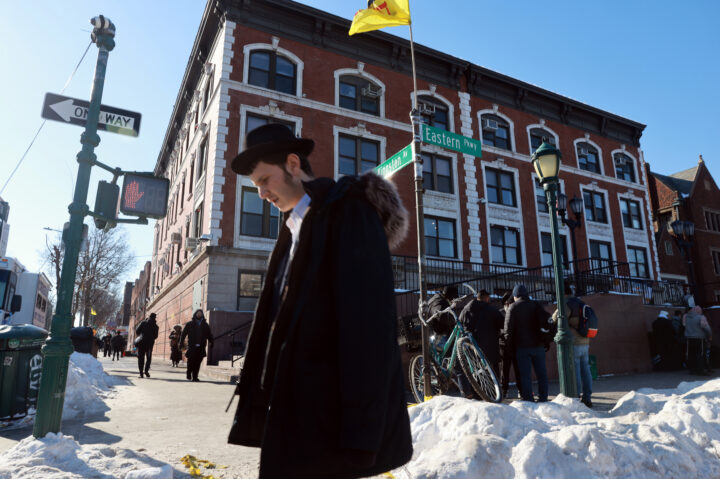
Spencer Platt/Getty Images
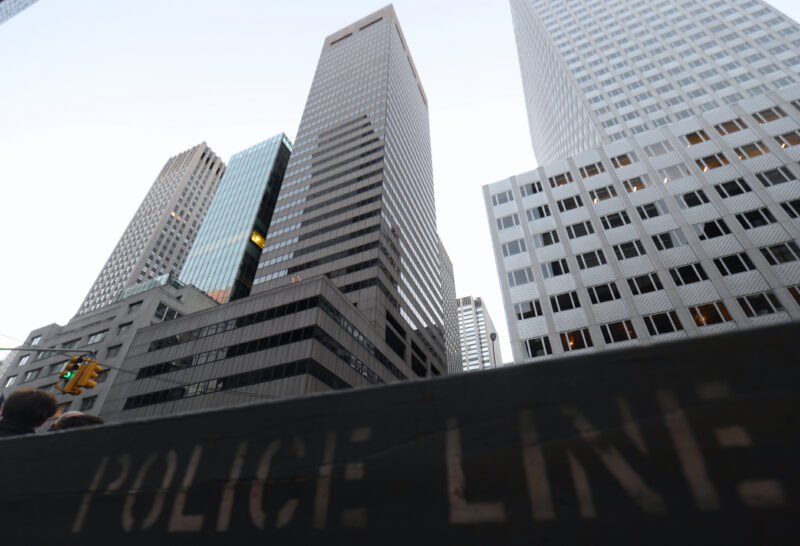
Members of the Hasidic Jewish community gather outside of the Chabad Lubavitch world headquarters, on January 29, 2026, in New York City.


 Add JewishInsider on Google
Nearly two-thirds of Jewish Americans say they feel less safe than a year ago, according to the American Jewish Committee’s newly released annual survey of Jewish public opinion, reflecting a heightened fear of antisemitism in the aftermath of several high-profile attacks against Jews and Jewish institutions.
As notable: About one-third of American Jews reported being a target of antisemitism — whether it was physical or in a virtual space. Nearly one-fifth said they would consider leaving the country as a result of antisemitism, a number that’s been on the rise over the last several years (up from 6% in 2024).
Young American Jews between the ages of 18-29 have faced the brunt of rising antisemitism, with 47% saying they were a target of antisemitism over the last year, compared to 28% among those 30 and over.
At the same time, about two-thirds (65%) of Jews overall said they felt safe attending Jewish institutions, while 60% said they were not worried about being a victim of antisemitism in the next year.
The polling, conducted by SSRS between September and October 2025, shows that both reported antisemitic incidents and fear of facing antisemitism have plateaued but are still near historic highs, when compared to the AJC’s previous surveys. (SSRS surveyed 1,222 Jewish respondents in one survey between Sept. 26-Oct. 29; it separately surveyed 1,033 U.S. adults between Oct. 3-5.)
Antisemitism continues to be particularly prevalent on college campuses, where 42% of students have reported anti-Jewish hate during their time in school — up from 35% in the AJC’s 2024 survey. The vast majority of Jewish parents (80%) said that the level of antisemitism on a campus plays a role in deciding where their student will attend college.
There’s also a noticeable gap between the near-universal view among Gen Z Jewish Americans that antisemitism is a problem (93%) and the significant but much smaller share of non-Jewish young Americans who think it is a problem (61%).
In addition, there is a noticeable spike in American Jews being exposed to explicit antisemitism when scrolling on social media. Over half of Jewish respondents (54%) said they’ve dealt with antisemitism on Facebook — up seven points in the last year. Over one-third (38%) said they’ve experienced antisemitism on YouTube — an 11-point spike in the last year. And two-fifths of Jewish respondents said they’ve experienced antisemitism on Instagram — up eight points since 2024.
Also significant: The survey asked Jewish respondents whether the phrase “globalize the intifada” — one that New York City Mayor Zohran Mamdani has pointedly declined to condemn — would make them feel unsafe. The vast majority (69%) of American Jews said it would either make them feel “very unsafe” or “somewhat unsafe.”
Among non-Jews, interestingly, the poll found very few (only 13%) had seen or heard the phrase “globalize the intifada” at all in the last year — possibly a reflection of why Mamdani’s refusal to condemn the slogan didn’t become a bigger political problem for him.
But among the general public, there was a wide awareness of how such virulently anti-Israel sloganeering is intermingled with antisemitism. More than three-quarters of overall respondents (79%) said that believing Israel has no right to exist is antisemitic, while about two-thirds said that anti-Zionist slogans like “Free Palestine” and “globalize the intifada” were connected to antisemitic incidents.
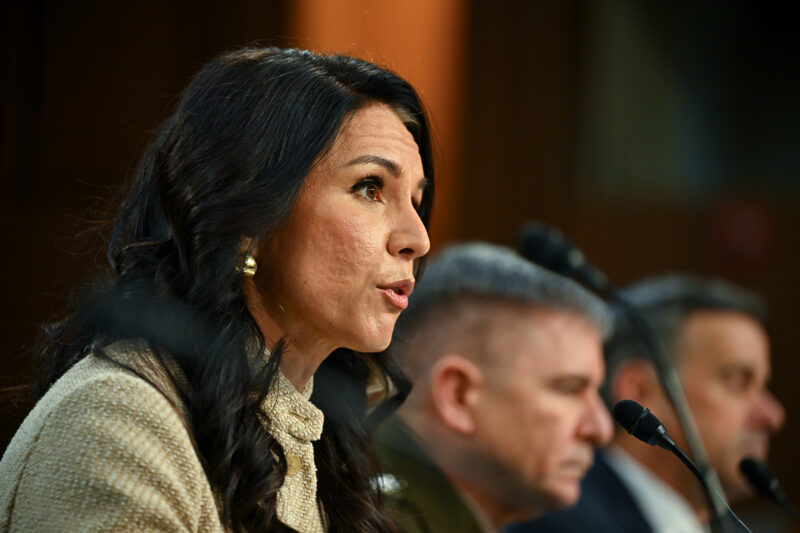
Carrie Prejean Boller, a member of the commission and a former Miss California, said she opposes Israel and defended Candace Owens from allegations of antisemitism
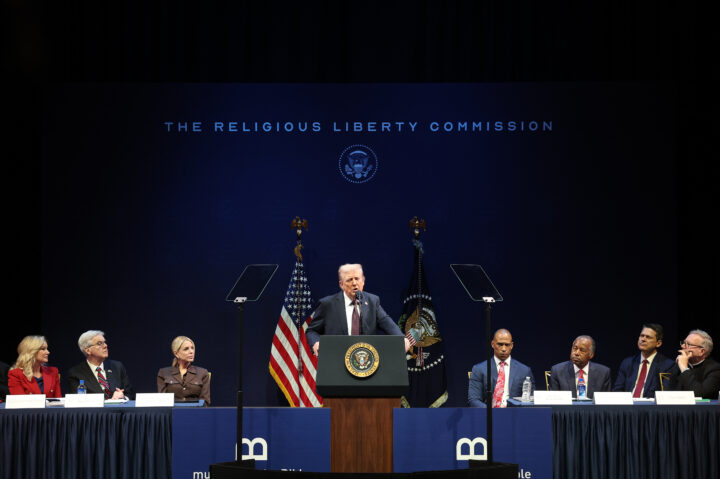
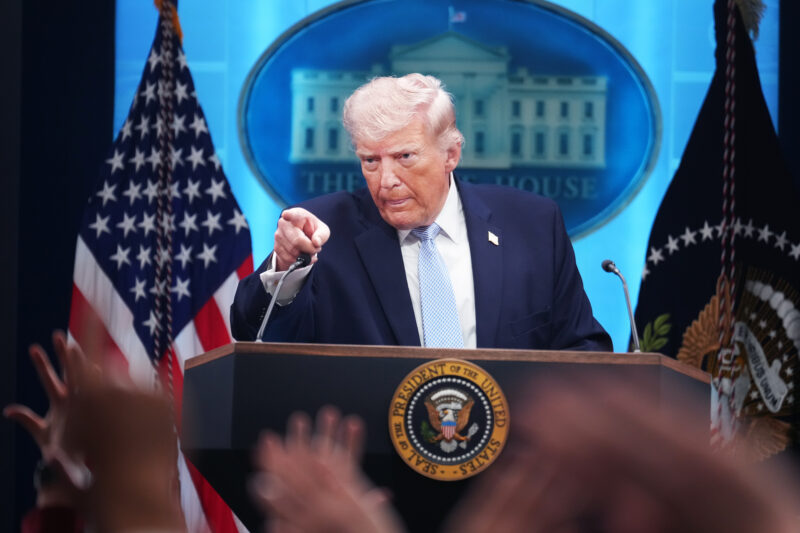
Win McNamee/Getty Images
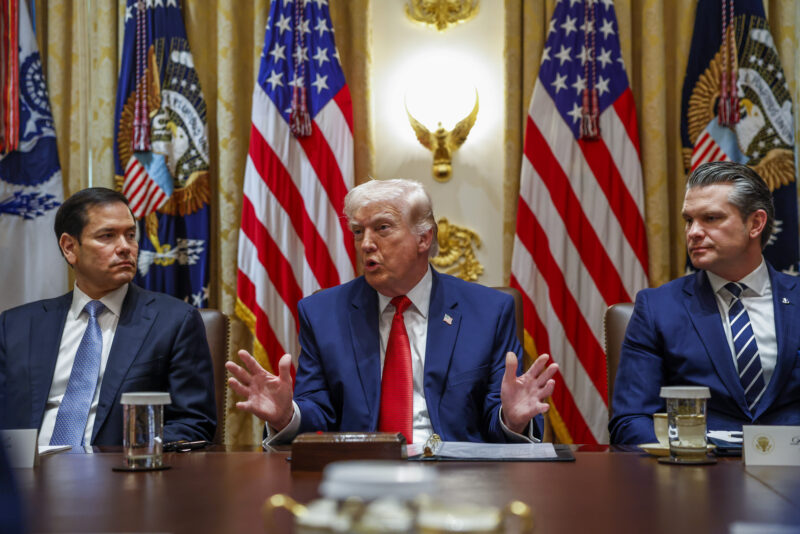
President Donald Trump speaks at the Museum of the Bible September 8, 2025 in Washington, DC.
When the White House Religious Liberty Commission gathered in Washington on Monday for the body’s first public hearing focused on antisemitism, attendees expected an informative if subdued meeting, meant to gather testimony from Jewish Americans who have faced antisemitism. The commission’s members are tasked with drafting a report with recommendations for President Donald Trump about how to promote religious liberty.
The speakers were mostly conservative, like the 13 members of the commission, which was created by Trump last year.
The conversation was largely friendly, barring one member of the commission, Catholic conservative activist and former Miss California Carrie Prejean Boller, who acted as more of an interrogator. She pushed back on witnesses’ testimony, arguing that they had defined antisemitism too broadly and questioning whether she would be considered an antisemite because she does not support Zionism and because she believes the Jews killed Jesus.
She also defended right-wing influencer Candace Owens from accusations of antisemitism.
“I listen to her daily,” said Prejean Boller, who appeared to be wearing a Palestinian flag pin. “I haven’t heard one thing out of her mouth that I would say is antisemitic.” In 2024, Owens was dropped from a Trump campaign event where she was slated to speak alongside Donald Trump Jr. after the campaign faced backlash for including Owens, who regularly shares antisemitic commentary in social media posts and on her podcast.
The first panel of speakers featured former UCLA law student Yitzy Frankel, who sued the university over its handling of antisemitism during the 2024 encampments; Yeshiva University President Ari Berman; Harvard alum Shabbos Kestenbaum; and former Auburn basketball coach Bruce Pearl. Each of them talked about their experiences of antisemitism — or combating it — in the United States after the Oct. 7, 2023, attacks in Israel.
After nearly an hour and a half, Prejean Boller revealed that she had been counting each mention of Israel in the course of the discussion.
“Since we’ve mentioned Israel a total of 17 times, are you willing to condemn what Israel has done in Gaza?” said Prejean Boller. “You won’t condemn that? Just on the record.”
Prejean Boller insisted that she opposes Israel because of her Catholic faith.
“Catholics do not embrace Zionism, just so you know. So are all Catholics antisemites?” Prejean Boller asked the panel, earning some boos from the audience, a mix of Jewish professionals, Christian activists and members of the Washington Jewish community. “I want to be clear on what the definition of antisemitism is. If I don’t support the political state of Israel, am I an antisemite, yes or no?”
At the end of the first panel, the Religious Liberty Commission’s sole Jewish member, Rabbi Meir Soloveichik of Congregation Shearith Israel in New York, offered a pointed response to Prejean Boller’s commentary about Catholics.
“This is an incredibly diverse country, and the one thing we should be careful about is speaking on behalf of all members of a religious community, even if one is a member of that religious community. I certainly wouldn’t claim to speak for all Jews on all subjects,” said Soloveichik. “We’re not known for agreeing on everything, and that certainly should be said for speaking about Catholics in America.”
Soloveichik then quoted Secretary of State Marco Rubio, “who also happens to be a very devout Catholic,” and who spoke about the Jewish people’s connection to the land of Israel during a visit to Jerusalem last year.
Prejean was a member of Trump’s campaign advisory board in 2020. The next year, she began using social media to rally against COVID-19 mask mandates. “You’re the next Rosa Parks. You’re the next Martin Luther King. This is so important that you stand,” she told a group of girls in 2021, urging them to go to school without masks, according to a video she posted on her Instagram.
At the time, she had 11,000 followers. Now she has 124,000 followers. She is also an advocate against transgender women and girls participating in female sports, and an opponent of same-sex marriage. Recently, she began regularly posting videos from Owens and Tucker Carlson, along with sharp criticism towards Israel. Her biography on the commission’s website lists only her beauty pageant title and a book she authored about it. A White House spokesperson did not respond to a request for comment.
“They mocked her. They censored her. They called her a ‘crazy conspiracy theorist’ simply for asking questions,” Prejean Boller wrote in a recent post about Owens. “I stand with Tucker,” she wrote in another post.
“I would really appreciate it if you would stop calling Candace Owens an antisemite,” Prejean Boller said at the hearing. “She’s not an antisemite. She just doesn’t support Zionism, and that really has to stop.”
Other commission members include Cardinal Timothy Dolan, the former Archbishop of New York; Pastor Paula White, a senior advisor to the White House Faith Office; and Pastor Franklin Graham, president and CEO of the Billy Graham Evangelistic Association and of Samaritan’s Purse. It is chaired by Texas Lt. Gov. Dan Patrick.
The rest of the Monday hearing proceeded as planned: bureaucratic, genial, straightforward. The commission’s membership is mostly Christian, and much of the discussion of antisemitism presented it as a problem for those who believe in Judeo-Christian values, and an issue for Jews and Christians to combat together — with an understanding that the government should be in the business of supporting Americans’ freedom of religion. The event took place at the Museum of the Bible, a private institution established by the evangelical founder of Hobby Lobby.
“I want to thank everyone who is part of this fight,” Housing and Urban Development Secretary Scott Turner said at the start of the event. “It’s a battle that President Trump will continue to wage for Jewish Americans, for Christians, and for all Americans of all faiths whose First Amendment freedoms are under attack. I know it’s fitting that we’re here at the Museum of the Bible. The word of God is powerful, and it’s a powerful reminder of the importance of the First Amendment.”
‘Accusations of dual loyalty have historically been used against Jews to exclude them from public life and even justify violence, making this trope especially harmful and dangerous,’ ADL's Dan Granot says

Kevin Dietsch/Getty Images
U.S. Sen. Bernie Moreno (R-OH) participates in a Senate Commerce, Science, and Transportation Committee hearing in the Russell Senate Office Building on January 28, 2025 in Washington, DC.
The Anti-Defamation League said on Tuesday that Sen. Bernie Moreno’s (R-OH) new proposal to ban dual citizenship risks reviving an antisemitic “dual loyalty” charge that has historically been used to target Jewish Americans.
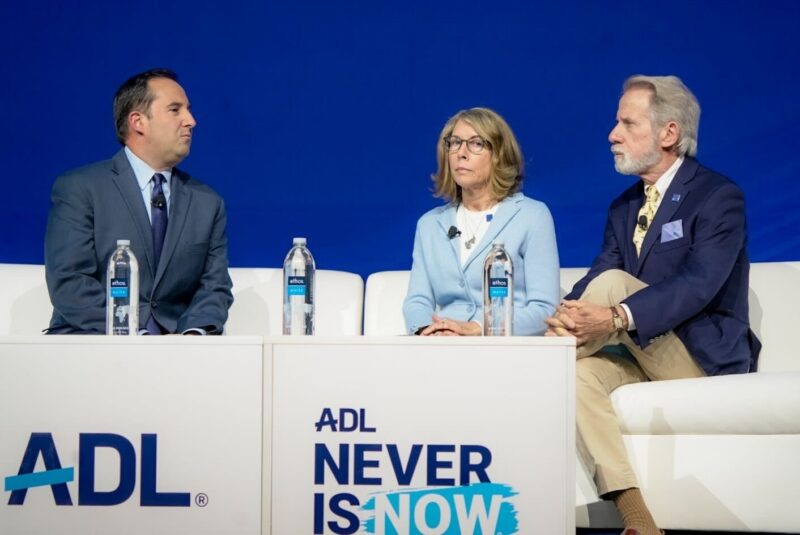
Dan Granot, the Anti-Defamation League’s senior director of government relations, criticized the bill, noting that claims of dual loyalty have been used to attack Jews in the past, and that the legislation risks playing into those attacks.
“The idea of questioning the loyalty of Americans based on dual citizenship is deeply troubling. Dual citizenship is a lawful and common status that millions of Americans hold, and it does not diminish anyone’s commitment to the United States,” Granot said in a statement to Jewish Insider. “Accusations of ‘dual loyalty’ have historically been used against Jews to exclude them from public life and even justify violence, making this trope especially harmful and dangerous.”
“America’s strength comes from the diverse backgrounds of its people and the cultural and familial perspectives they bring to civic life, all while remaining fully devoted to this country,” he continued. “We urge leaders to avoid rhetoric or proposals that invoke this antisemitic narrative.”
Jewish Americans — including Jewish lawmakers — have faced attacks over their support for Israel, in many cases using false and insidious claims that they hold dual loyalties. Far-right activists, in particular, have seized on such narratives.
A Moreno spokesperson did not respond to JI’s request for comment on the ADL’s criticisms.
Moreno himself was an immigrant to the United States from Colombia, but his office said the Ohio senator forfeited his Colombian citizenship after being naturalized as a U.S. citizen at the age of 18. His legislation, the Exclusive Citizenship Act, requires American citizens to pledge “sole and exclusive allegiance” to the U.S. and renounce citizenship from any other country, including U.S. allies, because they “could create conflicts of interest.”
“One of the greatest honors of my life was when I became an American citizen at 18, the first opportunity I could do so,” Moreno said in a statement announcing the bill’s introduction. “It was an honor to pledge an Oath of Allegiance to the United States of America and ONLY to the United States of America! Being an American citizen is an honor and a privilege — and if you want to be an American, it’s all or nothing. It’s time to end dual citizenship for good.”
Nearly half of respondents said they had experienced exclusion or minimization based on their Jewish identity
Helen H. Richardson/MediaNews Group/The Denver Post via Getty Images
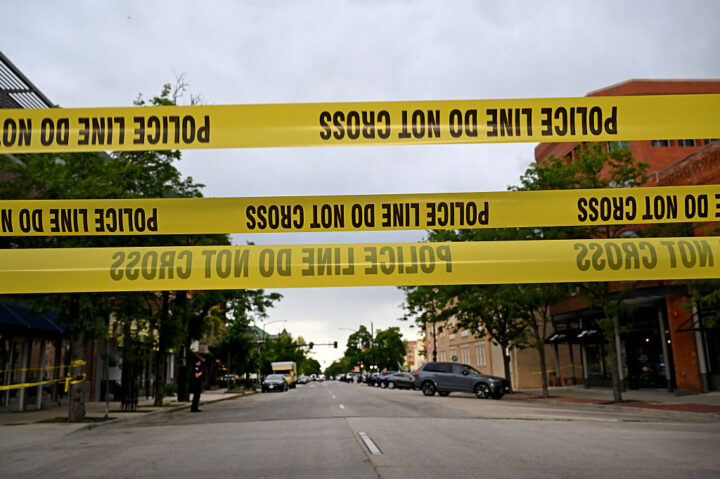
Law enforcement officials are on scene to investigate an attack on the Pearl Street Mall in Boulder, Colorado on June 1, 2025.
A majority of Jewish Americans see antisemitism as a common Jewish experience, according to a new joint study, released on Monday, commissioned by the Jewish Federations of North America and Anti-Defamation League.
According to the “Portrait of Antisemitic Experiences in the U.S.,” which relied on two nationally representative surveys of Jewish Americans and was conducted in partnership with Columbia University researchers, 55% of those surveyed experienced at least one form of antisemitism over the past year. Over half (57%) also said antisemitism is now a normal Jewish experience.
The immediate aftermath of the Oct. 7, 2023, Hamas terrorist attacks in Israel and the start of the war in Gaza fueled a record-breaking wave of antisemitic incidents. Such incidents increased by 5% in 2024, according to the ADL’s tally. The results mark an 893% increase over the past decade.
Over one-third (36%) of those surveyed witnessed actual or threatened antisemitic violence, and 44% had experienced exclusion or minimization based on their Jewish identity. One in five respondents (21%) who have witnessed an antisemitic attack reported signs of depression.
Forty-one percent of Jews reported having experienced online antisemitism. Other contexts where antisemitism was found included: public spaces (reported by 21% of Jews), educational institutions (13%), near Jewish institutions (9%) and the workplace (9%).
Nearly four-fifths of Jews (79%) expressed concern about antisemitism, and 48% have taken actions to increase their personal security. (As part of that group, 14% of Jewish respondents said they had made plans to leave the country, while nine percent said they had purchased a gun.)
The JFNA study surveyed 1,877 Jewish Americans by text message in six geographic areas between March 5-March 25, 2025, with a +/- 2.26% margin of error.
The ADL study surveyed 2,982 Jewish Americans by text message in 12 geographic and age categories between May 27-July 6, 2025, with a +/-3.2% margin of error.
The ADL’s audits have been criticized for changing its methodology of what constitutes an antisemitic incident while still comparing data year-to-year in the aftermath of the Oct. 7 Hamas terror attack. After Oct. 7, the organization began including “expressions of opposition to Zionism, as well as support for resistance against Israel or Zionists” — for instance, spray-painting “Free Gaza” graffiti — which resulted in a significant increase in the number of incidents in the 2023 audit. But even without the inclusion of anti-Zionist messaging as antisemitism, antisemitic incidents still would have doubled from 2022 to 2023.
“It is so profoundly sad that Jewish Americans are now discussing worst-case scenarios,” Jonathan Greenblatt, ADL CEO, said in a statement. “When American Jews – who have built lives, careers and families here for generations – are making contingency plans to flee, we must recognize this as a five-alarm fire for our entire country. This is not just a Jewish problem; it’s an American problem that demands immediate action from leaders at every level.”
A trend that Jewish Federations dubbed “the Surge” — a significant increase in Jewish engagement that was brought on by the Oct. 7 attacks — continues, according to the study, but at slightly lower levels than in 2024. Nearly one-third (31%) of American Jews reported increased participation in Jewish life, down from 43% last year. A survey from JFNA last month showed that the impact of “the surge” is waning more quickly among Jews from minority populations, including LGBTQ Jews, Jews of color, Jews with disabilities and financially vulnerable Jews, than it is among the broader Jewish community.
Eric Fingerhut, CEO of JFNA, lauded the nearly two-thirds of those surveyed who directly experienced antisemitism but “are responding by deepening their Jewish involvement.”
That “demonstrates the extraordinary resilience of our people,” said Fingerhut. “Rather than retreating in fear, American Jews are choosing to stand together, strengthen their bonds and affirm their identity.”
The House speaker joined Minority Leader Hakeem Jeffries and others for a vigil honoring Yaron Lischinsky and Sarah Milgrim, killed in the Capital Jewish Museum shooting

Marc Rod
Lawmakers gather on the Capitol steps on June 10, 2025 for a vigil for Yaron Lischinsky and Sarah Milgrim, Israeli Embassy staffers who were killed in an anti-Israel attack.
House Speaker Mike Johnson (R-LA) sharply denounced the anti-Israel movement on Tuesday, describing it as making common cause with terrorists and putting “a bounty on the heads of peace-loving Jewish Americans.”
Johnson gathered on the steps of the Capitol with House Minority Leader Hakeem Jeffries (D-NY), dozens of members of Congress, Israeli Ambassador to the U.S. Yechiel Leiter, American Jewish Committee CEO Ted Deutch, hostage family members including Ronen Neutra and staff from the Israeli Embassy and AJC for a vigil honoring Yaron Lischinsky and Sarah Milgrim, the Israeli Embassy employees killed by an anti-Israel activist outside an AJC event at the Capital Jewish Museum last month.
“It’s a dangerous time to be a Jewish American,” Johnson said, noting that the House had taken extra precautions to keep the event under wraps for security reasons. Visible and covert security surrounded the gathering.
“The monster who murdered [Lischinsky and Milgrim] was not motivated by peace, [but] something very different. He went to a Jewish museum to hunt down Jewish people, and we want to be crystal clear tonight: This is targeted antisemitic terrorism,” Johnson said. “There are no shades of gray. There is no other way to describe it, as we’ve seen in the weeks since this violence is definitely not isolated.”
He said that the D.C. shooter and the individual who attacked a march for the hostages in Gaza in Boulder, Colo., were “united in their sick hatred of the Jewish people.” He highlighted that both shouted “Free Palestine” during their attacks, a slogan he noted has proliferated at protests on college campuses and in American cities.
“‘Free Palestine’ is the chant of a violent movement that has found common cause with Hamas,” Johnson said. “It’s a movement that has lost hold of the difference between right and wrong, between good and evil, between light and darkness … They proclaim that violence is righteous, that rape is justice and that murder is liberation. They have created a culture of lies that puts a bounty on the heads of peace-loving Jewish Americans.”
Jeffries described the shooting as domestic terrorism and said Lischinsky and Milgrim were “victims of the same deadly antisemitism that fueled the attacks in Boulder, the attack at Gov. Josh Shapiro’s home in Pennsylvania, at synagogues, yeshivas, businesses and communities all across America.”
“Antisemitism has been a painful reality of Jewish life throughout the world for thousands of years, but now too many of our Jewish brothers and sisters here in America fear for their safety,” Jeffries said. “In this country, antisemitism has been metastasizing like a malignant tumor, and we must all work together to eradicate this cancer.”
Referencing the week’s Torah portion, when God instructed Moses to appoint elders to help him lead the Jewish people through the desert after leaving Mount Sinai, Jeffries said that lawmakers from both parties need to step up to help the Jewish community fight antisemitism.
“We will not let you shoulder this burden alone,” Jeffries said. “That’s a moral necessity here in the United States of America.”
Leiter said that “the intifada has been globalized, and like [George] Orwell’s ‘1984,’ ‘Free, free Palestine’ means ‘Death, death Israel,’ and it is now incumbent upon all of us to confront it,” Leiter said. “Today we are challenged to act, to honor the fallen, not just with words, but with a renewed commitment to fighting the scourge of hate, fighting the demonization and delegitimization of the State of Israel.”
AJC’s Deutch said that “antisemitism is antisemitism, period. There should be no more debate about which kind of antisemitism is more dangerous, or which we need to be more afraid of.”
“It is clear every antisemitism is and has been deadly, from the extreme left to the extreme right,” Deutch said. “Both must be condemned by everyone, no excuses, because if you can only see antisemitism when it is convenient then you’re not seeing it at all.”
He described the demonization of Israel and trends of blaming it for “every injustice in the world” as the “current socially acceptable form of antisemitism,” which has “sanitized” the hatred.
“There is a straight line from the demonization of Israel, the dangerous lies that people peddle about the one Jewish state to the antisemitic violence that impacts real people,” Deutch said. “When calls to globalize the intifada and chants [of] ‘from the river to the sea’ are screamed at protests, these must be called out for what they are. They are not slogans for a social justice movement. They are incitement to violence. Everyone must call that out forcefully and with clarity.”
Deutch said he appreciates Congress’ work to improve Jewish communal security, but argued that it is not normal nor acceptable for any religious group to need armed guards and security checkpoints to gather and practice their faith.
Lischinsky and Milgrim’s supervisors at the embassy shared statements from their families, highlighting their lives, the positive impacts they had on their communities and their passion for their work at the Israeli Embassy.
Please log in if you already have a subscription, or subscribe to access the latest updates.
 Continue with Google
 Continue with Apple