









































































The Maine Democrat, who won his primary in June, had been dogged by controversy for months before a rape allegation finally cost him his political allies
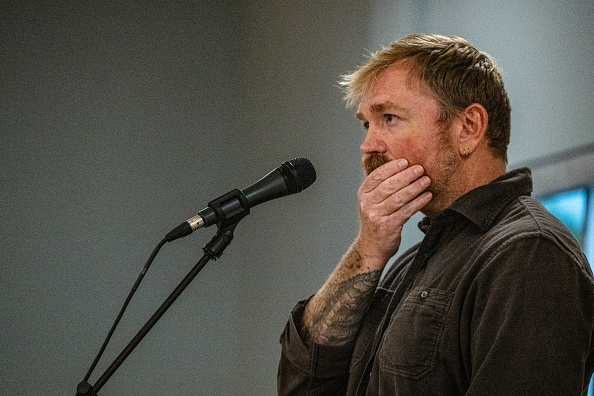
Photo by Laura Brett/Getty Images
Democratic U.S. Senate candidate Graham Platner speaks to voters at a town hall on June 7, 2026 in Portland, Maine.


 Add JewishInsider on Google
Maine Senate candidate Graham Platner, the scandal-plagued progressive insurgent, announced on Wednesday evening that he plans to drop out of the race amid intense pressure, two days after a former romantic partner accused him of rape.
Even as he announced his withdrawal, Platner remained defiant, claiming that the allegations against him were a conspiracy aimed at forcing him out of the race.
The sexual assault allegation by Jenny Racicot, who shared the details of the incident with Politico, followed months of controversies — including allegations of domestic abuse — that Platner withstood with the backing of top Democrats, including Sens. Elizabeth Warren (D-MA) and Bernie Sanders (I-VT) and, after the primary, Senate Minority Leader Chuck Schumer (D-NY). He lost the support of his political allies after the report was published on Monday.
Even before that, Platner had been dogged by controversy for months. Last October, Platner acknowledged that he had a tattoo of a Nazi symbol known as a Totenkopf for nearly two decades.
He denied knowing what the symbol meant, but a past acquaintance told Jewish Insider that Platner was aware of its Nazi association. Another former romantic partner, Lyndsey Fifield, who accused Platner of domestic violence, shared text messages with the New York Times showing she had informed friends of the Nazi symbol months before it became public knowledge and said he and his Marine colleagues had chosen the symbol deliberately.
In Reddit posts, Platner regularly used slurs, criticized sexual assault victims and praised Hamas’ tactics during the terror group’s 2014 war against Israel.
In his announcement, Platner continued to deny the sexual assault allegation, claiming that “large forces,” the “corporate media” and the “political establishment” are conspiring against him — specifically timed in order to force him off the ballot before the drop-out deadline next week.
“We live in a political system that is not built for normal people,” Platner asserted. “It is a system that is built structurally to make sure that movements like ours cannot flourish, that if they begin to succeed, they can be crushed. … We did it the way that we were told we are supposed to make change, and we won, and now they are not going to let us have it, not if it’s me.”
He said he’s leaving the race because “those in power … are using these allegations as an excuse” to block his ability to fundraise, access voter data and otherwise campaign.
Platner insisted he was not attempting to influence the process to replace him on the ballot — a claim disputed by the Maine Democratic Party and numerous news reports. He said that the process “needs to be open, transparent and democratic” and not shaped by “party apparatchiks” or party leadership in Washington.
He also said he “intend[s] to file my paperwork to withdraw,” indicating he had not yet actually done so.
In his statement, Platner also referenced his repeated claim that Israel committed genocide in Gaza, a charge that had become central to his campaign.
“All we were asking for was healthcare, was to end the genocide, to use our taxpayer dollars at home to uplift our communities, instead of waging war overseas,” Platner said.
Shortly before Platner’s announcement, the Maine Democratic Party’s state committee members met and voted to hold a nominating convention to choose a new nominee should Platner withdraw from the ballot. Party leaders said they’d disclose further details about the process “soon.”
Media reports indicate that county committees would be charged with selecting 500 to 600 total delegates for the convention.
In a text message to supporters on Wednesday, Platner’s campaign manager claimed that the Maine Democratic Party has been coordinating behind closed doors with the Democratic Senatorial Campaign Committee to cut Platner’s camp and supporters out of the nominating process.
Platner entered the Senate race to challenge Sen. Susan Collins (R-ME), a five-term incumbent, last August. From the beginning of the race, he touted his bona fides as a veteran who served in Iraq and Afghanistan and positioned himself as an anti-war candidate. He has blamed his past conduct on PTSD and his resulting alcohol dependence.
From the beginning, Platner positioned himself as a working-class outsider taking on the establishment — including both Collins and the Democratic establishment, which was backing Janet Mills, Maine’s governor, in the Democratic primary. His viral first campaign video was produced by Morris Katz, a political consultant who had also made political ads for New York City Mayor Zohran Mamdani.
Criticism of Israel was central to Platner’s campaign. He regularly attacked AIPAC and described Collins as “bought and paid for by [Israeli Prime Minister] Benjamin Netanyahu.” Liberal Jewish groups, including the Jewish Democratic Council of America and J Street, had opted not to endorse Platner, even after Mills dropped out of the race in April. Platner handily won the Democratic primary in June. Mills did not endorse him.
Democrats saw the race as a possible pickup opportunity in a midterm election year when many voters in the purple state are disillusioned by President Donald Trump.
Numerous Maine Democrats have already announced plans or filed paperwork to take Platner’s place on the ballot, including former Maine Centers for Disease Control Director Nirav Shah, former state Senate President Troy Jackson, former House candidate Jordan Wood, former Senate candidate David Costello, Secretary of State Shenna Bellows, former House candidate Paige Loud, state Rep. Valli Geiger and brewery owner Dan Kleban.
Geiger claimed on Wednesday that she was Platner’s preferred replacement, but a campaign spokesperson denied that, though the spokesperson said he had encouraged her to run if he dropped out.
The unfolding situation in Maine comes amid a broader trend in American politics in which immoral or questionable behavior by one’s peers has at times been ignored or obfuscated to serve a perceived 'greater good'
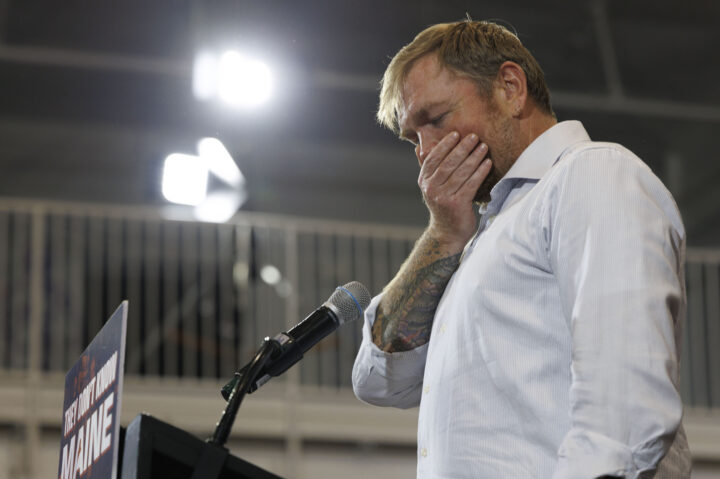
(CJ Gunther/Getty Images)
Democratic U.S. Senate candidate Graham Platner speaks at his Primary Election event on June 9, 2026 in Blue Hill, Maine.
When an ex-girlfriend of Graham Platner told Politico in a story published on Monday that the Maine Democratic Senate candidate had raped her in 2021 after entering her home while heavily intoxicated, she said she did so because the response to a recent New York Times report on Platner’s past dubious behavior had focused on discrediting Lyndsey Fifield, one of the women who featured prominently in the story, over her ties to the GOP.
Jenny Racicot, a Democrat, hadn’t wanted to go public with the rape accusation (which she had shared off-record with the Times), in part because she and Platner were largely politically aligned. “One of the reasons I didn’t come forward sooner was, the huge moral conflict that I had between supporting his politics, but not supporting him as a person,” Racicot told Politico. “My part of the story [in the NYT] was just a read-over,” Racicot said. “And the story was Lyndsey, and the accusations of her being politically motivated.”
The unfolding situation in Maine comes amid a broader trend in American politics in which immoral or questionable behavior by one’s peers has at times been ignored or obfuscated to serve a perceived “greater good” of electing a political ally despite their failing moral standards.
In recent years, both major parties have increasingly tolerated conduct that would have once been considered disqualifying — even as the #MeToo movement briefly changed the nature of the discourse. Similar arguments have surfaced across political controversies over the last decade (including against President Donald Trump), with supporters of embattled candidates and officials insisting that policy positions outweigh personal conduct and dismissing allegations as politically motivated.
In a short span of time, the 2017 rallying cry of “Believe women” gave way to “Believe women whose politics align with ours” — a mindset that extended to the widespread denial of Hamas’ sexual violence during the Oct. 7, 2023, terror attacks and against the Israeli hostages kept in captivity in Gaza.
But yesterday’s Politico report, which prompted calls from Platner’s most prominent backers — including Rep. Ro Khanna (D-CA) and Sens. Elizabeth Warren (D-MA) and Ruben Gallego (D-AZ) — for him to end his bid, may mark the point at which previous defenses of the Maine Democrat become politically untenable.
Since shortly after the launch of his campaign, Platner — a virtual unknown before last summer — has faced numerous controversies, from his tattoo of an SS totenkopf to Reddit comments praising Hamas tactics to the revelation that he exchanged inappropriate messages with numerous women despite being married. The Wall Street Journal reported last month that Platner’s vetting process — normally a weeks-long process — took place in a matter of days, expedited by Platner’s top strategist and done at a fraction of the cost of a standard background check, which likely would have flagged at least some of these issues.
Yet none of those allegations proved politically fatal — and Platner ended up winning the Democratic primary with 72% of the vote. Platner’s defenders echoed the rhetoric of many of Trump’s early backers: that the party establishment had targeted him, that the media had unfairly covered the incidents and that a candidate’s positions, rather than their personal lives, should be on the ballot.
Unlike Trump, who was weeks away from his 2016 presidential victory when the infamous “Access Hollywood” tape leaked, Platner had only recently clinched his party’s nomination after Gov. Janet Mills ended her bid. He can still be replaced on the ballot, provided he exits the race by next Monday, though any new candidate will face a much more difficult battle against Sen. Susan Collins (R-ME) in what had been the Democrats’ best hope for a pickup and control of the Senate.
Now, the question is whether American politics still has a meaningful threshold beyond which partisan leanings give way to concerns about character and ethics — or whether that threshold has simply become much higher than it once was.
Please log in if you already have a subscription, or subscribe to access the latest updates.
 Continue with Google

 Continue with Apple