














































































The letter, championed by the Caliifornia Democrat, currently has 30 Democratic co-signatories
Andrew Harnik/Getty Images
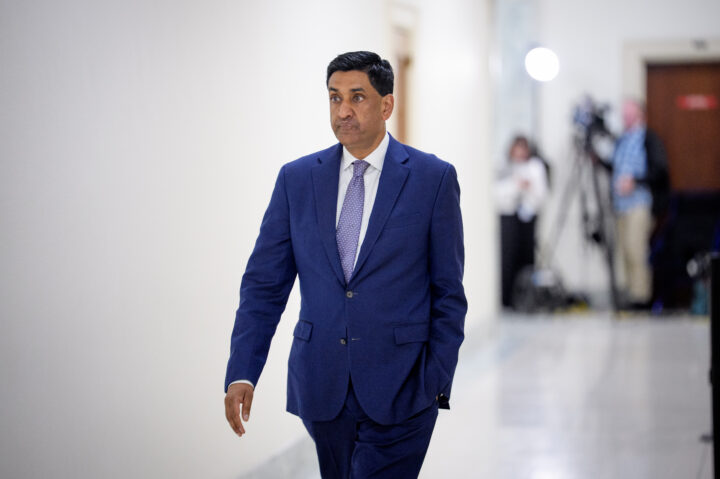
Rep. Ro Khanna (D-CA) on Capitol Hill on May 18, 2026, in Washington, DC.


 Add JewishInsider on Google
Rep. Ro Khanna (D-CA) and a group of at least 30 Democratic colleagues in the House and Senate are set to urge House and Senate leaders negotiating the 2027 National Defense Authorization Act to strip out a provision regarding U.S.-Israel cooperation that has drawn backlash from the far left and far right, according to a draft of the letter viewed by Jewish Insider.
Khanna has been a leading opponent of the provision since the NDAA came through the House Armed Services Committee, where his effort to remove the provision was defeated by a voice vote. House Republicans did not permit a vote on an amendment by Khanna and Rep. Thomas Massie (R-KY) to remove the provision when the bill came to the House floor.
The bill is likely to be largely finalized in negotiations between House and Senate committee leadership before it comes before both chambers for a final vote. Khanna’s letter, which is set to continue gathering signatures through Nov. 6, appeals to the chairs and ranking members of the House and Senate Armed Services Committees to strip the provision, versions of which have been included in both the House and Senate versions of the bill, as part of the negotiations.
The letter describes the provision as creating an “unprecedented integration of the United States defense industry with the defense industry of a foreign nation,” and describes the process to advance the provision as rushed and requiring greater deliberation as part of a “fundamental reassessment of the U.S.-Israel security relationship.”
“These provisions would significantly reduce Congress’ oversight of the U.S.-Israel defense relationship,” the letter states. “They would embed Israeli technology directly into acquisition programs and co-production lines, and once those commitments are made, the cost of reversing them may become prohibitive for any future President or Congress.”
The letter urges that, if the provision isn’t removed entirely, Congress should be required to reauthorize it annually, that human rights conditions should be added and that a counterintelligence certification should be required in advance of any technology transfer.
The provision, based on the U.S.-Israel FUTURES Act, would largely streamline and expand a variety of areas of cooperation that already exist between the U.S. and Israel. Its supporters, on a bipartisan basis, have argued that it significantly benefits the United States and its service members through access to Israeli technology and that opponents have misrepresented the provision and overstated the scope of its impact.
Supporters have emphasized that the provision would create no new programs nor provide for greater integration of the U.S. and Israeli militaries, and that it requires regular transparency reports to Congress and the public on the cooperative programs.
Khanna’s letter asserts that the provision would “reward” Israeli actions in Gaza, the West Bank and Lebanon, arguing, “These are not the actions of a government whose defense establishment should be granted deeper access to American military technology, nor rewarded with U.S. defense contracts.”
The letter further alleges that by utilizing Israeli technological innovations or working with Israel on such innovation, the U.S. would be “morally and legally implicate[d]” in alleged Israeli violations of international human rights law.
Though previous NDAAs already provided for U.S.-Israel cooperation on “emerging technologies” including artificial intelligence, cybersecurity, quantum computing and automation, with requirements to protect sensitive information and technology from adversaries, the letter frames the provision as a novel risk to U.S. technology security.
And it describes the provision as potentially damaging to American industry, though the cooperative programs are designed to support and grow the defense industrial bases of both countries.
The letter also again links the NDAA provision to a letter by Israeli Prime Minister Benjamin Netanyahu supporting winding down direct U.S. aid, which referenced an entirely separate resolution.
Current signatories to the letter include Sens. Jeff Merkley (D-OR) and Bernie Sanders (I-VT) and Reps. Don Beyer (D-VA), Andre Carson (D-IN), Greg Casar (D-TX), Joaquin Castro (D-TX), Jasmine Crockett (D-TX), Madeliene Dean (D-PA), Chris Deluzio (D-PA), Mark DeSaulnier (D-CA), Maxine Dexter (D-OR), Veronica Escobar (D-TX), Valerie Foushee (D-NC), John Garamendi (D-CA), Val Hoyle (D-OR), Jared Huffman (D-CA), Jonathan Jackson (D-IL), Pramila Jayapal (D-WA), Zoe Lofgren (D-CA), Stephen Lynch (D-MA), Jim McGovern (D-MA), Analilia Mejia (D-NJ), Chellie Pingree (D-ME), Mark Pocan (D-WI), Emily Randall (D-WA), Lateefah Simon (D-CA), Melanie Stansbury (D-NM), Derek Tran (D-CA), Gabe Vasquez (D-NM) and Bonnie Watson Coleman (D-NJ).
Adam Smith, a reliable supporter of Israel, said he would now join progressives in his party to oppose a provision bolstering a close U.S.-Israel alliance
Eric Lee/Bloomberg via Getty Images
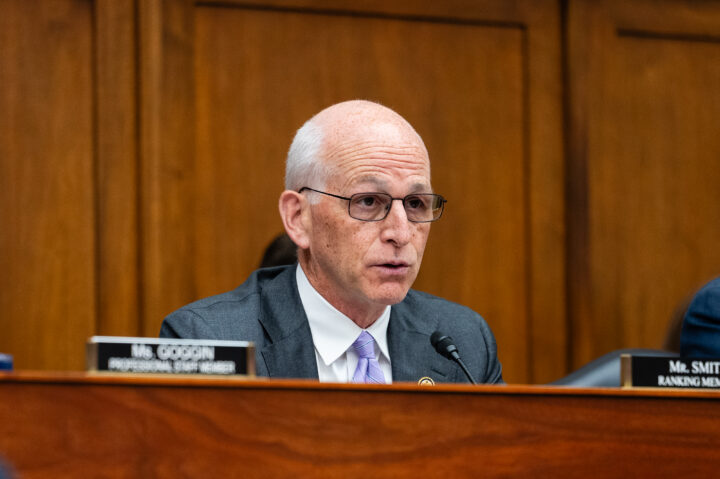
Rep. Adam Smith (D-WA), ranking member of the House Armed Services Committee, during a hearing on May 14, 2026.
Rep. Adam Smith (D-WA), the top Democrat on the House Armed Services Committee, now says he plans to support efforts to strip a provision on U.S.-Israel cooperation from the 2027 National Defense Authorization Act, after arguing strenuously against similar efforts during the committee’s markup of the same bill weeks ago.
The provision, based on the FUTURES Act, is relatively routine, creating a single official to oversee all U.S.-Israel cooperative programs in developing and acquiring defense technologies, and builds on existing programs. But critics have falsely claimed the provision would irrevocably link the U.S. and Israeli militaries and undermine American sovereignty.
Smith himself said during the committee markup that the way critics have described the amendment “is simply not accurate” and that the provision should not be treated as a referendum on the U.S.-Israel relationship.
In a message to constituents viewed by Jewish Insider, Smith said he now supports removing the provision.
“I previously opposed removing Section 224 because I looked at the ways the provision benefits the U.S. and helps us improve our anti-drone and anti-missile technologies,” Smith said in the message. “I still believe that Section 224 is something that primarily benefits the U.S., but after several conversations with constituents, I agree with the position that this provision is about more than just the U.S. working to improve our defense technology.”
Smith described his new opposition as based on Israeli activities in Gaza, the West Bank, Lebanon and Iran — despite arguing just weeks ago that, “taking a step back from using technology that is available to us just because we strongly disagree with where Israel is at right now, I think would be a mistake.”
“In the context of these ongoing conflicts, Section 224 carries meaning beyond the plain text substance of the provision. I want to advocate for peace and pressure Israel to meaningfully work with partners in the region to bring these conflicts to an end,” Smith said. “I cannot support endless conflict even though I support Israel’s right to exist. For these reasons, I will vote to remove Section 224 from the National Defense Authorization Act if it comes to the Floor.”
He emphasized in his message his criticisms of Israel and suggested that constituent feedback on the issue had helped shape his changing position on the subject — an indication of how grassroots pressure in blue districts is pushing traditionally pro-Israel members to the left on Israel policy issues.
Smith said previously that the amendment is ultimately a boon to the U.S. military by allowing it to benefit from Israeli innovations, and that its actual impacts are relatively minor.
“This is not a new framework,” Smith said during the committee meeting, noting that the U.S. already has three existing cooperative programs with Israel to develop new technologies, and that the provision does not create any new programs. “To say that this is us bowing to the bidding of Israel on this is completely inaccurate. The reason we’re doing this is because we benefit from that technology development.”
Smith did not respond to a request for comment about his new position on the provision.
An effort to strip the provision out of the bill did not come to a recorded vote in the committee — they were blocked by a voice vote. But Smith’s newfound support for removing it suggests that a significant number of Democrats will vote similarly.
The amendment failed by a voice vote, as committee leaders from both parties said critics were misrepresenting the legislation

Kevin Carter/Getty Images
The U.S. Capitol Building is seen at sunset on May 31, 2025 in Washington, DC.
The House Armed Services Committee blocked an amendment that sought to strip a relatively routine provision on U.S.-Israel cooperation out of the 2027 National Defense Authorization Act by a bipartisan voice vote.
Leaders of the committee on both sides of the aisle spoke out against the amendment, led by Rep. Ro Khanna (D-CA), saying that critics of the provision — who have claimed it would fuse the U.S. and Israeli militaries or subvert U.S. sovereignty — were misrepresenting the legislation.
The provision, Section 224 of the bill, builds upon existing U.S.-Israel cooperative programs in developing and acquiring defense technologies and requires the Pentagon to designate a single official to oversee all U.S.-Israel cooperative programs.
Khanna said, in introducing the amendment, that the “American people are tired of the arrogance and insolence of Prime Minister [Benjamin] Netanyahu telling America what we should do,” and described the amendment as a handout of additional U.S. support for Israel. He suggested that it would undermine U.S. sovereignty.
He also claimed, falsely, that Netanyahu had written to the sponsors of the NDAA provision praising them for it and framing it as his initiative and a way to subvert congressional oversight and approval.
Despite misrepresentations online, Netanyahu’s letter pertained to a separate piece of legislation endorsing his call to wind down U.S. aid to Israel, though both touch on the idea of expanding U.S.-Israel cooperative programs and co-development.
Lawmakers on both sides of the aisle pushed back.
Rep. Adam Smith (D-WA), the Armed Services Committee ranking member, said he is “very sympathetic” to Khanna’s “frustration … with Netanyahu’s leadership in Israel” but said that “the way this amendment was described is simply not accurate.” And he emphasized that the vote was not a referendum on the U.S.-Israel relationship broadly.
“This is not a new framework,” Smith said, noting that the U.S. already has three existing cooperative programs with Israel to develop new technologies, and that the provision does not create any new programs. “To say that this is us bowing to the bidding of Israel on this is completely inaccurate. The reason we’re doing this is because we benefit from that technology development.”
He explained that the reason such partnerships exist with Israel is because Israel has developed battle-tested and -proven systems that the U.S. can benefit from.
“Taking a step back from using technology that is available to us just because we strongly disagree with where Israel is at right now, I think would be a mistake,” Smith said.
Rep. Mike Rogers (R-AL), the Armed Services Committee chair, emphasized that the provision does not create any new programs but instead improves oversight by designating a single official to be responsible for existing U.S.-Israel cooperative programs.
“Claims that this provision somehow cedes authority to a foreign government are simply ridiculous,” Rogers continued.
Reps. Ronny Jackson (R-TX), Don Davis (D-NC), Don Bacon (R-NE), Joe Wilson (R-SC), Jared Golden (D-ME) and Austin Scott (R-GA) also spoke against the amendment, offering similar arguments. Jackson and Davis were the lead sponsors of the FUTURES Act, on which the provision was modeled.
Jackson and Davis both emphasized that they had not received any communication from Netanyahu about the provision in question, and noted that it builds on an effort that has been established over multiple recent NDAAs.
Jackson noted that the legislation even requires public reporting on the cooperative efforts, including how they benefit the U.S. “Those saying Sec. 224 is a military merger removing U.S. sovereign command simply have not read or do not understand this provision,” Jackson said.
Davis said that the amendment would not stop the existing collaboration between the U.S. and Israel, but would “hinder our ability to cooperate more efficiently” against bad actors globally.
Golden argued, “Opponents of Sec. 224 are really allowing a broader political disagreement and these concerns about Israel … to override a program that fundamentally advances U.S. national security.”
He emphasized that the provision doesn’t reduce U.S. oversight, provide Israel with access to U.S. data, give Israel control over U.S. defense programs or production, create a backdoor for military aid or “fuse” the U.S. military with Israel’s, referencing various arguments made against the program.
Rep. Sara Jacobs (D-CA) was the only member to join Khanna in supporting the amendment, claiming it would “institutionalize and expand U.S. military integration beyond anything in the history of the relationship, fusing our defense industries across research production and emerging technologies,” claiming that the effort contravenes U.S. arms sales laws, though no sales are involved in the provision under discussion.
She also suggested that the Israeli government was a cybersecurity threat to the U.S., pointing to the U.S. sanctions on the private Israeli spyware firm NSO Group.
AIPAC opposed the Khanna amendment, while J Street and a range of progressive groups supported it. Rep. Thomas Massie (R-KY) has said he would introduce an amendment on the House floor to remove the provision if the Armed Services Committee failed to do so.
The committee rejected, by a 26-30 vote, an amendment by Rep. Pat Ryan (D-NY) to block any further funding for operations in or against Iran, except in defense of the U.S. or its allies and partners from imminent attack. Davis was the only Democrat to cross party lines to oppose the amendment.
“It would prohibit the president and secretary of defense from using my constituents’, our constituents’ tax dollars to continue waging this ill-conceived and unconstitutional war in Iran,” Ryan said, describing the amendment as consistent with the House war powers vote to halt the Iran war.
Rogers said that “this incredibly reckless amendment would prohibit our military from defending our service members and our allies against [Iranian] attacks.”
An amendment by Rep. Wesley Bell (D-MO) to instruct the Pentagon to institute a department-wide policy prohibiting the display of hate symbols and setting uniform standards to identify, address and review hate symbols was adopted by a voice vote.
“The department currently relies on a patchwork of service-specific policies governing tattoos, symbols, and workplace displays,” Bell said. “As a result, standards vary across the military, creating inconsistencies, and how hate symbols are identified, addressed, and enforced. That lack of uniformity creates unnecessary gaps and uncertainty where there should be clarity.”
Bell and other Democrats framed the policy as a response to the Coast Guard’s moves last year to reclassify displays of swastikas as “potentially divisive” rather than inherently banned hate symbols.
“The swastika is not politically divisive. It is one of the most universally recognized symbols of hatred in human history,” Bell said. “It represents racial supremacy, it represents antisemitism, violent extremism and the systemic persecution and murder of millions.”
The Anti-Defamation League praised Bell and the committee for passing the amendment.
An amendment by Rep. Seth Moulton (D-MA), which Moulton said sought a full accounting from the Pentagon of the costs of U.S. military operations against Iran, failed in a party-line vote.
However, the text of Moulton’s amendment, as shared by the committee, included language calling for a diplomatic solution to the war in Iran and describing it as a “unilateral war of choice initiated by the president” without support from Congress, the American people or U.S. allies.
A separate amendment by Moulton, which conformed more closely to his description — requesting a report on the total cost of military operations in Iran including replacement value of equipment damaged or destroyed, the cost of munitions used, the costs for repairing or rebuilding damaged military facilities — was approved without incident as part of a bipartisan package of amendments.
As part of another bipartisan amendment package, the committee approved an amendment by Rep. Pat Harrigan (R-NC) would establish a U.S.-Abraham Accords Defense Cooperation Initiative, to improve cooperation between the U.S. and Abraham Accords countries, with a focus on air and missile defenses, missile development, intelligence, reconnaissance, planning special operations force development and joint military exercises.
The effort is aimed at deterring Iran and its proxies.
As part of that same amendment package, the committee added a request for the administration to provide Congress with a refreshed strategy for integrated air and missile defense with Middle East partners, which Congress first requested in a previous NDAA.
In another amendment package, the committee approved an amendment that would withhold 75% percent of U.S. funding for the Iraqi security forces until the Pentagon certifies that the Iraqi government has taken “credible steps” to reduce the influence and power of Iranian-aligned militia groups within the Iraqi security forces.
The committee also approved, as part of amendment packages, provisions requiring the Defense Department to report to or brief Congress on opportunities to expand defense partnerships in the Eastern Mediterranean to combat Hezbollah and other Iranian proxies, biosecurity risks from Iran, Russian influence and bases in Syria, the civilian harm investigation into the U.S. strike on a girls’ school in Minab, Iran, the Iranian drone attack that killed six U.S. service members in Kuwait on March 1 and the feasibility of using current authorities to support the professionalization of Syrian security forces.
The committee approved the amended NDAA by a 44-12 vote — an unusually large number of Democratic “No” votes on a generally bipartisan bill. Democrats had sought cuts to the overall topline funding proposal for the Pentagon in 2027, which Republicans rejected.
Republicans also successfully incorporated a provision to formally rename the Department of Defense as the Department of War, as the Trump administration has done informally.
Former U.S. Ambassador Daniel Shapiro called the provision largely ‘unremarkable,’ countering claims from the extremes that it would mark a surrender of U.S. sovereignty

Zack Frank
Capitol Building
A relatively routine provision that aims to facilitate expanded U.S. cooperation with Israel in the House’s draft of the 2027 National Defense Authorization Act has fueled outrage from the far left and far right, with some prominent figures making inaccurate claims that the provision would subjugate the U.S. military to Israel or otherwise compromise U.S. sovereignty.
The turmoil appears to have begun with an article published in the isolationist Quincy Institute’s Responsible Statecraft journal that claimed the legislation “would all but fuse the two countries’ armed forces together.”
The backlash has gained widespread attention, from current and former lawmakers, anti-Israel commentators and even a celebrity news account with more than 3.5 million followers on X — an unusual series of events for the wonky annual defense policy bill.
Critics are objecting to a provision in the bill, the “United States-Israel Defense Technology Cooperation Initiative,” which aims to expand and accelerate joint U.S.-Israel technological development and industrial cooperation; allow the U.S. to quickly adopt proven Israeli technologies; and promote joint training exercises, information sharing and co-production in areas including defense manufacturing, anti-tunneling, air- and missile-defense and various advanced technologies.
But the U.S. already has established cooperative programs in Israel in many of the areas enumerated in the bill, set up in previous years’ NDAAs and defense budget bills, without much fanfare — so the sort of cooperation laid out in the bill is hardly new, unprecedented or a significant change.
The language also closely hews to bipartisan legislation in both chambers, the U.S.-Israel FUTURES Act, which has 46 co-sponsors in the House and 11 in the Senate. Those bills aim to leverage U.S. and Israeli technology and innovation to assist in the defense of both countries.
“This provision promotes ongoing, and in some ways, expanded cooperation between the United States and Israel in developing key military technologies. It is quite unremarkable,” Daniel Shapiro, a former U.S. ambassador to Israel and senior Pentagon official who is now a distinguished fellow at the Atlantic Council, told Jewish Insider. “Those describing it as promoting ‘integration’ between the U.S. and Israeli militaries are making a mountain out of a molehill. But these days, there are a lot of people trying to make molehills into mountains in this arena.”
Critics on both sides of the aisle are mobilizing against the legislation.
Rep. Thomas Massie (R-KY) suggested that the legislation would undermine American sovereignty and vowed to introduce an amendment to strip it out of the bill if it makes it through the committee process.
Rep. Ro Khanna (D-CA), who sits on the Armed Services Committee, said he’ll try to remove the provision during the committee markup later this week. “Trump can’t kill the Massie/Khanna partnership no matter how much he posts on Truth Social,” Khanna said.
“Looking forward to posting that roll call vote from the Armed Services committee,” Massie responded. “Maybe they’ll go ahead and strip the provision instead of taking the vote, now that people are on to them.”
Anti-Israel commentators have also seized on the provision.
“This is what complete capture to a foreign government looks like and there hasn’t been a single shot fired,” former Rep. Marjorie Taylor Greene (R-GA) declared.
Former State Department official Josh Paul, an anti-Israel activist, claimed the provision would “intertwine our military with Israel’s” and give Israel “incredible leverage over America’s own defense priorities.”
The condemnation of this provision also foreshadows potential objections to future efforts to shift the U.S.-Israel relationship away from direct aid and toward jointly funded cooperative programs.
Indeed, Paul highlighted that likely shift as a reason to oppose this provision in a video on the subject.
In addition to the new cooperation provision, the NDAA draft includes language extending the U.S. weapons stockpile in Israel, counter-tunneling cooperation programs and counter-drone cooperation programs through 2029.
It authorizes $50 million for cooperative programs in emerging technology, as well as $100 million for each of the counter-drone and counter-tunneling programs and an annual $300 million for cooperative air defense systems including Iron Dome. All of that funding would still have to be appropriated separately.
It also praises the U.S. relationship with Jordan and urges efforts to expand cooperation with Amman, including on integrated air- and missile-defense systems and cybersecurity cooperation efforts.
Democrats are likely to push a range of other amendments related to the war in Iran at Thursday’s markup.
Notably, the bill backed by House Republicans also includes several provisions designed to hamstring isolationist-minded moves by the Trump administration, including limiting troop drawdowns from Europe and South Korea. It would also freeze construction of the “Trump-class” battleship until the technology is better developed.
Please log in if you already have a subscription, or subscribe to access the latest updates.
 Continue with Google

 Continue with Apple