






































































The real impact is likely the ‘special strategic partnership,’ as the countries are calling it, that bolsters Israel's global position at a time when many of the Jewish state's traditional partners have turned away
Press Information Bureau (PIB)/Anadolu via Getty Images
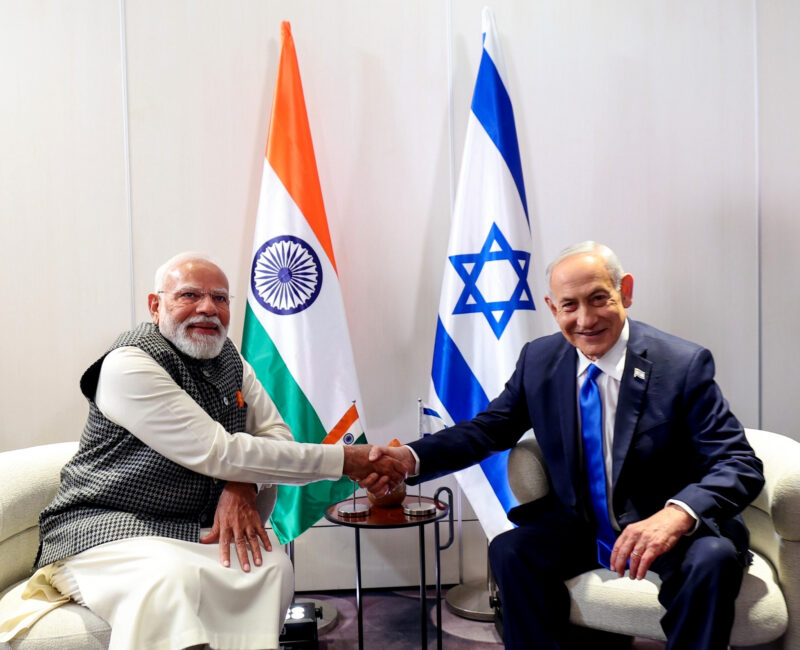
Indian Prime Minister Narendra Modi meets with Prime Minister of Israel Benjamin Netanyahu in New Delhi, India on February 25, 2026.


 Add JewishInsider on Google
Indian Prime Minister Narendra Modi’s visit to Jerusalem this week was an important geopolitical moment for Israel.
The biggest tangible outcome of the visit is that, according to Indian media, Israel plans to transfer Iron Dome and Iron Beam missile-defense technology to India, as part of a defense deal reaching as much as $8 billion-$10 billion. The governments only officially acknowledged “significant growth made in defense cooperation … both in scope and scale.”
As for confirmed deliverables, Israel launched expedited free-trade negotiations with the world’s most populous country and fastest-growing economy. The governments released a nine-page statement announcing agreements in a range of areas, including mineral exploration, AI, agriculture, cultural exchange and recruitment of up to 50,000 Indian workers to Israel in the next five years — fulfilling a major need for Israel, which revoked most work permits for Palestinians after the Oct. 7, 2023, attacks.
But the real impact is likely greater than any specific agreement. It’s the alliance on display between Israel and India — a “special strategic partnership,” as the countries are calling it — that bolsters Israel’s global position at a time when many of the Jewish state’s traditional partners have turned away.
Lauren Dagan Amoss of Bar-Ilan University’s Begin-Sadat Center for Strategic Studies and a leading India analyst in Israel, characterized Modi’s speech to the Knesset as “a threshold moment … designed to justify an upgrade from cordial relations to a partnership with strategic depth and deliverables. … The message was aimed at external stakeholders … especially Washington, the Gulf states, and the broader economic-technological community … rather than treating Israel as a standalone bilateral track.”
That dovetails with Israeli Prime Minister Benjamin Netanyahu’s remarks at a Cabinet meeting on Sunday, where he described his vision of a “hexagon of alliances around or within the Middle East. This includes India, Arab nations, African nations, Mediterranean nations (Greece and Cyprus), and nations in Asia that I won’t detail at the moment.” That “hexagon” creates “an axis of nations that see eye-to-eye on the reality, challenges, and goals against the radical axes, both the radical Shia axis, which we have struck very hard” — i.e. Iran — “and the emerging radical Sunni axis,” meaning Qatar, Turkey, and perhaps India’s historic adversary Pakistan, which signed a defense pact with Saudi Arabia less than six months ago.
Modi’s visit came as the world is watching the U.S. and Iran to try to understand if a military conflict is on the way, and while he did not make any specific reference to the Islamic Republic or nuclear weapons, the Indian leader spoke about terrorism, of which Iran is the leading state sponsor. Modi spoke about Israel and India both having “endured the pain of terrorism for a long time,” and said that “countering terrorism requires sustained and coordinated global action, because terror anywhere threatens peace everywhere. That is why, India supports all efforts that contribute to durable peace and regional stability.”
At a time of acute security needs for Israel, the Indian prime minister showed his understanding of Israel’s “security ethos,” Dagan Amoss wrote, and Modi signaled a shift towards deepening the countries’ defense ties, “from a procurement-centric logic to a capability-building approach: industrial integration, supply-chain resilience, and strategic connectivity through corridors, critical infrastructure, and technology as an enabling platform rather than one-off transactions.”
Rafael Chairman Yuval Steinitz: Israel entering a ‘laser revolution’ in its missile defense

John Keeble/Getty Images
A Rafael Iron Beam -M (250) and Iron Beam (450) High Energy Laser Weapon System (HELWS) are displayed during the Security Equipment International (DSEI) at London Excel on September 10, 2025 in London, England.
Israel’s Iron Beam system, which intercepts missiles with lasers, will be delivered to the IDF for initial operational use at the end of the month, Brig.-Gen. (res.) Daniel Gold, head of the Israeli Ministry of Defense Research and Development Directorate, said at the International DefenseTech Summit at Tel Aviv University on Monday.
“With development complete and a comprehensive testing program that has validated the system’s capabilities, we are prepared to deliver initial operational capability to the IDF on Dec. 30, 2025. Simultaneously, we are already advancing the next-generation systems,” Gold said.
According to Gold, “the Iron Beam laser system is expected to fundamentally change the rules of engagement on the battlefield.”
Former Israeli Finance Minister Yuval Steinitz, chairman of Rafael Advanced Defense Systems, which developed and produced the Iron Beam system, told the Misgav Mideast Horizons Podcast in an episode to be released Wednesday that the new missile defense system represents a “laser revolution.” (Jewish Insider’s Lahav Harkov co-hosts the podcast.)
“For the first time in human history, we are able to shoot down missiles, rockets, even artillery shells, mortar shells, cruise missiles, airplanes as well — not with projectiles, not with missiles or artillery shells, but with light,” Steinitz said.
According to Steinitz, American, Chinese, British, German and Russian companies have tried to develop effective laser weapons for decades.
“We managed to do it and we already intercepted [projectiles] in tests,” he said, noting that Lite Beam, a smaller version of the Iron Beam system, was successfully used in October 2024 to intercept roughly 50 UAVs shot at Israel by Hezbollah from Lebanon.
“This is revolutionary, and I am confident that this is just the beginning,” he added.
Iron Beam will initially be used to shoot down short and long-range missiles from Lebanon and Gaza, and the combined use of Iron Beam and the Iron Dome and David’s Sling missile defense systems, also produced by Rafael, will bring Israel close to 100% interception, Steinitz said.
He does not expect Iron Beam to fully replace Iron Dome nor David’s Sling in the coming years, because factors such as poor weather conditions and very large barrages could make the laser systems less effective.
The use of the laser system will also drastically lower the costs of missile defense, Steinitz said, because each use of the Iron Beam system costs around $3, as opposed to about $50,000 per Iron Dome interceptor. As such, it will cost less for Israel to intercept a rocket than it costs for its enemies to produce them, at $5,000-10,000.
In addition, Steinitz said that the Iron Beam system works faster than the Iron Dome.
“Once the [rocket] is rising over Gaza, interception will start immediately, because the laser can reach the incoming rocket at the speed of light,” he said. “With the Iron Dome, it’s two missiles flying, one from Gaza and one from Tel Aviv to meet each other midway.”
Shooting down rockets over Gaza will also mitigate the need for Israelis to run to shelters and safe rooms due to falling missile and interceptor fragments.
“We won’t sound the alarm in Tel Aviv, because we should be able to see [an interception] immediately if we succeed to intercept, and if we fail to intercept, we will have another opportunity, and then we shall put on the alarm,” Steinitz explained.
Steinitz also said that in the coming years, Rafael is likely to develop laser-based systems to intercept longer range missiles, such as those shot at Israel by the Houthis from Yemen and by Iran in the last two years.
Earlier prototypes with a shorter range have been used throughout the current war, mostly against drones launched by Hezbollah from Lebanon

IMOD/Rafael
Iron Beam laser
The world’s first laser-based missile defense system, known as “Iron Beam,” will be delivered to the IDF by the end of 2025, the Israeli Defense Ministry and arms manufacturer Rafael announced on Wednesday.
The ministry, Rafael and the Israeli Air Force completed tests on the Iron Beam system in recent weeks and said it is fully operational and able to intercept rockets, mortars, aircraft and drones.
The system “features an advanced targeting system that enables enhanced operational range, high precision, and superior efficiency while maintaining its unique advantage of rapidly neutralizing threats using laser technology at negligible cost,” the announcement reads. “The Iron Beam system represents a global technological and engineering breakthrough, expected to integrate into Israel’s multi-layered defense array as a complementary capability to the Iron Dome, David’s Sling, and Arrow air defense systems.”
Earlier prototypes with a shorter range have been used throughout the current war, mostly against drones launched by Hezbollah from Lebanon.
“Now that the Iron Beam’s performance has been proven, we anticipate a significant leap in air defense capabilities through the deployment of these long-range laser weapon systems,” the statement reads.
The Iron Beam will not replace existing missile defense systems, but it will cost significantly less to use lasers to shoot down projectiles than to produce interceptors for the Iron Dome and other systems. In the 12-day war against Iran alone, Israel and the U.S. reportedly spent a combined $1.5 billion on interceptor launches.
In addition, Israel can run out of interceptors, but the Iron Beam can work as long as it has a power source.
Rafael’s CEO and president, Yoav Tourgeman, said that Iron Beam “will fundamentally change the defense equation by enabling precise, rapid and cost-effective interception unmatched by any existing system.”
Israeli Defense Minister Israel Katz said that “this is not only a moment of national pride, but a historic milestone for our defense envelope: rapid, precise interception at marginal cost that joins our existing defense systems and changes the threat equation.”
The Defense Ministry renamed the system in Hebrew from “Magen Or” — light shield — to “Or Eitan,” meaning “strong light” or “Eitan’s light,” in honor of IDF Cpt. Eitan Oster, 22, who was killed in Lebanon and whose father was among the developers of the Iron Beam project.
Please log in if you already have a subscription, or subscribe to access the latest updates.
 Continue with Google
 Continue with Apple