








































































"Iran proved time after time that its promises cannot be trusted," Netanyahu told Witkoff in Jerusalem meeting
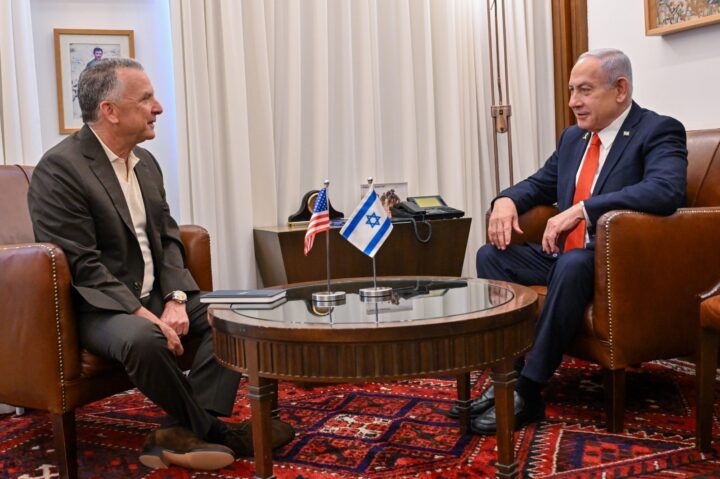
Kobi Gideon (GPO)
Prime Minister Benjamin Netanyahu, meeting in his office with US Special Presidential Envoy to the Middle East Steve Witkoff (Kobi Gideon (GPO)


 Add JewishInsider on Google
There are few things that Ha’aretz and the pro-Netanyahu Channel 14 agree on, but with American and Iranian officials set to meet for nuclear talks on Friday, there was near wall-to-wall agreement in Israel that the talks are unlikely to bring positive results.
Israeli Prime Minister Benjamin Netanyahu told White House Special Envoy Steve Witkoff during his visit to Israel on Tuesday that “Iran proved time after time that its promises cannot be trusted,” according to a statement from the Prime Minister’s Office.
An Israeli military source told Channel 14 that Netanyahu also warned Witkoff that Iran wants to use the negotiations to “kill time … to transfer offensive weapons to hiding places.”
Witkoff, along with Jared Kushner, are set to represent the U.S. in the talks, which were originally set to be held in Turkey but have reportedly been moved to Oman, and Iranian Foreign Minister Abbas Araghchi is expected to lead his country’s negotiating team. Iran has also demanded that the negotiations be limited to its nuclear program, while the U.S. seeks to curb Tehran’s ballistic missile program and support for regional proxies.
Hours after Witkoff met with Netanyahu on Tuesday, Iran launched a drone at the USS Abraham Lincoln, which the military shot down, and a U.S. ship escaped an Iranian attempt to stop it at sea.
Jerusalem eyed the move toward negotiations with Iran with skepticism.
Israeli Energy Minister Eli Cohen, a member of the Security Cabinet, said on Wednesday, “Let’s admit the truth. There is no value to a diplomatic agreement with Iran.”
“Iran has never kept any of its commitments, and even if it agrees to something, it’ll be a hudna [Arabic for a temporary ceasefire] until Trump is out of office,” Cohen told Israel’s 103FM.
Cohen said that “Trump is a businessman who wants the bottom line, and therefore he is taking his time to bring it. Our message to the U.S. is that negotiations with Iran are a waste of time.”
Cohen argued that it is in the interest of the region to see the Islamic Republic fall: “Saudi Arabia, Bahrain, the UAE and Azerbaijan told the U.S. ‘don’t attack Iran’ out of fear. It’s clearly lip service.”
Ehud Ya’ari, the in-house Middle East analyst for Israel’s Channel 12, wrote in an article published Wednesday that the talks will try to reach “an interim arrangement that will relieve the tension without solving the problems.”
“A move like this is not a good enough solution for Israel,” Ya’ari wrote. “An interim agreement means freezing problems, not solving them.”
At the same time, Ya’ari argued that a broader agreement that will satisfy both Trump and Iranian Supreme Leader Ali Khamenei is impossible, though an interim agreement will also be challenging.
Tamir Hayman, director of the Institute for National Security Studies at Tel Aviv University and former IDF intelligence chief, told Ha’aretz‘s Hebrew podcast “The Week” that “anything is better than an agreement with Iran. …Israel does not want an agreement.”
“Israel does not want any nuclear program at all, zero enrichment,” Hayman said. “We’ll want limits to missile manufacturing and the export of terror to the Middle East export of arms. … My concern in light of past statements by Witkoff is that … he’s only dealing with nuclear and for him, any compromise on enrichment [is acceptable].”
Hayman argued that “you can’t bring down a regime that you are negotiating with…Any agreement they reach is a lifeline for the regime.”
However, he added, “even without an attack, [the mullahs] will fall in the end,” citing the tens of thousands of protesters killed and Iranian leadership’s inability to save the country’s collapsing economy.
Hayman said he used to be opposed to “managing the conflict,” but now he believes that the current situation, in which Iran there is a domestic political and economic crisis and no centrifuges are spinning in Iran, “could be good and increase the chances that it will awaken something inside [Iran].”
Meanwhile, Israelis continued to live under the shadow of threats from Iran’s regime, after over a month of concern that Iran may retaliate for an American strike by attacking Israel. The ad for the latest episode of Eretz Nehederet, Israel’s answer to SNL, opened with host Eyal Kitzis looking bored in the studio with ticking clocks behind him and the message: “So, we are still waiting for Iran to attack.”
U.S.-Iran negotiations scheduled are ‘likely a diplomatic box-checking exercise and smokescreen,’ FDD’s Andrea Stricker said, while JINSA’s Jonathan Ruhe said U.S. military action is ‘unlikely for the moment’
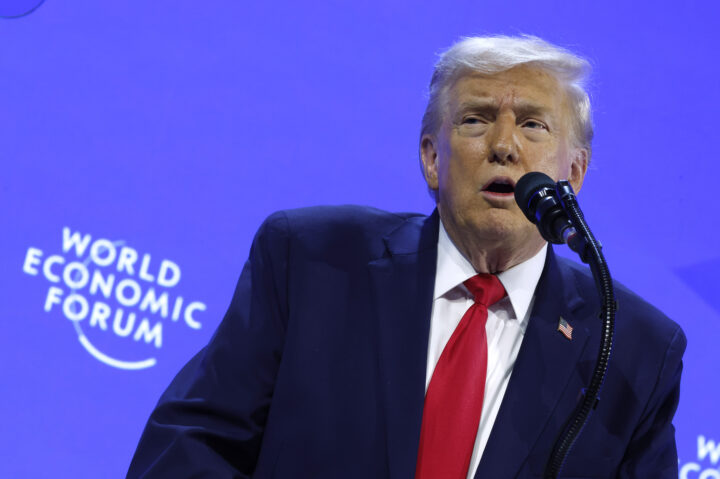
Chip Somodevilla/Getty Images
U.S. President Donald Trump gives a speech at the World Economic Forum (WEF) on January 21, 2026 in Davos, Switzerland.
Despite the Trump administration’s willingness to diplomatically engage with Iranian officials, leading Middle East experts told Jewish Insider on Monday that military action against Tehran still remains a very real possibility.
“I can’t tell you what I’m going to do,” President Donald Trump told reporters on Monday evening when asked about the threshold for an Iran strike.
“We have a tremendous force going there [to the Middle East], just like we did in Venezuela,” said Trump. “I’d like to see a deal negotiated. But right now, we’re talking to [Iran] and if we could work something out, that’d be great. If we can’t, probably bad things will happen.”
White House Special Envoy Steve Witkoff and Iranian Foreign Minister Abbas Araghchi are expected to meet in Istanbul on Friday to discuss a potential new nuclear agreement, according to reports. Jared Kushner, who has played a key role in recent high-profile diplomatic negotiations, is also expected to attend, alongside the foreign ministers of Turkey, Qatar, Egypt, Oman, Saudi Arabia and Pakistan, in the first meeting between the U.S. and Iran since U.S. strikes on Iranian nuclear facilities last June.
The planned talks come as the administration continues to exert pressure on Tehran — in response to Iran’s violent crackdown on protesters last month, Trump has publicly weighed the possibility of U.S. military intervention, ordering the movement of additional military assets into the region and issuing a series of stark warnings on social media indicating that U.S. forces are “ready, willing and able to rapidly fulfill [their] mission, with speed and violence” should a deal fail to be made.
While the administration has emphasized diplomacy as its preferred path, analysts caution that negotiations do not necessarily signal that the U.S. will not strike.
“Military intervention remains likely in light of President Trump’s demonstrated willingness to use force and the U.S. military buildup in the region,” said Michael Koplow, chief policy officer at the Israel Policy Forum. “Given the gulf between the American and Iranian positions and the general hard-line position of the Iranian regime on nuclear issues, it is hard to tag a nuclear deal as a likely outcome.”
Andrea Stricker, a research fellow at the Foundation for Defense of Democracies, told JI that a strike does remain on the table. She said that a deal could be difficult to reach and the upcoming meeting in Istanbul is unlikely to yield meaningful results or concessions from Iran.
“The planned meeting is likely a diplomatic box-checking exercise and smokescreen to enable a continued U.S. military buildup before Trump authorizes strikes,” Stricker said. “The administration’s demands that Iran abandon nuclear enrichment, cap its missile program, and halt support for regional proxies and terrorism, as well as stop executing its people, are nonstarters for the regime.”
Koplow said the administration’s “mixed signals” on whether it will seek diplomacy or take military action are likely “not a ruse or a diversion,” but instead a signal that Trump “has not actually made up his mind” and is “unsure what his end goal is.”
Jason Greenblatt, who served as White House Middle East envoy in the first Trump administration, asserted that “there’s no mixed signals,” arguing that the president’s messaging has been clear.
“President Trump has made the choice clear: a real, enforceable deal that ends Iran’s nuclear and missile threats and protects the U.S., our allies, and the Iranian people — or decisive action,” said Greenblatt, who emphasized that while Trump is reluctant to engage in war, the president will not accept an agreement he views as insufficient.
“He is not a war president,” Greenblatt said, “but he will not accept a weak deal. Iran’s leadership should understand by now that President Trump means exactly what he says.”
Stricker also noted that Trump has consistently sought to avoid prolonged conflict, but argued that Iran’s internal repression and continued nuclear advances may push the president toward decisive action. On Saturday, satellite images revealed new activity at Iranian nuclear sites, a potential sign that Tehran is aiming to salvage remaining materials from the June strikes.
“President Trump favors stability and prioritizes ending violence in global affairs,” she said. “After achieving the defanging of Tehran’s nuclear program, the regime has shown it remains a threat — the ongoing massacre is too much for Trump to tolerate as the leader of the free world.” “The president will likely ensure the regime pays a price, but whether the price is regime change remains to be seen,” she added.
When detailing what potential U.S. military intervention could look like, Koplow said that it would likely be “limited” in scope.
“Any U.S. action is likely going to fall short of what the Israelis would like to see, which is a campaign that doesn’t stop until the regime has fallen,” said Koplow. “Trump seems to favor quick strikes, and he is also facing wall-to-wall opposition from Arab states regarding the prospects of a long campaign that destabilizes the region and damages prospects for trade, investment, and growth.”
However, other analysts read the shift to negotiations as a signal that intervention is increasingly unlikely. Jonathan Ruhe, a senior fellow at the Jewish Institute for National Security of America told JI that U.S. military action is “unlikely for the moment.”
“An even bigger concern now is that military action could be off the table indefinitely, in a way it wasn’t just a day or two ago, as renewed talks now seem more likely,” said Ruhe.
Ruhe also noted that a key indicator of Trump’s intentions will be “how long he keeps the ‘armada’ within striking distance,” referring to the U.S. military assets in the region. He added that negotiating with Tehran will likely result in an unfavorable outcome for the U.S.
“Negotiating with Iran is absolutely the worst possible option for the United States now, because Iran’s regime will go from being on the ropes to thinking it prevailed,” said Ruhe, noting that Tehran is unlikely to agree to an “acceptable deal,” instead using the “prospect of talks to stave off military threats.”
“[Iran] is trying to do what it always does, playing for time and seeing what concessions it can wrangle without ever giving up anything itself,” Ruhe added. “This leaves zero upside for the U.S., since Iran is too emboldened to agree to serious concessions. There’s plenty of downside, too, since U.S. credibility would be dangerously eroded in Tehran’s eyes if Trump fails to fulfill his earlier threats.”
Koplow said Jerusalem is also concerned about a potential nuclear deal and is likely to perceive Iran’s willingness to enter talks as a way of “dragging out the process indefinitely.”
“[The Israelis] are concerned that Trump will back off his threats to take action or end up signing a deal that falls short of addressing the entire basket of issues — nuclear, missiles, and proxies,” said Koplow.
Ali Shamkhani, a senior adviser to Iranian Supreme Leader Ali Khamenei, had said Tehran would strike Israel in response to any U.S. military action, in an interview with the Lebanese-based Al Mayadeen.
Stricker warned that any agreement that falls short of dismantling the regime’s power structure and fails to address key issues would be problematic not only for the U.S. and Israel, but for the Iranian public.
“Any deal with the Islamic Republic would represent a historic betrayal of the Iranian people,” Stricker said. “The only negotiation America should entertain with Tehran is the exit of top regime officials from Iran and their relinquishing of power prior to an orderly transition to democracy.”
Please log in if you already have a subscription, or subscribe to access the latest updates.
 Continue with Google

 Continue with Apple