

























Any potential agreements between Jerusalem, Beirut and Washington will ultimately hinge on whether Hezbollah can be fully disarmed
Andrew Harnik/Getty Images
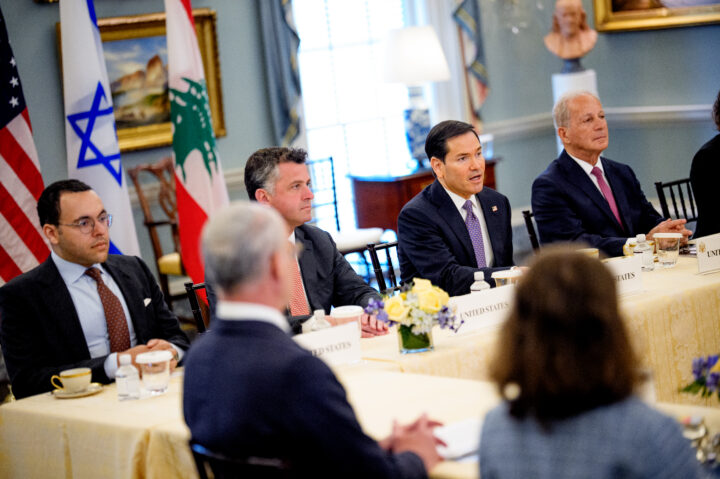
U.S. Secretary of State Marco Rubio (2nd-R), accompanied by U.S. State Department Counselor Michael Needham (C), and U.S. Ambassador to Lebanon Michel Issa (R), speaks as they begin working-level peace talks with Lebanese Ambassador to the U.S. Nada Hamadeh Moawad and Israeli Ambassador to the U.S. Yechiel Leiter at the U.S. State Department on April 14, 2026 in Washington, DC.


 Add JewishInsider on Google
The first round of direct talks between Israel and Lebanon has been received positively by diplomats, pro-Israel lawmakers and experts, who see it as a sign of Hezbollah’s waning influence in Lebanon. But despite the optimism surrounding the discussions, experts caution that disarming the terrorist group remains a daunting obstacle that stands in the way of any meaningful change — one that would require a significant shift from the Lebanese government and its armed forces.
On Tuesday, Israeli and Lebanese leadership convened at the State Department in Washington for the highest-level direct discussions in more than 30 years, aiming to outline a framework for “lasting peace” and a “permanent end” to Hezbollah’s influence, according to Secretary of State Marco Rubio.
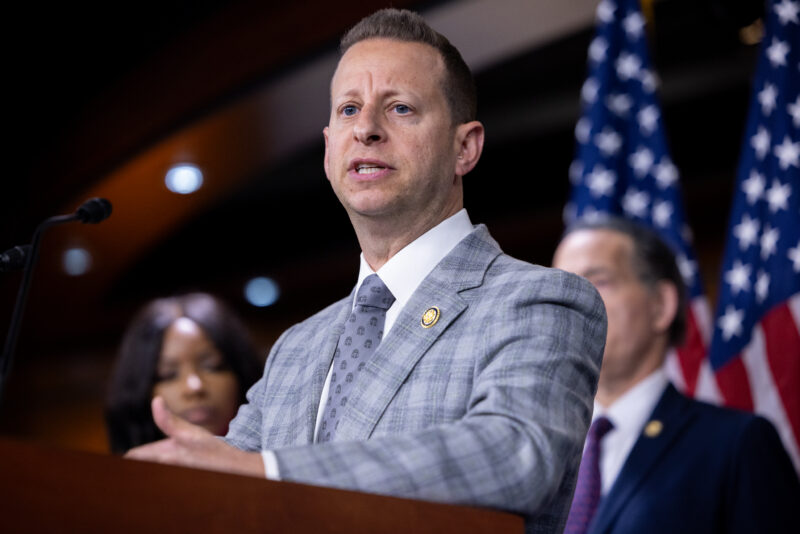
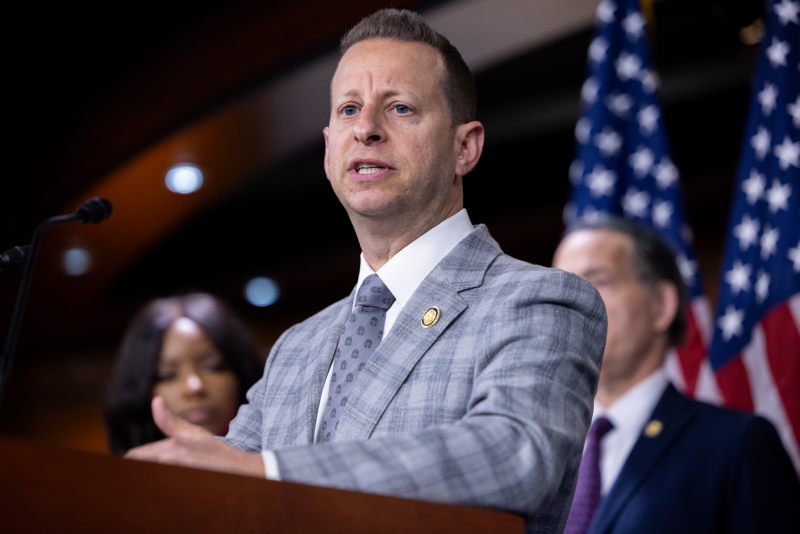
Rep. Jared Moskowitz (D-FL) told Jewish Insider that “it is great” that talks are taking place, expressing hope that “the Lebanese government, the United States and the Israeli government make a deal, and collectively, they push Hezbollah out.”
“That way the Lebanese people can be freed from the Iranian extremism that they have in their country,” Moskowitz said. “The Lebanese people are being held captive by the Iranian government because of Hezbollah. It’s obviously good for the United States, it’s good for Israel, but more importantly, I think it’s good for the people of Lebanon. I think disarming Hezbollah is obviously key to all this.”
Moskowitz added that while the Lebanese government appears to want to disarm Hezbollah, “they probably need help.”
“It’s not going to happen overnight, but I think it’s historic, and this is what the entire region wants,” he said. “This is what the Gulf states want. Everybody wants to come out of the extremism and the terrorism that Iran is trying to spread in the region.”
Sen. Rick Scott (R-FL) similarly told JI that Hezbollah disarmament is an important factor in talks.
“Why would you have talks if they [Hezbollah] are not going to disarm?” Scott said. “I’m not the prime minister of Israel but my condition would be that Hezbollah has got to disarm.”
Scott dismissed the notion that the Lebanese government and the Lebanese Armed Forces have not done enough to disarm the group, stating that the main problem is “not caused by Lebanon or by the military of Lebanon, it’s caused by Hezbollah.”
Sen. John Cornyn (R-TX) said that disarming Hezbollah should be a “red line” for Israel in talks. He added that Israel “needs a buffer zone so Hezbollah can’t continue to rain down terror on Israelis.”
“Hezbollah has historically been the best trained, best equipped opponents to Israel,” Rep. Don Bacon (R-NE) said. “Israel’s done a great job with them over the last two years, but they’re hardcore fervent believers in destroying Israel.”
Experts similarly described the talks as a meaningful development. John Hannah, a senior fellow at the Jewish Institute for National Security of America, called the discussions an “important breakthrough” and a sign of Hezbollah’s diminishing influence.
“Everyone should welcome the opening of a direct political dialogue between Israel and Lebanon,” Hannah said. “The fact that [the talks are] occurring at all is an important sign of Hezbollah’s declining hegemony over the Lebanese state.”
Robert Satloff, executive director of the Washington Institute for Near East Policy, described the talks as a “win-win-win” in a social media post, adding that Hezbollah emerged as a “big loser.”
“Today is a day to celebrate — we all saw a glimpse of what is possible after so much violence and conflict,” Satloff wrote on Tuesday. “That is a very good thing.”
Still, experts say disarming Hezbollah, which parties agree is necessary for any lasting piece, remains highly difficult and uncertain.
Even before Tuesday’s opening round of discussions, Hezbollah senior member Wafiq Safa said Hezbollah is “not bound” by any deals reached between Israel, Lebanon and the United States.
“It’s hard to be an optimist when it comes to the core question of Hezbollah’s disarmament,” Hannah said. “Even after all that’s been done over the past few years to weaken the group and its Iranian sponsors — including the loss of its legitimacy in the eyes of a majority of Lebanese — it’s not at all apparent that the raw balance of forces inside Lebanon has shifted sufficiently to favor Hezbollah’s near-term demise.”
Hannah described disarming Hezbollah as “worth trying,” but ultimately a “long shot.”
“Since the war against Iran broke out on Feb. 28, Hezbollah has shown through its sustained attacks on Israel that, while much diminished, its forces retain far more significant capabilities than many believed,” he said. “And in the wake of its battle against Israel, Hezbollah is making clear that if push comes to shove, it’s prepared to burn down the state before surrendering its weapons.”
Blaise Misztal, JINSA’s vice president for policy, said the task cannot be accomplished through Israeli military action alone and will ultimately depend on whether Lebanon and the LAF are willing to act.
“[Disarming Hezbollah] can only be fully done by a strong and committed Lebanese government,” Misztal said. “Israel can secure southern Lebanon with ground operations and strike Hezbollah sites in Beirut or the Bekaa Valley, but that will merely distance and degrade the threat, never fully remove it.”
“The question is whether the Lebanese government is, or can be convinced to be, strong and committed enough to take on the task of asserting its control over its own territory,” he added. “Thus far, it has failed to demonstrate either the political will or military capability to do so.”
Hannah similarly noted that “Israel is rightly unwilling to pay the necessary cost in blood, treasure and diplomatic opprobrium” required to fully dismantle Hezbollah, leaving the responsibility to Lebanon and its armed forces.
“The factor that has truly held Lebanon back from disarming Hezbollah has been Hezbollah’s retention of, as far as we can tell, overwhelming support among Lebanese Shiites,” David Daoud, a senior fellow at the Foundation for Defense of Democracies, said. “Having retained that popular support, it can deter the government from pursuing forcible disarmament by dangling the threat of civil war.”
But experts weren’t optimistic that the Lebanese government and LAF are capable — or willing — to take on that role. Hannah said Lebanon’s military “doesn’t appear to have the stomach to truly confront Hezbollah and dismantle the group’s armed wing,” noting that it has already “failed” to disarm the group in southern Lebanon, “much less the rest of the country.”
“It seems even less likely than before the Iran war that the LAF would now be willing to take on the risk of massively confronting Hezbollah,” he said, “in spite of the misery Hezbollah’s unilateral decision to enter the conflict on Iran’s behalf is now inflicting on the rest of Lebanon.”
David Daoud, a senior fellow at the Foundation for Defense of Democracies, also said Beirut “ultimately holds the key” to resolving the issue of Hezbollah’s disarmament. He said that while Lebanon has taken “immense and commendable” steps in “proscribing Hezbollah’s military activities,” the country’s “unwillingness to act against Hezbollah has been missing from the equation” and has “allowed the group to regenerate in the past.”
He added that Hezbollah still “retains enough military strength to make disarmament daunting” for Lebanese forces and the LAF, and that the group continues to wield significant political power.
“The factor that has truly held Lebanon back from disarming Hezbollah has been Hezbollah’s retention of, as far as we can tell, overwhelming support among Lebanese Shiites,” Daoud said. “Having retained that popular support, it can deter the government from pursuing forcible disarmament by dangling the threat of civil war.”
Daoud also raised concerns about Lebanon’s intentions in negotiations, arguing that Beirut may not truly be seeking meaningful change.
“A good test will be the extent to which the LAF fulfills the Lebanese government’s order from early April to put all of Beirut under its full control,” John Hannah, a senior fellow at the Jewish Institute for National Security of America, said. “Will the LAF truly confront and disarm Hezbollah in the capital or simply repeat the phony disarmament it claimed to have completed in the south?”
“Lebanon is seeking to use the negotiations to return to the status quo, and is willing to ‘pay the price’ of a joint photograph with an Israeli ambassador to achieve that objective,” he said. “This is because the situation in Lebanon is indeed dire — economic collapse compounded by war, the direct impact of the war itself and the emergence of sectarian tensions that could boil over into full-on conflict.”
If those dynamics remain unchanged, he warned that Hezbollah could indefinitely delay disarmament and eventually rebuild its strength.
“A good test will be the extent to which the LAF fulfills the Lebanese government’s order from early April to put all of Beirut under its full control,” Hannah said. “Will the LAF truly confront and disarm Hezbollah in the capital or simply repeat the phony disarmament it claimed to have completed in the south?”
Satloff said the challenge will ultimately require translating diplomacy into “practical steps,” including a shift in how the Lebanese military approaches disarmament.
“While some of this can happen in the negotiating room when the parties meet again, nothing can substitute for strong measures by the Lebanese state to isolate, weaken, delegitimize and disarm Hezbollah while promoting the idea of peace,” he said.
He suggested that turning Beirut into a “true weapons-free zone” is necessary “but not sufficient,” pointing to additional steps such as removing Hezbollah officials from government, expelling Iranian operatives from the country and shutting down the group’s financial and institutional networks.
Experts are raising red flags on the technology’s ability to influence voters and the lack of regulations around its use

Haim Zach/GPO
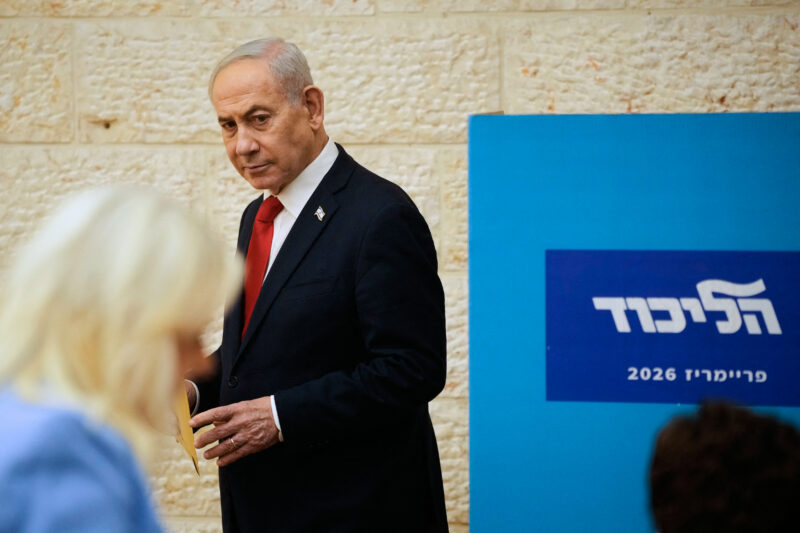
Israeli Prime Minister Benjamin Netanyahu votes in the September 2019 national election.
The run-up to next year’s Israeli election will be the first in which artificial intelligence tools to create images and videos and rapidly compose texts are easily accessible, and experts are raising red flags over the technology’s ability to influence voters and campaigns and the lack of regulations around its use.
Israeli politicians have long been early adopters of technological tools to boost their campaigns, from bypassing traditional media through Facebook to using social media data to target key demographics before most liberal democracies were doing so, and AI will likely be no different.
Tehilla Shwartz Altshuler, head of the Democracy in the Digital Age program at the Israel Democracy Institute, told Jewish Insider that Israel is one of the countries with the largest market penetration of AI in the world — 85% of Israelis have used ChatGPT and 76% use it frequently, according to a study by the Israeli Internet Association published in October — so it is only a matter of time before politicians use it in their campaigns.
(National elections are legally required to take place on Oct. 26, 2026, at the latest, but political tensions make an earlier date possible.)
“AI chatbots have significant penetration in the public,” Shwartz Altshuler said. “They will be used to ask whether to vote and for whom to vote. We have not seen anything like this before. … People use chatbots as a companion for emotional support. The concern over the great influence of chatbots on voter behavior is significant.”
Shwartz Altshuler said that there have already been attempts to “give poison injections” to AI models, such as creating fake news sites and positions on subreddits to manipulate the bots into giving more pro-Israel responses to users abroad, and those tools can be turned inward, toward Israeli voters.
She also pointed out that Israel does not have any laws requiring machine-generated content to be labeled.
“This is the first time we have an election in which we are unable to differentiate between authentic and machine-generated photos and videos,” she said. “There is a fear that the perception of reality is being undermined. People can forge documents and make deepfakes of politicians. … Machine-generated content can create an alternative reality, a very dangerous prospect when the content is very emotionally attractive.”
Yuval Dror, the former dean of media studies in Israel’s College of Management Studies, who hosts a popular technology podcast in Hebrew, was skeptical that computer-generated photos and videos will have a major impact on the next election.
“With photos, sometimes we can tell if it’s AI or not. With video, people usually know that it’s AI,” he told JI. “The impact of [AI-generated] video will mostly be economic, because it will be much easier to produce. In the past, you needed an ad agency, actors, post-production work. Now it’s much easier, so [campaigns will] save money.”
“You can create a false presentation in which masses of people say this or that and look like a grassroots movement,” Yuval Dror, the former dean of media studies in Israel’s College of Management Studies, said. “There is [already] an army of bots echoing a few people on social media.”
Dror was more concerned about AI-generated texts, which he noted can be much harder to detect.
AI may be used in upcoming political campaigns to flood social networks with content, making a candidate, message or policy appear to have more support than it does in reality. This already happens on X, where much of the political discourse in Israel takes place, but also in more closed networks like WhatsApp and Telegram, Dror said.
“You can create a false presentation in which masses of people say this or that and look like a grassroots movement,” Dror said. “There is [already] an army of bots echoing a few people on social media.”
“We’ve seen this for years. It will just get more and more convincing,” he added.
Shwartz Altshuler said that social media companies have difficulty stemming mass-bot content. “Generative AI can create a lot of versions of the same content, so the result is inauthentic, coordinated behavior on social media,” she said. “If there are slightly different versions of the same content, the social networks don’t detect” that it comes from bots.
“Most of these [AI tools] are not mentioned in the law or by past Central Election Committee decisions. They are in a grey area. [Campaigns] will do what they want,” Tehilla Shwartz Altshuler, head of the Democracy in the Digital Age program at the Israel Democracy Institute, predicted.
In addition, developments in AI since the last Israeli election, in 2022, can help politicians use data even more effectively to target potential voters with different kinds of messages and ads, she said.
Shwartz Altshuler recounted speaking with a prominent Israeli political strategist who told her, “First we win elections, and then we see if what we did is legal or not.”
“Most of these [AI tools] are not mentioned in the law or by past Central Election Committee decisions. They are in a grey area. [Campaigns] will do what they want,” she predicted.
Despite the fertile ground for election fraud using AI, Shwartz Altshuler said it is unlikely that new laws will be passed before the next election. “This coalition has no motivation to pass such laws [and] usually the courts say laws [regarding elections] can only be applied after the next election.”
She also pointed out that the current Central Election Committee chairman, Noam Solberg, is a conservative Supreme Court justice, and therefore would be unlikely to instruct the Knesset to pass laws addressing the issue.
Despite all the advances in AI, it may not be enough to cover for a weak candidate.
Dror said that Israeli politicians are already using AI to write texts for social media or speeches: “Some politicians are not capable of stringing together two sentences, so they let AI do it, but the result is no less awkward.”
They have also generated all kinds of pictures to post online, which Dror said “makes [them] look stupid,” using Israeli Environmental Protection Minister Idit Silman, who posted a picture earlier this year depicting French President Emmanuel Macron kissing Hamas leader Yahya Sinwar, as an example. Israeli Defense Minister Israel Katz frequently posted AI-generated images ridiculing Israel’s enemies when he was foreign minister last year.
“I don’t know that there’s an audience for this stupidity,” Dror said.
The new ISGAP report cites authenticated Muslim Brotherhood documents describing the group’s strategy of entrenching itself in the institutions of Western democracies
Salah Malkawi/Getty Images
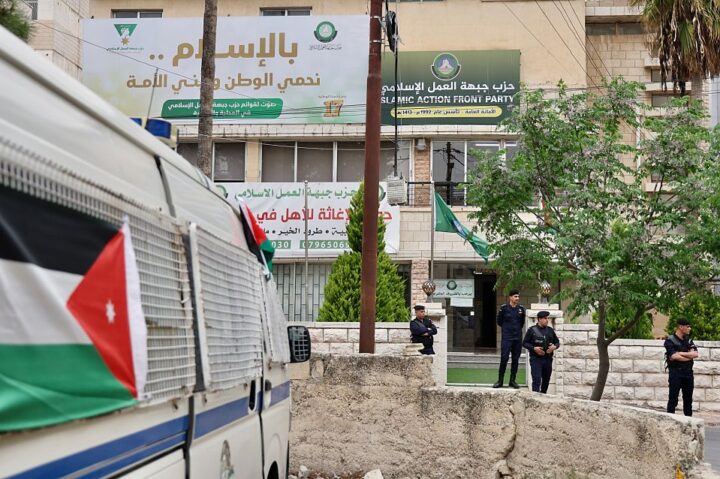
Jordanian police close the entrance of a Muslim Brotherhood headquarter after the announcement of banning the society in the country on April 23, 2025 in Amman, Jordan.
The Muslim Brotherhood’s influence has become increasingly pervasive in the United States, according to a new report by the Institute for the Study of Global Antisemitism and Policy, titled “The Muslim Brotherhood’s Strategic Entryism into the United States: A Systemic Analysis.”
President Donald Trump’s recent instruction to Secretary of State Marco Rubio to take steps toward banning Muslim Brotherhood-affiliated organizations came soon after ISGAP briefed policymakers from both parties and national security professionals, including Trump administration officials, in Washington and beyond about the study.
“For decades now, we’ve known that Islamism has been a problem within our liberal secular democracies,” ISGAP Vice President Haras Rafiq told the Misgav Mideast Horizons podcast. (Jewish Insider’s Lahav Harkov co-hosts the podcast.)
The new ISGAP report cites authenticated Muslim Brotherhood documents describing the group’s strategy – called tamkeen, which loosely translates to “empowerment” – of entrenching itself in the institutions of Western democracies.
“It was a 100-year plan, and they’re 43 years into it,” Rafiq said. “We looked at the who, why, what, where … and then analyzed how well we’re doing against it.”
The Muslim Brotherhood’s basic goals, he said, are “to set up a utopian Islamist state and enforce their vision of Sharia-based law on the whole state, and secondly, to spread that around the world. … [Their] tactic, the opium of the masses, is to wipe Israel off the map.”
In liberal democracies, one of the major elements of the plan is “figuring out a way to persuade Muslims, if you’re living in the West, that the Islam that your parents practice … is actually wrong and it fits into … innovation, false association with a deity, [and] haram, which means not allowed,” Rafiq said. “So first of all, change the Islam that’s practiced from within.”
The way the Muslim Brotherhood relates to non-Muslim societies, Rafiq said, is to “try to persuade others by using a faith-based identity politics which aligns with what they believe — that they are the proper Muslims. And over time, there are four key areas where they focus: One is political infiltration and legislation, the second is controlling the narrative, the media, the third is how they can increase the capacity [of those steps], and looking at Muslims and changing from within.”
Rafiq said that Muslim Brotherhood-sympathetic organizations latched onto the Sept. 11, 2001, attacks to increase their influence.
“It was a time when there was a lot of confusion,” he recounted. “What organizations like CAIR [the Council on American-Islamic Relations] and others were able to do was to latch onto people who wanted to understand who were these Muslims, why did people want to fly planes into the Twin Towers … and they actually were very quick to latch onto the media, the politicians, the people within civil society who were hungry to know more, and become one of the main voices.”
Texas Gov. Greg Abbott, a Republican, recently declared both the Muslim Brotherhood and CAIR to be foreign terrorist organizations banned from the state. Rafiq pointed out, however, that the state has not seized any assets or taken any concrete action against the organization.
The difference between CAIR, which presents itself as an advocacy group for a minority population, and other organizations that aim to do the same, Rafiq said, is that “ultimately, at the end of the day, the people who set up the organization actually are part of the Muslim Brotherhood Islamist worldview, and ultimately are trying to … use entrenchment to change the liberal democracy from within.”
Rafiq also cited ties between CAIR and unindicted co-conspirators in the Holy Land Foundation trial, the largest terrorism finance trial in the U.S., which shut down an organization that was funding Hamas.
“I guess other non-Islamist organizations that represent Muslims and other organizations don’t want those objectives and are not involved in these kinds of criminal activities,” he said.
CAIR has “been able to persuade and fool people that they’re actually representing Islam and Muslims and they’re the correct voices,” he said. Still, Rafiq cited polling that out of 1.9 billion Muslims worldwide, 1.4 billion reject Islamism, which includes the Muslim Brotherhood.
“The good news is still that the majority of Muslims around the world reject Islamism,” Rafiq said, while noting that he did not have specific data about the U.S.
However, Rafiq said that the Muslim Brotherhood has successfully inculcated young Muslims in the West with antisemitism.
“Antisemitism is a key tool that they use in the guise of being anti-Israel or anti-Zionist, etc., to recruit people to their worldview,” he said.
Rafiq called Qatar “the last man standing” in the Sunni Arab world, in that its regime supports the Muslim Brotherhood.
“Muslim Brotherhood Islamist ideology is deeply entrenched within all parts of [Qatar’s] civil society, all the way to the top,” he said. “As a result of this entrenchment … they’ve used tamkeen successfully across the board, from educating children all the way up to civil society organizations and the leadership. One can say the Muslim Brotherhood has a funding arm, which is directly the Emir and the institution, the country, the economy and the corporation that is Qatar.”
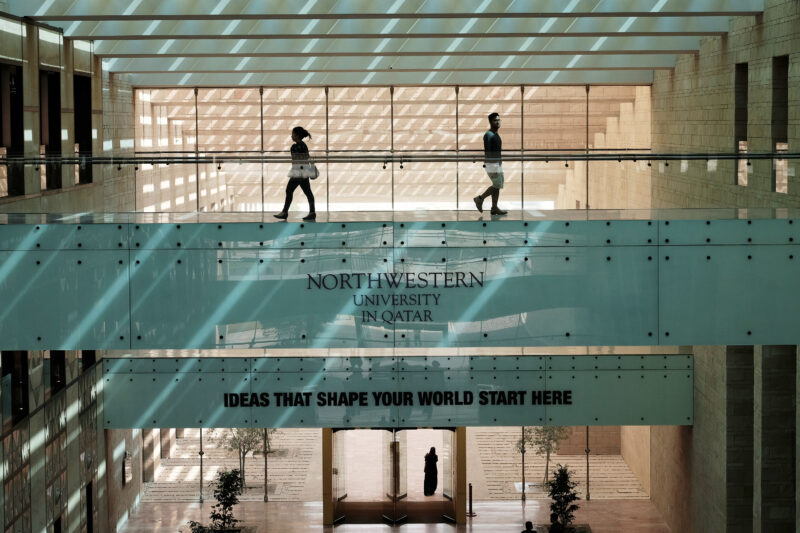
ISGAP has estimated that Qatar’s soft power assets worldwide are worth $1 trillion. The Gulf state is the largest state donor to universities in the U.S., and much of those donations are undocumented.
Qatar spreads the Muslim Brotherhood’s messages via Al Jazeera in Arabic and English.
“The English one will be a lot more palatable, but still pushing the Islamist narrative. The Arabic is downright nasty – and they get away with it, because what they’ve done is set up Al Jazeera as a corporation,” Rafiq said. “But they are 100% owned by the Qatari royal family. Therefore, in my view, when they operate in the U.S., they should [register] under the Foreign Agents Registration Act.”
Rafiq said the West can do more to make support for the Muslim Brotherhood more costly for Qatar and discourage its leadership from continuing. One example he gave is an ISGAP report exposing Qatari funding for Texas A&M, including a contract that said all of the research projects are property of the Qatar Foundation – including those with dual-use purposes that could be used to develop weapons. After initially denying the links, the president of the university pulled it out of Education City in Doha.
“That really hurt [Qatar],” Rafiq said. “The reason I know it hurt them was that we are constantly besmirched and lies are told about us and we are targeted by the Qatari government.”
Another win, Rafiq argued, was the Israeli strike on Doha in September.
“That was the key moment in which they realized that even though they have a defense agreement with the U.S., they can’t really hide. But the downside was that rather than actually use that and push on the advantage, what the U.S. government has done is create the situation with the ceasefire in Gaza … and pushed out countries like Saudi Arabia and the U.A.E. … and decided to bring in Qatar and Turkey, and that’s a problem.”
“We need more support from [the Trump administration] in terms of Qatar, and not to be taken in by geopolitics,” he added.
Rafiq compared fighting the Muslim Brotherhood without taking on Qatar to taking aspirin when you have cancer.
“Islamism is a virus or a cancer … which is spreading rapidly, and unless we deal with it, the root cause, and we persuade Qatar to stop funding it … it won’t really make a difference,” Rafiq said.
One of the challenges in combating Islamism, Rafiq said, is that “we don’t make it easy to recognize Islamism in the same way that we recognize fascism and communism … [because] they’ve been able to push this narrative so effectively of Islamophobia.”
“Islam is a set of ideas, a set of values. In a liberal democracy, no set of ideas should be beyond critique, satire or even parody, even if they are ideas that I believe – and I’m a Muslim,” he said. “The people who are intolerant have persuaded us that these concepts are intolerant; therefore, we fall in line.”
Please log in if you already have a subscription, or subscribe to access the latest updates.
 Continue with Google
 Continue with Apple