














































































At an eJP–ANU election panel, representatives of eight Zionist parties laid out plans on aliyah, antisemitism and pluralism; the governing coalition sent no one

Screenshot
Jewish Insider and its sister publication eJewishPhilanthropy and Anu: The Museum of the Jewish People's Tisch Center for Jewish Dialogue conducts an election panel at the museum on Wednesday, moderated by eJP Managing Editor Judah Ari Gross


 Add JewishInsider on Google
Many Diaspora Jews who care about the future of Israel have been watching the election campaigns in Israel unfold from afar.
And while Diaspora affairs do not rank high in Israelis’ concerns in Oct. 27 election — security and the economy are the top issues — most Zionist political parties have given thought to the issue, whether in their platforms or when candidates are asked about antisemitism and Israel’s connection to world Jewry.
Jewish Insider and its sister publication eJewishPhilanthropy, in partnership with Anu: The Museum of the Jewish People and the Peoplehood Coalition, conducted an election panel at the museum on Wednesday, moderated by eJP Managing Editor Judah Ari Gross, to hear how the parties plan to commit themselves to ties with global Jewry. The event was also supported by Anu’s Tisch Center for Jewish Dialogue, the American Zionist Movement, Global Jewry, Belong, Masa and the Jewish Federation of Tulsa (Okla.).
The following are their answers, condensed for space and clarity:
Yashar, led by Gadi Eisenkot:
Alex Rif, who was born in Ukraine in the former Soviet Union and founded an activist movement for Russian-Israelis, spoke about the discrimination and harassment Jews faced in the Soviet Union, but said when they arrived in Israel, they were made to feel “not Jewish enough.”
“My parents would tell me about times when people in the Soviet Union didn’t tell others that they were Jews because they were afraid. Unfortunately, we are going again to these times,” she said.
Rif said that “the issues of aliyah and absorption are in [Eisenkot’s] heart. … We have so many problems today. The antisemitism is rising. … [yet] this government, Netanyahu’s government, tried over and over to change the Law or Return, to cancel the grandchild clause” — meaning that anyone with one Jewish grandparent can immigrate to Israel — “and we’ve defended it.”
Rif called for “an international coalition to fight antisemitism,” to invest more in Birthright and Masa programs and to promote “an inclusive and respectful Judaism,” as well as protect the Law of Return.
Likud, led by Prime Minister Benjamin Netanyahu:
Diaspora Affairs Minister Amichai Chikli did not attend as planned, and Likud did not send anyone in his place. Otzma Yehudit, Religious Zionist Party, Shas and United Torah Judaism declined to participate in the panel, which meant that the current governing coalition was not represented.
B’Yachad, led by Naftali Bennett:
Moshe Kinley Tur-Paz, a lawmaker from Yesh Atid, one of the parties comprising B’Yachad, was born in Philadelphia but grew up in Israel. He said that he has been “trying to bring the voice of the Jews around the world, of world Jewry to Israel … and because Bennett himself also comes from a family of [immigrants to Israel] this is something very lively and very committed in our party.”
Tur-Paz said that while Diaspora Jews cannot vote in Israel, their position should be brought up in legislative debates, proposing a non-voting 121st Knesset member to represent them in parliament. In addition, he called for funding for more Hebrew learning around the world, and emphasized the need to connect young Diaspora Jews to Israel as well as to educate Israelis about world Jewry, which he repeatedly said was lacking. In addition, he called to form a task force to fight antisemitism.
Tur-Paz said that when he was a principal, he partnered the school in Israel with an Australian school so that the children could learn together online and connect. “Education is everything,” he said.
He also spoke about the Western Wall plan to allow pluralistic prayer services at the holy site, which was proposed and then shelved in the 2010s. “We need every Jew to feel in the [Jewish] Quarter as if it [belongs to] himself. … We will bring it back to the Jews of the world so everyone will feel that this is his land and it is his Kotel.” Asked why his party did not advance the issue when it was in power, Tur-Paz gave what he called a “scoop” that he had been drawing up legislation to do so before the coalition collapsed.
The Democrats, led by Yair Golan:
Gaby Lasky, a former Knesset member best known as a lawyer defending Palestinians and far-left activists against charges in Israel, moved to Israel from Mexico by herself at age 15. “Israel is the state of all the Jews around the world,” she said. “We believe that the connection between the state and Jewish communities outside of Israel is part of our identity, is part of our responsibility.”
The Democrats, she said, “believe in the values of the [Israeli Declaration] of Independence. We believe that Israel has to be a democratic and Jewish state, and for those reasons, we fight for Israeli democracy. … We fight for Israel to be a Jewish state, and that means … all the [denominations] of Judaism, not only Orthodoxy. … We have to change in Israel the fact that only Orthodox [conversion] is accepted. … We all share in common one thing, and that is Tikkun Olam. We believe that we can change this place for the better, and we can only do it if we do it together.”
Yisrael Beiteinu, led by Avigdor Liberman:
MK Oded Forer, a former cabinet minister and the former director-general of the Immigration and Absorption Ministry, said that Israel is “the land of all the Jewish people around the world. You’re a member of the Jewish people — this is your state. Even if you haven’t visited here once.”
Forer said that the mission of encouraging Jews to immigrate to Israel “isn’t complete. We need the majority of the Jewish people to live in Israel. .. I’m sure that we can do it.”
Forer called to help fund security and Jewish education for Diaspora communities. He also expressed appreciation for the generosity of Diaspora communities after the Oct. 7 Hamas-led attacks. Reflecting on both, he said that Israel’s support for world Jewry should be “unconditional” and so should world Jewry’s support for Israel.
Reservists and Economy Party, led by Yoaz Hendel: Writer and former Knesset member (2010-2013) Einat Wilf, whose Oz party merged with Hendel’s, said that she had been one of the small number of Knesset members who devoted time to Diaspora issues and said she had an “absolute, ongoing, unbroken commitment to this relationship … and this will not change whether there are or are not votes in it.”
She called for “more stable, organized, institutionalized, consultative mechanisms by which the Jewish people can have their voice heard and participate in having their voice heard, short of voting.”
“One of the ironic successes of Zionism is that Jews in Israel live in a bit of a bubble, and we do not realize how dangerous what is being built around us in the world,” Wilf said, adding: “We have one side of the political map that believes that changing of government will be enough [to reverse anti-Israel and antisemitic sentiment]; it won’t, and another side who has made [antisemitism] into something permanent. There’s always going to be antisemitism, so there’s kind of fatalist helplessness to it. .. It’s also going to be good for us, that Israeli leaders, coalition and opposition live in a bit less of a bubble.”
Amcha Yisrael, led by Ofer Winter:
Former Jerusalem Deputy Mayor Fleur Hassan-Nahoum spoke of choosing to move to Israel in 2001, and her experience defending Israel in international media, in English and in Spanish: “I’ve been fighting … for three years for the legitimacy of our country, for the legitimacy of a war that we didn’t start.”
“I believe that I’m the candidate that can represent the [English-speaking] voice in this country and Israel-Diaspora relations. We have a wonderful plan for aliyah, for Israel-Diaspora relations and for representing our country and the Jewish people,” she stated.
Hassan-Nahoum also called to reform the World Zionist Organization so that it is a more effective voice of the Diaspora. “Ninety percent of what they do with the money… is just give jobs to their friends, retired politicians. … There are people in this organization who have a job, that don’t show up to work. Most of them can’t even speak English or any [foreign] language. … The infrastructure, the apparatus exists. Let’s clean it up please.”
Blue and White, led by Benny Gantz:
Pnina Tamano-Shata, a Knesset member who was the first Ethiopian-born member of Israel’s cabinet as immigration and absorption minister, said that “the most important experience in [her] life” was when she moved to Israel at age 3, barefoot, with only the clothes on her back.
“We know every step we take impacts the Jewish world,” Tamano-Shata said. “We have to take responsibility [and have] accountability in such a challenging time.”
Tamano-Shata also called to “bring the young generation to be connect[ed] with Israel, to get the tools to deal not only with antisemitism, with a lot of fields — culture, education, the Jewish people and traditions and so much more.”
Tamano-Shata called for an “alternative vote,” without specifying what it would entail, to “give more influence to the Jewish community … [on] important issues that bother the Jews in [the] Diaspora.”
She also referred to the ongoing war in Ethiopia, and said that Jews there, including children, have been killed and kidnapped, and people need to think about them, as well.
Asked about her party’s stance on negotiations with Palestinians and support for a two-state solution — the view held by the majority of American Jews — Tamano-Shata said that while her party yearns for peace, a Palestinian state is out of the question at this point in time, particularly in the wake of Hamas’ Oct. 7 terror attacks.
Israel First, led by Sharren Haskel:
Haskel, a Knesset member and former deputy foreign minister from Likud, was born in Canada and her family moved to Israel when she was a child. She said that having more immigrants in the Knesset helps address the issues that immigrants and Diaspora Jewry face.
Her party has a four-pronged program, beginning with educating Israelis and Diaspora Jews as young as possible to be connected to one another. The second is self-defense, including Krav Maga lessons and leadership programs. The third is strengthening Jewish identity, including free Hebrew lessons in Diaspora communities, and a Hebrew-speaking au pair program. Finally, Haskel called for reducing overhead and streamlining overlapping programs in Jewish organizations that receive Israeli government funding.
Haskel also posited that mixing religion and politics in Israel has been damaging to relations with the Diaspora and called for the separation of religion and state, while strengthening Jewish identity and values.
Worldwide, 20 people were killed last year in four antisemitic attacks across three continents

Christopher Furlong/Getty Images
Members of the public and congregants seen as Police and other emergency responders attend the Heaton Park Hebrew Congregation Synagogue, where multiple were injured after stabbing and car attack on Yom Kippur, on October 2, 2025 in the Crumpsall suburb of Manchester, England.
Germany remained the country with the most antisemitic incidents relative to its Jewish population in 2025, among Diaspora countries with major Jewish populations, according to a new report from leading Jewish groups released on Wednesday.
According to the report, nearly 70 antisemitic incidents per 1,000 Jewish residents were recorded in Germany in 2025.
Not since the terror attack on a Jewish community center in Buenos Aires, Argentina, more than 30 years ago has the Jewish Diaspora experienced as deadly a year as 2025.
Worldwide, 20 people were killed last year in four antisemitic attacks across three continents — all in “J7” countries, the seven countries with the largest Jewish Diaspora populations — including deadly incidents in Sydney, Australia, and Manchester, England. Eighty-five people were killed in the 1994 AMIA attack in Buenos Aires, which still marks the deadliest terror attack on Jews outside of Israel.
The data comes from the second annual Report on Antisemitism by the J7 — a global alliance formed in July 2023 by major Jewish organizations representing the seven largest diaspora communities outside Israel: the United States, the United Kingdom, France, Germany, Canada, Argentina and Australia.
Tel Aviv University published a study with the same findings in April.
The J7’s 52-page report tracked over 23,000 antisemitic incidents across J7 countries in 2025 — a 136% total increase and a 97% surge in violent acts compared to 2022, prior to the Oct. 7, 2023, Hamas attacks in Israel.
While the number of antisemitic incidents in the U.S. plummeted by a third last year, assaults with a deadly weapon spiked, according to a May report by the Anti-Defamation League. The May 2025 killing of two Israeli Embassy staffers outside the Capital Jewish Museum in Washington marked the first Jews to be killed in antisemitic attacks on U.S. soil since 2019. One month later, a Jewish victim died from her injuries sustained in a firebombing attack in Boulder, Colo., at a march in support of the Israeli hostages.
Every J7 country’s antisemitic incidents remain dramatically above pre-Oct. 7 levels. Australia saw the sharpest rise of antisemitic incidents since 2021 (+270%), followed by Germany (+215%), the U.S. (+131%) and France (124%). Anti-Zionism was a key motivation behind a significant share of incidents: 48% in the U.K., 45% in the U.S. and 23% in Germany.
The report also features a new “in focus” section highlighting Ireland, which saw 143 antisemitic incidents — a rate of 65 per 1,000 Jewish people — while the country lacks a national strategy to combat antisemitism and dedicated security funding for religious institutions.
“The J7 Annual Report makes clear that antisemitism is no longer a temporary surge, but a sustained global crisis affecting Jewish communities across all seven countries,” said William Daroff, CEO of the Conference of Presidents of Major American Jewish Organizations, which represents the U.S. along with the ADL in the J7. Daroff called on governments, institutions and technology companies to “act with urgency, enforce the law, strengthen security and ensure that Jews can live openly and safely.”
Two attendees called the conversation ‘antagonistic,’ citing the group’s conversation about the humanitarian situation in Gaza
Ohad Kav
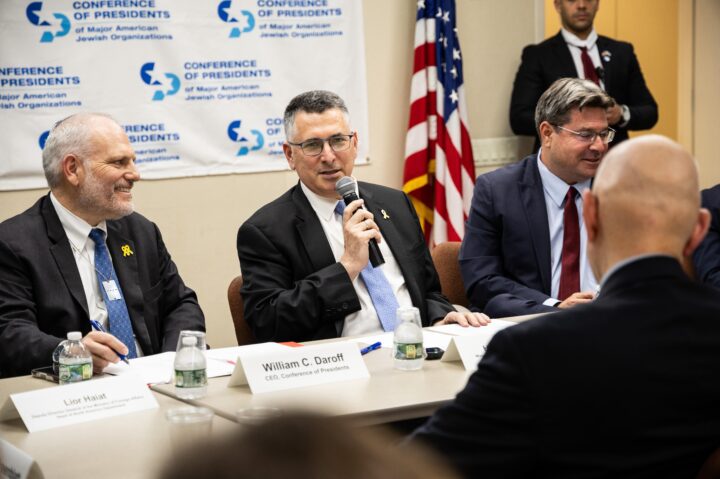
Israeli Foreign Minister Gideon Sa'ar (center) meets with members of the Conference of Presidents of Major American Jewish Organizations on Aug. 25, 2025, in New York City.
Israeli Foreign Minister Gideon Sa’ar met on Monday with American Jewish leaders in New York, speaking with the group at a moment when tensions between Diaspora Jews and Israel’s leaders over the conduct of the war seem to be growing.
The meeting was organized by the Conference of Presidents of Major American Jewish Organizations, and most of its members — representing the Reform, Orthodox and Conservative movements, as well as major national organizations including the Anti-Defamation League, the American Jewish Committee, and the Jewish Federations of North America — were present in the room.
Conference of Presidents CEO William Daroff said the 90-minute meeting was “positive and wide-ranging.”
“We spoke about the war, the plight of the hostages, and the challenges facing Israel, with a clear focus on strengthening U.S.-Israel relations,” Daroff told Jewish Insider. “The exchange underscored our unity, our partnership with Israel and our shared commitment to the Jewish future.”
Two attendees, who requested anonymity, described the meeting as antagonistic, saying Sa’ar took an argumentative tone against Jewish leaders in America who have raised concerns about the humanitarian situation in Gaza.
Amy Spitalnick, the CEO of the Jewish Council for Public Affairs, told JI after the meeting that she sees a growing distance between Israeli leaders and Jews in the United States.
“I think there is deep concern among many American Jews that this government’s quadrupling down on its approach is only going to widen the gap between the diaspora and Israel, when the vast majority of American and, frankly, Israeli Jews have made clear that they believe the war must end, the hostages must be released and the humanitarian crisis in Gaza needs to be addressed,” Spitalnick said.
That sentiment was echoed by Rabbi Liz P.G. Hirsch, CEO of Women of Reform Judaism.
“I said I was there representing two million Reform Jews. We’re the largest denomination in North America, and we are proud Zionists. We’re lovers and defenders of Israel, even as there are broad views within our movement,” Hirsch told JI on Monday. “The frame that this government is offering — and this is something I would say not just in this meeting, but publicly — is widening the breach between the North American community, between the full movement that I represent, and Israel.”
A spokesperson for the Israeli consulate in New York declined to comment. Sa’ar will also travel to Washington this week, where he is expected to meet with Secretary of State Marco Rubio on Wednesday. It will be Sa’ar’s first official visit to Washington since he was appointed Israel’s foreign minister last November.
Spielman hopes his new book on archeological finds from the City of David will help young Jews ‘stand on a foundation of truth’

Courtesy
Doron Spielman
After Israel waged war against an Iranian regime that has vowed to destroy the Jewish state and diaspora Jews face a heightened atmosphere of antisemitism stemming from the Israel-Gaza war, a new book aims to equip Israel supporters with “a foundation” to refute claims that Jews do not have ancient roots in the land of Israel.
When the Stones Speak: The Remarkable Discovery of the City of David and What Israel’s Enemies Don’t Want You to Know, written by former IDF spokesperson Doron Spielman, does so by recounting discoveries made in Israel’s largest excavation site, the City of David, where Spielman has worked closely with archaeologists for two decades to uncover and promote the site’s historical significance.
The book, Spielman suggested in an interview with Jewish Insider, is aimed at what he calls “the middle group of people” — “logical, reasonable people” who don’t know whether they’re pro-Israel or anti-Israel. “When they understand that ‘when the stones speak,’ they tell the story of the truth of the Jewish people’s connection to the land,” that could help sway the conversation on college campuses. This middle group will come to understand, he said, that “at the very least [the Israeli-Palestinian conflict] is a fight between two people who think they’re indigenous, and at the very best they understand the Jews are people who have only one land, they’ve been there for 3,800 years and therefore they have a right to defend it.”
That understanding “will have not only a huge impact on [the rise of antisemitism on college] campuses,” Spielman said, it “will have a huge impact on the Jews on those campuses. Jews on campus need to be able to stand on a foundation of truth that Israel is in fact their land. Without this knowledge, they cannot make that statement.”
Spielman hopes the book’s impact will also reach supporters of New York City mayoral candidate Zohran Mamdani, the presumptive winner of the city’s Democratic primary last week, amid his refusal to condemn the phrase “globalize the intifada” and denial that Israel has a right to exist as a Jewish state.
“He’s denying the Jewish people their right to live as a nation in the one place they ever called home,” Spielman told JI. “When the Stones Speak cuts through the lies with facts on the ground — literally.”
Spielman, who lives in Jerusalem, wrote the book’s first draft before Hamas launched its Oct. 7, 2023, attacks in Israel. Before the massacre, he had planned to meet with his editor on Oct. 8, 2023. That was put on hold when he was drafted into the reserves for 100 days. “When I came back to the book, I understood how far Hamas was willing to go with its ideology,” Spielman said. “If they aimed to erase our history, then the next thing they were going to try to do was erase us as a people.” So in light of Oct. 7, he reedited the entire book — which made it to The New York Times bestseller list just weeks after its May 13 publication.
“This is not just an academic debate, this is a battlefront,” Spielman continued. “The Jewish people need to understand and own our identity. This is critical — literally life and death — for Jews and Israel supporters to understand this because this is exactly what our enemies are fighting against.”
Since Israel launched its preemptive military campaign against Iran — a move that Spielman said “will prevent a major [worldwide] escalation later on with China,” which backs Tehran — Spielman said that the message of his book has become even more critical. It comes as the Iranian regime has been at the forefront of the effort to deny Jewish connections to ancient Israel.
“The Quds Force, which is the long arm of Iran and provides support for Hezbollah, Hamas, militias, is based on the very principle that the faith the ayatollahs want to establish reaches all the way to Jerusalem and replaces completely what they call the Zionist state,” Spielman said. “It’s not by chance that Hamas, which is a child of Iran, has taken this idea of denying Jewish history and translated it into absolutely the educational indoctrination of every Palestinian in Gaza and the West Bank, [who] are taught that Jews have no connection to their history in Jerusalem.”
Amid a rise of antisemitism in America, Spielman is hopeful that the book will help combat the movement by left-wing groups to equate the Zionist movement with “settler colonialism.”
“If we’re looking to understand why Jews are being attacked on campuses, it’s the same ideology of denying the connection between Jews and Jerusalem — that is exactly what is erupting on campuses, the claim that we are settlers and colonialists,” he said. “I wrote this book before Oct. 7 in order to establish firmly that we have the archaeological proof that the Jewish people are more indigenous to Israel than any people are in any area of the world today. We have an unbroken chain.”
Spielman expressed hope that the discoveries and insights from the City of David eventually make their way into textbooks used in American middle and high schools. He also called on the U.S. Department of Education to work proactively to ensure that students are taught about the historic ties of the Jewish people to the land of Israel.
He pointed to one of his findings from several years ago at the entrance of the City of David: the seals of two ministers who in the Book of Jeremiah tried to kill the namesake prophet.
“A massive campaign erupted throughout the Muslim world denying the legitimacy of these findings,” Spielman said. “They also realized what a threat this was to the narrative of the Palestinians which was claiming that the Jews have no connection and therefore they began identifying the City of David as a massive settlement effort, never mentioning the name of the City of David. It’s amazing that they did this because they realized that they can’t stop the archaeology so they tried to stop the entire site … [The] bottom line is that all of the claims that Jews are settlers shatter when they are held up over the bedrock of the City of David and the discoveries we’ve made.”
Spielman noted that City of David excavations have “widespread acceptance” across the political spectrum in Israel, with politicians from Prime Minister Benjamin Netanyahu to Yair Lapid, the opposition leader, having visited the site.
“Within the standard Israeli electorate, the City of David is really a central place of Israeli identity today and therefore the budget is funded by private individuals around the world as well as Israeli tax dollars,” Spielman told JI.
He urged world leaders to visit as well. “For the same reason that Washington, D.C., is the historical site that you want every diplomat from around the world to see, a diplomat that comes to Israel that only goes to Yad Vashem [Israel’s Holocaust museum] is only getting five years of the Jewish story of exile. When you go to the City of David, you’re getting 2,000 years.”
At the City of David, there is “something deeper than modern-day geopolitics,” Spielman said. “There is a claim here that goes to the heart. It’s something Israelis have ignored for a long time. We cannot stand strong about our rights to the land of Israel unless we understand the very foundations of our connections to the land. Archaeology, DNA, ancient texts and the stones of Jerusalem prove what history already knows— the Jewish people are not colonizers in their homeland.”
“It’s not enough to talk about how we carry out our military and that we’re a moral army. We have got to go back to the reason we’re here.”
Please log in if you already have a subscription, or subscribe to access the latest updates.
 Continue with Google

 Continue with Apple