






































The former Defense Department official said, ‘The risk is actually that these kinds of actions do set back the cause of normalization and integration’
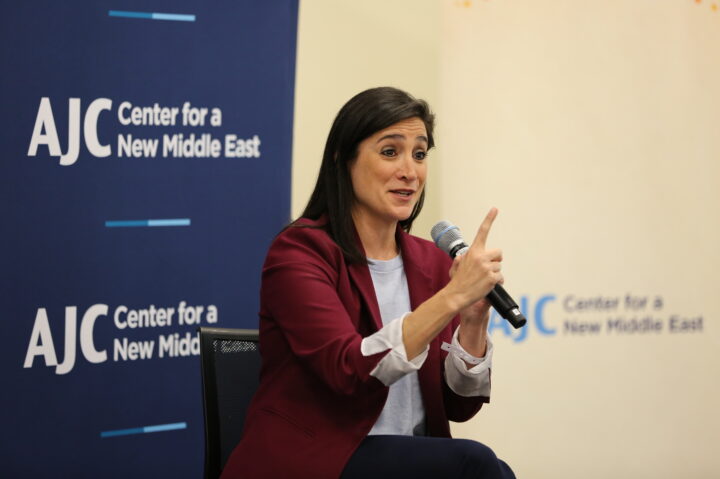
Martin H. Simon/AJC
Dana Stroul, the director of research at the Washington Institute for Near East Policy, speaks at AJC's Abraham Accords 5th Anniversary Commemoration on Capitol Hill in Washington on Sept. 10, 2025.


 Add JewishInsider on Google
Dana Stroul, the director of research at the Washington Institute for Near East Policy and a former senior Defense Department official in the Biden administration, warned on Wednesday that the Israeli strike on Hamas leaders in Doha is leading Arab states to rally around Qatar, potentially dealing setbacks to regional normalization.
Stroul, speaking at an American Jewish Committee event in Washington to mark the five-year anniversary of the Abraham Accords, said that Arab leaders are offering support for Qatar following the strike, and that both Israeli and Iranian moves to make the Gulf a “new battlefield in the Middle East” are making the U.S.’ regional partners “very nervous.”
“It is really disappointing that not one [Arab] government acknowledged Hamas,” Stroul said. “What’s very clear is that everyone else in the region is aligned that this was a strike on Qatar,” as opposed to a strike on Hamas. “This is about Qatari sovereignty. We’ve seen really a shoring up of Arab leaders’ alignment with and defense of Qatar.”
She said that there had been relatively little criticism in the region for Israel attacking Iran’s nuclear program, undermining Hezbollah or helping bring down the Assad regime in Syria, but “this time Israeli military action didn’t happen on what everyone sort of agrees is an adversary … that was a major non-NATO ally of the United States who is actively participating in diplomatic processes.”
“Now we have the leader of the [United Arab Emirates], who years ago was the leader of the Gulf Rift in isolating Qatar — he just went to Qatar,” she continued, noting as well that Israel was disinvited today from the Dubai Air Show, where it had a significant presence in previous years.
“The risk is actually that these kinds of actions do set back the cause of normalization and integration,” she continued.
She also called Qatar, as the host of the U.S. air base in the region, a critical hub of regional defense integration efforts.
Another crucial question, she added, is how the Hamas military leadership in Gaza holding the remaining living hostages will react to the Doha strike.
“I’m very, very worried about the hostages,” she said.
She said it’s unlikely that the strikes will make Hamas leaders in Gaza more willing to negotiate or release hostages. The dispute between the U.S. and Israel over the strikes, compounded by growing international criticism of Israel, could further harden their resolve to not negotiate or compromise.
Stroul said that the strike’s apparent failure to kill any of the senior echelon of Hamas leaders could make it a “worst-case scenario,” in which Hamas leaders are less incentivized to negotiate and could cause Qatar to withdraw from any further mediation.
She added that it’s unclear how ceasefire negotiations can continue, and that parties may look to Egypt to step up as the new mediator, placing it in a potentially precarious position.
She said it was common knowledge in the region that the Hamas leaders are “dead men walking,” but said it’s an “open question” whether now was the right time to carry out that strike, or its broader implications.
Stroul also said that Qatar had never been formally asked to expel the Hamas leaders — she said that former Secretary of State Tony Blinken had asked the Qataris to do so in late 2024 when ceasefire talks yielded little progress, but the Trump administration’s special envoy Steve Witkoff asked that be walked back so that he could continue talks. Stroul was out of government at the time.
And she said that Qatar’s support of Hamas pre-Oct. 7, frequently cited by the country’s critics, was conducted with Israel’s knowledge and support, and that of the United States.
Democrat Maura Sullivan, a military veteran running in a swing district, is aiming to succeed Rep. Chris Pappas in the House
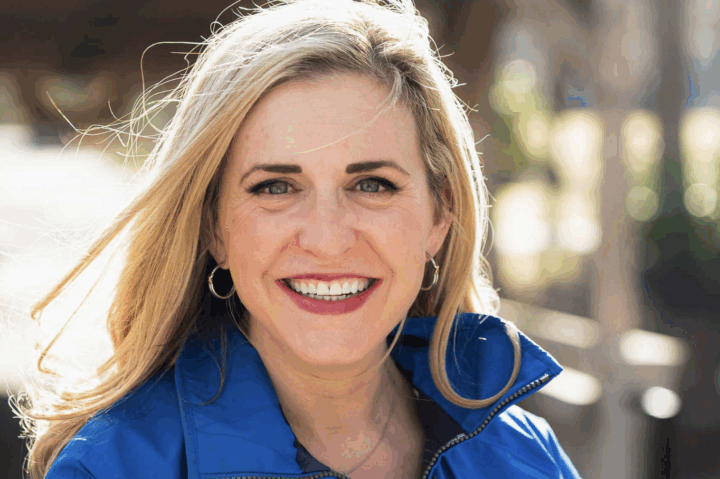
Maura Sullivan for Congress
Maura Sullivan
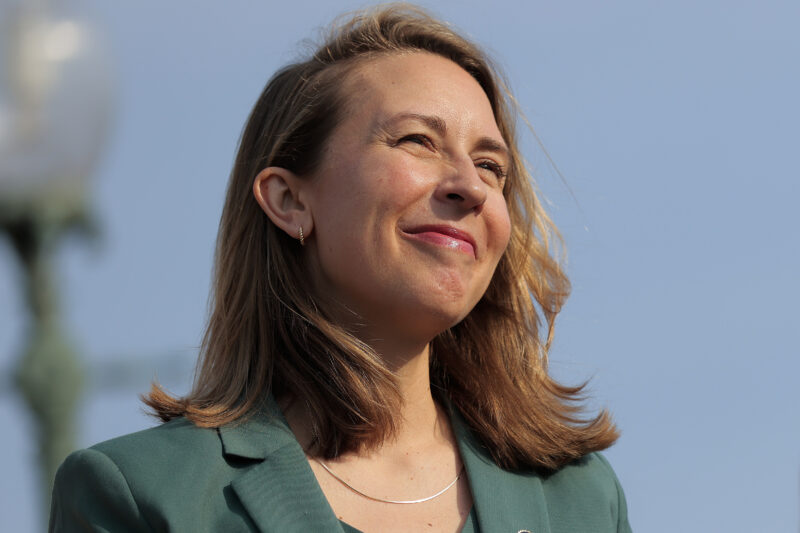
Maura Sullivan, a Marine veteran who served in Iraq and later worked as a senior Defense Department official, is aiming to leverage that experience to win the New Hampshire congressional seat currently held by Rep. Chris Pappas (D-NH), who is running for the Senate. She’s also leaning on that background as she stakes out her positions on the conflict in the Middle East.
Speaking to Jewish Insider, Sullivan strongly criticized Israel for the humanitarian crisis in Gaza, saying it must take action to ensure more aid to the Palestinian people, but at the same time said that she would not support efforts to cut off U.S. aid to the Jewish state and affirmed her commitment to the U.S.-Israel relationship and the need to eliminate Hamas.
As a Pentagon official, Sullivan said she spent time in the Middle East on “allied reassurance tours,” visiting allies and meeting with top officials, such as Israeli Prime Minister Benjamin Netanyahu and Moshe Ya’alon, then Israel’s defense minister, to learn about Israel’s challenges and capabilities and “talking about the incredibly important relationship between the United States and Israel and strongly reaffirming the United States commitment to our ally Israel.”
“I’ll bring that perspective to the work I do in Congress and will greatly inform because I have that firsthand perspective, experience and knowledge,” Sullivan said, adding that she’d be seeking a spot on the House Armed Services Committee if elected.
“I’ve been very clear since the devastating, absolutely deplorable Oct. 7 attacks that Hamas perpetrated that Israel has the right to defend itself,” Sullivan continued. “I also want to be clear that the conditions in Gaza are inhumane, they’re deplorable and they must be improved immediately. … Hamas can be destroyed and significant aid can be let in at the same time. It’s a false choice to think that those two objectives cannot occur simultaneously.”
She said she has firsthand experience with humanitarian supply issues in a war zone, having served as a logistics and operations officer in Fallujah, Iraq, to move food and other supplies through what was at times an urban combat zone.
Doing so, she said, is “logistically complex” but also “doable” and “necessary.” She said the U.S. should apply “maximum pressure” on Netanyahu to increase aid, or provide aid directly if that fails.
Unlike growing numbers of Democrats in Congress, though, Sullivan said that she does not support efforts to cut off the U.S. supply of arms to Israel in response to the humanitarian situation in Gaza.
“I do not think that the answer in this conflict is to make Israeli civilians less secure due to the actions of their government,” Sullivan said. “In an effort to solve this conflict, the Israeli people need to have the ability to defend themselves against not only Hamas, but also other nefarious actors, [like] Hezbollah and … Iran.”
Sullivan added that she wanted to be clear that Hamas is a terrorist organization, its attack on Oct. 7, 2023, was the “catalyst behind all of this” and that it must return the hostages.
The pathway to a lasting peace, through a two-state solution, requires “eradicating Hamas,” she continued. “The Palestinians need to be able to live in a demilitarized state that they control, not Hamas, and the Israelis need to be able to live beside them in peace.”
Sullivan has visited Israel three times, including visiting extended family of her husband, who is Jewish, in Tel Aviv and Jerusalem. She described a visit to Yad Vashem, while she was a Pentagon official, as particularly “powerful and unforgettable.”
Sullivan said she saw during her time in Iraq that “leadership in Washington was totally out of touch” — on both sides of the aisle — with the actual situation on the ground, “and we were sent to a war we never should have been in without a plan to win and without the resources to succeed, in what was arguably the biggest foreign policy debacle this country has seen since the Vietnam War.”
That experience, she said, showed her firsthand the real consequences of decisions made in Washington. She expressed strong support for long-running efforts in Congress to repeal the Authorizations for Use of Military Force for Iraq and Afghanistan.
“Congress has to go on the record if we are going to declare war,” Sullivan said, asked about the U.S. military strikes on Iran. She urged the administration to prioritize the safety of U.S. troops and “resist any effort to drive the U.S. into another costly and deadly war in the Middle East.”
But, Sullivan continued, “Iran is the leading state sponsor of terrorism, relentlessly driving violence and chaos against the United States, Israel and our allies. A nuclear armed Iran would represent a direct and unacceptable threat to America’s national security, regional stability, as well as Israel’s very existence.”
Given Iran’s recent violations of the Nuclear Non-Proliferation Treaty, she said that “Israel is absolutely justified in taking action to dismantle Iran’s dangerous nuclear ambitions. No nation should be forced to stand by while its survival is threatened.”
Sullivan also served on the American Battle Monuments Commission, visiting gravesites of fallen soldiers around the world, which “greatly heightened my sense of the role of America in the world” and what the U.S. means to its allies.
The Marine veteran described the antisemitism crisis in the United States as particularly personal for her, given that her husband is Jewish and they are raising their children, ages 3 and 5, in an interfaith home.
“I understand these issues at a deep and personal level. Judaism was a first-date conversation for my husband and I,” Sullivan said. “My children are not yet old enough to talk to them about it, but it is something that we will need to address as a family.”
She said that she would be a “strong voice in Washington” against antisemitism and noted that it had recently hit close to home when a group of neo-Nazis marched on the state Capitol in Concord.
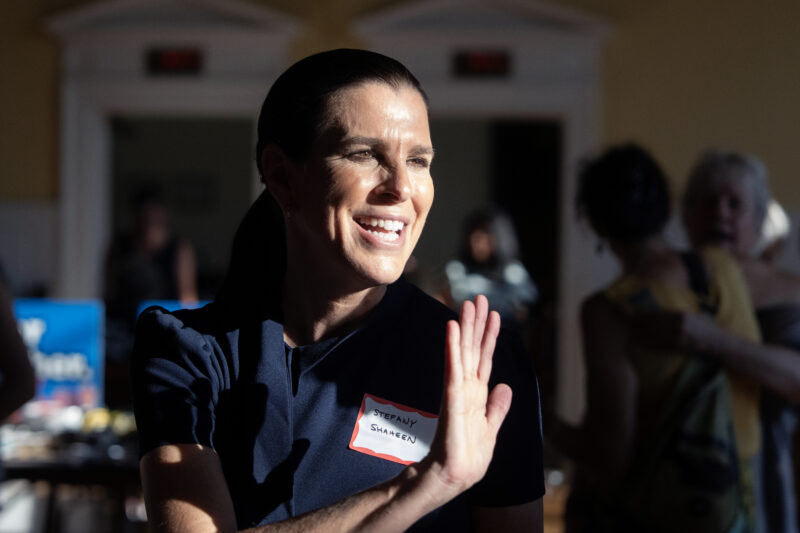
Sullivan leads the primary field in fundraising, having pulled in nearly $800,000 as of the end of the last quarter. Her leading Democratic primary challenge is Stefany Shaheen, the daughter of Sen. Jeanne Shaheen (D-NH) and a former Portsmouth city councilor, who raised $532,000 in the last quarter.
Carleigh Beriont, a Harvard professor and Hampton, N.H., selectwoman, entered the race in June, raising $162,000 that month. Multiple Republicans have filed to run for the seat, but none have reported raising any funds thus far.
Sullivan ran in the 2018 primary against Pappas, who is leaving the seat to run for the Senate. Sullivan won 30% of the vote in 2018 to Pappas’ 42%, before Pappas went on to win his first term in Congress.
The Marine veteran said that she believes that the Democratic Party and the country “needs new and different leadership,” and argued that her military background will make her more effective in holding the administration accountable.
Sullivan drew explicit comparisons between herself, and other female veterans running in swing districts, and the class of female national security leaders — including Sen. Elissa Slotkin (D-MI), Reps. Mikie Sherrill (D-NJ) and Chrissy Houlahan (D-PA) and former Rep. Abigail Spanberger (D-VA) — who helped Democrats win back the House in 2018.
She’s part of a group calling itself the Hellcats, which also includes New Jersey congressional candidate and Navy veteran Rebecca Bennett, that is trying to emulate their model.
If elected, Sullivan said she’d be the first female Marine ever elected to Congress.
She said she’s heard from voters in the 1st District, particularly veterans and small business owners who typically vote Republican, that they’re supporting her in part because of her military background.
She said her interest in public office was spurred by a family commitment to service as well — her grandfathers fought in World War II and her grandmothers were both involved in Jesuit education, as well as her own military service.
Coming back from Iraq, Sullivan felt a “very deep-seated obligation to commit my life to public service,” particularly because some of those she served with would not have that chance. “To live your life in a way that matters for something and for people way beyond yourself, something so much bigger than yourself — it was a transformational experience.”
Pentagon spokesperson Sean Parnell told JI: 'Senior Department of Defense officials will no longer be participating at the Aspen Security Forum because their values do not align with the values of the DoD.'
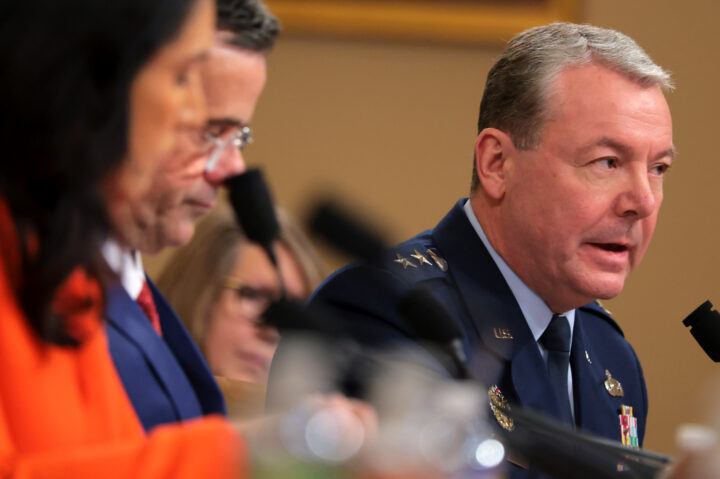
Kayla Bartkowski/Getty Images
Defense Intelligence Agency Director Jeffrey Kruse testifies during an annual worldwide threats assessment hearing at the Longworth House Office Building on March 26, 2025 in Washington, DC.
The 2025 Aspen Security Forum kicks off today and finds itself unexpectedly thrust into the ideological fights gripping the administration.
The Defense Department announced Monday that it would be withdrawing numerous senior military and civilian officials who had been set to speak at the conference.
Pentagon spokesperson Sean Parnell told Jewish Insider: “Senior Department of Defense officials will no longer be participating at the Aspen Security Forum because their values do not align with the values of the DoD. The Department will remain strong in its focus to increase the lethality of our warfighters, revitalize the warrior ethos, and project ‘Peace Through Strength’ on the world stage. It is clear the ASF is not in alignment with these goals.” Spokesperson Kinglsey Wilson offered even more pointed criticism to right-leaning outlet Just the News, saying the conference “promotes the evil of globalism, disdain for our great country, and hatred for the President of the United States.”
It’s tough criticism of a forum that prides itself on bipartisanship and aims to foster cross-partisan dialogue and solution-making, even as those attributes are in short supply in today’s Washington. The forum said in a statement, “we will miss the participation of the Pentagon, but our invitations remain open. … The Aspen Security Forum remains committed to providing a platform for informed, non-partisan debate about the most important security challenges facing the world,” noting that voices across the political spectrum will be speaking this week.
Many had been hoping to hear Defense Intelligence Agency Director Lt. Gen. Jeffrey Kruse, who was originally scheduled for a panel discussing the evolution of warfare, speak about his agency’s leaked report suggesting the strikes on Iran’s nuclear facilities had minimal effects, but Kruse was among the speakers withdrawn by the Pentagon.
Among the administration speakers still scheduled to appear are hostage envoy Adam Boehler, speaking on Thursday, and Tom Barrack, the U.S. ambassador to Turkey and special envoy to Syria. Barrack will be speaking on a Friday panel about the Middle East alongside former CIA Director David Petraeus and former Deputy National Security Advisor Dina Powell McCormick.
Wednesday’s Israel-focused panel will feature former IDF Intelligence Chief Amos Yadlin, former Israeli Ambassador to the U.S. Michael Herzog, former Biden administration official Brett McGurk and author and “Call Me Back” podcast host Dan Senor.
An Iran-focused panel on Thursday will include former U.S. National Security Advisor Stephen Hadley, former CEO of the Bulletin of Atomic Scientists Rachel Bronson and Johns Hopkins professor Vali Nasr.
There’s likely to be plenty of discussion throughout the week about the ways the Trump administration’s strikes on Iran will shape policy in the Middle East — and throughout the world — going forward, and about the ongoing impacts of the war in Gaza.
Former National Security Advisor Jake Sullivan will be speaking on Friday on a panel with former Secretary of State Condoleezza Rice and former Defense Secretary Robert Gates.
Former Defense Secretary Mark Esper and former Homeland Security Secretary Jeh Johnson will also be speaking Friday, on AI and cybersecurity issues, respectively. Former Deputy Treasury Secretary Wally Adeyemo will speak on Thursday about international aid and trade.
Sens. Chris Coons (D-DE), John Cornyn (R-TX) and Mark Warner (D-VA) will lead the conference’s annual “View from the Senate” panel on Friday.
We’ll be keeping an ear out for discussion about the internal debates between hawks and isolationists taking place within the Trump administration over America’s role and engagement in key global arenas — from the Middle East to Ukraine and Asia. We’ll also be tracking proposed efforts to restructure the U.S. intelligence community.
Expect a significant focus throughout the week on the many ways that the Trump administration’s unpredictable foreign policy — from its recommitment to providing Ukraine military aid to the status of tariffs against key countries, along with the recent, sweeping cuts to the State Department and U.S. Agency for International Development — is shaking up global affairs, how the private sector and foreign countries are adapting and how leaders can attempt to maintain bipartisanship on foreign policy.
The GOP lawmakers’ comments come after the president, taking a tougher line against Putin, overruled top Defense Department officials

BRENDAN SMIALOWSKI/AFP via Getty Images
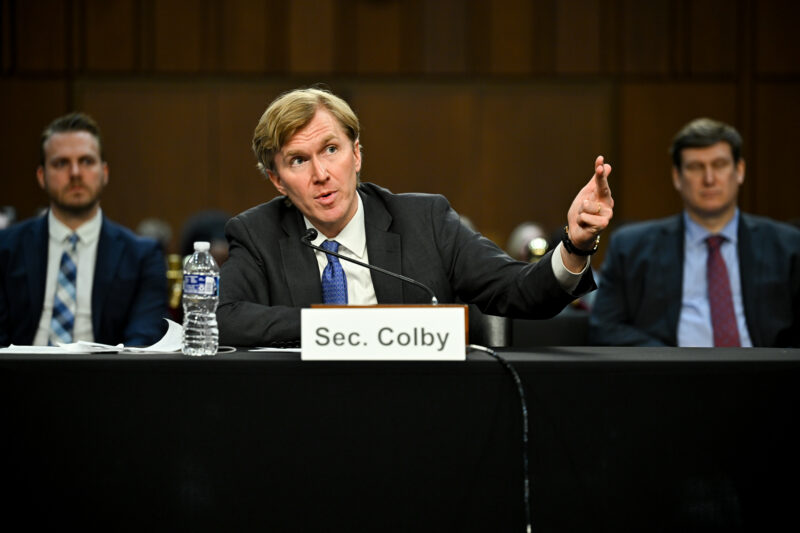
US Under Secretary of Defense for Policy Elbridge Colby (R) and US Secretary of Defense Pete Hegseth look on during a meeting with Foreign Affairs Minister of Peru Elmer Schialer and Defense Minister of Peru Walter Astudillo at the Pentagon in Washington, DC on May 5, 2025.
Senate Republicans on Tuesday emphasized that Trump administration officials need to follow the president’s lead on foreign policy, after President Donald Trump publicly overrode a Defense Department-instituted halt on weapons for Ukraine.
The public back-and-forth indicated discord between the president and the Pentagon. Trump on Tuesday appeared to suggest he was out of the loop about the Ukraine military freeze; when a reporter asked him who had ordered the halt, Trump responded, “I don’t know, you tell me.”
Top Pentagon policy official Elbridge Colby reportedly led the move, citing a review allegedly showing U.S. missile defense interceptor shortages. Secretary of Defense Pete Hegseth approved the decision without informing the White House, CNN reported, and Trump did not specifically direct him to halt the weapons transfers. Politico reported that a series of other unilateral moves by Colby have surprised and frustrated Trump administration officials and U.S. allies.
Trump’s own policy on Ukraine as it defends itself against Russian aggression has been inconsistent since taking office, but in recent months he has grown publicly frustrated with Russian President Vladimir Putin’s approach to the war. Trump is now also backing a bipartisan Senate sanctions bill targeting Russia, according to the bill’s lead sponsor, Sen. Lindsey Graham (R-SC).
Republican hawks on Capitol Hill praised Trump’s decision to reinstate U.S. aid to the country, with several warning Pentagon officials against working at cross purposes with the president, though they declined to directly address the behind-the scenes machinations.
“Policy on defense and otherwise, it’s clear, is set by the president, it’s not set by his underlings,” Sen. John Kennedy (R-LA) told Jewish Insider, adding that he thinks that Trump’s own position on the issue has hardened because “President Trump is rapidly becoming fed up with President Putin and starting to see him for what he is, which is a pirate and a liar” who only responds to pressure.
Kennedy denied that the Pentagon had been at odds with Trump, however, adding, “Whether you like it or dislike it, the people who generally get crosswise with the president that work for him only do it one time.”
Sen. Thom Tillis (R-NC) told JI, “Generally speaking, I don’t think [Trump] likes people getting out ahead of him. So they need to coordinate that. I assume they did, it could have just been one situation, but you need to coordinate with the president.”
Tillis added that “anything that cuts short or challenges Ukraine’s resupply and support is a bad idea, and it’ll be a disastrous mistake.”
Sen. Mike Rounds (R-SD) told JI, “I’m in favor of additional aid for Ukraine. Whether it is simply a matter of having the Department of Defense get very clear orders from the president, or if it’s a matter of clarifying for the rest of the world to hear that we’re not walking away from Ukraine, I think it’s a very important message to send.”
Sen. Mitch McConnell (R-KY), the former Republican Senate leader, offered the most pointed criticism of those in the administration who have advocated for cutting off aid to Ukraine.
“This time, the President will need to reject calls from isolationists and restrainers within his Administration to limit these deliveries to defensive weapons,” McConnell said in a statement. “And he should disregard those at DoD who invoke munitions shortages to block aid while refusing to invest seriously in expanding munitions production. The self-indulgent policymaking of restrainers — from Ukraine to AUKUS — has so often required the President to clean up his staff’s messes.”
According to Politico, Colby independently ordered a review of the AUKUS submarine pact with the U.K. and Australia, which also surprised other elements of the Trump administration.
Sen. Roger Wicker (R-MS), the chair of the Senate Armed Services Committee, declined to comment on “palace intrigue” and said he was “just glad to see Washington, D.C., on a bipartisan basis moving in the right direction in favor of the good guys.”
“Facts become clearer, and more and more people, including the president and members of the administration, are coming to the realization that Putin wants nothing but conquest, and if he gets it in Ukraine, he won’t stop there,” Wicker told JI. “So it’s just a matter of the truth coming to light.”
Sen. Ted Budd (R-NC) suggested that the change had come about as a result of new information, rather than discord within the administration.
“Well, I think all of us have the right to change your mind when you have new information, so he’s not happy with the situation,” Budd said. “Again, I think all of our hearts are supportive of Ukraine. We want to make sure they have the right leadership, and transparency that they’re doing the right thing. So I think he’s making the right decision with the information that he’s given in real time.”
Sen. Markwayne Mullin (R-OK) said he wasn’t familiar with the exchange between Trump and the Pentagon, but noted concerns about U.S. stockpiles.
“I don’t know what the back-and-forth is,” Mullin said. “I know what we’re trying to do right now is build up our stockpiles, because we let things get pretty low with some of our missile systems, but I haven’t heard the back and forth between Trump and the Pentagon.”
Among Democrats, Sen. Jeanne Shaheen (D-NH), the ranking member of the Senate Foreign Relations Committee, called out Colby and Hegseth by name.
“I am pleased that President Trump appears to have reversed course on the dangerous and shortsighted decision made by Secretary Hegseth and Under Secretary Colby to continue critical assistance to Ukraine,” Shaheen said in a statement. “Unfortunately, last week’s decision sent exactly the wrong message. And it came with a tragic human cost.”
Analysts outside the administration emphasized that Trump’s policy is his own and hard-liners inside the Pentagon should be mindful that their views are not necessarily the same as Trump’s.
“I think over the last few years, it has been very, very clear that the only person who speaks for President Trump is President Trump,” Carrie Filipetti, the executive director of the Vandenberg Coalition and an official in the first Trump administration, told JI. “There are a lot of people, specifically within the Pentagon, that are much more ideological, who have assumed that President Trump shares their ideology, when really President Trump has always been much more flexible and responsive.”
Filipetti added that, from her experience in the first Trump administration, the president could get frustrated when officials “tried to speak for him” or “got over their skis and assumed that they knew the direction he was going in.”
She said that the administration’s recent moves, as well as some of Trump’s hawkish policies dating back to his first administration, show that the calculated use of force and economic power are key to Trump’s foreign policy.
“This is really a vindication of what Trump has always said was America First, which includes the willingness to use force if he can see how it will prevent a longer-term conflict,” Fillipetti explained. “Right now, I think the people who have pushed for a more hawkish policy are gaining more influence, partially because they’re proving that the goal was never to start wars. The goal was to end wars by using force and strength as a deterrent.”
Heather Conley, a nonresident senior fellow at the American Enterprise Institute and the former president of the German Marshall Fund, said it seemed clear that the Pentagon had not coordinated its moves with other parts of the administration or Congress, catching the White House off-guard.
“I think this was probably a very important lesson that the senior leadership in the Pentagon learned: that there’s no independent review, that these things are all connected and are all highly political and need to be coordinated with the White House, and Congress, most certainly, as well,” Conley said. “I think this will be a reinforcing lesson for the Pentagon to not get ahead of the president.”
Referencing Colby specifically, Conley said, “He may have very strong views about what is needed, but the president is shaping this policy, he’s shaping it every hour and every day, and that means it’s moving very quickly. … [Administration officials] have to be in alignment for there to be success. And they also may not be able to pursue their own independent view of where things should go.”
Conley said that the capability review that prompted the cutoff was necessary — given proper coordination — for any administration, in light of the multiple draws on American weapons reserves.
She said that the situation highlights the need for the U.S. to significantly accelerate its missile-defense production capacity and find ways to prompt Ukraine to expand its domestic production capacity, explaining that the U.S. lacks the ability to produce sufficient interceptors to cover Ukraine, the Middle East and potentially Taiwan.
Conley also noted that this isn’t the first time the Pentagon has appeared to be acting out of step with the White House, pointing to moves by Hegseth on Ukraine policy dating back to February.
Administration spokespeople have denied any discord or lack of coordination within the administration.
Kingsley Wilson, the Pentagon’s press secretary, told CNN in a statement that said in part, “Secretary Hegseth provided a framework for the President to evaluate military aid shipments and assess existing stockpiles. This effort was coordinated across government.” White House press secretary Karoline Leavitt said that Trump “has full confidence in the secretary of defense.”
The Department of Defense and National Security Council did not respond to requests for comment.
Jewish Insider’s congressional correspondent Emily Jacobs contributed reporting.
Justin Overbaugh’s nomination to be deputy undersecretary of defense for intelligence and security will likely come before the full Senate soon

Win McNamee/Getty Images
Justin Overbaugh, nominee for the Deputy Under Secretary of Defense for Intelligence and Security, testifies before the Senate Armed Services Committee on Capitol Hill May 1, 2025 in Washington, DC.
Justin Overbaugh is set to be the latest affiliate of the Koch-backed Defense Priorities think tank placed in a top post at the Defense Department, approaching confirmation as the deputy under secretary of defense for intelligence and security.
Numerous others affiliates of the isolationist think tank have been picked for top roles in the Defense Department and the Trump administration, including Michael DiMino, the deputy assistant secretary of defense for the Middle East; William Ruger, the deputy director of national intelligence for mission integration; Dan Caldwell, a senior advisor at the Pentagon who has since been fired; and Daniel Davis, who was initially picked for the deputy director of national intelligence role but had his job offer rescinded amid public scrutiny.
A number of the Defense Priorities alumni throughout the administration have taken vocal positions opposing action against Iran and arguing the U.S. should pull back from the Middle East. Overbaugh, by contrast, lacks the extensive public record of those other officials — though he has also broadly called for a more restrained U.S. role in the world — and his nomination has attracted little public attention or controversy.
Overbaugh spent 25 years in the Army, retiring as a colonel, and focused on intelligence and global counterintelligence operations.
“I hope to lead the enterprise in strategic assessments that shape defense requirements, ensuring they are data-driven, actionable, and aligned with national security priorities,” Overbaugh said in written testimony to the Senate Armed Services Committee. “I believe that we do not have the resources to cover all threats simultaneously, therefore we must be deliberate and discerning about the capabilities we pursue to defend our Nation and deter, or if necessary, defeat, our adversaries.”
His confirmation hearing in early May passed without incident and he was reported favorably out of the committee weeks later. The nomination will likely be considered on the Senate floor soon.
He argued in a co-authored piece for the Journal of Strategic Security in 2023 that the U.S. needed to reformulate its global foreign policy approach.
“It is time for the United States to rethink the foundations of its foreign policy as its global hegemony declines. America’s existing grand strategic enterprise—one that aspired to build a rules-based international order through liberal markets, institutions, and norms since 1990—increasingly appears to be unsustainable,” the article reads. “As a result, the current generation of American leaders, advisors, and foreign policy practitioners need to consider whether the decline of the liberal hegemony signals a necessary decline in the fortunes of [the] United States on the world stage or, rather, provides an opportunity for a healthy reset of grand strategic thinking.”
It concludes, “Principled beliefs may have a place in American foreign policy but pursuing them demands a clear understanding of their impact to dispel the erroneous belief that there are no trade-offs involved.”
Please log in if you already have a subscription, or subscribe to access the latest updates.
 Continue with Google
 Continue with Apple