














































































The analysis by the Jewish Institute for National Security of America found that Tehran made 47% more in the three weeks following the MOU than it normally did in a month before the war
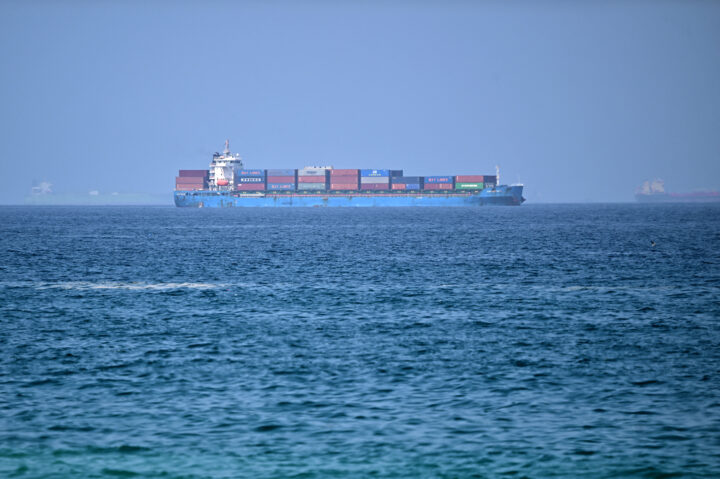
Photo by AFP via Getty Images
A cargo ship is pictured off coast of the Khor Fakkan Container Terminal, the only natural deep-sea port in the region, along the Gulf of Oman on June 28, 2026.


 Add JewishInsider on Google
Iran netted nearly $5 billion in the 22 days after Washington and Tehran signed their memorandum of understanding on June 17, according to a new report from the Jewish Institute for National Security of America.
The findings come as President Donald Trump announced on Monday that the U.S. would reimpose its naval blockade on Iranian ports effective July 14 at 4 p.m. ET, with an added 20% U.S. toll on all shipping through the strait.
The U.S. had lifted the blockade last month upon the signing of the MOU with Iran, at which time the Trump administration also issued a waiver that allowed the sale of Iranian oil. That waiver was revoked last week in response to Iranian attacks on shipping vessels in the strait, but the damage, JINSA says, was already done.
The JINSA report, published on July 8, found that once the initial maritime blockade was lifted mid-June, the Iranian regime “rushed to export its oil at the first opportunity.” Shipping data analyzed in the report indicates that Iran exported 50 million barrels of crude within the first two weeks after the blockade was lifted. By early July, total exports under the temporary truce topped 55 million barrels, netting the regime more than $4.5 billion.
Before the conflict, Iran typically exported between 47 million and 50 million barrels in a single month, averaging roughly $3.05 billion in revenue, according to the report. Because the U.S. waiver allowed Iran to sell its crude at standard market prices rather than the heavily discounted rates it usually relied on to bypass international sanctions, the regime pulled in 47% more cash in the 22 days following the MOU than it normally did in an entire month before the war.
Tehran has simultaneously maintained a tight grip on the Strait of Hormuz that has severely constrained broader global shipping, in what the report describes as a “bad omen for the future of maritime security in the Middle East — and U.S. deterrence of Iran.”
Daily global transit through the Strait of Hormuz fell from 15 million barrels of crude oil per day before the war to 4.8 million barrels per day during the first week after the MOU was reached — less than a third of normal volumes. By contrast, Iran managed to export 5 million barrels of its own crude oil per day during that same week.
Beyond standard oil sales, the report notes that Iran maintained an aggressive financial squeeze on foreign vessels transiting the region. Citing Israeli media reports, the report said Iranian authorities blocked commercial oil tankers from passing through the Strait of Hormuz unless they paid a transit fee of up to $2 million per vessel.
Tracking data from the shipping analytics firm Kpler suggests that these unauthorized checkpoints generated roughly $300 million in extra revenue for Tehran, directly violating the agreement’s terms guaranteeing free passage for international trade.
The U.S. announced sanctions on a network of companies and shipping facilitators involved in Iran’s oil export business

ATTA KENARE/AFP/Getty Images
Oil tanker SC Hong Kong is seen off the port of Bandar Abbas, southern Iran, on July 2, 2012.
The Treasury Department implemented new sanctions on Thursday targeting what the agency described as a “network of front companies and shipping facilitators that bankroll the Iranian armed forces by selling crude oil” — a critical revenue stream for the regime.
The latest round of sanctions, one of several announced in recent months, also targets six vessels in Iran’s “shadow fleet” of tankers used to transport oil to international markets, joining a list of more than 170 such vessels which have been sanctioned this year.
The Treasury is also adding sanctions on a subsidiary of Mahan Air, an Iranian airline used by the Islamic Revolutionary Guard Corps to help supply proxies and allies across the region.
“Today’s action continues Treasury’s campaign to cut off funding for the Iranian regime’s development of nuclear weapons and support of terrorist proxies,” Treasury Secretary Scott Bessent said in a statement. “Disrupting the Iranian regime’s revenue is critical to helping curb its nuclear ambitions.”
In its announcement, the Treasury Department said that Iran’s oil exports are a crucial source of funding for the Iranian regime, particularly as the Islamic Republic seeks to rebuild after its war with Israel.
“Following its defeat in the 12-Day War with Israel, Iran’s military has increasingly come to rely on the sale of Iranian crude oil to supplement its annual budget and finance the rebuilding of its depleted forces,” the statement reads.
The companies targeted under the sanctions are tied to Sepehr Energy Jahan Nama Pars Company, an arm of the Iranian military responsible for oil sales and exports. The companies being targeted operated variously out of the UAE, Panama, Greece, India and Liberia.
The ships in question are flagged in Palau, Panama and Gambia.
According to the Treasury’s announcement, Mahan subsidiary Yazd International Airways Company was used by the IRGC to transport Quds Force officers to Lebanon to support Hezbollah attacks on Israel and to ship weapons to the Assad regime in Syria.
The sanctions also seek to crack down on Mahan’s procurement of Western aircraft and identify several such aircraft as blocked property.
Bessent also attended a meeting at the White House on Thursday with recently freed hostages.
“We heard their firsthand accounts of the atrocities experienced on that day and over the past two years,” Bessent said on X. “Thanks to President Trump’s historic actions and bold leadership, all of the hostages have been freed, and we are closer than ever to a lasting peace in the Middle East. At @USTreasury, we are committed to safeguarding Americans and our allies from terror, wherever it presents.”
Please log in if you already have a subscription, or subscribe to access the latest updates.
 Continue with Google

 Continue with Apple