






































































Hamawy, despite his past ties to a convicted terrorist, faced minimal scrutiny from outside groups — including many of his primary rivals
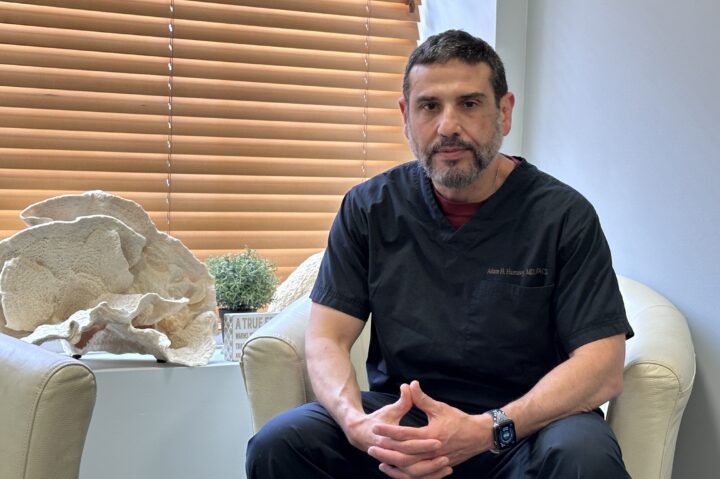
Islam Dogru/Anadolu via Getty Images
Adam Hamawy, a plastic surgeon, is seen during an exclusive interview at in New York, United States on April 24, 2024.


 Add JewishInsider on Google
Adam Hamawy’s victory on Tuesday in a closely watched congressional primary in New Jersey, which elevated an outspoken critic of Israel whose past ties to a convicted terrorist had drawn scrutiny during the campaign, is raising questions over why the far-left Democrat did not face outside opposition from the pro-Israel group AIPAC or its well-funded super PAC.
Hamawy, who won 28% of the vote in New Jersey’s 12th Congressional District, prevailed with a modest plurality over the multi-candidate primary field competing to succeed Rep. Bonnie Watson Coleman (D-NJ). With 93% of the vote counted on Wednesday, Brad Cohen, the mayor of East Brunswick and a Jewish Democrat who touted his support for Israel while identifying as an AIPAC member, placed second with 15%. Hamawy is all but assured a seat in Congress next year as the district heavily favors Democrats.
Despite a double-digit deficit, Cohen’s performance exceeded many expectations, indicating that he likely could have finished in a stronger position with help from AIPAC’s super PAC, United Democracy Project, some local Jewish leaders suggested in interviews on Wednesday.
While Cohen posted relatively robust fundraising figures, pulling in $700,000 over the course of the race, he struggled to keep up with Hamawy, a plastic surgeon and Army veteran who claimed just over $1 million. Notably, Hamawy also drew support from a newly created super PAC, American Priorities, launched as a left-wing counterweight to AIPAC, which spent more than $1.5 million in the primary to bolster his ascendant campaign.
UDP’s conspicuous absence as American Priorities aggressively promoted Hamawy during the final days of the primary allowed the new group to shape the narrative as he drew skepticism over his efforts to downplay a decades-old association with a radical Muslim cleric convicted of inspiring the 1993 World Trade Center bombing as well as his work for a now-shuttered al-Qaida-linked front group in Bosnia.
Such vulnerabilities were the sort that UDP would presumably have been eager to exploit to thwart an extreme detractor of Israel who had argued against the country’s Iron Dome missile-defense system that protects civilians from attacks.
UDP, which looked at all of the candidates in the crowded field, had considered backing Cohen but ultimately determined he did not have a credible chance of winning, according to a source familiar with the situation who spoke on the condition of anonymity to address a confidential matter.
Patrick Dorton, a spokesperson for UDP, defended the group’s choice not to engage. “We play in races where we have a reasonable opportunity to win,” he explained in a brief interview with JI on Wednesday. “This was a multi-candidate field with obviously the anti-Hamawy vote very split.”
“We didn’t see a path to victory,” Dorton said broadly of the primary. “We did a careful analysis of the race, including polling, and came to the conclusion not to get involved.”
Steve Klinghoffer, a Jewish community leader and philanthropist and a former AIPAC board member, strongly disagreed with UDP’s assessment. He said he had “numerous conversations” with AIPAC to try to convince the group to get involved in the primary but declined to share what he had been told in response.
“If they stay out there’s a good reason,” noted Jason Shames, CEO of the Jewish Federation of Northern New Jersey, who said he spoke with AIPAC about the primary and got the sense that the group did not “see much upside” in being directly involved. “I give them the benefit of the doubt,” he told JI, calling the group “very careful” and “more strategic” than critics might think.
“In my assessment, this was a missed opportunity, and it’s greatly disturbing,” Klinghoffer told JI, calling the primary “highly winnable” and citing “private polling that showed it would be closer” if AIPAC had devoted its resources to the contest.
Still, Jewish and pro-Israel leaders in New Jersey were largely divided about AIPAC’s decision, with some saying they trusted UDP’s calculus and others expressing more skepticism about its motivations.
“If they stay out there’s a good reason,” noted Jason Shames, CEO of the Jewish Federation of Northern New Jersey, who said he spoke with AIPAC about the primary and got the sense that the group did not “see much upside” in being directly involved. “I give them the benefit of the doubt,” he told JI, calling the group “very careful” and “more strategic” than critics might think.
Ben Chouake, the president of NORPAC, a pro-Israel advocacy group in New Jersey that endorsed Cohen, said there were more complex challenges at play that had influenced the result beyond AIPAC’s decision to hold its powder.
“We supported Brad Cohen and raised a fair amount of money for him and tried to put together a ground game within the Jewish community,” he told JI. “But I don’t think our community, as a whole, is as unified as it needs to be.”
But he believed AIPAC’s involvement “absolutely” could have made a difference in the race, saying the vote tally was not insurmountable. “I think it was a worthwhile effort for us,” he stressed. “I’m not upset that we did it.”
Cohen, who sought to draw attention to Hamawy’s controversial past ties in the closing stretch of the race, did not respond to messages from JI seeking comment.
Even as UDP now sits on a nearly $95 million war chest to use in the midterms, it also has reason to stay on the sidelines, as the AIPAC brand has become increasingly toxic among Democrats who have vowed to reject its support.
The super PAC had also endured an embarrassing setback in March in a nearby northern New Jersey Democratic special election, where it spent heavily to block Tom Malinowski, a moderate former congressman who had expressed interest in conditioning U.S. aid to Israel. The foray backfired, however — propelling a progressive activist with far more antagonistic positions on Israel to the House.
The reputational damage stemming from that effort still lingers in New Jersey, according to some Jewish leaders. One pro-Israel leader speculated that AIPAC simply “got gun-shy,” after its handling of the March election. Outside the state, UDP has otherwise shown a penchant for caution — most recently investing in a Democratic congressional race in a Maryland district home to a more moderate constituency.
“My guess is they probably were afraid this time that by coming in to support Brad, it might have harmed a very good candidate,” a Jewish Democrat told JI, noting it “raises a question of what AIPAC’s strategy” is going forward. “I think they need to also look in the mirror” and “assess this terrain very carefully” in weighing “what they’re going to do in the future.”
“Unfortunately, it’s a tougher climate for AIPAC and other pro-Israel PACs, especially on the Democratic side,” Mark Levenson, a Jewish community leader in New Jersey, told JI. “The environment has changed.”
Amid a national political landscape now favoring anti-establishment, left-wing sentiment of the sort espoused by Hamawy and his progressive allies in other key races, AIPAC likely “understood its brand had taken a hit, particularly in New Jersey,” said one Jewish Democrat who viewed Hamawy’s election as a troubling sign of the party’s direction. “AIPAC called it wrong previously.”
“My guess is they probably were afraid this time that by coming in to support Brad, it might have harmed a very good candidate,” the activist said on Wednesday, noting it “raises a question of what AIPAC’s strategy” is going forward. “I think they need to also look in the mirror” and “assess this terrain very carefully” in weighing “what they’re going to do in the future.”
Dan Cassino, a political scientist and pollster at Fairleigh Dickinson University, said it was “hard to imagine that there were a lot of Hamawy supporters who would have turned against him because AIPAC was opposed to him,” given their already jaundiced view of the group.
“If AIPAC had gotten involved very early, and thrown around enough money to dissuade some candidates from running, they could have made a difference,” he told JI. “But once that field was set, I don’t think they could have changed the result,” he said, pointing out the “risk that getting involved in a race that led to another win for a disfavored candidate would hurt AIPAC’s credibility even more.”
Micah Rasmussen, the director of Rider University’s Rebovich Institute for New Jersey Politics, argued it “would be foolish to blame AIPAC for the results of the election,” saying the “single thing that could have changed the outcome is for the field of candidates to have consolidated behind one candidate as a viable alternative to Adam Hamawy.”
“Whatever else might be said about AIPAC, they are not political novices,” he told JI. “No one can believe they sat on their hands because they couldn’t think of anything else to do.”
“You’re really left to wonder,” Rasmussen mused, “whether they view Adam Hamawy as a foil or a lightning rod for Jewish voters across the country.”
Booker’s appearance could help Street mobilize the district’s base of Black voters, but analysts still view him as underdog to far-left challenger Chris Rabb
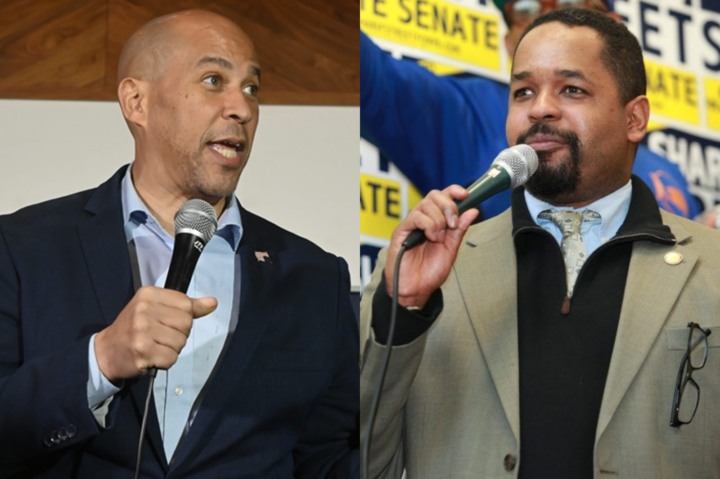
Getty Images/Sharif Street campaign page
Sen. Cory Booker (D-NJ) and Pennsylvania state Sen. Sharif Street
Sen. Cory Booker (D-NJ) is set to attend a rally with Pennsylvania state Sen. Sharif Street on Monday, a last-minute boost for Street’s campaign ahead of his Tuesday congressional primary in Philadelphia where his challenger, far-left state Sen. Chris Rabb, is favored to win.
Local analysts say that the appearance by Booker — a well-known face to local voters across the Delaware River from his home state — should help Street’s campaign, but were skeptical that it would be enough to help him beat Rabb.
One local Democratic strategist said that they don’t expect Street to win, but he remains a viable candidate, with support from many local Democrats including Philadelphia Mayor Cherelle Parker.
Booker, the strategist said, is known locally because of the shared media market, and could provide a boost with older Black voters, though the strategist said that bringing in Booker is “not some coup like a robocall from Obama.”
The strategist said that winning over Black voters will be pivotal to a Street victory, but was skeptical of Booker’s appeal among the younger Black population.
Larry Ceisler, a public affairs executive in the district, said he was doubtful of the extent to which Booker’s appearance would move the needle, though he also acknowledged that Booker is a well-known moderate locally.
Booker’s appearance could send a signal to some moderate voters who had been backing physician Ala Stanford — until recently seen as the leading candidate in the race, prior to a series of high profile stumbles — to switch their allegiance to Street, Ceisler added.
Even as the super PAC backing Miller isn’t officially affiliated with AIPAC, the progressive lawmaker’s move shows how pro-Israel donors are now shunned by some Dems

Keith Mellnick
Rep. Jan Schakowsky (D-IL)
Rep. Jan Schakowsky (D-IL) rescinded her endorsement of Cook County Commissioner Donna Miller, who is running in a Democratic congressional primary in Illinois’ 2nd District, over support Miller is reportedly receiving from AIPAC-aligned forces.
Miller has not been endorsed by AIPAC and neither the group nor its super PAC are publicly spending any money in the district. But it’s widely rumored in the Chicagoland area that pro-Israel forces are backing a new group, Affordable Chicago Now, that’s spending about $900,000 on behalf of Miller’s campaign. Schakowsky also said Miller is accepting individual donations from AIPAC supporters.
Schakowsky’s reversal is a notable step in a campaign by progressives to make even perceived ties to AIPAC or any individual donors who have supported the pro-Israel group toxic within the Democratic Party — even if their support for a candidate isn’t coming through AIPAC.
“Illinois deserves leaders who put voters first, not AIPAC or out-of-state Trump donors,” Schakowsky said in a statement. “I cannot support any candidate who is funded by these outside interests.”
It’s not clear how much influence Schakowsky’s endorsement will have outside her district, given her limited profile in a majority-Black district — as opposed to her wealthy, progressive Lakefront constituency. But it comes amid a broader campaign by left-wing activists in the Democratic Party to turn AIPAC and its donors into a burden for Democratic candidates.
The Illinois primaries are set to be a major test of pro-Israel donors’ influence and political instincts after a high-profile fumble in New Jersey, in which the group’s spending was seen as helping to elevate a far-left anti-Israel candidate.
Former Rep. Tom Malinowski (D-NJ), the target of AIPAC’s spending in New Jersey, in an op-ed released on Thursday, said that Democratic leaders should “collectively … refuse [AIPAC’s] support” and reject its endorsements and assistance — arguing that the group’s biggest donors are Republicans, even while acknowledging most AIPAC members are Democrats.
Please log in if you already have a subscription, or subscribe to access the latest updates.
 Continue with Google

 Continue with Apple